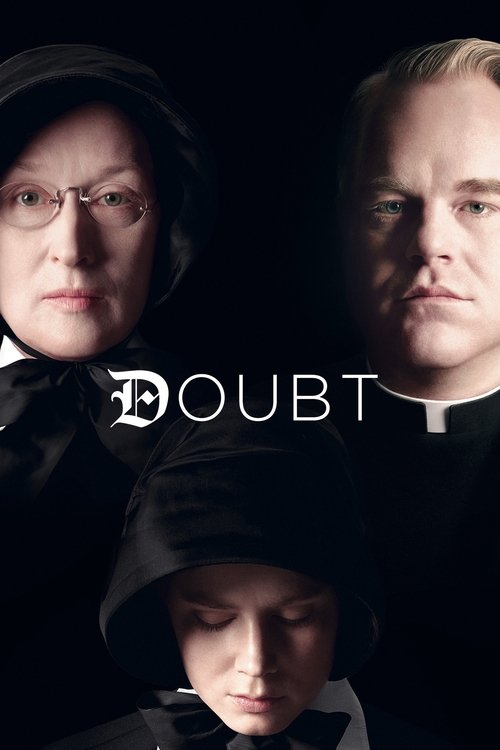
Doubt
2008 · John Patrick Shanley
For when you want a film to chew on for days — one that turns your living room into a debate. Choose it for a serious night, ideally with someone to argue with when it ends.
What it's about
In a 1964 Bronx Catholic school, the flint-hard principal, Sister Aloysius, becomes convinced that the parish's charismatic new priest has behaved improperly with the school's first Black student. With no proof — only instinct, gossip, and fragments — she goes to war with him, and the film becomes a duel over what she knows versus what she can only believe.
The experience
A tense, talk-driven pressure cooker: scenes play like fencing matches, and the film deliberately never hands you certainty, so you end up interrogating your own verdict. It makes you think hard and argue afterward.
Performances
Meryl Streep and Philip Seymour Hoffman go head-to-head in some of the fiercest two-person scenes of the decade, Amy Adams brings aching uncertainty as the young nun caught between them, and Viola Davis, in a single extended scene, nearly walks off with the whole film.
The craft
Adapted by John Patrick Shanley from his own Pulitzer Prize–winning play, the film keeps the stage version's scalpel-sharp dialogue while using tilted angles, storm weather, and confined spaces to make suspicion feel physical. Every image is engineered to keep the question genuinely open.
Why it matters
A defining actors' showcase of the 2000s — it earned Oscar nominations across its principal cast — and the model for how moral-ambiguity drama can reach a mainstream audience without softening.
Snapshot
Doubt is a chamber drama of moral epistemology: a film about the difference between knowing and believing, staged inside the disciplinary machinery of a 1964 Bronx Catholic parish. Adapted by John Patrick Shanley from his own Pulitzer Prize– and Tony Award–winning 2004 play Doubt: A Parable, it pits Sister Aloysius Beauvier (Meryl Streep), the school's flint-hard principal, against Father Brendan Flynn (Philip Seymour Hoffman), a progressive priest she becomes convinced has behaved improperly with the parish's first Black student. The film's governing formal principle is withholding: it never confirms whether Flynn is guilty, and it engineers its images, performances, and structure so that the audience is made to feel the vertigo of judging without proof. It is best understood as a filmed argument — a "parable," per its subtitle — whose subject is certainty itself, arriving in American cinemas at a moment when the Catholic Church's abuse crisis had made that subject unavoidably charged.
Industry & production
Doubt was a prestige literary adaptation produced by Scott Rudin and released through Miramax Films in December 2008, timed transparently for awards season. Its pedigree was its business model: a Pulitzer play, a director returning to material he owned outright, and a cast headed by Streep and Hoffman — two of the most decorated actors of their generation — supported by Amy Adams and Viola Davis, both rising figures. The economics of such a project rest less on spectacle than on performance and reputation, and the film's marketing foregrounded the acting and the "you decide" ambiguity of its premise.
The strategy paid off in recognition if not in the top awards. Doubt received five Academy Award nominations — Streep (Best Actress), Hoffman (Best Supporting Actor), Adams and Davis (both Best Supporting Actress), and Shanley (Best Adapted Screenplay) — a remarkable four-acting-nomination haul. Conspicuously, it earned no Best Picture or Best Director nomination, a split that became part of its critical story: the film was read as an actors' vehicle and a writer's piece more than a director's. It won none of the five. I won't cite box-office figures, as I can't verify precise numbers here, but the film is generally understood to have been a modest commercial performer whose value to its studio lay in prestige.
Casting drew directly on theatrical prestige as well: the role of Sister Aloysius had been originated on Broadway by Cherry Jones, and the film's decision to recast at the highest star wattage — Streep — was a characteristic screen-adaptation move, trading stage authenticity for box-office and Oscar visibility.
Technology
Doubt is, in technological terms, a conservative and classical production, and deliberately so. It was photographed on 35mm film by Roger Deakins, whose practice in 2008 remained photochemical; the grain, latitude, and color rendition of film stock suit a period piece set in 1964 and lend the winter Bronx exteriors their cold, silvered quality. There is no significant visual-effects dimension to the film; its "technology" is entirely that of classical narrative cinema — camera, lens, light, and the built environment of production design. The relevant innovations are compositional and optical (see Technique), not digital. This restraint is itself a statement: the film's power is meant to feel unmediated, a matter of faces and rooms rather than apparatus.
Technique
Cinematography
Roger Deakins's photography is the film's most discussed formal element, and rightly so. Deakins has spoken in interviews about using canted, off-vertical framings — "Dutch tilts" — to externalize the story's moral instability, a device that intensifies as the film progresses and the ground beneath the characters' certainties gives way. Where a lesser use of the tilt would read as a gimmick, here it is calibrated: early scenes sit level, and the world visibly leans as doubt takes hold. Deakins pairs this with a cold, naturalistic palette — the blacks of habits and cassocks, the gray light of a New York winter — and with recurring imagery of wind and weather that the screenplay foregrounds (falling leaves, a blown-out lightbulb, storms) as figures for rumor, spirit, and forces beyond control. The result is a photographic style that is austere on its surface but quietly editorializing, nudging the viewer toward unease without ever supplying evidence.
Editing
The film was cut by Dylan Tichenor, an editor associated with dense, dialogue-driven American dramas. Doubt's editorial challenge is that it is fundamentally a series of confrontations — two-handers and small-group scenes in offices, gardens, and the rectory — and its rhythm depends on the modulation of reaction. The cutting favors sustained shots and the timed release of close-ups, allowing performances to breathe and letting the audience study faces for the "tell" that the film refuses to confirm. Its most demanding sequences — the two extended verbal duels between Aloysius and Flynn — are edited to keep the balance of power in flux, a matter of when to cut to whom.
Mise-en-scène / staging
Because Doubt originates as a play, its staging bears the marks of theatrical architecture: institutional interiors, thresholds, and the choreography of who is permitted to sit, stand, or enter. Production designer David Gropman and costume designer Ann Roth reconstruct a hermetic Catholic world of 1964 in precise material terms — the principal's office as a seat of surveillance, the gendered geography of the rectory (where priests dine on meat and laugh) against the convent (where nuns eat in near-silence). Roth's costuming does dramatic work: the black-bonneted Sisters of Charity habits turn Aloysius into an almost monastic silhouette of authority. Shanley opens the material out just enough — schoolyards, streets, a garden — to register the changing world of the mid-1960s pressing on the parish walls, without dissolving the play's essential claustrophobia.
Sound
Howard Shore's score is spare and grave, used sparingly enough that the film's dominant sonic textures are diegetic: wind, footsteps on polished floors, the hush of the convent, the amplified voice of a sermon. Shanley's screenplay is built around two set-piece homilies — one on gossip, one on doubt — delivered from the pulpit, and the film treats the spoken word as its principal instrument. Silence and ambient weather do much of the atmospheric labor, keeping music from resolving the tension the images refuse to resolve.
Performance
Performance is where Doubt concentrates its ambition, and the four Oscar-nominated turns operate in deliberately different registers. Streep's Aloysius is severe, comic, and frightening, a woman whose certainty is both her weapon and her possible undoing. Hoffman's Flynn is warm, defensive, and genuinely unreadable — the performance's achievement is that it supports both a guilty and an innocent interpretation without settling. Adams's Sister James supplies the audience's own oscillation, a good heart pulled between charity and suspicion. The single most celebrated element is Viola Davis's Mrs. Miller, the mother of the boy at the center of the case, who appears in essentially one scene of roughly ten minutes and reframes the entire moral field with a devastating, pragmatic maternal calculus. That a supporting-actress nomination should rest on one scene became a touchstone in discussions of screen acting.
Narrative & dramatic mode
The film's mode is the parable — announced by the play's subtitle and by Flynn's opening sermon, which asks whether doubt can be as sustaining a bond as certainty. Structurally, Doubt is a controlled escalation of accusation without adjudication: it presents suspicion, circumstantial detail, and psychological pressure, then deliberately declines the third act of resolution that genre convention trains us to expect. Its final movement delivers not a revelation but a rupture — Aloysius's confession of doubt — that turns the whole apparatus of certainty back on the film's most certain character. This is dramaturgy as ethical trap: the audience is invited to convict or acquit, and then confronted with its own eagerness to do either. The mode owes much to the courtroom and the interrogation drama, but strips out the mechanism (evidence, verdict) that those forms exist to satisfy.
Genre & cycle
Doubt sits at the intersection of several traditions: the prestige stage-to-screen adaptation, the American issue drama, and the institutional-Catholic film. Within the 2000s, it belongs to a cycle of works reckoning — directly or obliquely — with the Church's sexual-abuse crisis, which had become a dominant American story after the 2002 Boston Globe investigations. Doubt approaches that cycle from the side: set decades before the scandals broke, it dramatizes the very conditions — clerical authority, institutional secrecy, the near-impossibility of proof — that the later revelations would expose. It is worth noting the film predates by several years the more direct cinematic reckoning of Spotlight (2015), and can be read as an earlier, more allegorical entry in the same broad conversation.
Authorship & method
The controlling authorial fact is that Doubt is Shanley's material through and through: he wrote the Pulitzer-winning play and then adapted and directed it himself, making him a rare case of a playwright shepherding his own text to the screen. Shanley came to filmmaking with a distinguished screenwriting reputation — he won the Academy Award for the original screenplay of Moonstruck (1987) — but a thin directing résumé; Doubt was only his second feature as director, after Joe Versus the Volcano (1990). The play draws on Shanley's own Bronx Catholic-school upbringing, and it is dedicated to a nun who taught him — a biographical rootedness that lends the material its texture. As a director he was widely judged the film's least assertive author, deferring to text and performance; the critical shorthand that Doubt is a "filmed play" reflects both this deference and the genuine theatrical density of the writing.
His key collaborators are the film's real visual and sonic authors: cinematographer Roger Deakins, whose canted grammar supplies the film's argument in images; composer Howard Shore, whose restraint keeps the drama unresolved; editor Dylan Tichenor, who governs its confrontational rhythm; and designers David Gropman and Ann Roth, who build its airless institutional world. Producer Scott Rudin, a specialist in literary and theatrical adaptations, is the connective industrial figure.
Movement / national cinema
Doubt is a work of mainstream American cinema and belongs to no formal movement. Its more meaningful lineage is the tradition of American theatrical realism transferred to film — the line of prestige adaptations from Broadway and Off-Broadway seriousness — and, thematically, the American Catholic imagination that runs through writers like Shanley. It is a New York film in a specific, autobiographical sense: rooted in the Bronx of Shanley's youth and shot in and around the city, it treats a particular ethnic-Catholic milieu with insider knowledge rather than anthropological distance.
Era / period
Two periods matter. The film is set in 1964, and it is precise about that moment: the Second Vatican Council's reforms are in the air, the assassination of President Kennedy — a Catholic — has just occurred, and the civil-rights struggle is reshaping American life, all of which the film registers through Flynn's push toward a warmer, more modern Church and through the arrival of the parish's first Black student. Aloysius embodies a pre-conciliar order of discipline and hierarchy sensing its own obsolescence. The film was made and released in 2008, and its reception was inseparable from that later moment — the post-2002 climate in which any drama of clerical impropriety carried the weight of the abuse crisis. Doubt's power derives partly from this doubled temporality: a 1964 story that its 2008 audience could not watch innocently.
Themes
The central theme is the title: the moral and spiritual condition of doubt, and its relation to certainty, faith, and action. Shanley's parable proposes, unsettlingly, that certainty can be a form of violence and doubt a form of connection — Flynn's sermons frame it, and Aloysius's final breakdown enacts it. Around this core cluster several others: the abuse of, and dependence on, institutional authority; the near-impossibility of adjudicating private wrong; the gendered power structure of the Church, in which a woman of formidable conviction is nonetheless outranked by any priest. Race enters through Mrs. Miller, whose scene refuses easy moral clarity by introducing a mother's survival calculus that the nuns' righteousness cannot accommodate. Change and its cost — Vatican II, a modernizing America, the collision of the old order with the new — runs underneath. Above all, the film is about the ethics of suspicion, and it makes the audience a participant in that ethics.
Reception, canon & influence
Critically, Doubt was received as a serious, superbly acted film weakened, in some accounts, by its theatrical origins — praise for the performances and the writing, reservation about whether Shanley had found a fully cinematic form. The four acting nominations codified the consensus that the film's greatness lived in its faces, with Streep and Hoffman's duets and Davis's single scene singled out repeatedly. The absence of Best Picture and Director nominations reflected the same judgment. Its legacy in the acting canon is secure: Davis's Mrs. Miller in particular is frequently cited as a masterclass in maximal impact from minimal screen time.
Its influences run backward to a deep tradition of moral-interrogation drama and Catholic-conscience storytelling, and to the courtroom-without-a-verdict structure it inverts. Forward, its clearest cultural resonance is as an early, oblique entry in cinema's reckoning with clerical abuse and institutional cover-up — a conversation that would find more literal expression in later films. The honest record is that Doubt's enduring influence is more actorly and thematic than stylistic: it is remembered as a summit of ensemble screen acting and as a rare mainstream film willing to leave its central question permanently, deliberately open. Beyond that, the durable specifics of its downstream influence on filmmakers are thin enough that I would rather flag the gap than manufacture a lineage.
Reception
A prestige awards player in 2008 — five Oscar nominations, zero wins — that some critics wrote off as stagey filmed theater; it's since climbed into beloved status online as one of the great modern acting showcases, endlessly rewatched and quoted.
How Doubt was received, from release to now →
Influences: the films it descends from and the films it influenced
- The Third Man (1949) — Establishes the canted dutch-angle as a grammar of moral disorientation — the exact expressive vocabulary Deakins revives to make the audience feel the ground tilting beneath Sister Aloysius's certainty.
- A Streetcar Named Desire (1951) — Model for transposing a playwright's text to screen nearly intact while confining Method-acted combat to airless interiors, so the theatricality becomes pressure rather than staginess.
- On the Waterfront (1954) — Fuses American theatrical realism with the Catholic priest as institutional conscience, the tradition of moral-interrogation staging Shanley inherits directly from the Bronx-parish world.
- 12 Angry Men (1957) — Single-room deliberation drama built on sustained reaction shots and shifting doubt among a fixed cast — the chamber-verdict structure Doubt formally inverts by withholding the ruling.
- Winter Light (1963) — Renders a clergyman's crisis of faith through diegetic-dominant sound and refused consolation, the template for using restraint (not scoring) to keep spiritual resolution suspended.
- The Children's Hour (1961) — Lillian Hellman self-adapting her own play about an unprovable accusation that annihilates a school — the playwright-guarding-her-text lineage plus the withheld-truth engine Doubt runs on.
- A Man for All Seasons (1966) — Robert Bolt adapting his own stage play into a conscience-versus-institution period drama, establishing the self-adaptation model where costume and ecclesiastical setting carry the argument.
- Who's Afraid of Virginia Woolf? (1966) — Faithful stage-to-screen chamber duel whose escalating two-hander combat drew a full sweep of acting nominations — the prestige-adaptation-as-actors'-showcase precedent.
- Network (1976) — Beatrice Straight's Oscar-winning five-minute appearance is the direct precedent for Viola Davis's single-scene turn — maximal emotional impact from minimal screen time.
- The Good Shepherd (2004) — Distills clerical scandal to a chamber drama of unprovable suspicion, resolving 'faith-versus-evidence' through character-actor underplaying and withheld proof rather than disclosure — the seed's exact register, intensified.
- August: Osage County (2013) — Tracy Letts self-adapting his Pulitzer play through the Scott Rudin / Meryl Streep / Ann Roth prestige-adaptation pipeline — the same industrial machine engineering an ensemble-acting summit from a stage text.
- Calvary (2014) — A parable of a good priest under the shadow of clerical abuse, sustaining Doubt's withheld-resolution structure where certainty about guilt is the true violence.
- Spotlight (2015) — The literal, journalistic reckoning with clerical-abuse cover-up that Doubt broached obliquely — extending the institutional-Catholic cycle from private suspicion to documented exposure.
- Fences (2016) — August Wilson's play brought to screen preserving its full theatrical density in a single location, with Viola Davis again converting confined stage-derived material into an acting-summit performance.
- After the Hunt (2025) — Builds a chamber play on an unresolved accusation and an opaque authority figure, treating deliberate non-resolution as the film's central formal device — the withheld revelation.
- Chithha (2023) — Sustains suspicion of child abuse entirely through conversational tension and moral ambiguity, staging emphasis in charged dialogue and never depicting the act.
- Heretic (2024) — Adapts theater directly to screen as a dialectical interrogation about faith and certainty, where the drama is entirely verbal cross-examination — the filmed-theater, argue-belief mode Heretic runs on.
- Oleanna (1994) — Mamet directing his own two-hander on an ambiguous accusation, where certainty becomes violence and the audience is denied any verdict — the same self-adapted, withheld-resolution architecture.
- The Magdalene Sisters (2002) — Dramatizes the airless institutional-Catholic world of nun-enforced authority, giving costume-as-power and confined interiors the same oppressive charge Doubt builds around Aloysius's habit.
- Revolutionary Road (2008) — Deakins shooting a same-year chamber drama in 35mm photochemical restraint, proving his method of using controlled framing to indict a claustrophobic domestic institution.
- Frost/Nixon (2008) — Peter Morgan self-adapting his own stage play into a filmed interrogation duel released the same year — the playwright-shepherds-his-text model applied to a confrontation of wills.
- Carnage (2011) — Yasmina Reza adapting her own single-apartment play of escalating verbal warfare, sustaining theatrical density and real-time confrontation without opening the material out cinematically.
- The Hunt (2012) — A clergy abuse accusation adjudicated entirely through belief rather than proof, sharing The Hunt's interrogation of conviction without evidence and the irreversibility of suspicion.
- Equus (1977) — A playwright filming his own tightly argued chamber play about faith versus certainty, sharing Equus's interrogation structure where the investigator's own conviction, not the 'crime,' is what's truly on trial.
Similar films
- Spotlight (2015) — influence & lineage
- Who's Afraid of Virginia Woolf? (1966) — influence & lineage
- 12 Angry Men (1957) — influence & lineage · same viewing thread
- Dead Man Walking (1995) — same viewing thread
- Capote (2005) — same viewing thread
- The Last Temptation of Christ (1988) — often watched together
- First Reformed (2018) — often watched together
- Conclave (2024) — shared sensibility
All the films related to Doubt →
Watch it with: curated runs of related films
- Judgment and Mercy — Watch these together for the way each puts a life on the scales — a jury room, a death-row block, a slave plantation, a gunfighter's conscience — and asks what mercy costs the people handing down the verdict.