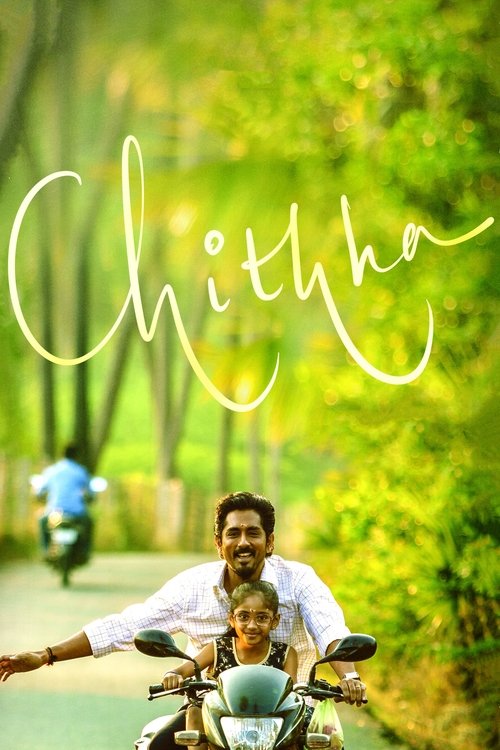
Chithha
2023 · S. U. Arunkumar
For when you want a thriller with real moral weight — not a comfortable watch, but one that earns every hard minute. Save it for a night when you're ready to feel something heavy and come out the other side.
What it's about
Easwaran, a young government employee, is raising his brother's daughter Sundari, and the film takes its time showing the easy, lived-in bond between uncle and niece. Then Sundari goes missing, a predator surfaces in their town, and Easwaran — first wrongly suspected himself — is pulled into every guardian's worst nightmare.
The experience
Harrowing but never exploitative: the dread is real and the subject is child abuse, yet the film's most shattering scenes are quiet conversations, not violence. It leaves you shaken, protective, and unexpectedly moved by its tenderness.
Performances
Siddharth, who also produced, strips away every star mannerism for a performance of trembling restraint — the fear and helplessness of a man who loves a child he couldn't protect.
The craft
S. U. Arunkumar directs a subject that invites sensationalism with unusual discipline, refusing both titillation and easy vigilante payoff to stay with the long aftermath — the shame forced onto survivors, the limits of what love can fix. The patient first act makes everything after it land twice as hard.
Why it matters
It arrived amid a wave of socially conscious Tamil genre cinema and stood out as proof that a mainstream thriller could handle child abuse with honesty instead of spectacle.
A young government worker raising his brother's daughter — the bond between chithha (uncle) and niece drawn with unhurried, lived-in warmth — is plunged into every guardian's nightmare when a child predator surfaces in their town. S. U. Arunkumar, who announced himself with the rural charmer Pannaiyarum Padminiyum and the cop drama Sethupathi, here achieves something Tamil cinema rarely manages: a thriller about child sexual abuse that refuses titillation and vigilante catharsis alike, holding instead on the long aftermath — the shame imposed on survivors, the helplessness of the men who love them. Siddharth, who also produced, strips away star mannerism for a performance of trembling restraint; the film's most wrenching passages are conversations, not confrontations. Released in 2023 amid a wave of socially conscious Tamil genre cinema, it drew public praise from directors across Indian film industries and prompted real debate about how survivors are treated on screen. Its quietest scenes — a child's silence at a doorway, an adult learning to listen — cut deepest.
Reception
Released quietly in September 2023 and turned into a pure word-of-mouth phenomenon — theaters added shows within days, and by year's end it was locked into nearly every 'best Tamil films of 2023' list. Its standing has only hardened since: it's now the reference point for how Tamil cinema can handle its difficult subject with care.
How Chithha was received, from release to now →
Influences: the films it descends from and the films it influenced
- The Hunt (Jagten) (2012) — Builds unbearable dread around an accusation of child abuse through close-quarters domestic staging and communal silence — never depicting the act — the anti-titillation, conversation-driven tension Chithha adopts wholesale.
- Kaakka Muttai (2014) — Establishes the Tamil naturalist mode of non-star child performers and lived-in slum domesticity observed without melodrama, the observational restraint Chithha extends to its uncle-niece household.
- Visaranai (2015) — Pioneers unflinching aftermath-of-violence realism in Tamil cinema that withholds catharsis and stages brutality through implication and sustained dread rather than spectacle.
- Peranbu (2018) — Carries an intimate guardian-child bond on a mainstream superstar (Mammootty) stripped of all heroics — the de-glamorized anti-star restraint Siddharth channels as the caretaking uncle.
- Prisoners (2013) — Threads a thriller through a guardian's desperation after a child vanishes, sustaining dread via withheld information and moral corrosion rather than action set-pieces.
- Mystic River (2003) — Traces the lifelong aftermath and buried shame of childhood sexual abuse, letting trauma surface through restrained adult performance instead of flashback spectacle.
- Room (2015) — Centers a captive child's protector and their intimate domestic bond, keeping the horror off-screen so that the aftermath — not the crime — becomes the true subject.
- Doubt (2008) — Sustains suspicion of child abuse entirely through conversational tension and moral ambiguity, staging emphasis in charged dialogue and never depicting the act.
- Spotlight (2015) — Models procedural restraint around child sexual abuse that refuses sensational reenactment, keeping victims' shame central and the horror strictly implied.
- Monsoon Wedding (2001) — Exposes intra-family child sexual abuse inside a warm domestic setting, staging the guardian's protective reckoning intimately rather than as courtroom melodrama.
- Aruvi (2016) — Reframes a female survivor's dignity against a sensation-hungry society, refusing titillation while confronting abuse and shame head-on — the same ethical camera Chithha keeps.
- Pariyerum Perumal (2018) — Uses silence and long-held reaction shots to let injustice register on the face, making stillness the primary instrument of emphasis in 2010s Tamil social cinema.
- Gargi (2022) — Contemporary Tamil drama built around child sexual assault and survivor-shame with courtroom restraint and an anti-star Sai Pallavi turn, refusing every exploitative beat.
- Jai Bhim (2021) — Foregrounds the aftermath of institutional violence in a Tamil social-issue frame, casting a superstar (Suriya) in a de-glamorized, procedurally restrained role.
- Koozhangal (Pebbles) (2021) — Pushes silence-as-emphasis to a near-wordless formal extreme, letting endurance and withheld dialogue carry the drama in Tamil realist idiom.
- Super Deluxe (2019) — Handles taboo — including a child endangered by predatory adults — with formal control and tonal precision rather than exploitation, expanding what Tamil cinema will stage.
Similar films
- Jai Bhim (2021) — influence & lineage
- Super Deluxe (2019) — influence & lineage
- Kishkindha Kaandam (2024) — same viewing thread
- Manas (2024) — same viewing thread
- Vikram Vedha (2017) — shared sensibility
- Viduthalai: Part I (2023) — shared sensibility
- Asuran (2019) — shared sensibility
- Aasha (2026) — shared sensibility
All the films related to Chithha →
Watch it with: curated runs of related films
- Small Towns, Long Memory — Watch these together for how patiently they sit with a place and its people — a last farmer, a slipping memory, a homecoming after twenty-two years — each measuring belonging in soil, kin, and time.