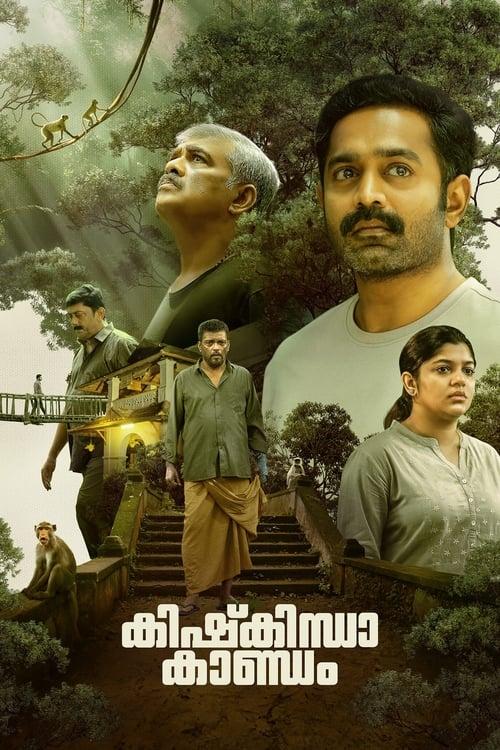
Kishkindha Kaandam
2024 · Dinjith Ayyathan
For a night when you want a slow-burn puzzle that respects your intelligence — something to watch closely, then argue about and immediately want to rewatch. More absorbing than stressful, but it asks for your full attention.
What it's about
A newlywed couple moves into a house at the edge of a Kerala forest, sharing it with the husband's father, a retired soldier whose memory has begun to slip. The village around them belongs as much to monkeys as to people, and small wrongnesses start to accumulate — a missing gun, gaps in the old man's account of things, forest officials asking questions nobody can quite answer. What begins as domestic unease slowly hardens into a mystery about what this family knows and won't say.
The experience
Quiet, humid, and patient — the tension builds through glances and half-finished sentences rather than shocks, and by the last stretch you're leaning forward, re-checking everything you thought you'd seen. It's the kind of mystery that plays fair and still gets you.
Performances
Vijayaraghavan, a Malayalam character actor with four decades behind him, gives a career-crowning turn as the aging patriarch — dignity and confusion so tightly braided you can never tell which one you're watching.
The craft
Bahul Ramesh both wrote and shot it, and that unity shows: the dense green frames aren't just atmosphere, they're evidence, quietly telling you things the dialogue withholds. The construction is meticulous enough that a second viewing plays like a different, sadder film. A big screen helps you catch what's hiding in plain sight.
Why it matters
One of the great word-of-mouth hits of Malayalam cinema's remarkable 2024, and the film that announced Dinjith Ayyathan as a director to watch.
In a village at the edge of a Kerala forest where monkeys outnumber people, a newlywed couple settles into the household of a retired soldier — and small things begin to go wrong: a missing gun, gaps in the record, questions the old man answers a beat too slowly. Dinjith Ayyathan's second feature became one of the defining word-of-mouth hits of Malayalam cinema's extraordinary 2024, a mystery that plays scrupulously fair while hiding its design in plain sight. Written and shot by the same man, Bahul Ramesh, it has an unusual unity of purpose: the humid green frames aren't atmosphere but evidence, and a second viewing reveals how much the camera told you from the start. Vijayaraghavan, a character actor with four decades of work behind him, gives the performance of his career as the patriarch — dignity and fog inseparable — with Asif Ali and Aparna Balamurali circling him in mounting unease. The title invokes the monkey-kingdom chapter of the Ramayana, and like that epic's forest book, this is a story about what gets lost there, and who goes searching.
Reception
No reappraisal needed — it landed in September 2024 as the sleeper hit of the year, word-of-mouth carried a quiet mystery-drama to roughly ₹75 crore worldwide, and its OTT run only swelled the acclaim. Within months it was being cited as Exhibit A in the 'Malayalam cinema is in a golden age' conversation.
How Kishkindha Kaandam was received, from release to now →
Influences: the films it descends from and the films it influenced
- Drishyam (2013) — Established the Malayalam fair-play thriller in which mundane domestic detail—a schedule, a household object, a family routine—is planted early and later weaponized as retroactive evidence, the exact hide-in-plain-sight contract Kishkindha Kaandam inherits.
- Manichitrathazhu (1993) — Malayalam prototype for the mystery whose solution lives inside a character's fractured psyche, structuring the film so a first viewing misreads behavior that a rewatch decodes correctly.
- Memento (2000) — Made memory loss itself the engine of a detective plot, forcing the audience to distrust the protagonist's recall and reassemble the truth—the 'memory-and-fog' mechanism Kishkindha Kaandam builds around its dementia-afflicted patriarch.
- The Sixth Sense (1999) — Perfected the terminal reveal that recontextualizes every prior frame, rewarding rewatch by re-reading visual information the camera had shown plainly but the viewer misinterpreted.
- Rear Window (1954) — Canonized the camera-as-clue: the frame becomes the literal site of investigation, and what is (or isn't) shown within the composition is the evidence—Bahul Ramesh's blocking treats the lens as a detective's eye in the same way.
- Vertigo (1958) — Template for obsessive searching after a vanished person whose identity is itself the mystery, staging loss-and-searching as a formal spiral rather than a whodunit.
- Chinatown (1974) — Locked point-of-view to an investigator who—and thus the viewer—is denied the full picture, using restricted framing to keep withheld information hidden until it lands with force.
- Rashomon (1950) — Foundational study of memory as unreliable testimony, where competing recollections make epistemology itself the subject—the fog-of-recall problem the seed dramatizes through failing memory.
- The Father (2020) — Renders dementia formally so shifting set details and continuity 'errors' become diegetic clues to a decaying mind, putting the viewer inside the same disoriented subjectivity Vijayaraghavan's character imposes.
- Zodiac (2007) — Model of the searching procedural that privileges obsessive re-examination of archival and remembered evidence over resolution, valuing the rewatch of the case file itself.
- Anatomy of a Fall (2023) — Contemporary fair-play construction where the truth is assembled entirely from contested testimony and ambiguous domestic detail, refusing an omniscient camera so the audience must adjudicate the evidence themselves.
- Thondimuthalum Driksakshiyum (2017) — Defines the 2024-adjacent Malayalam new-wave grammar of long observational takes and ensemble naturalism structured around a lost/stolen object, the procedural-realism register Kishkindha Kaandam works in.
- Joji (2021) — Restrained, watchful camera treating a patriarchal family unit as a crucible of suspicion, letting quiet domestic unease rather than incident carry the tension.
- Kumbalangi Nights (2019) — Shares the humid, saturated-green Kerala palette and backwater-village staging, using landscape texture and natural light as an emotional register within an ensemble frame.
- Bhoothakaalam (2022) — Turns memory, grief, and an ailing elder in a closed domestic house into ambient dread, blurring the line between psychological decline and external threat the way the seed blurs dementia and clue.
- Nayattu (2021) — Uses the Kerala forest-and-village terrain as an active pursuit space, staging loss-and-searching as movement across a landscape that conceals and reveals.
Similar films
- Drishyam (2013) — influence & lineage
- Kumbalangi Nights (2019) — influence & lineage
- Chithha (2023) — same viewing thread
- Kadaisi Vivasayi (2022) — same viewing thread
- Meiyazhagan (2024) — same viewing thread
- Manas (2024) — same viewing thread
- Lubber Pandhu (2024) — same viewing thread
- Maharaja (2024) — shared sensibility
All the films related to Kishkindha Kaandam →
Watch it with: curated runs of related films
- Small Towns, Long Memory — Watch these together for how patiently they sit with a place and its people — a last farmer, a slipping memory, a homecoming after twenty-two years — each measuring belonging in soil, kin, and time.