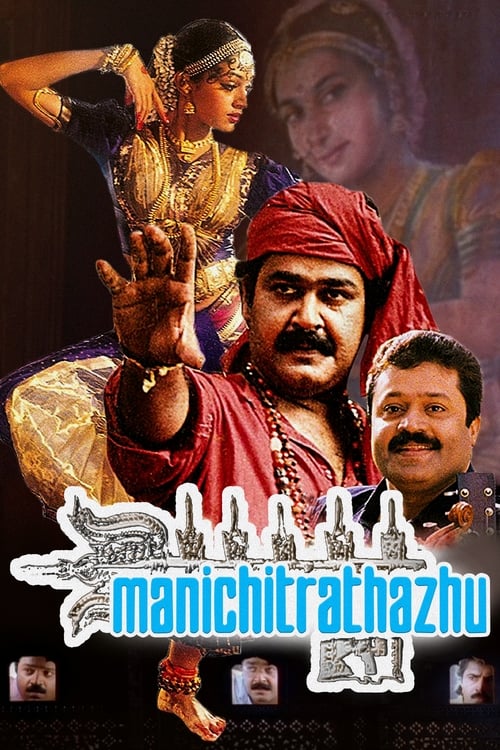
Manichitrathazhu
1993 · Fazil
For when you want a haunted-house story with brains — scares that come with a puzzle attached, and enough comedy to keep the evening light until it isn't. A crowd-pleaser you can also chew on afterward.
What it's about
A young couple moves into the husband's ancestral mansion in Kerala despite family warnings that it's haunted — legend says a vengeful dancer was sealed behind an ornate locked door generations ago. When strange things start happening, the household splits between calling a sorcerer and calling a psychiatrist, and the film lets reason and superstition circle each other for its whole running time without cheaply dismissing either.
The experience
It starts as breezy domestic comedy, thickens into folk horror, and tightens into a psychological mystery — the shifts are seamless, and the last stretch is genuinely gripping. Funny, eerie, and smarter than it first lets on.
Performances
Mohanlal's eccentric psychiatrist supplies the mischief, but the film belongs to Shobana — a trained classical dancer whose performance builds to something ferocious and unforgettable.
The craft
Fazil ran the production like an all-star workshop, with major directors — Priyadarshan, Sibi Malayil, Siddique-Lal — each handling units under his command, and the seams never show. The blend of comedy, folk myth, dance, and detective logic into one coherent film is a feat of tonal engineering few industries even attempt.
Why it matters
One of Malayalam cinema's crown jewels and a peak of its early-nineties golden age, it was remade across multiple Indian languages and remains the benchmark for the psychological folk-horror crowd-pleaser.
One of Malayalam cinema's crown jewels, and proof that its early-nineties golden age could fuse commercial forms other industries kept apart. Fazil's tale of a young couple moving into an ancestral mansion against family warnings begins as breezy domestic comedy, thickens into folk horror built on the legend of a vengeful dancer sealed behind an ornate lock, and resolves as something closer to a psychological detective story — reason and superstition circling each other for two and a half hours without either being cheaply dismissed. The production was itself an ensemble of talent: Priyadarshan, Sibi Malayil, and Siddique-Lal, each a major director in his own right, handled units under Fazil's command. Mohanlal's eccentric psychiatrist gives the film its mischief, but it belongs to Shobana, a trained classical dancer whose performance — culminating in a bravura passage of pure Bharatanatyam — won the National Award. Remade in Kannada, Tamil, Hindi, and Bengali, none of the copies touch it; the original's balance of laughter and dread has never been successfully picked.
Reception
A blockbuster on release in 1993 — it swept Kerala and won the National Film Award for Best Popular Film — and its stature has only compounded since, routinely topping polls as the greatest Malayalam film ever made.
How Manichitrathazhu was received, from release to now →
Influences: the films it descends from and the films it influenced
- Kishkindha Kaandam (2024) — Malayalam prototype for the mystery whose solution lives inside a character's fractured psyche, structuring the film so a first viewing misreads behavior that a rewatch decodes correctly.
- Drishyam (2013) — Malayalam precedent for a patient, slow-build mystery that banks on a delayed psychological disclosure, and for Mohanlal deliberately suppressing star charisma to serve a controlled reveal.
- Bhargavi Nilayam (1964) — The ur-text of Malayalam haunted-mansion cinema — the vengeful female spirit tethered to an ancestral nalukettu — supplying the exact spatial grammar (the sealed room, the possessed house) Fazil rebuilds around the titled 'ornate lock.'
- Madhumati (1958) — Established the Indian past-life-vengeance template in which a wronged dead woman reaches into the present through a living woman's body, the structural engine behind Nagavalli's possession of Ganga.
- Psycho (1960) — Its third-act psychiatrist's monologue that clinically diagnoses a split personality is directly echoed by Dr. Sunny's rational explanation of Ganga's dissociation, converting supernatural dread into pathology.
- The Three Faces of Eve (1957) — Pioneered the single-actress dual-personality performance — one body visibly switching between distinct selves — the clinical DID showcase Shobana executes as Ganga/Nagavalli.
- Gaslight (1944) — Codified the woman-unravelling-inside-a-grand-house thriller, where an isolated wife's grip on reality erodes amid period interiors — the domestic-psychological staging Fazil transplants to the tharavadu.
- Rebecca (1940) — The dead woman whose presence saturates an ancestral estate and colonizes the new mistress's imagination is the Nagavalli-haunts-Ganga device in embryo.
- Bees Saal Baad (1962) — Fused village folk-superstition dread with a rational investigator who unmasks the 'ghost,' the reason-versus-superstition detective structure Fazil splits between Sunny and the exorcist Brahmadattan.
- The Haunting (1963) — Sustains deliberate ambiguity over whether the haunting is supernatural or the projection of a psychologically fragile woman — the interpretive tension that powers Manichitrathazhu's entire mystery.
- Chandramukhi (2005) — Direct Tamil remake preserving the DID diagnosis, the vengeful dancer-spirit, and the Bharatanatyam-as-possession climax while rebalancing the comedy-horror tonal shifts for a star vehicle.
- Aptamitra (2004) — Kannada remake that carried the psychiatrist-versus-exorcist framework and the possessed-classical-dancer climax verbatim, the first node in the film's multilingual-remake diffusion.
- Bhool Bhulaiyaa (2007) — Hindi remake by a Malayalam-cinema alumnus that retains the classical-dance possession finale and the rational-doctor-stages-a-fake-exorcism resolution, proving the craft template's portability.
- Aptha Rakshaka (2010) — Kannada continuation that extends the same Nagavalli-lineage possession-and-diagnosis machinery, treating the ancestral-mansion vengeful spirit as a reusable franchise device.
Similar films
- Thaniyavarthanam (1987) — shared sensibility
- Kumbalangi Nights (2019) — shared sensibility
- Drishyam (2013) — shared sensibility
- Andhadhun (2018) — shared sensibility
- Tumbbad (2018) — shared sensibility
- Kishkindha Kaandam (2024) — shared sensibility
- Michael Madana Kama Rajan (1990) — shared sensibility
- Maharaja (2024) — shared sensibility