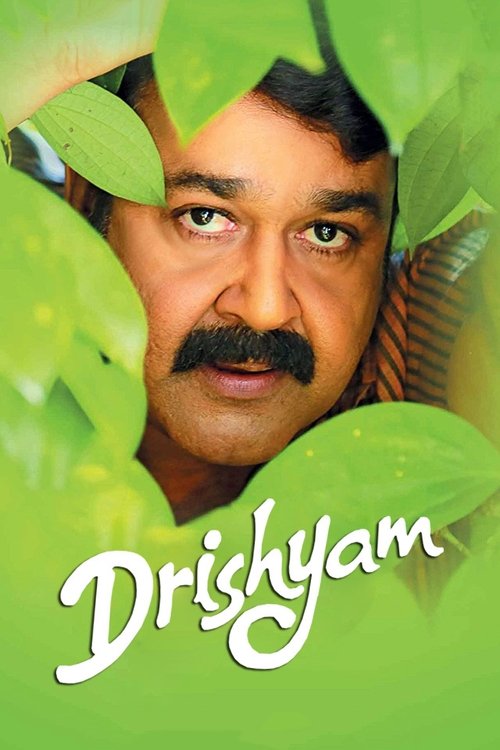
Drishyam
2013 · Jeethu Joseph
For when you're craving a smart, twisty thriller to watch in one sitting — the kind you finish and immediately want to make someone else watch so you can see their face. Gripping rather than gory; brains over brutality.
What it's about
Georgekutty is a self-made man in a small Kerala hill town — a fourth-grade dropout who runs the local cable TV service, married with two daughters, and has absorbed a lifetime of movie plots from his own broadcasts. When the entitled son of a powerful police officer secretly films his teenage daughter, one terrible turn leaves the family in danger, and Georgekutty deploys everything the movies taught him to shield them from an investigation that gets closer by the day.
The experience
A slow-burn thriller that tightens like a vise — the first stretch lulls you with ordinary family life, then every small detail starts paying off. You spend the back half holding your breath, matching wits with a man who is always one step ahead of the people hunting him.
Performances
Mohanlal is remarkable precisely because he plays an unremarkable man — an ordinary, slightly complacent father whose cunning surfaces without ever breaking the surface of his everydayness. The performance's restraint is what makes the suspense work.
The craft
Jeethu Joseph's screenplay is the star: a clockwork construction where offhand early scenes turn out to be load-bearing, and the cat-and-mouse plays out through memory, testimony, and timeline rather than action. It's a thriller built on writing and structure, proof you don't need spectacle when the plotting is airtight.
Why it matters
A massive Malayalam-cinema phenomenon that was remade across multiple Indian languages, spawned sequels, and became the modern benchmark for the Indian family thriller.
Snapshot
Drishyam is a Malayalam-language thriller written and directed by Jeethu Joseph, built around Georgekutty (Mohanlal), a fourth-standard dropout who runs a small cable-television network in the hill town of Rajakkad, Idukki. When his elder daughter is secretly filmed bathing by Varun, the entitled son of a senior police officer, a confrontation ends in the boy's death at the hands of the terrified family. The remainder of the film is not a whodunit but a how-does-he-get-away-with-it: Georgekutty, whose only real education has come from years of watching films at his cable station, engineers an elaborate defense built not on hiding evidence but on manufacturing memory — planting a false but corroborated timeline in the minds of witnesses so that investigators can never place his family at the scene. The picture became one of the defining commercial and critical successes of 2010s Malayalam cinema and, through an unusually large family of official remakes, one of the most widely re-told Indian films of its era. It is at once a tight domestic thriller, a study of an ordinary man outwitting institutional power, and a sly piece of meta-cinema about what watching movies teaches a person.
Industry & production
Drishyam was produced by Antony Perumbavoor under the Aashirvad Cinemas banner, the production house most closely associated with Mohanlal's star vehicles of the period. It arrived at a moment when Malayalam cinema was consolidating a reputation for content-driven mid-budget filmmaking — films that competed on screenplay and craft rather than scale — and it became a flagship example of that model paying off spectacularly at the box office. Contemporary reporting placed it among the highest-grossing Malayalam films to that date; I will not attach a specific figure, because the reliable English-language record varies and precise gross claims for regional Indian releases of this period should be treated with caution. What is not in doubt is that its commercial performance was large enough to make it a reference point for the industry and, crucially, a property valuable enough that remake rights were quickly acquired across multiple Indian languages.
The film's production was comparatively modest in resources relative to its impact: a largely location-based shoot in Kerala's Idukki region, a compact principal cast, and a running time and structure that foreground writing over spectacle. Its success is often cited as evidence that a strong original screenplay, anchored by a major star willing to play an unglamorous everyman, could outperform far more expensive productions.
Technology
Detailed, verifiable technical specifications for Drishyam are thin in the English-language scholarly and trade record, and I will not invent camera models, lenses, or a digital-intermediate pipeline that I cannot confirm. What can be stated responsibly is contextual: by 2013 Malayalam feature production had largely moved to digital acquisition and digital post, and Drishyam's naturalistic, location-heavy look is consistent with that industry norm rather than with celluloid. The film's "technology" is more interesting at the level of its story than its apparatus — its plot turns on consumer and civic technologies of the early 2010s: the hidden mobile-phone/camera recording that sets the tragedy in motion, the cable-TV business that gives Georgekutty both his livelihood and his cinematic education, and the paper trail of bus tickets, hotel bills, and restaurant receipts that he weaponizes as forensic counter-evidence. The film is acutely aware that ordinary people now generate a documentary record of their own movements, and it makes the forging of that record the engine of its suspense.
Technique
Cinematography
The cinematography, by Sujith Vaassudev, favors an unshowy realism appropriate to a story about an unremarkable family in a specific rural-town milieu. The visual grammar is functional and legible rather than stylized: it prioritizes clear staging of domestic space, the geography of the family home, and the police station, so that the audience can later reconstruct the "map" of the alibi as precisely as the investigators try to. The restraint is strategic — because the film's twists depend on the viewer trusting what they have and haven't been shown, an ostentatious camera would undercut the plainness the deception relies on.
Editing
Edited by Ayoob Khan, the film is structured in two clearly weighted movements: an unhurried first act that establishes routine, character, and the texture of family life, and a tightening second half in which the investigation and Georgekutty's counter-strategy interlock. The editing's key achievement is control of information — the withholding and delayed revelation of what actually happened on the crucial day, and the eventual re-cutting of scenes in the viewer's understanding once the mechanism of the alibi is disclosed. The famously patient build has been both praised (as earned suspense) and, by some viewers, felt as slow; the strategy is deliberate, since the ordinariness that the long first act establishes is exactly what the thriller machinery later exploits.
Mise-en-scène / staging
Staging is central to Drishyam's design because the plot is, literally, about staging: Georgekutty choreographs where his family is seen, by whom, and in what sequence, so that innocent witnesses will later testify to a fabricated timeline in good faith. The film's mise-en-scène thus does double duty — the modest home, the church, the local eateries and bus routes are both realistic backdrop and, retrospectively, the props and set-marks of a performance directed by the protagonist. The domestic interiors are rendered with lived-in specificity, which grounds the family emotionally and makes the later revelation of what is buried beneath ordinary civic construction land with grim irony.
Sound
The score for the film is generally credited to Anil Johnson; I flag mild uncertainty on the precise division of song versus background-score credits, which is inconsistently reported in English sources. Drishyam is not a song-driven film in the classical Indian mode — music is used sparingly and functionally, mostly to underscore family warmth early and mounting dread later, rather than as set-piece musical numbers. The relative musical restraint reinforces the film's realist, suspense-first register.
Performance
The film rests on Mohanlal's central performance as Georgekutty, and it is frequently cited as one of his most disciplined turns. He plays deliberately down from his star wattage: a soft-spoken, semi-literate, somewhat complacent family man whose cunning emerges only under pressure, and even then is masked by an affable, unthreatening surface. The role's power lies in its withholding — the audience is never entirely certain how far ahead of everyone he is thinking, and Mohanlal keeps that ambiguity alive. Meena, as his wife Rani, anchors the family's fear and moral anguish, while the daughters register the trauma that motivates the entire cover-up. The antagonist axis — the grieving, increasingly ruthless senior police officer who is also the dead boy's mother — supplies the film's moral counterweight, ensuring that the family's opponent is not a cartoon but a parent in agony, which is essential to the film's ethical tension.
Narrative & dramatic mode
Structurally, Drishyam belongs to the "inverted" or "howcatchem" tradition rather than the classic mystery: the audience largely knows what the family did, and the suspense derives from whether and how the crime will be concealed. Its dramatic mode is domestic thriller fused with a duel-of-wits procedural — a battle between an untrained but movie-schooled patriarch and a state apparatus with every institutional advantage. The screenplay is admired for its clockwork construction: seemingly incidental early details (Georgekutty's film-watching, casual conversations, an outing) are revealed to be load-bearing components of the alibi. The film also practices a distinctive form of retroactive revelation — a final reframing that recontextualizes the entire investigation and reveals just how completely the protagonist has controlled the narrative, closing on a note of moral disquiet rather than clean resolution.
Genre & cycle
Drishyam sits at the intersection of the crime thriller, the family melodrama, and the everyman-versus-system drama that recurs across Indian popular cinema. Within Malayalam cinema it belongs to a strong regional lineage of screenplay-driven suspense and investigation films, and it helped intensify a 2010s cycle of "intelligent thriller" successes in the industry. More broadly, it became a template unto itself: the "ordinary father commits the perfect concealment to protect his family" premise proved so portable that the remakes effectively propagated a mini-genre across Indian language cinemas.
Authorship & method
The controlling authorship is Jeethu Joseph's, as both writer and director — the film is fundamentally a screenwriter's picture, and its reputation rests on the architecture of its plot. Joseph's method here is one of patient setup and delayed payoff, trusting the audience to sit through ordinariness in exchange for a rigorously logical unraveling. Among key collaborators: Sujith Vaassudev's cinematography supplies the naturalism that makes the deception credible; editor Ayoob Khan governs the crucial rhythm of disclosure; composer Anil Johnson provides restrained scoring; and Mohanlal, as star-collaborator, calibrates a performance that deliberately suppresses star charisma in service of the everyman conceit. Producer Antony Perumbavoor's Aashirvad Cinemas provided the star-vehicle framework within which an unusually writerly thriller could reach a mass audience.
Movement / national cinema
The film is a landmark of contemporary Malayalam cinema, part of the wave sometimes discussed under the loose banner of a "New Generation" or content-first turn in the industry — even though Drishyam, as a mainstream Mohanlal vehicle, is more populist than the art-leaning end of that movement. Its significance to national cinema is unusual: rather than traveling primarily through subtitles, it traveled through remaking. It became one of the clearest recent demonstrations of Malayalam cinema functioning as an originator of stories for the larger Indian film ecosystem, with Tamil, Telugu, Kannada, Hindi and other-language versions carrying its premise to audiences far beyond Kerala.
Era / period
Released in late 2013, Drishyam is very much a film of its moment: the early-2010s convergence of ubiquitous mobile recording, a rising appetite for tightly plotted thrillers in Indian regional cinema, and a maturing Malayalam industry confident in mid-budget, star-anchored, screenplay-led filmmaking. Its anxieties — surveillance by ordinary devices, the vulnerability of a family's private life to a stray recording, the gulf between an unlettered citizen and a powerful officialdom — are legible as period concerns of the smartphone era's first decade.
Themes
Several themes interlock. The most prominent is the protective ferocity of family — the film asks how far an ordinary man will go, and how much moral compromise he will absorb, to shield his wife and daughters. Closely tied is the theme of the common man versus institutional power, with Georgekutty's cunning framed as the only weapon available to the powerless against a state that can coerce and brutalize with impunity; the film does not flinch from depicting police cruelty, which complicates any simple reading of law and order. A third, self-reflexive theme is cinema as education: Georgekutty's stratagems come from the films he watches, making the movie a quiet argument about how popular storytelling teaches, informs, and even arms its audience. Underlying all of this is a persistent moral ambiguity — the family are both victims and perpetrators, the antagonist is both oppressor and bereaved mother, and the film's celebrated ending leaves the audience implicated in admiring a deception that conceals a death and denies grieving parents the truth.
Reception, canon & influence
Critically and popularly, Drishyam was received as a major success and is frequently ranked among the standout Malayalam films of the 2010s and among Mohanlal's most acclaimed later-career performances. Praise centered on the screenplay's construction and the restraint of the lead performance; the most common reservation concerned pacing, with some viewers finding the long first act slow before the thriller mechanics engage.
On influences on the film (backward): the premise drew comparisons to Keigo Higashino's Japanese novel The Devotion of Suspect X, which likewise turns on an ordinary man engineering a meticulous cover-up (including the manipulation of timelines) to protect a woman and her daughter after a killing. This resemblance was widely noted by commentators, but Jeethu Joseph has publicly maintained that his story was original and the similarity coincidental. I present this as a documented critical comparison and an authorial denial, not as an established case of adaptation. More broadly, the film clearly draws on the inverted-thriller tradition and on the long Indian-cinema archetype of the resourceful common man outwitting the powerful.
On legacy (forward): Drishyam's most conspicuous influence is its extraordinary remake footprint. It was officially remade across several Indian languages — including Tamil (as Papanasam), Telugu, Kannada, and Hindi (the 2015 Drishyam with Ajay Devgn), among others — making the Georgekutty story one of the most re-told Indian narratives of its generation and a case study in how a regional-language original can seed pan-Indian franchises. Joseph and Mohanlal returned to the material with Drishyam 2 (2021), which continued Georgekutty's story and itself spawned remakes, confirming the property as a durable franchise; further continuation has been reported in the trade press, but I would treat any specifics beyond Drishyam 2 with caution absent confirmation. The film's deeper legacy is conceptual: it helped cement the 2010s appetite for intelligent, screenplay-first thrillers in Indian popular cinema and stands as a defining example of Malayalam cinema exporting not just films but story-blueprints across the subcontinent.
Reception
A record-shattering blockbuster on release — it became the first Malayalam film to cross ₹50 crore — and a decade on it's grown into the ur-text of the Indian thriller, spawning a hit sequel and remakes in a half-dozen languages.
How Drishyam was received, from release to now →
How to watch Drishyam: what to notice on a first viewing
- Notice how plainly the camera frames each room. Sujith Vaassudev keeps the visual grammar functional and unstylized, staging the family home and the police station so their geography stays legible throughout. The plainness keeps attention on the people and the rooms they live in.
- Watch how long the film lingers on ordinary routine. Editor Ayoob Khan gives the first act room to establish family life and small daily habits in detail before the investigation tightens the film's second half. The patient opening makes this family feel real before anything threatens it.
- Notice how soft-spoken and unassuming Mohanlal plays Georgekutty. Mohanlal plays deliberately down from his usual star wattage, an affable, semi-literate family man whose cunning stays masked behind an unthreatening surface. You are never quite sure how far ahead of everyone else he is actually thinking.
- Listen for how sparingly music enters the film. Anil Johnson's score is used functionally rather than as set-piece numbers, mostly underscoring family warmth early and mounting dread as the film goes on. The music tells you the temperature of a scene without ever announcing the plot.
- Track which ordinary places the family visits repeatedly. The home, the church, local eateries, and bus routes recur as plain, lived-in backdrops rendered with specific, unglamorous detail rather than as generic sets. The family's routine is mapped through places a village would recognize.
The whole guide to watching Drishyam, with the keys for a rewatch →
Influences: the films it descends from and the films it influenced
- Dial M for Murder (1954) — The template for the choreographed-alibi inverted thriller — the audience is shown the murder plan first, so tension migrates from 'whodunit' to whether one overlooked physical detail will unravel a meticulously staged cover-story.
- Rope (1948) — Pioneers the sustained dread of concealing a body in plain sight while an investigator circles, the exact suspense engine of Georgekutty hosting scrutiny over the thing he has hidden.
- The Devotion of Suspect X (Yôgisha X no kenshin) (2008) — The specific mechanism Drishyam is repeatedly compared to — an unremarkable man engineers a cover-up by manipulating the timeline around a death to shield a woman and her daughter, defeating police through logistics rather than force.
- Witness for the Prosecution (1957) — Model for the retroactive-revelation payoff: a final disclosure retroactively reframes every prior scene the audience thought it understood, rewarding patient setup with a logical rug-pull.
- A Wednesday! (2008) — Defines the screenplay-first Indian thriller of the ordinary man methodically out-planning the institution, with the ground truth of his operation withheld until a closing reveal.
- Manichitrathazhu (1993) — Malayalam precedent for a patient, slow-build mystery that banks on a delayed psychological disclosure, and for Mohanlal deliberately suppressing star charisma to serve a controlled reveal.
- Traffic (2011) — The Malayalam New Generation's construction-first hit whose clockwork multi-strand screenplay reset the industry's appetite for engineered, plot-mechanic-driven storytelling that Drishyam then perfected.
- Drishyam (2015) — The official Hindi remake that transposes the two-act controlled-disclosure structure and choreographed-alibi beats almost intact, the flagship of the film's pan-Indian remake footprint.
- Papanasam (2015) — Joseph re-directing his own screenplay in Tamil with Kamal Haasan, re-staging the same suppressed-star everyman conceit and alibi choreography for a new mass audience.
- Drishyam 2 (2021) — A sequel that doubles down on retroactive revelation, retro-fitting new information back into the original's plot so the first film itself is re-read — a meta-extension of the disclosure craft.
- Badla (2019) — A chamber thriller of competing, deliberately constructed narratives resolved by a last-act reversal, riding the screenplay-first, twist-engineered thriller wave Drishyam helped cement.
- Kishkindha Kaandam (2024) — Established the Malayalam fair-play thriller in which mundane domestic detail—a schedule, a household object, a family routine—is planted early and later weaponized as retroactive evidence, the exact hide-in-plain-sight contract Kishkindha Kaandam inherits.
- Maharaja (2024) — Builds Indian everyman suspense on an object hidden in plain sight and information withheld from both investigators and audience, the concealment-through-ordinariness Maharaja inherits and complicates.
- Drishyam (2015) — The direct source text: Joseph authored the withheld card and the two-part architecture — an unhurried first half that plants apparently idle domestic business (a bus ticket, a restaurant bill, a police-station renovation) which the second half retrieves as manufactured evidence, and Kamat's Hindi version reproduces that beat structure almost shot-for-function.
- Memories (2013) — Joseph's own naturalistic investigative thriller from the same year, applying the identical controlled-disclosure editing rhythm of doling out clues to reorder the viewer's understanding.
- Mumbai Police (2013) — A contemporaneous Malayalam thriller built entirely on strategically withheld information, releasing a retroactive revelation that recontextualizes the protagonist's own actions.
- Kahaani (2012) — An ordinary-person-versus-institution thriller whose entire architecture is a concealed premise sprung as a retroactive twist, the same 'the audience was misdirected all along' construction.
- Andhadhun (2018) — Extends the clockwork-plot craft — an everyman improvising escalating cover-ups inside a watchmaker's lattice of misdirection where each detail is later load-bearing.
- Talvar (2015) — Shares the naturalistic-procedural realism and the thesis that an investigation's 'truth' is a narrative that gets constructed and reconstructed by how evidence is sequenced and disclosed.
Similar films
- Drishyam (2015) — influence & lineage
- Manichitrathazhu (1993) — influence & lineage
- Talvar (2015) — influence & lineage
- Andhadhun (2018) — influence & lineage
- Kireedam (1989) — shared sensibility
- Kishkindha Kaandam (2024) — shared sensibility
- Vikram Vedha (2017) — shared sensibility
- Maharaja (2024) — shared sensibility