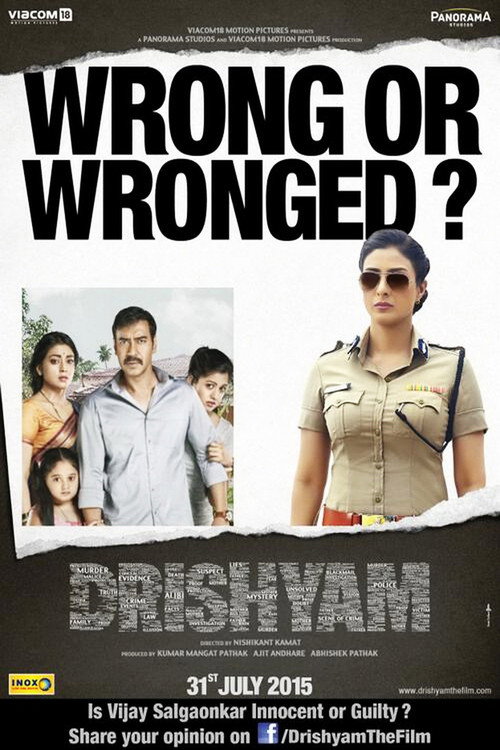
Drishyam
2015 · Nishikant Kamat
For a gripping, brainy thriller night when you want to root for someone outmatched and watch a plan under pressure — comfort-food suspense with real moral weight underneath.
What it's about
Vijay runs a small cable-TV business in a Goan village and has watched so many movies that narrative craft has soaked into his bones. When a blackmail attempt against his teenage daughter ends with a powerful woman's son dead in the family's backyard, Vijay doesn't run and doesn't confess — he builds an alibi out of ordinary family life, staged so meticulously that the police can't find a seam. The investigator bearing down on him is the boy's mother: the state's Inspector General of Police.
The experience
A slow-coiling cat-and-mouse that tightens for two hours straight — less about whodunit than whether an ordinary man's nerve and ingenuity can hold against the full machinery of the state. It makes you complicit: you know everything, and you still sweat every interrogation.
Performances
Ajay Devgn plays Vijay with stubborn, watchful stillness, and Tabu is formidable as the police chief who is also a grieving mother — the film lives in the standoff between her authority and his composure.
The craft
The screenplay, carried over from Jeethu Joseph's Malayalam original, is the star: a procedural chess game where the audience holds all the pieces and the tension comes from watching the cover story bend without breaking. Kamat directs it patiently, letting family routine — a trip, a bus, a bill — become the raw material of suspense.
Why it matters
One of the most successful remakes in modern Indian cinema, it helped turn the Drishyam story into a pan-Indian franchise phenomenon and proved that a twisty, dialogue-driven thriller could be a mainstream Hindi blockbuster.
Snapshot
Nishikant Kamat's Drishyam is the Hindi-language remake of Jeethu Joseph's Malayalam film of the same name (2013), and one of the most consequential adaptations in modern Indian commercial cinema. Ajay Devgn plays Vijay Salgaonkar, a fourth-standard dropout who runs a small cable television operation in the Goan village of Pondolem. When his elder daughter Anju is filmed surreptitiously at a school nature camp and then blackmailed by the boy who shot the video — Sameer, son of the state Inspector General of Police, Meera Deshmukh (Tabu) — a struggle in the Salgaonkar backyard ends with the boy dead. Vijay, who watches films compulsively in his cable office and has absorbed decades of narrative craft by osmosis, does not flee and does not confess. He builds an alibi: he takes his family on a small, ordinary, meticulously witnessed trip and then teaches them to remember the wrong days.
The film is not a whodunit. The audience sees the death and the disposal. What it withholds is a single fact, held back until the last movement, and the entire structure is organized around the eventual detonation of that fact. In genre terms it is an inverted mystery — a howcatchem — but its true subject is testimony: how memory is manufactured, how the poor are disbelieved by default, and how the machinery of cinema itself can be repurposed as a weapon against the state. The title, from the Sanskrit-derived word for sight or that which is seen, is not decorative. Released 31 July 2015, it became a substantial commercial and critical success and the hinge of a franchise and a remake chain that now spans several languages and at least two national industries beyond India's.
Industry & production
Drishyam was produced by Kumar Mangat Pathak and Abhishek Pathak under Panorama Studios, in association with Viacom18 Motion Pictures — a pairing typical of the mid-2010s Hindi mid-budget model, where an independent producer with a strong property partnered with a studio arm for distribution muscle and marketing reach. The economics rested on a specific, then-mature logic: acquire a proven regional screenplay, attach a bankable star, keep the budget disciplined, and let word of mouth carry a content-driven thriller past its opening weekend rather than front-loading it.
The Malayalam original's extraordinary reception in Kerala made its remake rights among the most valuable in Indian cinema in the mid-2010s. Before the Hindi version, the film had already been remade in Telugu as Drushyam (2014, with Venkatesh, directed by Sripriya), in Kannada as Drishya (2014, with V. Ravichandran, directed by P. Vasu), and Jeethu Joseph himself directed the Tamil version, Papanasam (2015), with Kamal Haasan. The Hindi film arrived last among the major Indian-language versions and inherited the burden of following four.
Crucially, this was a faithful remake in an industry whose default remake practice had long been the opposite. The dominant Hindi mode for adapting southern hits — Ghajini, Wanted, Singham, Rowdy Rathore — was maximalist rework: bigger action, added songs, star-vehicle inflation. Drishyam took the reverse approach, preserving the original's structure, pacing and central withholding almost intact. The Hindi screenplay adaptation is credited to Upendra Sidhaye, working from Joseph's original. The significant changes are geographic and textural rather than architectural: the setting moves from Rajakkad in Kerala's Idukki district to a village in Goa, retaining a comparable regional specificity — a coastal, hill-adjacent, partly Christian milieu legible as somewhere particular rather than as generic Hindi-film small-town.
Technology
The production is a straightforward digital-era Hindi feature: shot digitally, finished through a digital intermediate whose grading pushes toward the desaturated greens and grays of monsoon Goa rather than the saturated coastal palette the location usually attracts. The published record on specific camera and post vendors is thinner than for larger 2015 releases, and I will not assert particulars I cannot support.
The more interesting technological account is diegetic. Drishyam is a film about consumer media technology as both the source of catastrophe and the instrument of escape. The inciting crime is committed with a mobile phone camera: a video shot without consent, then used as leverage. The protagonist's livelihood is a village cable television headend — a small operator in the pre-DTH-saturation, pre-streaming Indian mediascape, someone who physically controls what an entire village sees. His expertise is not technical but curatorial: thousands of hours of films watched at the console, which is to say a lifetime of studying how narratives are constructed and how audiences are led.
The investigation, in turn, runs on the era's forensic apparatus of trace evidence — bus tickets, hotel bills, restaurant receipts, cinema stubs, call records, and the testimony of people who saw. Vijay's counter-move is to flood that apparatus with real documents attached to false dates. The film thus dramatizes a specific technological moment: enough recordkeeping to build a case, not enough networked surveillance to catch a determined forger. A version of this story set a decade later, under ubiquitous CCTV and phone-location telemetry, would have to be built differently, and the film's period-boundness is part of its interest.
Technique
Cinematography
Avinash Arun — whose Marathi directorial debut Killa (2014) had established him as a major regional talent — shoots Goa as working landscape rather than holiday. Interior Goa: laterite, banana leaf, corrugated roofing, rain-heavy air, the green pressing in. The Salgaonkar house and its yard are established early and thoroughly, so that when the yard becomes a crime scene and later an excavation site, the audience already possesses its geography. Arun favours unhurried compositions and a mid-distance observational register in the domestic passages, holding the family in the frame together — a formal statement of the unit Vijay is defending.
The register hardens for the police material. Interrogation and station scenes are tighter, more frontal, more static; the visual grammar of pressure is applied by shrinking the frame rather than by cutting faster. Light is largely naturalistic, with practicals doing much of the night work in the cable office, where Vijay's face is repeatedly lit by the screen he is watching — a straightforward but effective figure for a man illuminated by cinema.
Editing
The film's cutting, credited to Aarif Sheikh, is the site of its most consequential craft decision. Drishyam is a two-part structure with a deliberate tonal seam: an unhurried first movement establishing domestic texture and the local ecology of petty police corruption, then a second movement of sustained procedural pressure. The first half's leisureliness is not indulgence; it is the alibi being laid down in front of us, in plain sight, disguised as character work.
The signature device is the retrospective replay: material already shown is returned to, recut, and reframed once the audience acquires the information that changes its meaning. This is a very old suspense technique — the reveal that retroactively rewrites the preceding hour — and Drishyam deploys it with unusual discipline, because it has been scrupulously fair. Nothing shown was false; only its interpretation was. The single fact the film conceals is concealed by omission, not by lie, which is what keeps the final turn satisfying rather than cheap.
Mise-en-scène / staging
The staging is organized around a small set of charged spaces: the cable office, the house and its backyard, the police station, the tea shop, the bus. The police station carries the film's central irony — it is under reconstruction, and the image of an institution being physically rebuilt while a crime lies beneath it is the film's thesis rendered as location.
Costume and property design keep the class geography exact. Vijay's cheap shirts, sandals, mustache and scooter are set against the Deshmukhs' uniform, car and bearing. The film is precise about what a lower-middle-class family in a village can and cannot do: which officials they must placate, which favours they can call in, how the neighborhood's goodwill functions as a resource. That the villagers' loyalty later becomes a form of testimony is a structural pay-off of purely social staging.
Sound
The score, by Sameer Phaterpekar, is notably restrained by the standards of Hindi thrillers of the period — sparing with stings, willing to let interrogation scenes run on room tone and voice. Rain and ambient village sound do much of the atmospheric work, and the film trusts silence in its tensest passages.
The song score is an unusual prestige gesture: compositions by Vishal Bhardwaj with lyrics by Gulzar. Placing two of Hindi cinema's most literary music collaborators on a remade regional thriller signals the film's ambitions — this is not a masala rework — and the songs are concentrated in the early domestic movement, establishing the family's ordinariness before the plot arrives to threaten it. The second half essentially abandons the song form, which for a 2015 Hindi release of this scale is itself a formal decision.
Performance
Ajay Devgn's Vijay is built almost entirely from stillness. The performance withholds — no showpiece monologue until very late, no visible strain. Its effectiveness depends on the audience's prior knowledge of Devgn as an action star and, specifically, as the incorruptible super-cop of the Singham films; Drishyam inverts that persona and asks him to play the man the police cannot break. The flicker of calculation behind an unreadable face becomes the film's suspense engine.
Tabu's IG Meera Deshmukh is the film's other pole, and the more complex construction: an officer whose authority is real, whose methods become indefensible, and whose motive — a missing son — is the same motive driving her adversary. She plays the collapse of officer into mother without softening either. Rajat Kapoor as her husband supplies the civilian conscience she has suspended. Shriya Saran gives Nandini a legible terror that makes the family's fragility plausible. Ishita Dutta, in her Hindi debut, and Mrunal Jadhav as the younger daughter carry the sequences in which the police brutalize children — the film's hardest material, staged without flinching. Kamlesh Sawant's Constable Gaitonde is an unusually exact portrait of petty official sadism: a man whose cruelty is small-scale, personal and entirely enabled.
Narrative & dramatic mode
Drishyam belongs to the inverted mystery, the form associated in popular memory with Columbo and, in cinema, with the tradition running through Clouzot's Les Diaboliques (1955) and Hitchcock's suspense doctrine: give the audience the information, then let them sweat. Its innovation is to invert the inversion. We know everything except one thing, and that omission converts a procedural into a magic trick whose method is only disclosed at the end.
Dramatically, the film is a duel between two parents, each protecting a child, in which the ordinary weapons are reversed: the powerful family has the state, the powerless family has narrative craft. The moral position is deliberately unstable. Vijay's cause is sympathetic; his method requires implicating an entire village in perjury and training his own children to lie under duress, and the film does not pretend this is costless.
The film's most self-aware layer is that its hero's method is cinema. He has learned from watching films how investigations proceed, how testimony is corroborated, how audiences are misdirected. The plot is therefore a demonstration of film literacy as practical power — a reflexive move that flatters the viewer while making a genuine claim about what mass cinema teaches its audience.
Genre & cycle
The film sits at the intersection of two identifiable mid-2010s cycles. The first is the Hindi content-driven mid-budget thriller that followed Kahaani (2012) and Talaash (2012) and included Special 26 (2013), Badlapur (2015), NH10 (2015) and Talvar (2015) — films sold on premise and craft rather than spectacle, sized to profit from strong word of mouth. Drishyam is the most commercially successful of that cluster to be adapted rather than originated.
The second is the south-to-Hindi remake pipeline, which by 2015 had been running at industrial scale for a decade. Drishyam's distinction within it is fidelity. It demonstrated that a southern property could be transposed with its structure and tone intact and outperform expectations — a lesson the industry absorbed, though not always well.
It also belongs, more loosely, to the Indian "family under siege" thriller, in which the domestic unit rather than the individual is the protagonist, and to the long tradition of Indian popular narratives about the ordinary citizen outwitting an unjust apparatus.
Authorship & method
Nishikant Kamat came to Drishyam from a Marathi-and-Hindi career built on institutional pressure and ordinary men breaking: Dombivli Fast (2005), his Marathi breakthrough about a commuter's rebellion, which he remade in Tamil as Evano Oruvan (2007); Mumbai Meri Jaan (2008), a multi-strand response to the 2006 train bombings; the action films Force (2011) and later Rocky Handsome (2016); the Marathi hit Lai Bhaari (2014); and Madaari (2016), another film about a private citizen forcing the state to answer. He also worked as an actor. His method on Drishyam was essentially interpretive — the screenplay was Joseph's, and Kamat's contribution was tonal control, performance direction and the decision to resist inflation. Kamat died in August 2020, at fifty, and Drishyam stands as the widest-reaching film of his career.
Jeethu Joseph, though not credited as director here, is the film's true author in the structural sense: the concept, the withheld card, and the second-half architecture are his. Avinash Arun's photography, Aarif Sheikh's cutting, Sameer Phaterpekar's score, and the Bhardwaj–Gulzar songs constitute the Hindi version's distinct signature, with Upendra Sidhaye's adaptation handling dialogue and the Goa transposition. Ajay Devgn's contribution should be counted as authorial too — the film's restraint is inseparable from a major star agreeing to underplay.
Movement / national cinema
Drishyam is best understood as a document of Malayalam cinema's export power. The 2013 original emerged from the "New Generation" Malayalam wave that had been reshaping the industry since roughly 2011 — Traffic, Salt N' Pepper, 22 Female Kottayam, Ustad Hotel — a movement characterized by tighter budgets, contemporary settings, screenplay-first construction and a willingness to break from star-vehicle convention. Joseph's film applied that discipline to a mainstream Mohanlal vehicle and produced a phenomenon.
What followed was a circulation map of unusual reach: Malayalam to Telugu, Kannada, Tamil and Hindi; then to Sinhala (Dharmayuddhaya, 2017); then, most significantly, to China, where Sam Quah's Sheep Without a Shepherd (2019) became a major hit and generated its own sequels and further regional adaptations, including an Indonesian version. Few Indian screenplays have traveled this far, and Drishyam is plausibly the most-remade Indian film of the century so far. The Hindi version's role in that map is as amplifier: it carried the property to the largest domestic audience and to the diaspora markets that Hindi cinema commands.
Era / period
2015 was a transitional year for Hindi cinema — after the multiplex consolidation and the "hundred-crore" star-vehicle logic of the early decade, before streaming reorganized the middle of the market. The year's slate ran from Bajrangi Bhaijaan and Bajirao Mastani to Piku, Masaan and Talvar, and the mid-budget adult drama still had reliable theatrical space. Drishyam was made for exactly that space and would be a harder theatrical proposition five years later.
Its politics are also of the moment. The film's unflinching depiction of custodial violence — including against children — and of a senior officer using her position for a private end, landed in a period of intensifying public argument about police impunity in India, an argument Talvar was prosecuting the same year from the opposite direction. Drishyam does not editorialize; it simply shows what the institution does to people who have no leverage, and lets the audience conclude that the protagonist's deception is the only defense available to him.
Themes
Sight and testimony. The title governs the film. What is seen, who is believed when they say they saw it, and how a sequence of true observations can be assembled into a false account — this is the film's entire method and its argument.
Memory as construction. Vijay does not fabricate documents so much as fabricate recollection, drilling his family until their memories of two days are stable, consistent and wrong. The film's most quietly disturbing sequences are the rehearsals.
Class and the presumption of guilt. The Salgaonkars' powerlessness is specified with unusual precision — a family that cannot afford a lawyer, cannot refuse a summons, cannot expect procedure. The film's suspense depends on the audience's understanding that the truth would not save them.
Parenthood as amoral force. Both parents in the film do indefensible things for their children, and the film refuses to rank them. Meera's line of reasoning and Vijay's are the same reasoning; only their resources differ.
Cinema's instrumentality. The reflexive core: the protagonist's education is popular film, and popular film is what defeats the state. It is simultaneously a joke about movie logic and a serious claim about mass media as a form of vernacular literacy.
The buried foundation. The film's governing image — a crime lying beneath the institution built to prosecute it — reads as a statement about Indian policing that the dialogue never has to make.
Reception, canon & influence
Critical reception in India was strongly favourable, with praise concentrated on the screenplay's construction, Devgn's restraint and Tabu's performance, which was widely singled out as among the strongest of her mid-career work. The most common reservation concerned the film's status as a remake — reviewers who knew Joseph's original debated how much credit was Kamat's — and, secondarily, the deliberate slowness of the first half. It was a substantial commercial success; precise figures are better taken from box-office trackers than asserted here, and I will not invent them. Its awards record likewise is best consulted directly rather than summarized from memory.
Backward influences. The film's structural lineage runs through the inverted mystery: Clouzot's Les Diaboliques, the Hitchcockian suspense principle of privileged audience information, and the television grammar of Columbo. Within Indian cinema it draws on a long tradition of the ordinary man's stratagem against an unjust order. A widely circulated comparison, made repeatedly since 2013, links the premise to Keigo Higashino's novel The Devotion of Suspect X (2005) and its screen adaptations, in which an unremarkable man constructs an elaborate deception to shield a neighbor who has killed. Jeethu Joseph has publicly rejected the suggestion of borrowing. The resemblance is at the level of premise rather than plot mechanics, and the record contains claim and denial rather than resolution — it should be reported as such.
Forward legacy. Drishyam reset expectations for the Hindi remake: it demonstrated that fidelity could outperform inflation, and that a mid-budget adult thriller with a star willing to underplay could hold theaters for weeks. It confirmed Malayalam cinema's screenplays as India's most valuable exportable commodity, and it seeded a franchise — Joseph's Drishyam 2 (2021), released on streaming and itself a considerable success, and its Hindi counterpart Drishyam 2 (2022), directed by Abhishek Pathak with Devgn and Tabu returning, which extended the original's central trick by revealing that the first film's ending had itself been another layer of construction. Further installments have been announced in both languages; their status as of this writing is best verified against current trade reporting.
Beyond India, Sheep Without a Shepherd made the property a Chinese blockbuster and launched a further chain of adaptations, an unusual reversal of the usual direction of remake traffic. For a Hindi film that began as the fifth version of a Kerala screenplay, Drishyam's ultimate significance is that of a relay point in one of contemporary world cinema's most remarkable circulation stories — and, on its own terms, a well-built thriller about the uses of having watched a great many films.
Reception
In 2015 it lived in the shadow of Mohanlal's Malayalam original — a solid hit, but the default review was 'watch the 2013 one instead.' Then the sequel's monster post-pandemic box office run in 2022 retroactively canonized it as Bollywood's go-to thriller, the version a whole generation of Hindi-film watchers met first.
How Drishyam was received, from release to now →
How to watch Drishyam: what to notice on a first viewing
- Notice how thoroughly the film shows you the house and yard. Early scenes linger on the Salgaonkar home and its backyard in calm, observational, mid-distance shots, long before either space carries any weight. By the time the yard matters, you already know it by heart, which is exactly what the film needs from you.
- Watch the frame tighten whenever the police start questioning someone. Domestic scenes hold the family in loose, wide compositions, but interrogation scenes turn tighter, more frontal, and more static, shrinking the space around whoever is being pressed. Arun applies pressure with the frame itself, not with faster cuts, so the discomfort builds even when nothing is said.
- Listen for how often the score drops out during tense scenes. Sameer Phaterpekar's music stays sparing with stings, letting interrogation, rain, and village ambience carry entire scenes on room tone alone. Trusting silence over a score forces you to sit in the discomfort instead of being cued through it.
- Watch Vijay's face for any flicker while he is questioned. Devgn plays the whole role from stillness, withholding any showpiece speech or visible strain and giving the police almost nothing to read. An unreadable face is the whole engine of the suspense: you are watching a man give nothing away.
- Notice how Vijay's face is lit by the screen he watches. In the cable office at night, the television is often the only light source on his face, a small, literal image of a man shaped by cinema. Everything Vijay knows about outwitting the police, he learned from the films that light is coming from.
The whole guide to watching Drishyam, with the keys for a rewatch →
Influences: the films it descends from and the films it influenced
- Drishyam (2013) — The direct source text: Joseph authored the withheld card and the two-part architecture — an unhurried first half that plants apparently idle domestic business (a bus ticket, a restaurant bill, a police-station renovation) which the second half retrieves as manufactured evidence, and Kamat's Hindi version reproduces that beat structure almost shot-for-function.
- Les Diaboliques (1955) — Establishes the template of a corpse concealed inside the household's own utility geography (drained pool, plumbing) so that suspense is generated by architecture rather than chase, and installs the patient, shabby, out-of-jurisdiction inspector who wins by returning rather than by force.
- Rope (1948) — The purest inverted-mystery grammar: the killing is shown first, and every subsequent scene is tension between guests circling the concealment site and the audience's privileged knowledge of what is inside it — Drishyam's police-station-under-reconstruction is the same chest in the same room.
- Dial M for Murder (1954) — Structures an entire film as an alibi assembled and then dismantled through physical paper — latchkeys, letters, stub receipts — so the climax is an evidentiary chain reasoned aloud; Drishyam runs the identical mechanism in reverse, with the amateur building the paper trace the professionals must accept.
- Prescription: Murder (1968) — The Columbo pilot codifies the 'howcatchem': the murderer's cover story is stated early, and drama becomes attritional re-interviewing where the detective revisits small inconsistencies in dates and sightings — Drishyam borrows the rhythm but flips allegiance so the audience roots for the alibi to hold.
- The Wrong Man (1956) — Makes ordinary testimony the engine of terror: whether a family can prove where it was on a given date, verified by hotel registers, ticket clerks and strangers' recall — Drishyam's second half is that procedure weaponized, with a family drilled to recite a false but corroborated itinerary.
- Yôgisha X no kenshin (Suspect X) (2008) — The disputed precedent (premise, not plot mechanics; Joseph has publicly denied borrowing): an unremarkable man shields a neighbor's killing by pre-computing how investigators reason and building a deception aimed at their method rather than at the facts.
- Ittefaq (1969) — Proved a Hindi thriller could run on plot mechanics with the song apparatus withdrawn — the precedent for Drishyam's front-loading its songs into the domestic first act and then abandoning music entirely once the investigation begins.
- The Usual Suspects (1995) — Popularized the retrospective-replay cut: a closing montage re-shows footage the audience has already accepted as neutral, recoded by one new fact — Drishyam's finale replays the family's earlier 'innocent' errands as the deliberate laying of an evidentiary trail.
- Killa (2014) — Arun's own directorial feature, shot by him the year before Drishyam, sets the palette he brings to Kamat: desaturated coastal-monsoon greens and grays in available light, wide domestic exteriors held long enough to become a map of the house and its backyard.
- Dombivli Fast (2005) — Kamat's own template for the ordinary salaried man versus an institution, and for the tonal restraint he imports here — pressure rendered through diminishing frame size and unraised voices rather than through montage or score.
- Andhadhun (2018) — Extends Drishyam's commercial proof that a mid-budget Hindi thriller can be sold on watertight plot mechanics and a star underplaying, with deferred reveals seeded as throwaway domestic detail rather than telegraphed by score or coverage.
- Drishyam 2 (2021) — Adds a further recursion to the original device by revealing that the first film's ending was itself a staged layer, so the sequel's retrospective replay recodes not raw events but a prior film's already-explained solution — and it reuses the same house and backyard as a load-bearing set.
- Drishyam 2 (2022) — Carries the Hindi cast forward into Joseph's recursion and confirms the fidelity thesis Kamat established: the remake's value lies in preserving Malayalam screenplay architecture intact rather than inflating it with stars, action or songs.
- Sheep Without a Shepherd (2019) — Reverses the usual direction of remake traffic by making the Kerala screenplay a Chinese blockbuster, and makes explicit what Drishyam keeps implicit — the protagonist's film-literacy is dramatized as citable cinema, his method sourced aloud to the movies he has watched.
- Papanasam (2015) — Joseph re-directing his own screenplay in Tamil the same season, which isolates the variable: identical scene order and reveal mechanics, but Kamal Haasan plays the cable operator's cunning as visible calculation where Devgn plays it as stillness, proving the script's suspense survives opposite performance registers.
- Kahaani (2012) — The contemporaneous Indian model of the withheld card: a protagonist whose stated account is the film's real misdirection, resolved by a final sequence that retroactively re-annotates every earlier scene rather than introducing new information.
- Talvar (2015) — Released weeks after Drishyam and built on the same editing device — the same night replayed with competing reconstructions — while sharing its thesis that police procedure is a class instrument, with the middle-class family's account weighed against the investigating officer's need for a story.
Similar films
- Drishyam (2013) — influence & lineage
- Talvar (2015) — influence & lineage
- Andhadhun (2018) — influence & lineage
- Vikram Vedha (2017) — shared sensibility
- Kishkindha Kaandam (2024) — shared sensibility
- Maharaja (2024) — shared sensibility
- Athadu (2005) — shared sensibility
- Aaranya Kaandam (2011) — shared sensibility