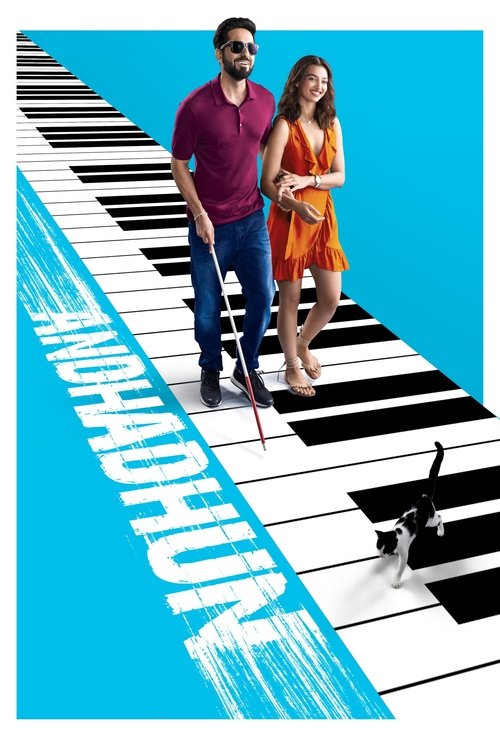
Andhadhun
2018 · Sriram Raghavan
For when you want to be played like a piano — a twisty, blackly funny crime night, ideally with friends you can yell at the screen with. Pure pleasure, zero comfort-food predictability.
What it's about
A Pune pianist fakes being blind — the act sharpens his playing, gets him sympathy, tips, and a cheap flat. Then he's booked for a private recital and walks into an apartment containing a corpse, a composed widow, and a secret he must pretend not to see. Keeping up the act in that room is only the beginning: the lie keeps demanding more, and every escape route opens onto something worse.
The experience
A wicked, breakneck ride — genuinely tense one minute, laugh-out-loud the next, with rug-pulls arriving so fast you stop trusting anything. It's the rare thriller where you're gasping and grinning at the same time.
Performances
Tabu is the film's dark engine — poised, funny, and quietly terrifying, often all in the same scene. Ayushmann Khurrana is superb in a role that requires him to perform sightlessness badly and well at once, sustaining panic behind unblinking eyes.
The craft
Sriram Raghavan's plotting is watchmaker-precise: every gag is loaded early and paid off late, and the piano isn't decoration — the music is wired into the suspense, with whole sequences scored to what the 'blind' man plays while chaos unfolds around him. The tonal control, swerving between Hitchcockian tension and farce without dropping either, is the real magic trick.
Why it matters
A sleeper that became a phenomenon — a huge hit at home and a surprise blockbuster in China — and it cemented Raghavan's reputation as Hindi cinema's sharpest genre stylist while proving mid-budget thrillers could travel.
Snapshot
A pianist who is not blind pretends to be blind, and is then punished for it by a plot that keeps taking his pretense literally. Andhadhun — the title puns on andha (blind) and dhun (melody), with andhadhund (reckless, headlong) hovering behind it — is Sriram Raghavan's fifth feature and the film that consolidated his standing as Hindi cinema's most disciplined genre stylist. Akash (Ayushmann Khurrana) wears prosthetic lenses and carries a cane because the affectation sharpens his playing and secures him a cheap flat and easy sympathy. Invited to give a private recital, he arrives to find his host already murdered, and must sustain the performance of blindness in a room containing a corpse, the dead man's much younger wife Simi (Tabu), and her lover, a police inspector (Manav Vij). From that single, superbly sustained situation the film metastasises into an escalating black farce of organ trafficking, blackmail, poisoning and roadside catastrophe, before resolving into a retrospective monologue whose truthfulness the last shot quietly withdraws.
Released on 5 October 2018 by Viacom18 Motion Pictures with Matchbox Pictures, it opened modestly and grew by word of mouth into one of the year's defining mid-budget successes, then had an unusual second life as a substantial theatrical hit in China in 2019. It won the National Film Award for Best Feature Film in Hindi and for Best Adapted Screenplay, with Khurrana sharing Best Actor. It has since been remade in Telugu, Malayalam and Tamil.
Industry & production
The film belongs precisely to the Hindi "content film" economy of the mid-to-late 2010s: a mid-range budget, no A-list male star in the conventional sense, a script developed over years, and a multiplex-first release pattern that relied on second-weekend growth rather than opening-day saturation. Viacom18's studio arm had been among the more consistent backers of this tier; Matchbox Pictures, producer Sanjay Routray's outfit, had already worked with Raghavan on Badlapur (2015).
The screenplay is credited to Raghavan with Arijit Biswas, Pooja Ladha Surti, Yogesh Chandekar and Hemanth Rao — an unusually large writing room by Hindi standards, and a visible one: the film's density of reversals has the feel of a plot stress-tested by many hands. It is openly adapted from Olivier Treiner's thirteen-minute French short L'Accordeur (The Piano Tuner, 2010), which supplies the premise and the central sequence of a false blind man trapped with a killer, and which the film credits. Everything after that first act — the doctor, the auto-rickshaw driver and his wife, the ransom, the rabbit — is invention.
Setting the film in Pune rather than Bombay was a consequential production choice. It gave the story a mid-sized city's texture of restaurants, apartment colonies and small-time hustlers, and let the film draw on Marathi acting traditions: Chhaya Kadam, Ashwini Kalsekar and others bring a register of performance quite distinct from Bombay film naturalism. The casting of Anil Dhawan as Pramod Sinha, a faded actor of the 1970s, is the production's sharpest economy — Dhawan is himself a real leading man of that decade, and the film furnishes Sinha's flat and soundtrack with his own back catalog, so that the character's nostalgia and the audience's are the same artifact.
Technology
Andhadhun is a film of practical means rather than technological ambition, and the public record on its specific camera and lens package is thin. It was shot digitally, as effectively all Hindi productions at this budget level were by 2018, and the sensor latitude of contemporary digital capture is doing quiet work throughout: much of the film takes place in dim domestic interiors lit by table lamps, television glow and window light, and the murder sequence in particular depends on holding legible detail in a deep, softly lit apartment without resorting to the hard theatrical modeling that older stocks would have required.
The more interesting technological dimension is musical. The piano is not decorative but structural, and the film's construction required performances that could be shot, cut and scored around rather than laid in afterwards — Khurrana trained at the keyboard, and the staging repeatedly asks us to accept hands, instrument and sound as continuous within the frame. Equally significant is the archival dimension: the film's soundtrack folds in recordings from Dhawan's own 1970s vehicles, so that the analog texture of that era's playback singing sits inside a contemporary digital mix as a deliberate foreign body.
Distribution mattered too. India's digital-cinema networks made a slow-burn release viable in a way 35mm print economics never had — a film could add screens in week two on the strength of word of mouth. And the Chinese release, arriving in a window when Indian films were finding real traction in that market after Dangal and Secret Superstar, demonstrated a distribution pathway that had not existed for Hindi genre cinema a decade earlier.
Technique
Cinematography
K.U. Mohanan, an FTII-trained cinematographer whose credits include Don 2 and Talaash, shoots Pune in warm, slightly soured domestic tones — ochres, browns, the amber of a bar lamp — against the cooler blue-gray of night exteriors and hospital corridors. The film's governing visual idea is deep, legible space. Because Akash must not appear to see, the camera cannot use his eyeline; instead Mohanan and Raghavan stage in depth so that the audience sees everything Akash is pretending not to. The corpse, the bloodstain, Simi's hands, the inspector's shoes: these sit in the frame behind or beside the foreground business, unremarked, generating suspense purely through composition rather than through cutting to a look.
The camera also learns to lie. Mohanan withholds the reaction shot at the exact moments a thriller conventionally supplies it, holding instead on Khurrana's unfocused, deliberately dead gaze. Mirrors, glass doors and reflections recur — a man who claims not to see is constantly caught in surfaces that see for him. The film's few flourishes are pointed: the pre-credit image of a one-eyed rabbit in a field, and the final European sequence with its flatter, cleaner light, visually announcing that we have crossed into a different order of narration.
Editing
Pooja Ladha Surti — also a co-writer, and Raghavan's editor since Agent Vinod — cuts for information management above all. The film's comedy and its dread come from the same operation: knowing exactly when to give the audience a fact and when to withhold it from a character. The recital sequence in the Sinha flat is the model, played long and patiently, letting the viewer's knowledge accumulate ahead of everyone's, with cuts timed to near-discoveries rather than to discoveries.
Surti's second mode is acceleration. Once the plot turns picaresque — the drugging, the abduction, the ransom — the cutting tightens into cross-cut parallel action, comic in rhythm, with beats landing on precisely the wrong reveal. The two-year ellipsis before the coda is the film's boldest cut: an abrupt excision that hands narration over to Akash himself, and thereby licenses everything questionable that follows.
Mise-en-scène / staging
The film's spaces are characterized with real specificity: Sinha's flat, thick with the memorabilia of a career nobody remembers; the restaurant where Akash performs for tourists and dates; the shabby rooms of the auto driver and his wife; the doctor's clinic, a place of casual atrocity dressed as routine care. Props are load-bearing rather than atmospheric — the cane, the dark glasses, the lottery ticket, the neighbor's window, the child's video camera. Raghavan's staging repeatedly builds a set-piece around a single physical constraint (a man who must not look; a body that must not be seen; a rabbit crossing a road) and then wrings out every permutation before releasing it.
Sound
Sound is the film's most sophisticated system. Akash's fabricated blindness makes the soundtrack a rival channel of information: cane taps, footsteps, cutlery, a mobile ringing where it should not be. The score by Daniel B. George (who also scored Badlapur) works largely in restraint, letting the piano itself carry tension, and the film plays constantly on the boundary between diegetic and non-diegetic music — Akash's playing bleeds outward into the score and back again, so that the character's art becomes the film's commentary on him.
Amit Trivedi's songs, with lyrics by Jaideep Sahni, are written in and around a retro idiom that lets them sit alongside the genuine 1970s recordings drawn from Dhawan's filmography. The result is a soundtrack with two historical layers, and the film uses the older one as a memory device, a period pastiche and, in the murder sequence, as grotesque counterpoint.
Performance
Khurrana's task is a double act: he plays a sighted man playing a blind man, and must be convincing to the other characters while remaining transparently false to us. He solves it largely through eye discipline and a faint over-precision in movement — the tell of a man who has rehearsed helplessness. Coming off Vicky Donor and a run of high-concept comedies, and with Badhaai Ho arriving in the same month, this was the performance that established his range beyond likeability.
Tabu's Simi is the film's center of gravity and its most economical creation. She underplays throughout, treating murder as household administration, and her comic timing — a resource the industry had rarely asked her for — turns menace into deadpan. The role reads as a late entry in her line of morally compromised women running back through Maqbool and Haider, and it began a genuine second-act resurgence in her career. Around them, Anil Dhawan supplies meta-casting pathos, Manav Vij plays the inspector as a bully collapsing under his own incompetence, Ashwini Kalsekar and Chhaya Kadam contribute two sharply etched studies in opportunism, and Zakir Hussain's doctor treats organ theft with the bedside manner of a man discussing a mortgage.
Narrative & dramatic mode
The film runs on dramatic irony in its first half and on farcical escalation in its second. The opening act is pure Hitchcockian suspense mechanics: the audience knows, the protagonist knows, one antagonist suspects, and nobody may say so. From roughly the midpoint, the mode shifts — every attempted solution generates a worse problem, alliances re-form every ten minutes, and the moral floor drops out until there is no innocent party left, Akash included. The comedy is not relief from the horror; it is the horror, viewed from the correct distance.
The final movement reframes everything. The last act arrives as Akash's own account, told to Sophie in a European café two years later, and the film's closing gesture — a cane swung at an obstacle he should not be able to see — retroactively converts his testimony into a possible fabrication. The film refuses to adjudicate. This structural withholding, more than any single twist, is what generated the film's remarkable afterlife in online explainer culture.
Genre & cycle
Andhadhun sits at the confluence of two cycles. The first is the Hindi neo-noir revival that runs from Ram Gopal Varma's Satya (1998) through Vishal Bhardwaj, Anurag Kashyap, Dibakar Banerjee, Navdeep Singh and Sujoy Ghosh's Kahaani (2012) — a body of work that reintroduced moral ambiguity, criminal procedure and urban texture to a mainstream cinema long organized around romance and family. The second is the black comic thriller, whose Hindi lineage includes Kaminey and Delhi Belly, and whose international grammar — escalating incompetence, bodies that will not stay disposed of — descends from the Coens.
Within Raghavan's own filmography it is the endpoint of a project begun in Ek Hasina Thi (2004) and Johnny Gaddaar (2007): pulp plotting executed with classical precision, unencumbered by the reassurance of a moral center.
Authorship & method
Raghavan is a director-cinephile whose films are built from an inherited library — Hitchcock, Vijay Anand's twisty musical thrillers, the paperback crime of James Hadley Chase, and the pulp Frenchman Frédéric Dard, whom he would later adapt directly for Merry Christmas (2024). Johnny Gaddaar wore its debts openly; Andhadhun metabolizes them. His method is recognizable across the work: a rigorously mechanical plot, a protagonist whose competence is his undoing, popular film history invoked as texture rather than as quotation, and a refusal to punish or redeem on schedule.
The collaboration is unusually stable and unusually integrated. Surti's dual role as co-writer and editor means the film's information architecture is designed and executed by the same person. Mohanan supplies a photographic style that serves plot legibility rather than mood for its own sake. Trivedi, Sahni and George construct a score that is simultaneously the protagonist's occupation, the film's suspense engine, and its historical commentary. The five-name writing credit suggests a long development, and the plot's near-total absence of slack bears that out.
Movement / national cinema
The film belongs to what is loosely called New Bollywood: the post-multiplex Hindi cinema in which mid-budget, script-driven films could succeed without stars, item numbers or the diaspora blockbuster template. Its Pune setting matters here. By moving out of Bombay, Raghavan taps a regional performance culture — Marathi theater and cinema actors in supporting roles, Hindi and Marathi code-switching in dialogue — that gives the film a specificity of place rare in Hindi thrillers of the period. It is also, quietly, a film about the informal economy: everyone in it, from the doctor to the rickshaw driver to the pianist, is running a small fraud, and the plot is simply what happens when several such frauds collide.
Era / period
2018 was a hinge year for Hindi cinema. Several very large star vehicles underperformed while a cluster of mid-budget films — Raazi, Stree, Badhaai Ho, Andhadhun — succeeded on concept and word of mouth, a pattern widely read at the time as evidence that the star system's grip was loosening. Simultaneously, streaming arrived at scale: Netflix's Sacred Games in July and Amazon's Mirzapur in November of the same year established a competing venue for exactly the kind of morally complicated genre storytelling Andhadhun was doing theatrically. And the Chinese market had, over the preceding two years, opened unexpectedly to Indian films. Andhadhun is a product of all three conditions.
Themes
Blindness in the film is never a disability; it is a posture, a business strategy and an ethical condition. Akash's fake blindness is a form of artistic vampirism — he borrows the perceptual authority of an experience he has not had — and the plot's cruelty consists in making him actually pay for the loan. Around this sits a broader theme of complicity: nearly every character sees a crime and calculates its market value rather than reporting it, and the film's real subject is that calculation.
The organ trade supplies the film's most vicious joke. The epigraph — "What is life? It depends on the liver" — announces a pun that the plot then literalises, as bodies become inventory. Chance is the countervailing force: a lottery ticket, a rabbit on a road. In a story where every character schemes meticulously, outcomes are decided by animals and accidents.
Finally, there is nostalgia, embodied in Dhawan's Sinha — a man whose past is more vivid than his present, murdered in a flat full of evidence of his own former significance. The film treats 1970s Bollywood with affection and with a certain coldness: it is beautiful, it is over, and it is a crime scene.
Reception, canon & influence
Critical reception in India was strongly positive and unusually unanimous, with particular praise for the screenplay's construction, Tabu's performance and the sustained tension of the first-act set piece; the most common reservation concerned the density of twists in the final third and the ending's refusal to settle. It opened to moderate business and grew, ultimately becoming one of the year's notable profit stories. Its Chinese release in 2019 was the genuine surprise: the film performed substantially better there than at home, joining the short list of Indian titles to find a mass Chinese audience.
Institutional recognition followed at the National Film Awards, where it took Best Feature Film in Hindi and Best Adapted Screenplay, and where Khurrana shared Best Actor. It featured prominently in that season's popular awards as well.
Looking backward, its debts are clear and mostly acknowledged: Treiner's L'Accordeur for the premise; Hitchcock for the ethics of the compromised observer and the suspense grammar of withheld knowledge; the international tradition of the imperilled blind protagonist running through Wait Until Dark; Vijay Anand and the Hindi thriller-with-songs for the integration of music into plot; and the Coens for the tone in which disaster becomes funny.
Looking forward, the influence is concrete. It was remade as Maestro in Telugu (2021), Bhramam in Malayalam (2021) and Andhagan in Tamil (2024) — an unusually rapid pan-Indian circulation. It reinforced a commercial argument that Hindi thrillers could travel without stars, a case extended the following year by Badla, and it contributed to a sustained boom in Hindi genre filmmaking across theaters and streaming. It reset two careers: Khurrana's, toward dramatic range, and Tabu's, into a prolific and highly visible late phase. Within Raghavan's own work it set the terms for Merry Christmas. And its ending became a small permanent fixture of Indian online film culture — a puzzle argued over continuously in the years since, which is its own kind of canonization.
Reception
A modest opener that word-of-mouth turned into 2018's sleeper hit, it has since climbed into 'best Hindi film of the decade' conversations and become the default gateway rec for modern Bollywood thrillers.
How Andhadhun was received, from release to now →
How to watch Andhadhun: what to notice on a first viewing
- Watch what sits in the background behind Akash. The camera never uses his eyeline, so Mohanan stages in depth instead. A stain, a pair of shoes, a hand, all sitting unremarked behind the foreground conversation. The suspense comes from composition rather than cutting. You see what the scene refuses to point at. The frame keeps handing you information the people inside it are not sharing.
- Notice when a thriller would cut to a reaction and does not. Mohanan holds on Khurrana's flat, unfocused gaze at exactly the moments another film would show somebody registering a shock. Mirrors, glass doors, and reflections keep catching people anyway. The missing reaction shot is the suspense engine. You are left doing the reacting that the film declines to do for you.
- Listen for cane taps, cutlery, footsteps, a phone ringing wrongly. Sound carries facts the image withholds. Daniel B. George keeps the score restrained and lets the piano do the work. Akash's playing bleeds out into the score and back in again. The soundtrack runs as a second channel alongside the picture. Half of what you learn in this film arrives through your ears.
- Watch how calmly Tabu handles a household problem. Simi underplays everything. She treats a crisis as administration, keeps her voice level, and lets comic timing do the menacing. Tabu had rarely been asked for this register before. The deadpan is what makes her frightening. Nothing in her manner escalates, so you cannot tell how far she will go.
- Look at the memorabilia on the walls of Sinha's flat. Anil Dhawan plays a faded seventies actor, and the flat and the soundtrack are furnished with Dhawan's own back catalog. Real recordings from that era sit inside the contemporary mix as a foreign body. The nostalgia is handled with affection and coldness at once. That past is beautiful, it is finished, and it is evidence.
The whole guide to watching Andhadhun, with the keys for a rewatch →
Influences: the films it descends from and the films it influenced
- L'Accordeur (2010) — The 13-minute source supplies the load-bearing device Andhadhun expands to feature length: a pianist faking blindness must keep playing while a murder's aftermath is arranged in the room around him, so the performance itself becomes the suspense instrument — any falter is confession.
- Wait Until Dark (1967) — Codifies the blind-protagonist single-set constraint piece in which the camera grants the audience spatial knowledge the protagonist lacks — objects placed just outside their reach, intruders held in frame behind them — the exact grammar Raghavan runs through the Sinha flat sequence.
- Rear Window (1954) — The ethics of the compromised observer: a witness immobilised by his own condition and complicity who cannot report what he saw without exposing his fraud, with the visual field deliberately restricted to what he can and cannot verify.
- The Man Who Knew Too Much (1956) — Diegetic music as the suspense clock — the performance that must be completed becomes the timer against which the crime resolves — the principle Andhadhun industrializes by making the protagonist's occupation, the score and the plot mechanism the same object.
- Les Diaboliques (1955) — The template for the conspiratorial couple whose corpse-disposal logistics generate the plot, and for a closing reversal that retroactively reassigns who was performing for whom rather than delivering closure.
- Teesri Manzil (1966) — The Hindi thriller-with-songs integration Raghavan explicitly inherits: R.D. Burman numbers staged as investigation and misdirection rather than interruption, so a musical performance advances the murder plot instead of pausing it.
- Jewel Thief (1967) — Builds its reveal architecture on a genial performer whose public persona is itself the deception, with twists timed to land on and around the musical set pieces — the structural rhyme behind Andhadhun's meta-cast, ingratiating protagonist.
- The Ladykillers (1955) — Criminals using musicianship as cover, undone inside a single domestic interior by an unassuming resident, with the comedy generated by amateurs negotiating the practicalities of a body — the tonal blueprint for the flat's escalating farce.
- Blood Simple (1984) — The botched-crime chain in which every corrective act deepens the hole, sustained through long near-wordless sequences whose tension comes purely from each character possessing a different fraction of the truth.
- Fargo (1996) — The deadpan register in which catastrophe plays as mundane comedy, and the ordinary competent professional — not a criminal — whose modest opportunism opens the trapdoor; the tone Raghavan cites for making disaster funny without winking.
- Johnny Gaddaar (2007) — Raghavan's dry run at the same machinery — James Hadley Chase paperback plotting, popular Hindi film history invoked as texture rather than quotation, and a protagonist whose cleverness is precisely the instrument of his ruin — worn openly there, metabolized in Andhadhun.
- Badlapur (2015) — Establishes his refusal to punish or redeem on schedule: sympathy is allowed to migrate mid-film and the moral ledger is left unsettled, the authorial habit that makes Andhadhun's rabbit-and-cane ending readable as a deliberate withholding rather than a cheat.
- Badla (2019) — Extends the commercial and formal case Andhadhun made months earlier — a chamber-scale Hindi thriller carried by construction rather than stardom, built on competing narrations of one event that visibly revise each other as the film restages them.
- Maestro (2021) — Telugu remake that transposes the information architecture near beat-for-beat, and in doing so functions as a control experiment: the withheld-reaction-shot and staging-in-depth grammar is retained while the performances change, exposing how much of the original's tension was editorial rather than acted.
- Bhramam (2021) — A cinematographer-turned-director's Malayalam restaging of the mirror blocking and deep-staged apartment geography with an entirely new score, which demonstrates by subtraction how load-bearing Trivedi's music was as suspense engine rather than accompaniment.
- Andhagan (2024) — The Tamil leg of an unusually fast pan-Indian circulation, retaining the two-year ellipsis and the ambiguous final beat intact — evidence that the film's remake value lay in its plot mechanism rather than its star or its milieu.
- Merry Christmas (2024) — The direct successor within Raghavan's own work: another French pulp adaptation (Frédéric Dard), another single-location constraint stretched across one night, Tabu again deployed as deadpan menace, and sound and period playback again carrying plot information the dialogue withholds.
- Monica, O My Darling (2022) — The clearest inheritor of the black-comic Hindi neo-noir register Andhadhun reopened — retro-pastiche scoring used as ironic commentary, corpse logistics played as farce, and an ostensibly hapless protagonist revealed as the coldest operator in the room.
- Maharaja (2024) — A contemporary Indian puzzle-box thriller propelled by an object/deception and cascading moral reversals, trusting the audience with concealed architecture in the same register as Maharaja.
- Aaranya Kaandam (2011) — An Indian puzzle-box tragicomedy of crime whose against-the-grain, jaunty scoring ironizes escalating violence — the same sound-against-image irony Yuvan Shankar Raja uses to sharpen menace.
- Super Deluxe (2019) — A tonally slippery neo-noir black comedy driven by amoral coincidence and escalating twists, a contemporaneous Indian instance of using genre mechanics to provoke.
- Vikram Vedha (2017) — A mainstream moral-relativist thriller whose riddle-and-twist architecture converts ethical instability into commercial entertainment — VV's exact proof that moral philosophy can power a mass thriller.
- Drishyam (2013) — Extends the clockwork-plot craft — an everyman improvising escalating cover-ups inside a watchmaker's lattice of misdirection where each detail is later load-bearing.
Similar films
- Vikram Vedha (2017) — shared sensibility
- Aaranya Kaandam (2011) — shared sensibility
- Jigarthanda (2014) — shared sensibility
- Maharaja (2024) — shared sensibility
- Vada Chennai (2018) — shared sensibility
- Chithha (2023) — shared sensibility
- Drishyam (2015) — shared sensibility
- Super Deluxe (2019) — shared sensibility