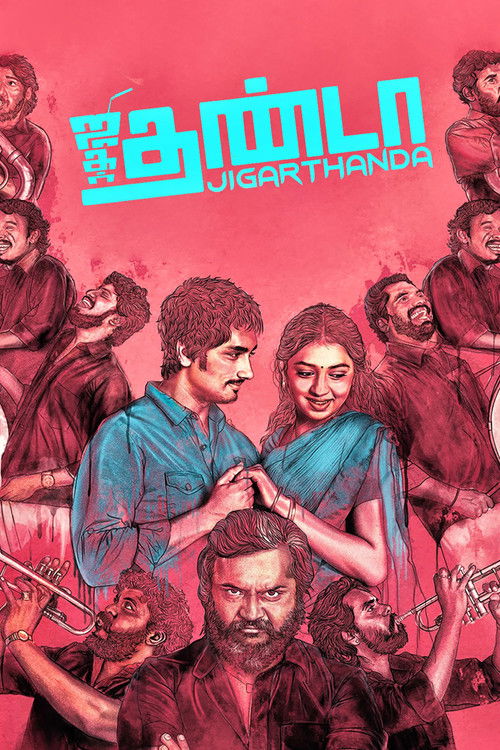
Jigarthanda
2014 · Karthik Subbaraj
For when you want a crime movie with a sense of humor about itself — something twisty and alive that you can't predict, ideally with friends who'll gasp and laugh at the same moments. More rollercoaster than comfort watch.
What it's about
An aspiring director, desperate for his big break, decides his ticket is a brutally realistic gangster film — so he travels to Madurai to secretly study a feared local crime boss up close. His amateur spying goes about as well as you'd expect, and when he's caught, the relationship between the filmmaker and his subject takes turns neither of them saw coming. It's a crime story, a dark comedy, and a love letter to moviemaking all at once.
The experience
Wildly tonal in the best way — genuinely menacing one scene, laugh-out-loud funny the next, with a second half that keeps pulling the rug. Long but propulsive, and it sneaks real feeling in under the swagger.
Performances
Bobby Simha is ferocious and unexpectedly poignant as the gangster Sethu — a career-making, award-winning turn that swings from terrifying to hilarious without breaking the character. Siddharth plays the striving director with just the right mix of ambition and cowardice.
The craft
Karthik Subbaraj directs with a stylist's confidence — bold needle-drops, patient suspense set pieces, and a script that keeps folding the film-within-a-film idea back on itself in clever ways. The Madurai setting is rendered with real texture; the local slang, food, and streets ground every flourish.
Why it matters
A defining film of the post-2010 Tamil new wave that cemented Subbaraj as one of its sharpest genre voices, and hugely influential on the decade's self-aware Indian gangster films — spawning a sequel and a Hindi remake.
Snapshot
Jigarthanda is a Tamil-language crime comedy-thriller that doubles as a fable about cinema itself. Its premise is deceptively simple: an aspiring director, hungry for a breakthrough, decides to make a "realistic" gangster film and goes undercover to study a feared Madurai crime boss — only to be discovered, humiliated, and then, in a reversal that powers the second half, recruited by the very gangster who now wants to become a movie star. The film was Karthik Subbaraj's second feature, following his acclaimed debut Pizza (2012), and it consolidated his reputation as one of the sharpest genre stylists of the post-2010 Tamil "new wave." Named after the iced, milk-based Madurai drink, the title signals the film's rootedness in a specific regional culture even as its subject — the hunger to be seen on screen — is universal. It is best remembered today for Bobby Simha's ferocious, career-making turn as the gangster Assault Sethu, a performance that won him a National Film Award, and for its confident fusion of pulp violence, showbiz satire, and genuine pathos.
Industry & production
Jigarthanda arrived during a fertile moment in Tamil cinema, when a cohort of young directors was proving that tightly budgeted, idea-driven films could break out commercially without the apparatus of superstar vehicles. Subbaraj himself had come up through this ecosystem: Pizza, a low-budget horror-thriller with a twist ending, had been a surprise hit produced within the independent milieu around C. V. Kumar's Thirukumaran Entertainment, and its success earned Subbaraj the latitude to make a more ambitious follow-up. Jigarthanda was a mid-budget, independently financed production rather than a major-studio tentpole; I am not able to confirm the exact producing banner from memory with certainty, so I will leave that detail to the verifiable record rather than assert it. What is clear is that the film was made outside the star-driven blockbuster model, betting instead on concept, structure, and a strong ensemble.
The casting reflects that bet. Siddharth, an actor with an established profile across Tamil, Telugu, and Hindi cinema, took the ostensibly leading role of the director Karthik — a somewhat self-effacing, reactive protagonist. The film's real gamble was elevating Bobby Simha, then a supporting player, to the volcanic central antagonist-turned-collaborator. Lakshmi Menon played the female lead, and comedian Karunakaran provided a running comic register. The production was shot substantially in and around Madurai, whose specific streetscapes, temples, and working-class geography are essential to the film's texture and are not interchangeable with the more frequently filmed Chennai.
Technology
Jigarthanda was produced and finished digitally, in line with the standard workflow of Tamil features by the mid-2010s, when digital acquisition and DI (digital intermediate) color grading had become near-universal for films of this scale. I do not have reliable knowledge of the specific camera system used, so I will not name one. What the technology enabled, however, is visible on screen: a heavily stylized, saturated grade that pushes the gangster world toward neon and shadow, and the flexibility to move fluidly between the naturalistic handheld observation of the "research" scenes and the more composed, genre-inflected imagery of the crime plot. The film's aesthetic ambitions — its self-conscious play with the look of "movie" reality versus lived reality — are inseparable from a digital finishing pipeline that let Subbaraj and his cinematographer sculpt tone in post.
Technique
Cinematography
The photography, credited to Gavemic U. Ary, is one of the film's defining pleasures, and it works because it is keyed to the story's central irony: a film about the gap between real menace and cinematic menace. The camera treats Madurai as a character, using its temple-town density, narrow lanes, and hard sunlight to ground the crime world in place. Against that, the gangster material is stylized — low angles, expressive color, and framings that self-consciously quote the visual grammar of the gangster genre. This tension is deliberate: when the film is "observing" reality it adopts a looser, more documentary posture; when it tips into the world Assault Sethu wants to inhabit, it becomes glossier and more heightened. The result is a movie that lets its own images comment on the difference between fear and its performance.
Editing
Cut by Vivek Harshan — a frequent Subbaraj collaborator who also edited Pizza — the film is structured around a decisive tonal pivot roughly at its midpoint, and the editing is what makes that hairpin turn land. The first movement builds dread and comedy in tandem as Karthik's covert surveillance repeatedly courts disaster; the second reorients the entire enterprise once Sethu's ambition is unleashed. Harshan's cutting sustains the thriller's suspense in the early stretches and then modulates into the more farcical, showbiz-satire rhythm of the back half without letting the film feel like two disconnected pictures. Twist construction is a Subbaraj signature, and the editing is engineered to withhold and then reveal information at maximum effect.
Mise-en-scène / staging
The staging draws a sharp line between two worlds: the grimy, lived-in criminality of Madurai and the artificial, aspirational space of filmmaking. Sethu's domain is dressed with the iconography of small-city gangsterdom, while the film-within-the-film sequences let Subbaraj stage cinema-about-cinema — sets, cameras, and the paraphernalia of production become part of the décor. The recurring motif of watching — Karthik surveilling Sethu, Sethu later demanding to be watched — is built into the blocking, with characters repeatedly positioned as observers and observed.
Sound
Sound and, above all, music are central to Jigarthanda's identity; the film even carries "Music" among its genre tags for good reason. Santhosh Narayanan's score and songs are not decorative but structural, driving tone shifts, punctuating violence, and lending the gangster world an operatic charge. Narayanan, who had also scored Pizza, was at this point emerging as one of the most distinctive composers of his generation, and Jigarthanda is often cited among his signature early works. The soundscape swings between menace and irony in step with the narrative's genre modulations.
Performance
Bobby Simha's Assault Sethu is the film's engine and its legacy. The performance is frightening in the first half — coiled, unpredictable, capable of sudden brutality — and then, remarkably, becomes funny and even poignant as Sethu's childlike craving for stardom is exposed, without ever losing its danger. It is a genuinely two-phase characterization, and the fact that Simha won the National Film Award for Best Supporting Actor for the role speaks to how fully realized it is. Siddharth plays the counterweight: a more passive, morally compromised figure whose ambition curdles into exploitation, a deliberately less flashy turn that gives Simha room to detonate. Karunakaran supplies comic ballast, and Lakshmi Menon anchors the film's emotional and romantic register.
Narrative & dramatic mode
Structurally, Jigarthanda is a film of two halves joined by a reversal — a mode Subbaraj favors. The first half operates as a suspense-comedy of infiltration: the low-status artist trying to steal the truth of a dangerous man. The second half inverts the power dynamic into a satire of the film industry, as the gangster's desire to be immortalized on screen makes him, paradoxically, vulnerable to the filmmaker. The dramatic irony is layered: we watch a man make a movie about a criminal, while the criminal tries to author his own myth, while the film we are watching quietly interrogates both. This meta-cinematic reflexivity — cinema about the making of cinema, and about the seductive, corrupting power of being filmed — is the film's deepest structural idea, and it is executed with pulp energy rather than academic solemnity.
Genre & cycle
The film is an unusually clean example of genre hybridity: it is simultaneously a gangster picture, a backstage showbiz satire, a comedy, and a thriller, with music as a load-bearing element. It belongs to a broader Tamil cycle of the early-to-mid 2010s in which younger directors reworked crime and thriller templates with formal cleverness and tonal daring — the milieu that Pizza had helped inaugurate. Within the gangster tradition specifically, Jigarthanda is notable for refusing straight glorification: it treats the gangster both as a figure of real terror and as a figure hungry for the flattering lie that cinema tells about men like him.
Authorship & method
Jigarthanda is a defining early statement of Karthik Subbaraj's authorship. Across his filmography, Subbaraj is identifiable by a set of recurring preoccupations: twist-driven, bifurcated structures; genre fusion; a deep cinephilia that turns filmmaking itself into subject matter; and a fascination with obsession and ambition. Here those signatures are already fully formed. The film also showcases his method of building around a strong central conceit and a bravura antagonist rather than a conventional hero.
Crucially, the film reflects Subbaraj's collaborative core team, several of whom recur across his work: composer Santhosh Narayanan, whose music is arguably co-authorial in shaping the film's tone; editor Vivek Harshan, whose cutting realizes the twist architecture; and cinematographer Gavemic U. Ary, whose photography stages the reality-versus-cinema divide. Subbaraj wrote as well as directed, and the screenplay's tight engineering of reversal and reveal is central to its effect. The through-line of these collaborations is a director who treats structure, music, and image as a single integrated design.
Movement / national cinema
The film sits squarely within the resurgence of Tamil cinema's independent and mid-budget sector in the 2010s — a movement in which directors like Subbaraj demonstrated that regional, culturally specific stories with formal ambition could succeed commercially. Its Madurai setting is itself a statement: Tamil cinema has a strong tradition of Madurai-set films with their own idiom of masculinity, violence, and speech, and Jigarthanda both draws on and gently satirizes that tradition. The film is thus doubly national and regional — a product of a specific Tamil moment and a specific south Tamil Nadu locale.
Era / period
Set in the contemporary present of its making, Jigarthanda is very much a film of the mid-2010s: it presupposes a media landscape in which everyone understands the currency of fame and the machinery of movie-making, which is precisely what makes the gangster's yearning for stardom legible. The film captures a moment when Tamil cinema was newly confident about reflexivity and genre play, and when a supporting actor could still be launched to national recognition through a single well-written role.
Themes
The governing theme is the seductive, distorting power of cinema — the way the promise of being seen can turn even a killer into a supplicant, and the way an artist's ambition can slide into exploitation. Closely bound to this is the gap between reality and representation: the film that Karthik sets out to make (truthful, dangerous) and the film Sethu wants to star in (flattering, mythic) are at war throughout. Ambition and its costs form a second axis — both men chase a version of glory, and neither emerges clean. There is also a persistent interrogation of masculinity and violence, treated with enough affection to be funny and enough clarity to be critical. Finally, the film is about authorship itself: who gets to tell a story, who is told, and what is lost in the translation from life to screen.
Reception, canon & influence
Jigarthanda was widely praised on release for its originality, its tonal control, and above all Bobby Simha's performance, and it is now generally regarded as a landmark of 2010s Tamil cinema and as the film that confirmed Subbaraj — after Pizza — as a major directorial voice. Simha's National Film Award for Best Supporting Actor is the film's most concrete critical honor; beyond that specific accolade I will avoid asserting particular box-office figures or additional prizes I cannot verify from memory. The consensus, however, is that the film was both a critical and popular success and that it enjoys enduring cult and canonical standing.
Looking backward, the film's influences are legible: the international gangster tradition and its self-aware, tonally playful post-Tarantino descendants; the long lineage of movies about movie-making and the corrupting glamour of fame; and the specific Tamil tradition of Madurai crime cinema, which supplies both texture and target for satire. Subbaraj's declared cinephilia sits behind all of this — Jigarthanda is a film made by someone who loves and distrusts movies in equal measure.
Looking forward, its influence runs along two clear lines. Within Subbaraj's own career, it established the template — genre fusion, structural reversal, cinema-about-cinema — that he would elaborate across subsequent films, and it fed directly into Jigarthanda DoubleX (2023), a period companion piece that returns to the same thematic terrain of gangsters, filmmaking, and the moral power of the image. More broadly, it contributed to a climate in Tamil cinema in which reflexive, genre-blending, idea-first filmmaking became commercially viable, and it remains a touchstone reference point for films about the collision of crime and cinema. Its most lasting single legacy may simply be Assault Sethu — proof that a supporting role, written and played without compromise, can outlast the film that contains it.
Reception
A hit with critics and audiences on release, it quickly graduated from 'promising second film' to being cited as one of the defining works of the 2010s Tamil new wave — the film that announced Karthik Subbaraj as a major voice.
How Jigarthanda was received, from release to now →
How to watch Jigarthanda: what to notice on a first viewing
- Watch for shots that turn glossy and low-angled around Sethu. Karthik Subbaraj and cinematographer Gavemic U. Ary shoot the real gangster world loose and documentary-like, then turn glossy and stylized whenever the film enters the version Sethu wants to star in. The camera argues that Sethu's danger and Sethu's stardom are two different things wearing the same face.
- Track who is watching whom in every scene. Karthik spies on Sethu to research him, and the blocking keeps returning to people positioned as observers and the observed, on both sides of the camera. The film is about the hunger to be seen, and it makes watching itself the plot.
- Listen for how the score shifts under a scene's mood. Santhosh Narayanan's music doesn't just decorate scenes, it drives the tonal swings, tipping a moment from comic to menacing or back before the dialogue catches up. The music is doing narrative work that the images and dialogue leave undone.
- Watch Bobby Simha's face when Sethu isn't performing menace. Simha plays Assault Sethu as genuinely frightening, but Subbaraj keeps finding beats where something needier and more childlike flickers under the threat. A gangster's fear-based power and his hunger to be adored turn out to be close cousins.
- Notice how fast a scene can flip from comedy to violence. Subbaraj fuses a gangster picture, a showbiz satire, comedy, and thriller, letting tone swing hard within a single scene rather than settling into one genre. Genre-mixing this deliberate isn't indecision, it's the film keeping you off balance on purpose.
The whole guide to watching Jigarthanda, with the keys for a rewatch →
Influences: the films it descends from and the films it influenced
- 8½ (1963) — Established the cinema-about-cinema engine in which a blocked director's creative crisis IS the plot — the model for building a film around the act of trying to make one rather than around a hero.
- Sullivan's Travels (1941) — Pioneered the tonal-whiplash structure of a filmmaker who leaves comfort to seek 'authentic' underclass material, swinging from farce to sudden brutality — the exact register-shifting Subbaraj uses when comedy curdles into gang violence.
- The King of Comedy (1983) — Supplies the deluded-aspirant protagonist who invades a powerful man's world to manufacture his own fame, sustaining discomfort-comedy where the audience can't tell ambition from delusion.
- Man Bites Dog (1992) — The template for 'the power of being filmed': a crew embeds with a killer who performs for the lens, the camera implicating both subject and makers — Jigarthanda's core conceit of a gangster seduced by his own image.
- Pulp Fiction (1994) — Source of the post-Tarantino gangster idiom Jigarthanda both deploys and satirizes: needle-drop tonal counterpoint, garrulous menace, and pop-reflexive dialogue as a mode of staging crime.
- Get Shorty (1995) — Directly models the crime-meets-cinema plot machine — a mobster who wants a movie made — turning the collision of the underworld and the film industry into narrative structure.
- Nayakan (1987) — Set the Godfather-descended template of the Tamil gangster as tragic mythic figure, the very iconography against which Assault Sethu is written and comically inverted.
- Subramaniapuram (2008) — Codified the Madurai crime-cinema texture — period grit, local dialect, friendship curdling into sudden knife violence — that Jigarthanda both borrows for authenticity and lampoons as the 'real' its filmmaker chases.
- Aaranya Kaandam (2011) — The Tamil New Wave neo-noir that legitimized structurally ambitious, tonally cool gangster filmmaking with Santhosh Narayanan's genre-bending score — the immediate craft climate Jigarthanda extends.
- Pizza (2012) — Subbaraj's own debut establishing his signature twist-architecture and reveal engineering — the rug-pull screenplay mechanics he refines and doubles here.
- Pudhupettai (2006) — A meta-gangster film that foregrounds the ugly authenticity of the real underworld against filmi glamour, carrying forward Pudhupettai's de-heroization as explicit subject.
- Soodhu Kavvum (2013) — Extends the Tamil dark-comedy-crime register with a Santhosh Narayanan score and Bobby Simha carrying comic-menace from a gangster ensemble, continuing the caper-satire tone.
- Jigarthanda DoubleX (2023) — Direct period companion piece returning to the gangster-and-filmmaking terrain, again staging the moral power of the image and the corrupting glamour of being put on screen.
- Super Deluxe (2019) — Extends the reflexive, genre-blending, idea-first Tamil filmmaking Jigarthanda helped make commercially viable, treating structure and tonal collision as the primary authorial statement.
- Vada Chennai (2018) — Carries forward the ambitious, non-linear, structurally layered Tamil gangster epic within the same New Wave crime lineage, using chronological fracture as a reveal device.
- Petta (2019) — Applies Jigarthanda's genre-fusion and mid-film structural reversal inside a mass-hero star vehicle, proving the twist-and-fuse method scales to commercial spectacle.
- Living in Oblivion (1995) — Mines the same comedy of low-budget filmmaking chaos — the yawning gap between a director's cinematic ambition and the humiliating reality of the set — that fuels Karthik's arc.
- Bowfinger (1999) — Builds its comedy on guerrilla filmmaking around a subject manipulated into a movie he doesn't fully control — the same con of shooting a real dangerous man as raw material.
- Vikram Vedha (2017) — A Tamil neo-noir pairing a director-outsider with a gangster played by Vijay Sethupathi in contrasting comic-menacing registers — the same anti-hero performance calibration Sethupathi brings to Vedha.
Similar films
- Jigarthanda DoubleX (2023) — influence & lineage
- Aaranya Kaandam (2011) — influence & lineage
- Vada Chennai (2018) — influence & lineage
- Super Deluxe (2019) — influence & lineage
- Vikram Vedha (2017) — shared sensibility
- Maharaja (2024) — shared sensibility
- Pudhupettai (2006) — shared sensibility
- Soodhu Kavvum (2013) — shared sensibility