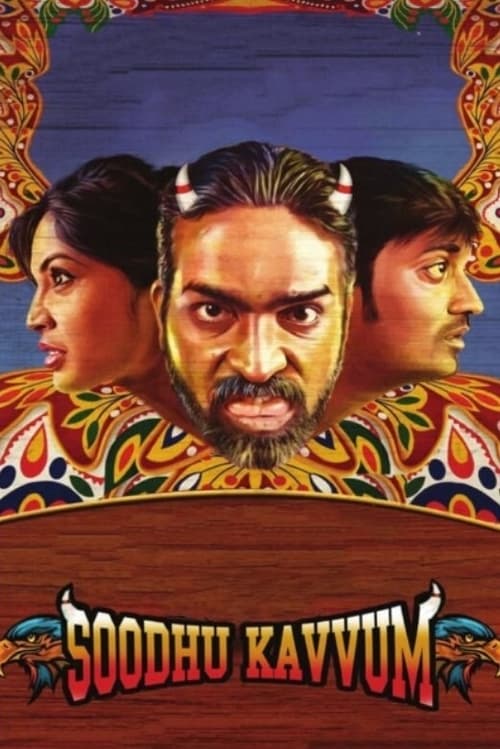
Soodhu Kavvum
2013 · Nalan Kumarasamy
When you want to laugh at crime going wrong — a hangout comedy with caper momentum, ideal for a group watch or a night when you want clever fun with zero heaviness. Pure comfort with a wicked edge.
What it's about
Das is a small-time kidnapper who treats abduction like a modest trade, complete with a personal code — rule one: never touch the children of powerful people. Three broke, jobless young men fall in with him, the crew takes one lucrative job that breaks the golden rule, and suddenly they're tangled up with politicians and hunted by a genuinely unhinged police officer.
The experience
Deadpan, absurd and consistently funny — a caper where every plan is slightly too stupid to work and the film knows it. It's breezy and quotable, with a streak of dark, cheerful amorality that keeps you grinning through the chaos.
Performances
Vijay Sethupathi is the engine: his unhurried, blank-faced sincerity as a kidnapper with principles — and an imaginary girlfriend he treats as entirely real — is a masterclass in playing absurdity dead straight.
The craft
Nalan Kumarasamy's debut script is the star — tight, twisty plotting where every gag pays off and the tone stays affectionately amoral without turning mean. Made cheap and shot loose, it proves that in comedy, writing and timing beat budget every time.
Why it matters
A signature film of the early-2010s Tamil new wave of low-budget, content-first genre cinema, it minted Vijay Sethupathi as the movement's defining star and made the dark caper a viable mainstream mode in Tamil film.
Snapshot
Soodhu Kavvum is a Tamil-language dark comedy–crime caper, the debut feature of writer-director Nalan Kumarasamy, released in May 2013. It follows Das (Vijay Sethupathi), a methodical small-time kidnapper who lives by a personal code — chiefly, never to abduct the children of the powerful — and the three unemployed young men who become his accomplices. When the crew breaks Das's cardinal rule and takes on a lucrative job entangled with politicians, they find themselves pursued by a volatile police officer and caught in a widening web of double-crosses. The film became one of the signature titles of the early-2010s Tamil "new wave" of low-budget, content-driven genre cinema, prized for its deadpan absurdism, its unusually amoral yet affectionate tone, and its confirmation of Vijay Sethupathi as the movement's defining star. Its title — colloquially, that gambling or vice will devour those who chase it — announces the moral-comic engine beneath the caper: greed as a trap that swallows the greedy.
Industry & production
The film was produced by C. V. Kumar under his Thirukumaran Entertainment banner, and its production context is inseparable from its meaning. In the years immediately preceding it, Kumar had positioned Thirukumaran as the central incubator of a Tamil low-budget movement, backing debut and early-career directors on modest budgets with an emphasis on script over star power — a slate that includes Attakathi (2012), Pizza (2012), and Mundasupatti (2014). Soodhu Kavvum sits at the heart of that cycle. It was made economically, on a compact schedule and largely on Chennai locations, with a young cast whose fees were commensurate with the small-film economics of the moment.
Nalan Kumarasamy came to the feature through the short-film route rather than the traditional assistant-director apprenticeship, having emerged from a televised directing competition — a pathway that, together with Thirukumaran's willingness to bet on untested voices, typifies how the new wave recruited talent outside established studio hierarchies. The commercial outcome is well attested in outline if not in audited figures: the film was a clear success relative to its small outlay, and it is routinely cited as one of the modest-budget titles that proved the viability of the movement's economics. Precise, verifiable box-office numbers for the film are not something I can responsibly quote, and readers should treat any single hard figure with caution; the safer historical claim is that it returned a healthy profit on a small investment and became a word-of-mouth hit.
Technology
Soodhu Kavvum was made at the point when Tamil independent production had largely completed the transition to digital acquisition, and it belongs to that first generation of new-wave films whose very existence depended on the lower cost and flexibility of digital capture. The digital workflow is part of what made the film's economics possible: compact camera packages, location-heavy shooting in real Chennai apartments, bars, and streets, and a post-production pipeline geared to a small budget. There is no evidence that the film pursued technological spectacle — no large-scale visual effects, no elaborate stunt technology — and it would be a mischaracterization to frame it as a technically ambitious production in that sense. Its innovations are those of craft and writing rather than apparatus. The one domain where technology and aesthetics visibly meet is the sound and music production, where contemporary digital recording and a genre-fluent electronic-inflected score gave a small film a polished, urban sonic surface disproportionate to its budget.
Technique
Cinematography
The photography (credited to Dinesh Krishnan) serves the comedy rather than upstaging it. The visual approach is clean, controlled, and observational: compositions that hold on characters long enough for deadpan reactions to land, and a restrained camera that treats absurd events with a straight face. The film's humor depends heavily on tonal understatement, and the cinematography supports this by declining to over-signal the jokes — situations are framed matter-of-factly, so that the gap between the criminal enterprise's mundane presentation and its escalating chaos becomes the source of comedy. The Chennai settings are rendered as ordinary, lived-in spaces rather than glamorized backdrops, reinforcing the film's grounding in a recognizable lower-middle-class milieu.
Editing
The editing is central to the film's comic and narrative architecture. The screenplay is a nested, reversal-driven caper in which apparently simple events turn out to be staged, and later revelations recontextualize earlier scenes; the cutting has to manage this machinery so that surprises pay off without confusing the audience. Comic timing here is an editorial achievement as much as a performance one — the film repeatedly builds gags on the beat of a cut, on the withheld reaction, or on the abrupt juxtaposition of the criminal and the banal. The pacing sustains a caper's forward momentum while leaving room for the character digressions and running jokes that give the film its texture.
Mise-en-scène / staging
The film's world is deliberately small and specific: cramped apartments, neighborhood bars, unremarkable streets. Within these ordinary spaces, Kumarasamy stages a densely plotted crime story, and much of the comedy arises from the friction between the ordinariness of the settings and the criminality of the action. Props and running visual motifs — the paraphernalia of a low-rent kidnapping operation, the domestic clutter of the young men's shared life — anchor the absurdism in the mundane. The staging favors ensemble configurations, keeping the four principals in frame together so their contrasting temperaments can play off one another.
Sound
Sound design and, above all, music are among the film's most distinctive elements. Composer Santhosh Narayanan — then early in a career that would make him one of the movement's signature musical voices — supplies a score and songs that blend contemporary, electronically textured arrangements with a playful sensibility matched to the film's tone. The soundtrack was itself a component of the film's popularity, with its songs circulating widely and reinforcing the film's cool, youthful, urban identity. The music does not merely decorate scenes; it participates in the tonal control, lending stylish momentum to sequences whose on-screen content is petty, seedy, or violent, and thereby sharpening the comic irony.
Performance
Performance is the film's beating heart. Vijay Sethupathi's Das is a study in unhurried, low-key charisma — a criminal who is neither glamorized nor moralized against, played with a naturalism that makes his absurd code of conduct feel entirely reasonable to him. Around him, an ensemble of then-emerging actors builds a gallery of eccentrics: the three young accomplices are differentiated by comic temperament (including a memorable strain of delusion and idealism among them), and the film's most-cited supporting turn is the unhinged, self-dramatizing police officer played by Bobby Simha, whose volatility supplies both menace and farce. The performances share a crucial discipline — they play the ridiculous with total conviction, never winking at the audience, which is precisely what allows the film's absurdism to read as comedy rather than caricature.
Narrative & dramatic mode
The film operates in the mode of the black-comic caper: a crime story whose engine is a scheme, whose pleasure is the reversal, and whose ethical stance is ironic detachment. Its dramaturgy is built on rules and their violation — Das's code establishes the premise, and the plot is set in motion the moment that code is broken. From there the narrative proceeds through layers of deception, revealing that events the characters (and the audience) took at face value were orchestrated, and folding political intrigue into the small-time crime plot. The mode is essentially comic-fatalistic: characters pursue money and are punished, rescued, or ruined by forces larger and more chaotic than themselves. Interwoven is a low-key romance (Das and a young woman he becomes involved with) that humanizes the caper without softening its cynicism. The tone holds violence, farce, satire, and sentiment in a single register — a balancing act that is the film's principal formal accomplishment.
Genre & cycle
Soodhu Kavvum is a hybrid: crime film, black comedy, and political satire braided together. It belongs unmistakably to the early-2010s Tamil new wave — the cluster of low-budget, genre-literate films by first-time or early-career directors that reoriented mainstream Tamil cinema away from the star-vehicle template toward writing-driven, tonally adventurous work. Within that cycle it is a leading example of the dark-comedy strain, sitting alongside genre experiments such as the anthology-thriller and neo-noir films that Thirukumaran and its contemporaries were producing in the same window. It also participates in a broader regional appetite for the crime-caper and the amoral-antihero comedy, but its specific flavor — deadpan absurdism grounded in a recognizable Chennai underclass, laced with satire of politics and policing — is characteristic of this particular Tamil moment rather than of any imported template.
Authorship & method
As writer-director, Nalan Kumarasamy is the film's decisive author, and Soodhu Kavvum announces a sensibility built on tonal control: the ability to sustain deadpan comedy across genuinely dark material without collapsing into either grimness or slapstick. His method here is script-first — the film's reputation rests on its screenplay's construction (its rule-based premise, its reversals, its ensemble of vivid eccentrics) and on dialogue and character comedy rather than on visual spectacle. That authorial signature is inseparable from his key collaborators. Composer Santhosh Narayanan is arguably the most important of them, contributing a musical identity that became part of the film's brand and reflecting the close director-composer partnerships characteristic of the movement. Cinematographer Dinesh Krishnan and the film's editor translate the screenplay's tonal demands into precise comic timing and legible plotting. Standing behind all of them is producer C. V. Kumar, whose curatorial role — selecting the project, protecting its offbeat tone, and financing it within a sustainable small-film model — makes him a genuine authorial presence in the new-wave sense, closer to a creative producer than a passive financier. The record on some individual technical credits in English-language sources is thinner than for a major studio film, and where I am less than certain of an exact credit I have said so rather than assert it.
Movement / national cinema
The film is a canonical artifact of the Tamil new wave (or "small film" movement) that crystallized around 2011–2014. That movement's defining features — modest budgets, digital production, debut directors, genre experimentation, morally ambiguous protagonists, urban lower-middle-class settings, and a refusal of the star-first economics of mainstream Kollywood — are all present in Soodhu Kavvum. It belongs, too, to the specific institutional story of Thirukumaran Entertainment as the movement's most influential incubator. More broadly, the film is an index of a shift in Tamil (and by extension South Indian) cinema toward writer-driven, content-led filmmaking that could succeed commercially without conventional star vehicles — a shift that reshaped the industry's sense of what a viable film could look like.
Era / period
Soodhu Kavvum is very much a film of its precise moment: post-digital-transition, early-2010s Tamil cinema, when a generation of young filmmakers and audiences hungry for fresher genre fare converged with producers willing to underwrite them cheaply. Its texture — its music, its youthful ensemble, its cynicism about politics and policing, its milieu of unemployed young men scheming for money — reflects the anxieties and idiom of urban Tamil youth culture of the early 2010s. It arrived at the leading edge of a wave that would crest over the following two or three years, making it both a period document and a trendsetter.
Themes
The film's governing theme is greed and its consequences, encoded in the title itself: the pursuit of easy money as a trap that consumes those who chase it. Around that spine cluster several others. There is a satire of power — of politicians and of policing — in which the ostensibly criminal protagonists appear almost principled beside the corruption and derangement of the officially powerful. There is the theme of the code: Das's self-imposed moral rules give the film its structure and its ethical irony, dramatizing how personal honor systems collapse under the pressure of temptation. There is the disillusionment of youth — unemployment, aimlessness, and the lure of shortcuts — rendered comically but with real social grounding. And there is a recurrent motif of delusion and coping, expressed through the eccentric interior lives of the characters, which lets the film treat mental fragility as both comedy and pathos. Underlying all of it is a fatalistic, absurdist worldview: a sense that schemes spiral beyond control and that the universe of the film is governed less by justice than by chaos and irony.
Reception, canon & influence
Critically, Soodhu Kavvum was received as a breakthrough — praised for its originality of tone, the sophistication of its screenplay, its performances (Sethupathi's above all, with Bobby Simha's supporting turn singled out), and Santhosh Narayanan's music. It was widely embraced as one of the freshest Tamil films of its year and quickly entered the informal canon of the new wave as a reference point for how to do dark comedy in Tamil. It also functioned as a career-defining film: it consolidated Vijay Sethupathi's rise into one of the movement's most important stars and helped launch or elevate several of its collaborators.
Looking backward, the film's influences are less a matter of specific cited sources than of a shared genre vocabulary — the international tradition of the black-comic crime caper and the amoral-antihero comedy, filtered through the sensibilities of a director working in the Tamil idiom. The English-language record does not, to my knowledge, document a precise lineage of named models the director acknowledged, so it is more accurate to place the film within that broad genre inheritance than to claim direct, specific antecedents.
Looking forward, its legacy is substantial. It stands as one of the titles that validated the low-budget, content-driven model and thereby encouraged producers and audiences to support offbeat genre filmmaking. It reinforced Thirukumaran Entertainment's reputation and the viability of its curatorial approach. It contributed to the ascendance of its central talents across the subsequent decade of Tamil cinema. And it helped establish dark comedy as a commercially respectable register in a film culture long dominated by other modes. Its enduring status as a fan favorite and a frequently cited example of the new wave's achievements is the clearest measure of its influence; where later projects have sought to extend or revisit its world, that continued interest testifies to the durability of the original's reputation.
Reception
A low-budget sleeper hit that critics loved on release in 2013, it has only grown in stature since — a decade on, it's routinely ranked the gold standard of Tamil dark comedy and a cornerstone of the 2010s Tamil new wave.
How Soodhu Kavvum was received, from release to now →
Influences: the films it descends from and the films it influenced
- Big Deal on Madonna Street (1958) — Established the bungling-amateur-gang caper template in which an elaborately planned heist collapses into farce through the sheer incompetence and eccentricity of its members — the structural engine of Soodhu Kavvum's rule-bound kidnappers.
- The Ladykillers (1955) — Ealing's model of playing homicide and a 'foolproof' criminal scheme as deadpan black comedy, letting the ensemble of mismatched crooks — not the violence — drive the humor.
- Fargo (1996) — A kidnapping-for-ransom plot staged in a drab, mundane milieu and played with observational restraint, where amateurish criminals are sprung by their own greed — the exact tonal register of greed-as-trap Soodhu Kavvum works in.
- Pulp Fiction (1994) — Codified the nonlinear reversal structure and the hitmen-as-ordinary-men deadpan dialogue comedy — criminals discussing banalities — that Soodhu Kavvum's underplayed ensemble scenes inherit.
- Lock, Stock and Two Smoking Barrels (1998) — Built the interlocking-ensemble caper as clockwork: separate criminal schemes converging toward a rug-pull payoff, propelled by score-driven comic timing.
- In Bruges (2008) — Demonstrated sustaining deadpan comedy across genuinely dark, violent material without collapsing into grimness or slapstick — the precise tonal-control problem Nalan Kumarasamy solves.
- Snatch (2000) — The plot conceived as a collision of colliding lowlifes chasing a MacGuffin, with rapid-cut comic momentum and a fatalistic reversal structure.
- Aaranya Kaandam (2011) — The immediate Tamil New Wave predecessor that proved a nonlinear neo-noir with amoral ensemble and black comedy could work in the Tamil idiom, clearing the ground for Soodhu Kavvum's register.
- Subramaniapuram (2008) — Validated the low-budget, content-first model rooted in mundane-milieu realism that the new wave's small-film economics — and Soodhu Kavvum's production — were built upon.
- Panchatanthiram (2002) — Tamil black comedy where a botched scheme spirals via accidental death and frantic cover-up, carrying forward the escalation-and-concealment engine in a modern indie register.
- Jigarthanda (2014) — Extends the Tamil dark-comedy-crime register with a Santhosh Narayanan score and Bobby Simha carrying comic-menace from a gangster ensemble, continuing the caper-satire tone.
- Kadhalum Kadanthu Pogum (2016) — The director's own follow-up applying the same deadpan underplaying, Vijay Sethupathi lead and Santhosh Narayanan score to another scheme-driven, rule-and-violation comic plot.
- Super Deluxe (2019) — Carries the tonal-control-over-dark-material and interwoven-ensemble reversal structure to an anthology form, again anchored by Vijay Sethupathi's deadpan register.
- Mandela (2021) — Extends the deadpan satire-of-power through a mundane-milieu everyman and a system/rule-driven comic structure, inheriting Soodhu Kavvum's tonal recipe for political comedy.
- Pizza (2012) — Shares producer C.V. Kumar / Thirukumaran Entertainment and the same sustainable small-film, twist-driven genre-screenplay model that curated Soodhu Kavvum.
- Attakathi (2012) — Santhosh Narayanan's debut score and the same close director-composer partnership model, in the same movement, that gives Soodhu Kavvum its musical identity.
- Naduvula Konjam Pakkatha Kaanom (2012) — Sibling in method: a deadpan ensemble comedy generated entirely from a single absurd premise, shot in a mundane milieu on the movement's low-budget content-first economics.
- Delhi Belly (2011) — An Indian black-comic caper of ordinary men trapped by a criminal scheme spiraling out of control — the same amoral-antihero comedy of greed as trap in a parallel language cinema.
Similar films
- Super Deluxe (2019) — influence & lineage
- Jigarthanda (2014) — influence & lineage
- Aaranya Kaandam (2011) — influence & lineage
- Vikram Vedha (2017) — shared sensibility
- Nadodikkattu (1987) — shared sensibility
- Pudhupettai (2006) — shared sensibility
- Viduthalai: Part I (2023) — shared sensibility
- Vada Chennai (2018) — shared sensibility