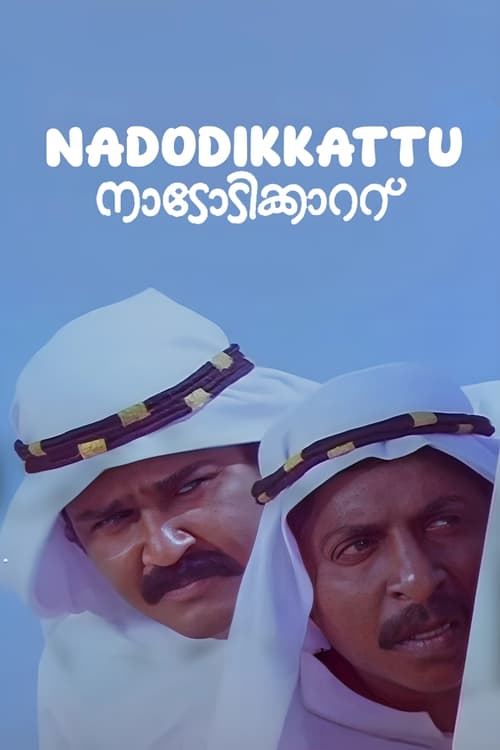
Nadodikkattu
1987 · Sathyan Anthikad
For when you need a proper laugh and a comfort watch that still has something on its mind — perfect for a low-stakes evening, alone or with family. Zero challenge, maximum charm.
What it's about
Dasan and Vijayan are two educated, hopelessly unemployed friends in 1980s Kerala who pool everything they have to escape to the riches of Dubai — and get swindled into landing in Chennai instead. Broke in a strange city, they stumble through odd jobs and mistaken identities until a chain of misunderstandings tangles them up with smugglers and worse. It's a buddy comedy where the real villain is joblessness itself.
The experience
Warm, fast, and endlessly quotable — broad slapstick riding on a current of real economic frustration, so the laughs have a bittersweet edge. It's the kind of comedy that feels like hanging out with old friends.
Performances
Mohanlal's timing as Dasan is effortless — one of the roles that defined his everyman comic genius — and Sreenivasan, who also wrote the film, is the perfect deadpan foil as Vijayan; their chemistry carried a whole franchise.
The craft
Sreenivasan's script is the engine: sharp social observation smuggled inside farce, with dialogue so precise that lines from it passed into everyday Malayalam speech. Sathyan Anthikad directs with an unfussy warmth that keeps the satire humane rather than bitter.
Why it matters
One of the most beloved Malayalam films of the 1980s, it became the template for a whole strand of socially observant 'middle cinema' comedy and one of the defining Mohanlal–Sreenivasan collaborations.
Snapshot
Nadodikkattu ("Vagabond Wind") is a Malayalam comedy of unemployment and disillusion, and one of the most durably beloved films the industry produced in the 1980s. It follows two educated but jobless friends, Dasan (Mohanlal) and Vijayan (Sreenivasan), whose scheme to escape a jobless Kerala for the riches of Dubai collapses into farce: cheated by a travel agent, they land not in the Gulf but in Madras (Chennai), where a chain of misunderstandings entangles them with a shadowy employer and a smuggling ring. The film paired two of Malayalam cinema's defining talents of the decade — Mohanlal as star and Sreenivasan as writer-actor — under Sathyan Anthikad, and its blend of broad slapstick with sharp social observation made it a template for a whole strand of "middle cinema" comedy. Its dialogue entered Kerala's everyday speech to a degree few films anywhere achieve, and it launched a recurring Dasan–Vijayan franchise. Where this dossier's record thins — chiefly on below-the-line technical credits and precise commercial figures — it says so rather than inventing detail.
Industry & production
The film belongs to the commercial mainstream of Malayalam cinema at a moment when that mainstream was unusually hospitable to socially observant comedy. By the mid-1980s the industry had settled into a productive middle ground between the art cinema of Adoor Gopalakrishnan and G. Aravindan and pure masala entertainment, and Sathyan Anthikad — often working from Sreenivasan's screenplays — became one of the principal architects of that middle space. Nadodikkattu arrived in 1987 as part of a sustained Anthikad–Sreenivasan run that had begun with Sanmanassullavarkku Samadhanam (1986) and would continue through T. P. Balagopalan M.A., Varavelpu and, at its peak, Sandesham (1991).
Production followed the standard economics of Malayalam cinema of the period: modest budgets, tight schedules, location-heavy shooting split between Kerala and Madras (still the industry's post-production hub), and a reliance on a repertory of familiar character actors. The specific producing banner and several technical credits for Nadodikkattu are not information I can confirm with certainty, and I will not guess at them; what is securely established is the creative nucleus — Anthikad directing, Sreenivasan writing and co-starring, Mohanlal leading, and Shyam composing. The film's commercial success is well attested in its afterlife — it spawned sequels and became a perennial television rerun — but I do not have reliable box-office figures to cite, and offer none.
Technology
Nadodikkattu was made with the standard toolkit of 1980s Indian regional cinema: 35mm color film, single-camera coverage, and post-synchronized sound rather than location sync-sound, which was near-universal practice in Malayalam production of the era. Dialogue, effects and music were all built in post, a technical fact with real aesthetic consequences — it freed the camera on cramped Madras locations and lent the performances the crisp, slightly heightened vocal clarity that made the film's lines so quotable. Color stock and lab work of the period favoured a naturalistic, somewhat flat palette suited to the film's unglamorous milieu of lodging houses, small offices and street corners. There is nothing technologically experimental here; the film's innovations are entirely in writing and performance, and its craft lies in deploying ordinary tools with discipline.
Technique
Cinematography
The visual scheme is functional and unshowy in the manner of Anthikad's cinema generally: the camera serves the actors and the comic geography of a scene rather than calling attention to itself. Framing favours the two-shot and the loose group composition, keeping Dasan and Vijayan in the same frame so their contrasting temperaments — Dasan's relative steadiness against Vijayan's excitable pessimism — play as visual counterpoint. Location work in Madras is used for texture and for the specific comedy of two Malayali fish out of water in a Tamil metropolis. I cannot reliably attribute the cinematography credit and decline to guess; what can be said is that the lighting and lensing are naturalistic, prioritizing legibility of face and gesture over pictorial effect, consistent with the film's grounded register.
Editing
The cutting is paced to dialogue and performance, holding on exchanges long enough for verbal comedy to land and for reaction to register — a rhythm closer to the timing of stage farce than to montage-driven action. Comic set-pieces are built through accumulation: a misunderstanding is planted, allowed to compound, and paid off, with the edit patient enough to let audiences stay ahead of the characters. The film sustains a feature-length plot of mistaken identity without losing clarity, which is itself an editorial achievement given how many crossed purposes it juggles.
Mise-en-scène / staging
Staging is the film's quiet strength. Anthikad places his characters in precisely observed lower-middle-class spaces — the shared room, the employment queue, the small business premises — and choreographs comedy out of the friction between people and their environments. The blocking keeps the central duo physically bound together, underscoring a partnership that is the film's emotional spine. Props and settings do real narrative work: the paraphernalia of the Gulf dream, the trappings of a business that is not what it seems. Nothing is decorative; the world is dressed to be believed, so the farce has something solid to push against.
Sound
As noted, the soundtrack is entirely constructed in post. Shyam's score and songs supply the film's musical identity, while the dubbed dialogue track carries its true payload — Sreenivasan's writing, delivered with a comic precision that made individual lines detach from the film and circulate on their own. The interplay of Malayalam and the Tamil-inflected setting is itself a source of sonic comedy. I will not name specific song titles I cannot verify.
Performance
Performance is where Nadodikkattu is unimpeachably great. Mohanlal, then ascending to the extraordinary run that would define him, plays Dasan with a relaxed naturalism that grounds the film; his gift for making comedy look like ordinary behavior rather than "acting" is fully on display. Sreenivasan, playing Vijayan while also having written the part, gives the film its acid — a figure of educated frustration, quick to complaint and self-pity, whose sourness is both funny and pointed. The two form one of Malayalam cinema's great comic pairings, their chemistry rooted in genuine contrast rather than mere banter. Around them, a deep bench of character actors — Thilakan among them, as the employer Anantan Nambiar — supplies the ensemble texture that Malayalam comedy of this period did better than almost any other Indian cinema.
Narrative & dramatic mode
The film's mode is social comedy sliding into farce. Its engine is the classic farcical mechanism of mistaken identity and escalating misunderstanding: two ordinary men, seeking only a job, are swept into a scheme whose real nature they misread completely, and the plot's pleasure lies in the widening gap between what they believe they are doing and what is actually happening. But beneath the farce runs a steady current of realism. The premise — educated youth unable to find work, staking everything on migration — is not a contrivance but the defining anxiety of a generation of Malayalis, and the film never lets the comedy fully sever from that reality. The result is a tonal doubleness characteristic of the Anthikad–Sreenivasan school: you laugh continuously, but the thing you are laughing at is a genuine social wound.
Genre & cycle
Nadodikkattu sits at the center of the 1980s Malayalam "middle cinema" comedy cycle — films that were commercial and star-driven yet carried real social content, distinct both from art cinema and from formula entertainment. Within that cycle it belongs specifically to the unemployment-and-migration comedy, a recognizable Kerala subgenre nourished by the state's high literacy, chronic joblessness, and the mass exodus of workers to the Persian Gulf. It is also, structurally, a buddy comedy and a fish-out-of-water travel narrative. The film proved generative enough to found its own mini-cycle: the Dasan–Vijayan characters returned in Pattanapravesham (1988) and Akkare Akkare Akkare (1990), making the pair among the few recurring comic protagonists in Malayalam cinema.
Authorship & method
The film is best understood as a collaboration between two authorial sensibilities. Sathyan Anthikad is the presiding director of Malayalam "feel-good realism," a filmmaker whose method is to root comedy in closely observed ordinary life, to trust actors, and to keep technique subordinate to character. Sreenivasan, his most important collaborator here, is the more astringent voice — a screenwriter of unusual social acuity whose scripts diagnose Kerala's contradictions (unemployment, political posturing, class pretension) through characters who are never simply likeable. The tension between Anthikad's warmth and Sreenivasan's cynicism is precisely what gives their shared films their bite; Nadodikkattu is one of the purest expressions of that partnership.
The other securely identifiable authorial contribution is Shyam's music. Mohanlal's stardom is itself a shaping force: the film is built to his register of unforced naturalism. Regarding the cinematographer and editor, I do not have credits I can state with confidence, and I flag that gap rather than fill it with invention.
Movement / national cinema
The film is a product of Malayalam cinema at a high point of its regional distinctiveness. Among India's film industries, Malayalam cinema of the 1980s was singular for how thoroughly its commercial mainstream absorbed the values of realism and social observation — a legacy, in part, of the state's strong film-society culture and its politically literate audience. Nadodikkattu exemplifies the mainstream wing of that sensibility: not the festival art cinema of Adoor or Aravindan, but a popular cinema that nonetheless assumed its audience wanted recognizable life and real subject matter alongside their laughter. In the broader map of Indian national cinema, it stands as evidence of Malayalam film's capacity to make socially serious comedy commercially dominant — something few other industries managed in the same period.
Era / period
1987 places the film in the middle of the decade that made Mohanlal and Mammootty the twin poles of Malayalam stardom and that established the Anthikad–Sreenivasan and Priyadarshan–Mohanlal collaborations as commercial forces. It is a pre-liberalization Kerala film: the Gulf migration it dramatizes was already reshaping the state's economy and social fabric, and the educated unemployment it satirizes was a defining feature of the period's public discourse. The film captures, almost as documentary undertone, a specific moment in Kerala's history — after mass education, before mass prosperity, when Dubai stood as the great imagined escape from a home that could not employ its own.
Themes
The governing theme is unemployment and the indignity it inflicts on the educated. Dasan and Vijayan are not fools or wastrels; they are qualified men whom their society has no use for, and the film's comedy is inseparable from that structural failure. From this flows its second great theme: the Gulf dream — migration as the only available horizon of hope, and the vulnerability it creates to exploitation, embodied in the con that misdirects the heroes' entire venture. Third is the theme of friendship and solidarity: the partnership of the two men is the one asset the film treats as unqualifiedly real amid a landscape of scams and false promises. Running through all of it is a satirical scrutiny of institutions — of a political and economic order that generates aspiration it cannot satisfy. The film's tonal genius is to hold anger and affection together: it is furious about its subject and tender toward its people.
Reception, canon & influence
Nadodikkattu was a major popular success and has only grown in stature since. In the canon of Malayalam cinema it is routinely named among the greatest comedies the industry has produced, and it endures as a fixture of television rerun and of collective cultural memory. Its most extraordinary legacy is linguistic: Sreenivasan's dialogue passed into everyday Malayalam speech, with lines and character names surviving as ready-made references decades after release — a penetration of the vernacular that is the surest measure of a comedy's canonicity, and one few Indian films of any language have matched.
Looking backward, the film draws on the durable traditions of farce (mistaken identity, escalating misunderstanding, the buddy pairing) and on the specifically Malayali realism that the industry's film culture had cultivated; it is the descendant of a cinema that had already learned to fold social observation into popular form. Looking forward, its influence is threefold. It consolidated the Anthikad–Sreenivasan model of socially conscious mainstream comedy, which shaped the industry's output for years. It confirmed the Mohanlal–Sreenivasan comic pairing as a bankable creative unit. And it founded a franchise: the Dasan–Vijayan characters recurred in Pattanapravesham (1988) and Akkare Akkare Akkare (1990), an unusual instance of serialized comic protagonists in Malayalam cinema. More diffusely, it stands as a reference point for every later Malayalam film that has tried to make a nation's economic anxieties funny without making them trivial — proof that a regional popular cinema could be at once hugely entertaining and unmistakably about something real.
Reception
A big hit on release in 1987, it has only grown since — the Dasan-and-Vijayan duo became so beloved that the film turned into a franchise and a permanent fixture of Malayalam pop culture, endlessly rewatched on TV and quoted across generations.
How Nadodikkattu was received, from release to now →
Influences: the films it descends from and the films it influenced
- Kodiyettam (1977) — Established the Malayalam idiom of building a film out of unforced naturalist performance and closely observed ordinary lower-middle-class routine — the observational realism Anthikad domesticates for popular comedy.
- Yavanika (1982) — Proved a Malayalam popular-genre frame could carry sharp diagnostic social observation without collapsing into either pure entertainment or pure message — the 'about something real' balance Nadodikkattu inherits.
- Poochakkoru Mookkuthi (1984) — Calibrated Mohanlal's comic timing and reactive underplaying inside farce, the naturalist-comic register the seed film is built around.
- Boeing Boeing (1985) — Set the template of Mohanlal-anchored mistaken-identity farce driven by escalating misunderstanding and a paired comic foil — the exact mechanics of Dasan and Vijayan's imposture.
- Sanmanassullavarkku Samadhanam (1986) — The founding Anthikad–Sreenivasan–Mohanlal collaboration that fixed the model of socially conscious comedy rooted in a closely observed neighborhood, subordinating technique to character.
- T. P. Balagopalan M.A. (1986) — Directly precedes the educated-unemployment theme, building comedy around an over-qualified, under-employed protagonist played in Mohanlal's naturalist key.
- Gandhinagar 2nd Street (1986) — Perfected the dialogue-paced ensemble comedy staged in shared communal lower-middle-class spaces, the two-shot-blocked observational staging Nadodikkattu extends.
- Pattanapravesham (1988) — Direct franchise sequel that carries the Dasan–Vijayan characters forward, an unusual instance of serialized comic protagonists continuing the same buddy-imposture engine.
- Vadakkunokkiyantram (1989) — Sreenivasan directing his own script pushes his signature technique of the never-simply-likeable protagonist to its purest form, isolating the astringent voice that gave the seed film its bite.
- Akkare Akkare Akkare (1990) — Third franchise entry that transplants the Dasan–Vijayan con-men pairing into a foreign-set caper, proving the two-hander comic unit portable beyond its Kerala setting.
- Sandesham (1991) — The purest later expression of Sreenivasan's social-satire method — political posturing skewered through unlikeable characters — whose dialogue penetrated the vernacular exactly as Nadodikkattu's had.
- Vellanakalude Nadu (1988) — Same Anthikad–Sreenivasan–Mohanlal unit turning educated unemployment and small-enterprise struggle into observational social comedy with an astringent undertow.
- Varavelpu (1989) — Extends the method of making a Gulf-returnee's economic disillusion funny before turning it bitter — comedy about real economic anxiety that refuses to trivialize it.
- Ramji Rao Speaking (1989) — Extends the middle-cinema comedy of ordinary strugglers into a tightly plotted mistaken-identity/kidnapping farce built on a bickering buddy ensemble.
- In Harihar Nagar (1990) — Carries forward the vernacular-quotable, dialogue-driven farce of unemployed young men in an observed locality, with lines passing into everyday Malayalam speech as Sreenivasan's did.
Similar films
- Michael Madana Kama Rajan (1990) — shared sensibility
- Soodhu Kavvum (2013) — shared sensibility
- Bangalore Days (2014) — shared sensibility
- Kadaisi Vivasayi (2022) — shared sensibility
- Velaiyilla Pattathari (2014) — shared sensibility
- Nayakan (1987) — shared sensibility
- Thaniyavarthanam (1987) — shared sensibility
- Manjummel Boys (2024) — shared sensibility