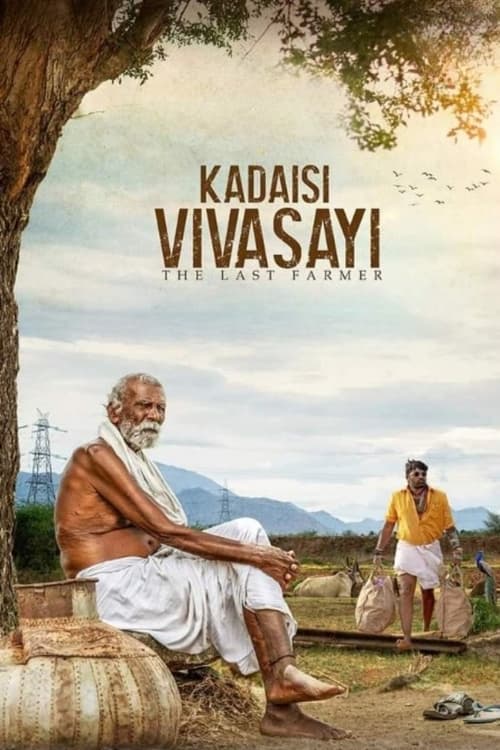
Kadaisi Vivasayi
2022 · M. Manikandan
For when you want something unhurried and soulful — a film to sink into on a quiet evening, more meditation than plot machine. Choose it when you're patient and want to feel connected to something older than yourself.
What it's about
Maayandi is an octogenarian farmer, the last man still working the soil in a Tamil village that has otherwise given up on agriculture. Asked to raise the ceremonial grain for a temple festival, he instead gets tangled in a petty criminal case that lands him, absurdly, in jail — and the village has to reckon with what it's lost while its last farmer sits behind bars.
The experience
Slow, tender, and wry — it moves at the pace of the fields it films, with an undercurrent of gentle absurdist comedy about courts and paperwork colliding with a man who lives by seasons. It leaves you calmed and a little heartbroken at once.
The craft
M. Manikandan wrote, directed, shot, and produced it, and that single sensibility shows: the film watches its landscapes and rituals with a documentary patience, framing farming itself as something beautiful and endangered. The rural textures — light, birdsong, soil — are the point, and they reward an unhurried, distraction-free watch.
Why it matters
Widely embraced as one of the standout Tamil films of its moment, it became a touchstone for an ecological, observational strain of Indian cinema that argues for the countryside without sermonizing.
Snapshot
Kadaisi Vivasayi ("The Last Farmer") is a Tamil-language rural drama written, directed, shot, and produced by M. Manikandan, the filmmaker who arrived internationally with the two-child fable Kaaka Muttai (2014). Its premise is stark and almost parabolic: Maayandi, an octogenarian and the only man still tilling soil in a village that has otherwise walked away from agriculture, is tasked with raising the symbolic grain for a temple festival — and is then swept into a petty criminal case that lands him, absurdly, in jail. The film is best understood as a work of observational social realism cast in the shape of a folk tale: unhurried, tender, ecologically minded, and deeply skeptical of the machinery — bureaucratic, legal, agrochemical — that has hollowed out the Indian countryside. It carries additional weight as a memorial object. Its non-professional lead, an elderly real-life farmer named Nallandi, completed his scenes but died shortly before the 2022 release, so the film survives partly as a record of a face and a way of life that were both vanishing as the camera watched. Critically embraced and a commercial failure, it went on to win the National Film Award for Best Feature Film in Tamil.
Industry & production
The film belongs to a strand of Tamil cinema that sits deliberately at an angle to the mainstream star system while still drawing on its resources. Manikandan developed the script from the mid-2010s; the project passed through several industrial hands — Eros International was attached at an early stage — before Manikandan's own Tribal Arts Production carried it, with Vijay Sethupathi Productions and 7Cs Entertainment involved in distribution. That arrangement is telling: Sethupathi, by then one of Tamil cinema's most bankable and critically respected leads, took a supporting role and lent his production banner to the release, effectively using star capital to shepherd a non-commercial film into theaters. Manikandan was explicit that it should not be marketed as a Vijay Sethupathi vehicle.
Production was unusually patient. Reports describe roughly a year of location scouting across a large number of villages before filming settled in and around Usilampatti in the Madurai region, with principal photography running about 95 days around 2018. The multi-year gap between shooting and the February 2022 theatrical release is partly attributable to the film's independent financing path and to the disruption of the pandemic years. The delay had one irreversible consequence: Nallandi's death before the premiere. The precise production budget and box-office figures are not part of the reliably documented record, and I won't invent them; the consistent characterization in coverage is that the film earned wide acclaim but performed poorly commercially — an outcome entirely typical for slow, star-light rural realism in a market dominated by mass entertainers.
Technology
Kadaisi Vivasayi is a digitally originated feature that uses contemporary tools in the service of an almost anti-technological aesthetic. Manikandan, a cinematographer by training, shoots in naturalistic available and daylight-weighted conditions, favoring the deep, saturated greens of paddy and the dust-and-ochre palette of a dry Tamil Nadu village. The technological story here is less about novel apparatus than about restraint: lightweight digital capture allows long observational takes, real-location shooting far from studio infrastructure, and a documentary responsiveness to non-professional performers and to landscape. The film's sonic construction pairs Tamil folk and devotional idioms with orchestration by an English composer (see Sound and Authorship below), a modest instance of transnational post-production collaboration. Detailed technical specifications — camera systems, lensing, aspect-ratio choices — are not something I can confirm from the public record, so I flag that rather than guess.
Technique
Cinematography
Manikandan photographs his own film, and the visual signature is continuous with Kaaka Muttai: patient, eye-level, and attentive to texture. The camera treats the fieldwork of farming — plowing, sowing, tending, the movement of bullocks and water — as inherently cinematic material worth watching in real duration, rather than compressing it into montage. Landscape is a co-protagonist; wide compositions place the small, stooped figure of Maayandi against expanses of cultivated and fallow land, dramatizing his solitude as the "last" farmer through framing alone. The recurring motif of the dead peacocks — India's protected national bird, found in his field — is handled with a quiet, almost still-life gravity that lets an ecological catastrophe register without editorializing. The photography's realism is not raw; it is composed, with an eye for the dignity of labor and the ordinary beauty of rural light.
Editing
Editing is by B. Ajithkumar, himself an accomplished editor and filmmaker within the Tamil independent scene. The cutting rhythm is deliberately unhurried, built to accommodate the film's contemplative register and its long observational passages. Rather than tightening the narrative into cause-and-effect propulsion, the editing lets scenes breathe to their natural length, allowing agrarian process, ritual, and village conversation to accumulate meaning. This slow-cinema tempo is a structural argument as much as a stylistic one: it asks the viewer to inhabit the rhythms of cultivation and community that the film mourns as endangered.
Mise-en-scène / staging
The staging draws its authority from actuality. Real villages, real farmland, real temple spaces, and largely non-professional performers give the film a documentary density; the frame is populated with the genuine textures of agrarian life rather than art-directed approximations. The temple festival — for which Maayandi must grow the ceremonial grain — organizes the film's spatial and social world, tying individual labor to communal and devotional ritual. Manikandan stages the encounter between the rural individual and institutional power (police, court, the apparatus of a wildlife-protection charge) with a plain, unforced irony: the machinery is neither cartoonishly villainous nor benign, merely indifferent, and the staging lets its absurdity emerge from ordinary procedure.
Sound
The soundscape marries the ambient textures of the countryside — animals, water, wind, the acoustics of open fields and temple grounds — with a score credited to Santhosh Narayanan alongside the English composer Richard Harvey. Narayanan, one of contemporary Tamil cinema's most adventurous composers, is well suited to a project that blends folk and devotional Tamil musical idioms with orchestral color; the Harvey collaboration signals a reach toward a broader, more classically orchestrated palette. The music is used sparingly enough that silence, birdsong, and the sounds of manual labor remain expressive elements in their own right rather than being papered over.
Performance
The film's central gamble is its casting of Nallandi, a real farmer and non-professional, as Maayandi. The performance is not "acting" in the conventional sense so much as authenticated presence: his weathered face, gait, and unforced handling of agricultural tasks supply a truth no trained star could counterfeit, and the film's emotional force is inseparable from that authenticity. His posthumous Special Mention at the National Film Awards recognized precisely this. Around him, Vijay Sethupathi takes the supporting role of Ramaiah, a villager driven to madness by the death of the woman he loved — a part Sethupathi has described as among the most difficult of his career, and one he plays against his star image, submerged into the ensemble. Yogi Babu, a comic actor of considerable popularity, also appears in support, his presence modulated to fit the film's naturalistic key rather than deployed for broad comedy.
Narrative & dramatic mode
The dramatic mode is that of the humanist parable told in a realist register. The plot is deceptively slight — an old man grows grain for a festival; buries dead peacocks he finds; is misread by a witness as having killed the protected birds; is arrested and jailed for fifteen days while his crop, and by extension the festival and the village's continuity with its own traditions, hang in the balance. From this thin thread Manikandan draws a wide-angle meditation on agrarian decline, ecological poisoning (the birds are victims of the chemical regime that has displaced Maayandi's older methods), and the incomprehension between rural life and legal-administrative power. The film resists melodrama and the tidy climaxes of commercial storytelling; its "conflict" is diffuse and systemic rather than personal. The result is closer to fable and elegy than to conventional social-problem drama — a mode in which the individual case (one farmer, one absurd charge) is transparently a synecdoche for a national condition.
Genre & cycle
Formally the film is a rural social-realist drama with strong affinities to slow cinema and to the ethnographic, place-rooted filmmaking that recurs across Indian regional cinemas. Within Tamil cinema it belongs to a lineage of village-set and agrarian films, but it is distinguished by its near-documentary treatment and its refusal of the folkloric-heroic register that often accompanies rural subjects. Thematically it joins a broader body of Indian cinema addressing the farmer's crisis — agrarian distress, indebtedness, and the collapse of traditional cultivation — though Kadaisi Vivasayi approaches that subject obliquely and elegiacally rather than as protest cinema. It also sits comfortably within the international festival-realist idiom, sharing DNA with the observational humanism that runs from Italian neorealism through much of subsequent world art cinema.
Authorship & method
This is thoroughly an auteur work: Manikandan is credited as writer, director, cinematographer, and producer, and the film extends the method established by Kaaka Muttai and continued through Kuttrame Thandanai and Aandavan Kattalai — non-professional or against-type casting, real locations, self-shot naturalism, and a compassionate attention to the socially marginal. His decision to build a feature around a genuine elderly farmer, and to spend a year finding the right village, reflects a documentary ethic underlying the fiction. The key collaborators reinforce that sensibility. Editor B. Ajithkumar brings the patient rhythmic control associated with Tamil independent cinema. Composer Santhosh Narayanan, working here with English composer Richard Harvey, supplies a score that bridges Tamil folk-devotional traditions and orchestral scoring. The distribution partnership with Vijay Sethupathi, who also performs, is itself part of the authorship story: a major star subordinating himself, on screen and as a producer-distributor, to a director's uncommercial vision.
Movement / national cinema
Kadaisi Vivasayi is a product of Tamil (Kollywood) cinema, but of its parallel, festival-and-awards-facing wing rather than its mass-market mainstream. It participates in a wider Indian "new realism" that has recurred across the country's regional film cultures — filmmaking grounded in local specificity, non-professional performance, and social observation. Its lineage runs back to the socially engaged and neorealist-influenced strands of Indian art cinema and to Tamil directors who have used regional, rural, and caste-and-class realities as their material. The film's international recognizability owes to its alignment with a global art-cinema grammar of slow, humanist, place-based storytelling, even as its textures — the temple festival, Murugan worship, Usilampatti's landscape, the Tamil agrarian idiom — are irreducibly local.
Era / period
The film is a creature of the late-2010s-into-2020s moment in Indian cinema, shot around 2018 and released in February 2022 after a long gestation lengthened by the pandemic. It arrives at a time of acute national attention to agrarian distress and, in the years surrounding its release, to farmer mobilization across India; while the film is not topical agitprop, it cannot be separated from that context. It also belongs to a period in which streaming and star-backed distribution reshaped how small, serious films could reach audiences, and in which the National Film Awards continued to function as a validating counterweight to box-office logic — a dynamic that directly shaped this film's afterlife.
Themes
The governing theme is the disappearance of traditional agriculture and, with it, an entire relationship between people, land, faith, and season. Maayandi as "the last farmer" is an elegiac figure for a self-sufficient agrarian order displaced by migration, chemical agriculture, and economic pressures. Interlocking themes follow: ecological harm, crystallized in the poisoned peacocks whose deaths ironically criminalize the one man living in harmony with the land; the collision between rural innocence and an indifferent legal-bureaucratic state, where a compassionate act (burying protected birds) becomes a punishable offense; faith and communal ritual, embodied in the temple festival and Murugan devotion that give the labor its meaning; and, through the Ramaiah subplot, love, loss, and madness as another register of human fragility within the village. Underlying all of it is a meditation on dignity — the dignity of manual labor, of the old, of the poor — and on cultural memory as something actively being lost.
Reception, canon & influence
Critically, the film was warmly received, praised for its authenticity, its humane vision, and Nallandi's irreplaceable presence, even as it failed commercially — the familiar fate of slow rural realism in a star-driven market. Its most durable validation came institutionally: it won the National Film Award for Best Feature Film in Tamil, with a Special Mention for Nallandi, at the 69th National Film Awards, and it drew recognition from critics' awards bodies as well; I'd note that reporting on the finer breakdown of these honors is not always consistent, so the safest claims are the two national wins just named.
Looking backward, the film's influences are the humanist-realist traditions of Indian and world art cinema — neorealism's non-professional casting and location shooting, the observational patience of slow cinema — filtered through Manikandan's own established method from Kaaka Muttai onward and through the specific ethnography of Tamil agrarian life. Looking forward, its legacy is still consolidating, and it would overstate the record to claim a defined "school" descending from it. What can be said is that it stands as a benchmark for star-supported independent realism in Tamil cinema — a demonstration that a major star's production banner can carry an uncommercial, socially serious film to theaters and to national honors — and as an unusually poignant memorial, preserving both an endangered agrarian world and the face of the real farmer who briefly embodied it.
Sources: Wikipedia — Kadaisi Vivasayi, Wikipedia — Nallandi, Wikipedia — M. Manikandan, Outlook India, IMDb news.
Reception
It slipped out quietly — a festival run in 2021, then a small theatrical release in February 2022 — before word of mouth and streaming turned it into one of the most acclaimed Tamil films of its era, now a fixture of best-of-the-2020s conversations in Indian cinema circles.
How Kadaisi Vivasayi was received, from release to now →
Influences: the films it descends from and the films it influenced
- Bicycle Thieves (1948) — Establishes the neorealist template Manikandan revives — casting a non-professional as the lead and staging the entire social drama on real streets rather than sets, letting an ordinary man's small crisis carry the film.
- Do Bigha Zamin (1953) — Imports De Sica's location-and-nonprofessional neorealism directly into Indian cinema through a farmer dispossessed of his land, founding the Indian agrarian-realist strain Kadaisi Vivasayi belongs to.
- Pather Panchali (1955) — Shoots rural life in natural light with village non-professionals, and pairs it with a folk-classical score (Ravi Shankar) that bridges indigenous tradition and orchestration — the same fusion Santhosh Narayanan and Richard Harvey attempt here.
- The Tree of Wooden Clogs (1978) — Casts actual peasant farmers as themselves and structures the film around the seasonal rhythm of agrarian labor in natural light, the endangered-rural-world memorial mode Manikandan adopts.
- Chomana Dudi (1975) — Kannada parallel-cinema study of a landless laborer's bond to soil, shot on real locations as social realism — a direct South Indian precedent for centering an agrarian marginal figure.
- Manthan (1976) — Indian parallel-cinema rural ethnography built with village non-professionals and a documentary attention to farmers' collective economic life, the socially-serious method later Tamil realism inherits.
- Thaneer Thaneer (1981) — The Tamil precedent for village social realism — a near-documentary ensemble dramatizing a rural water crisis, proving Tamil cinema could carry uncommercial agrarian subject matter.
- Elippathayam (1981) — Applies slow-cinema patience and contemplative long-take pacing to the decline of a feudal-agrarian order in South Indian art film, the formal restraint Manikandan and editor B. Ajithkumar practice.
- The Turin Horse (2011) — Distills slow cinema to the endurance of rural labor in extended takes with ambient wind as near-constant sound and landscape as an oppressive protagonist — the observational-long-take/ambient-naturalism extreme this film gestures toward.
- Kaaka Muttai (2014) — Establishes Manikandan's own signature that this film extends — self-shot naturalism, non-professional casting, and compassionate observation of socially marginal subjects on real locations.
- Vaazhai (2024) — Agrarian-labor realism shot on a real plantation with a child-led non-professional cast, continuing the humanist rural-Tamil memorial mode of preserving an endangered agricultural world.
- Once Upon a Time in Anatolia (2011) — Treats an arid rural landscape as protagonist across long contemplative takes and builds its soundscape from ambient wind and insects rather than score, the same landscape-as-character/ambient method.
- Court (2014) — Indian new-realism built on non-professional casting, static observational long takes, and ambient naturalistic sound, humanizing a marginal figure caught in an indifferent system.
- Visaranai (2015) — Tamil realism using against-type and non-professional actors with observational staging of the powerless, part of the same star-supported serious-realism wave in Tamil cinema.
- Koozhangal (Pebbles) (2021) — Makes an arid Tamil landscape the true protagonist through near-real-time observational long takes of a walk, cast entirely with non-professionals — the purest contemporary Tamil parallel to this film's craft.
- Karnan (2021) — Roots its drama in a specific village's ethnography using local non-professional faces and landscape, extending socially-conscious rural Tamil realism into contemporary cinema.
Similar films
- Kishkindha Kaandam (2024) — same viewing thread
- Meiyazhagan (2024) — same viewing thread
- Manas (2024) — same viewing thread
- Lubber Pandhu (2024) — same viewing thread
- Chithha (2023) — same viewing thread
- Lost Ladies (2024) — same viewing thread
- Mahanadhi (1994) — shared sensibility
- Cactus Pears (2025) — shared sensibility
All the films related to Kadaisi Vivasayi →
Watch it with: curated runs of related films
- Small Towns, Long Memory — Watch these together for how patiently they sit with a place and its people — a last farmer, a slipping memory, a homecoming after twenty-two years — each measuring belonging in soil, kin, and time.