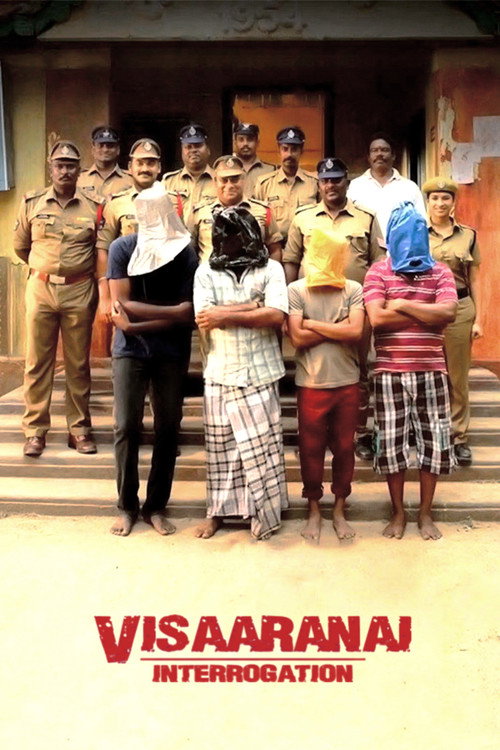
Visaranai
2016 · Vetrimaaran
For when you want cinema that punches — a tense, furious ripped-from-reality thriller that doubles as a moral gut-check. Absolutely a challenge, not a wind-down watch; choose it when you're ready to be shaken.
What it's about
Four Tamil migrant workers sleeping rough in a neighboring state are rounded up by police and beaten toward confessing to a burglary they know nothing about. Surviving that ordeal only pulls them into a second, larger machine back home, where a corrupt nexus of police and politicians needs inconvenient people erased. It's adapted from an autobiographical novel by a rickshaw driver who lived through such a detention himself.
The experience
Relentless and physically hard to watch in stretches, then coldly gripping as the scale of the machinery reveals itself — the film moves like a thriller but lands like testimony. It leaves you angry, and it means to.
Performances
Samuthirakani is quietly chilling as a senior cop caught inside the system he serves — a performance of weary compromise that earned him a National Film Award.
The craft
Vetrimaaran shoots the station-house scenes with unflinching directness and builds the second half like a procedural trap, the editing tightening as the men's options vanish. The violence is staged for truth rather than spectacle, which is exactly what makes it so hard to shake.
Why it matters
It premiered at Venice, won Indian National Film Awards, and became India's Oscar submission — proof that Tamil cinema could take police brutality head-on and reach the world doing it.
Snapshot
Visaranai ("Interrogation") is a Tamil-language procedural nightmare in two movements: four Tamil migrant labourers sleeping rough in Guntur, Andhra Pradesh, are swept up by local police and beaten toward a confession for a burglary they know nothing about; having survived that, one of them is drawn into a second, larger machine back in Tamil Nadu, where a corrupt police-political apparatus needs witnesses erased. Adapted from Lock Up, an autobiographical Tamil novel by M. Chandrakumar — an auto-rickshaw driver who was himself detained and tortured in Andhra Pradesh in the early 1980s — the film was produced by the actor Dhanush's Wunderbar Films and premiered in the Orizzonti section of the 72nd Venice International Film Festival in 2015, where it took the Amnesty International Italia award. It went on to win the National Film Award for Best Feature Film in Tamil, with further National Awards for Samuthirakani (Best Supporting Actor) and Kishore Te. (Best Editing), and was selected as India's official submission for the Best Foreign Language Film Oscar at the 89th Academy Awards. It runs a little under two hours and carried an adults-only certificate.
Its formal proposition is severe: no songs in the conventional sense, almost no score, no star turn, no redemptive arc. It is one of the most unsparing films the Tamil industry has produced about state violence, and it arrived at the precise moment when Tamil cinema was retooling itself around caste, class and the subaltern subject.
Industry & production
The film sits at an instructive junction in Tamil commercial cinema. Vetrimaaran had made two features with Dhanush — Polladhavan (2007) and Aadukalam (2011), the latter a National Award sweep including Best Direction and Best Actor — and that relationship converted into patronage. Dhanush produced and presented Visaranai under Wunderbar Films, which meant a star's banner underwriting a film with no star in it, and no obvious commercial hook. This is the classic mechanism by which Tamil cinema has funded its harder work since the late 2000s: the star as producer buying prestige and cover for a director whose commercial credit he shares.
Casting followed the same logic in reverse. Dinesh Ravi, in the lead as Pandi, had come out of Pa. Ranjith's Attakathi (2012), a film that helped inaugurate the industry's Dalit-authored turn. Samuthirakani — a director in his own right — plays Muthuvel, the Tamil constable whose decency is the film's cruellest trap. Kishore, Aadukalam Murugadoss, Ajay Ghosh and E. Ramdoss fill out an ensemble of faces that read as working bodies rather than as personalities. Anandhi appears in a small part. The absence of a marquee name is not incidental economy; it is the film's argument about anonymity made in casting.
The Venice premiere preceded the Indian theatrical release of 5 February 2016 by several months, and the festival laurels plus the National Awards did much of the film's marketing for it. Reliable, specific box-office figures for the release are not something the public record supports with confidence; what is clear is that the film performed strongly enough for its scale to consolidate Vetrimaaran's standing as a director who could take a bleak, songless film into general release and be taken seriously.
Technology
Visaranai was made at the point when digital acquisition had become the default across the Tamil industry, and it uses that default deliberately rather than incidentally. Sustained low-light interiors — a lockup lit by little more than a bare bulb and whatever leaks through a barred window — are shot without the heavy fill that photochemical stock would have demanded, so the dark stays dark and faces sink into it. The absence of magazine changes permits takes that run as long as the performances can sustain, which matters enormously to sequences whose horror is cumulative rather than punctual.
The digital pipeline also underwrites the grade: a desaturated, slightly jaundiced palette, greens and khakis and the sodium wash of a police station at night, with skin tones pushed toward gray. This is the mid-2010s Indian realist look, and it depends on a digital intermediate to hold together across locations shot months and hundreds of kilometers apart.
More broadly, digital economics are what made the film possible at all. The cost floor for a location-shot, ensemble-cast, effects-free feature had dropped far enough by 2015 that a star's production house could absorb the risk on a project with no commercial insurance policy in it. The technological story of Visaranai is therefore less about any single tool than about the budget structure that cheap capture opened up for the Tamil realist wave.
Technique
Cinematography
Ramji's photography is the film's most consequential craft decision, and his credits — including Kaadhal (2004) and Paruthiveeran (2007), two foundational texts of the Tamil realist turn — explain why. He shoots the lockup in close, low, often handheld setups that never quite give the viewer a stable master. Geography stays partial: you learn the room the way a prisoner does, by which corner the blows come from. Where a genre thriller would cut to an authoritative overhead, Visaranai stays at floor level.
Crucially, the camera declines to aestheticize the violence. There is no slow motion, no expressive angling, no red-tinted stylization. Beatings are frequently framed so that the act is partly occluded — by a body, a doorframe, the edge of the lens's interest — which relocates the horror from spectacle to sound and duration. The exterior material, especially the Andhra sequences, is looser and more observational, and the shift in register when the film crosses back into Tamil Nadu is registered photographically before it is registered in plot.
Editing
Kishore Te.'s National Award was earned on a specific problem: how to make an ordeal that is, by definition, repetitive feel escalating rather than monotonous. His solution is a cutting rhythm that lengthens rather than tightens. Early interrogation beats are relatively conventionally covered; as the days compound, shots are held past the point of comfort, and elisions become brutal — a cut that skips the intervening hours and returns to men in worse condition, letting the audience infer the interval.
The film's largest editorial gesture is the structural bifurcation. The transition from the Guntur lockup to the Tamil Nadu material is a genuine hinge, and the decision not to smooth it — to let the film seem, briefly, to have resolved before it reveals that the first ordeal was only the smaller machine — is an editing conception as much as a screenwriting one.
Mise-en-scène / staging
The lockup is the film's principal set and functions as a proposition about power: a small, dirty, over-inhabited room with a policeman's desk and calendar just outside it, so that torture and paperwork share a frame. The banality is exact — tea being drunk, shifts changing, a superior arriving and the tempo of violence adjusting to his presence. Bureaucratic routine is staged as the medium in which cruelty is suspended, not as its opposite.
The staging's single most brilliant stroke is linguistic. The four Tamil men are interrogated by Telugu-speaking police; they are beaten for failing to answer questions they cannot understand, and their attempts to explain are received as insolence. Language becomes the physical architecture of the trap. Later, when the police need a usable confession, the men are coached — made to memorize and rehearse a script of their own guilt, corrected on delivery like actors in a bad play. The film thus stages the manufacture of truth as a performance-directing exercise, which is about as pointed as a filmmaker's self-implication gets.
Sound
The soundtrack is built from room tone, breath, footfall on concrete, and the specific unmusical impact of a lathi on a body. G. V. Prakash Kumar's score is used so sparingly that its absence becomes a formal signature: the extended violence plays essentially unscored, denying the audience the emotional handrail that music provides. When music does enter, it tends toward drone and low sustained texture rather than melody or theme.
Offscreen sound does much of the heavy lifting — a scream from an adjacent room, blows heard while the frame holds on a listening face. The public record is not clear on how much of the dialogue track was captured live versus rebuilt in post, a common ambiguity for Tamil productions of this period; what is audible is a mix that privileges spatial plausibility and refuses the enhanced, foregrounded punch-sound of commercial action cinema.
Performance
The ensemble works in a register of exhaustion. Dinesh's Pandi is the film's spine and is played almost entirely without heroic inflection: his defiance is stubborn rather than noble, and it is progressively ground down into compliance and then into a numb, dangerous knowledge. Samuthirakani's Muthuvel is the film's moral hinge and the source of its most disturbing effect — he is warm, competent, genuinely protective, and precisely for those reasons the instrument by which Pandi is delivered to a worse fate. The National Award recognized a performance built on withheld information: a decent man doing what the institution requires and telling himself a story about it.
The supporting police performances resist villain acting. They are bored, irritable, professionally efficient, occasionally jovial. This is the most political choice in the film's performance design, since it locates the violence in the job rather than in individual sadism.
Narrative & dramatic mode
Visaranai is structured as a double trap. The first movement is a closed-space ordeal narrative, its dramatic question narrow — will they confess, will anyone intervene — and its resolution partial: legal help arrives, a magistrate is reached, the men are extracted. That resolution is then revealed as a false floor. The second movement opens the aperture onto financial and political corruption, in which Pandi and Muthuvel become inconvenient witnesses to a matter far above their station, and the state's response is not interrogation but erasure — a staged "encounter" that resolves the paperwork problem by removing the people.
The dramatic mode is tragic rather than thriller-shaped, because agency is systematically withdrawn from the protagonists. Nothing they choose alters the outcome; the film's engine is the mismatch between the scale of the men's understanding and the scale of the machine. This is also why the second movement, which is not drawn from the Chandrakumar novel's account and appears to be Vetrimaaran's extension of the material, is structurally necessary: without it, the film would be an account of an atrocity survived. With it, the film argues that survival was never the variable.
Genre & cycle
The film sits inside the Indian custodial-violence and police-corruption tradition, whose canonical texts are Govind Nihalani's Aakrosh (1980) and Ardh Satya (1983) — the parallel-cinema counter-tradition to the vigilante police hero. Visaranai strips that tradition of its remaining consolations: Ardh Satya's protagonist at least possessed a subjectivity the film honored, while Visaranai denies its policemen interiority as thoroughly as it denies its prisoners power.
In Tamil terms, it belongs to the realist cycle running from Kaadhal (2004) through Paruthiveeran (2007), Subramaniapuram (2008) and Aadukalam (2011) — rural and small-town settings, non-glamorous casting, regional dialect, violence with consequences — and it pushes that cycle from the register of tragic romance and community feud into the register of the state. It is simultaneously a prison film, a wrong-man thriller stripped of the wrong man's eventual vindication, and a conspiracy film in which the conspiracy is simply how the institution normally operates.
Authorship & method
Vetrimaaran apprenticed under Balu Mahendra, the cinematographer-director whose work was central to the Tamil and Malayalam new waves of the late 1970s and 1980s, and the inheritance is visible in the attention to physical environment and unhurried observation. His own signature is elsewhere: a fascination with hierarchies of subordination — the trainer and the fighter in Aadukalam, the gangster's hierarchy in Vada Chennai (2018), caste and land in Asuran (2019) — and a refusal to let his protagonists' virtues save them.
Ramji brought a body of realist camerawork already associated with the cycle's founding films. Kishore Te. is Vetrimaaran's long-standing editor, and the shaping of duration in Visaranai is arguably his most visible contribution to the director's method. G. V. Prakash Kumar, who had scored Aadukalam, here performs the harder compositional task of near-absence. The screenplay is Vetrimaaran's own, adapted from Chandrakumar's Lock Up; the decision to build a second, invented movement onto a documented first-person account is the central authorial act of the film, and it converts testimony into structural argument.
Movement / national cinema
Visaranai is a document of a specific reconfiguration in Tamil cinema in the 2010s, in which caste, class and regional identity moved from background texture to explicit subject. Pa. Ranjith's Attakathi (2012) and Madras (2014), Vetrimaaran's own work, and later Mari Selvaraj's films constitute a body of cinema authored substantially from and about subaltern positions — a development with few parallels in the other major Indian industries at that scale of commercial visibility.
The film's particular contribution is to make linguistic minority status the mechanism of oppression: Tamils in Andhra Pradesh, migrant, undocumented in any useful sense, unintelligible to the authority that holds them. In a national cinema often organized around linguistic-regional pride, Visaranai dramatizes language as vulnerability. Its selection as India's Oscar submission also marks the period in which regional-language films, particularly Tamil and Marathi, regularly displaced Hindi cinema in that role.
Era / period
The novel's events belong to the early 1980s; the film transposes them into an unspecified but recognizably contemporary present, and the transposition is the point. Mobile phones, television news and modern policing infrastructure change nothing about the mechanism. Released in 2016, the film landed in a decade of intensifying Indian public argument about custodial deaths, encounter killings and police impunity — an argument that would sharpen considerably in the years after. Its refusal to date its atrocity is what allows it to function as an ongoing accusation rather than a period reckoning.
Themes
The governing theme is the manufacture of guilt: the state does not seek a perpetrator, it requires a closed case, and bodies are the raw material from which closure is produced. Related to it is the theme of the unusable witness — the man who has seen too much and whose only possible disposition is disappearance.
Language and unintelligibility run through the film as both plot mechanism and metaphor for a citizenship that cannot make itself heard. Complicity is treated with unusual rigor: Muthuvel is not corrupt, and that is exactly the problem, since institutions run on the compliance of decent people. And the film is consistently attentive to class and the migrant condition — the four men are legible to the state only as available bodies, which is the same way the labor market sees them. The title's promise of "inquiry" is finally ironic: no one in the film is trying to find anything out.
Reception, canon & influence
Critical reception in India was strongly positive and, in the film press, close to unanimous — the film was widely read as a landmark in Tamil cinema's engagement with the state, and its craft awards at the National Film Awards ratified that reading institutionally. The Venice Orizzonti premiere and the Amnesty International Italia prize gave it a human-rights framing on the international circuit; sustained international critical literature on the film remains comparatively thin, and its overseas reputation has rested more on the Oscar submission and festival circulation than on extensive Anglophone criticism.
Backward, its lineage runs through Nihalani's Aakrosh and Ardh Satya and the wider parallel-cinema treatment of state violence and rural powerlessness; through Balu Mahendra's observational method as transmitted to Vetrimaaran directly; and through the Tamil realist films of the 2000s, several photographed by Ramji, which established the industry's tolerance for non-glamorous location work and dialect performance. Its affinities with the international political thriller — the Costa-Gavras tradition of institutions as the antagonist — are real but are best described as convergence rather than documented borrowing; the record does not support specific claims about the director's citations here.
Forward, its influence is unusually traceable. Vetrimaaran returned to custodial violence and state force directly with Viduthalai (Part 1, 2023; Part 2, 2024), making the concern a through-line of his authorship rather than a single outing. The Tamil films of custodial injustice that followed — most prominently Jai Bhim (2021), on the custodial death of an Irula man, and Writer (2021), on a police clerk's conscience — operate in a space Visaranai opened commercially as well as artistically, demonstrating that audiences would attend films that indicted the police without a heroic counterweight. The Malayalam Nayattu (2021) inverts the same material from the police side. And when the custodial deaths of Jayaraj and Bennix in Sathankulam, Tamil Nadu, became a national scandal in June 2020, Visaranai was invoked repeatedly in public discussion as the film that had already shown what had happened — an unusual instance of a fiction feature entering the vocabulary of a country's argument with itself about its police.
A Deleuzian reading
A policeman asks a question in Telugu.
The full Deleuzian reading of Visaranai →
Reception
It stunned from day one — a Venice premiere, an Amnesty International Italia award, three National Film Awards, and India's Oscar entry for 2016 — and a decade on it's only grown, now routinely cited as the hardest-hitting Indian film of the 2010s and the moment Tamil cinema's new wave got undeniable.
How Visaranai was received, from release to now →
How to watch Visaranai: what to notice on a first viewing
- Notice you are never given a full view of the cell. Ramji shoots close, low, and often handheld, withholding the wide establishing shot a thriller would normally give you to orient yourself. You learn the room's geography the way a prisoner does, by which corner the blows come from.
- Notice the desk and calendar just outside the cell. Tea gets poured, shifts change, and the pace of violence adjusts when a superior arrives, all staged with the same flat routine as any workplace. Cruelty here shares a frame with paperwork, which is exactly how the film argues it actually operates.
- Notice the men are questioned in a language they don't speak. Telugu-speaking officers interrogate Tamil-speaking laborers, and their attempts to explain in the wrong language are read as insolence. The trap here isn't just physical; it's built directly into who can and cannot be understood.
- Listen for how little music plays under the hardest scenes. G. V. Prakash Kumar's score stays so sparing that extended stretches play essentially unscored, without music to cushion or explain what you're seeing. The film withholds the emotional handrail a score usually provides, and leaves you to sit with it directly.
- Notice how ordinary and even bored the officers seem. The supporting policemen are played as irritable, occasionally jovial professionals rather than as theatrical villains. Locating the harm in the job rather than in any one man's cruelty is the film's most pointed choice.
The whole guide to watching Visaranai, with the keys for a rewatch →
Influences: the films it descends from and the films it influenced
- Aakrosh (1980) — Nihalani builds an entire courtroom film around a tribal defendant who never speaks in his own defense, making inarticulacy before the law the formal engine rather than a theme — the device Visaranai retools as migrants interrogated in a language they cannot answer in.
- Ardh Satya (1983) — Om Puri's sub-inspector fixed the Indian screen grammar of the policeman as a functionary ground down by rank instead of a villain — the exact performance register Samuthirakani inherits as Muthuvel, whose decency operates procedurally and fails anyway.
- Veedu (1988) — Vetrimaaran's mentor films a woman's attrition against municipal procedure in patient real-location observation with almost no score, refusing to dramatize paperwork — the transmitted method behind Visaranai's bureaucratic banality.
- Kaadhal (2004) — Ramji's handheld available-light location shooting with unknown faces and unsanded dialect established the industry tolerance for de-glamorised image-making that Visaranai's low-light digital lock-up is photographed inside.
- Kalloori (2007) — Ramji again photographs non-professional performers in unlit rural interiors with flat naturalistic exposure, normalizing a Tamil realist image where faces sit in genuine shadow — the tonal precondition for Visaranai's occluded violence.
- Vazhakku Enn 18/9 (2012) — A police station is staged as a machine that processes poor teenagers into a case file, with statement-taking played out at procedural length — the direct rehearsal for Visaranai's coached-confession sequence.
- Subramaniapuram (2008) — Location sound, Madurai dialect and violence that arrives without musical announcement legitimized the non-star realist ensemble, letting Visaranai cast four interchangeable unknown bodies whom the audience cannot rank by stardom.
- Aadukalam (2011) — The trainer/fighter architecture is the first full statement of Vetrimaaran's hierarchy-of-subordination structure, cut by Kishore Te. and scored by G. V. Prakash Kumar — the same craft team whose score is here reduced to near-absence.
- The Confession (1970) — Interrogation is staged as attrition — repetition, sleep deprivation, the slow drafting of a statement the prisoner will eventually sign — the convergent formal precedent for building torture out of expanding duration rather than shock cuts.
- Z (1969) — The coda that undoes an achieved verdict by administrative means is the formal precedent (convergence, not documented citation) for Visaranai's false resolution, where deliverance from the first lock-up only feeds the second trap.
- Virumaandi (2004) — Inherits Virumaandi's social-issue thesis film mode, turning custodial violence into a structural critique of state justice with the same unflinching, procedural realism.
- Mahanadhi (1994) — Institutional/custodial cruelty destroying ordinary innocents through entrapment blocking and relentless cumulative dread — the vulnerability-of-goodness and narrowing-frame craft carried to its harshest conclusion.
- Viduthalai Part 1 (2023) — Vetrimaaran re-enters custodial force from inside the constabulary, opening on an extended single-take aftermath, converting Visaranai's outsider-victim vantage into the view of the man holding the lathi.
- Jai Bhim (2021) — Reconstructs a custodial death as evidentiary record — station diary entries, remand paperwork and medical reports intercut with the beating — extending Visaranai's discovery that the document trail is where the crime is actually made.
- Writer (2021) — Puts the drama in the station writer's ledger, where a clerk must falsify an entry, taking literally Visaranai's insight that custodial death is manufactured in the paperwork rather than at the moment of the blow.
- Nayattu (2021) — Inverts the seat — constables become the hunted — while retaining the handheld pursuit, near-absent score and total absence of a rescuing institution that Visaranai used against the police.
- Asuran (2019) — Again refuses to let the protagonist's virtue save him, and again uses Kishore Te.'s expanding duration inside the violence so that assault is measured in unbroken minutes rather than impact cuts.
- Karnan (2021) — Stages a police reprisal on a village as collective, administratively sanctioned and largely off-frame in its worst moments — the subaltern-turn grammar working in the commercial space Visaranai proved existed for films that indict the police without a heroic counterweight.
- Chithha (2023) — Pioneers unflinching aftermath-of-violence realism in Tamil cinema that withholds catharsis and stages brutality through implication and sustained dread rather than spectacle.
- Viduthalai: Part I (2023) — Vetrimaaran's own earlier custodial-torture procedural established the confined-interrogation grammar — handheld naturalism inside the police station, torture staged in real time without musical cushioning — that Viduthalai extends outdoors into a counter-insurgency setting.
- Court (2014) — Tamhane holds static wide takes on procedural tedium until the boredom itself becomes the indictment of the machinery — the same duration-as-argument tactic Visaranai applies to the lock-up instead of the courtroom.
- Kirumi (2015) — A petty informer inside the police apparatus, played by the non-star Kathir, with the station rendered as a workplace of small favours and quotas rather than a set-piece — contemporaneous Tamil work in the non-villainous-police register.
- Vada Chennai (2018) — His own docu-real staging of custodial brutality and state-street collusion supplies Vada Chennai's method for filming institutional violence without stylization.
- Kadaisi Vivasayi (2022) — Tamil realism using against-type and non-professional actors with observational staging of the powerless, part of the same star-supported serious-realism wave in Tamil cinema.
Similar films
- Asuran (2019) — influence & lineage
- Jai Bhim (2021) — influence & lineage
- Aadukalam (2011) — influence & lineage
- Viduthalai: Part I (2023) — shared sensibility
- Vada Chennai (2018) — shared sensibility
- Vikram Vedha (2017) — shared sensibility
- Pudhupettai (2006) — shared sensibility
- Maharaja (2024) — shared sensibility