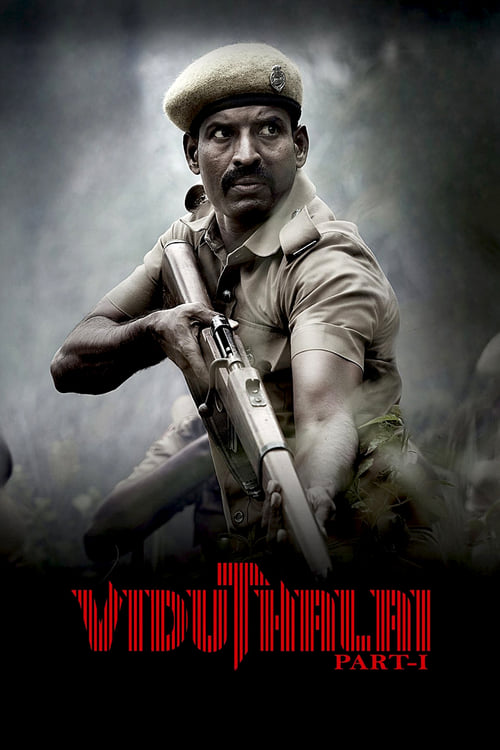
Viduthalai: Part I
2023 · Vetrimaaran
For when you want serious, morally weighty cinema that trusts you with hard material — a film to think about long after, not background viewing. Challenge, not comfort.
What it's about
In the late 1980s, Kumaresan — a gentle, newly posted police constable played against type by Soori — is folded into a militarized manhunt for Perumal Vaathiyar, a schoolteacher turned insurgent leader fighting a mining project and the state violence protecting it. Stationed among the very villagers the operation brutalizes, Kumaresan starts to see, from the inside, exactly what the uniform he wears is being used for.
The experience
Grave, immersive, and quietly devastating — a thriller that trades chase-movie momentum for the slow horror of watching a decent man discover what he's part of. It's demanding viewing, with real dread and real tenderness in it.
Performances
Soori, known for comedy, is a revelation as Kumaresan — his softness makes every indignity land — while Vijay Sethupathi brings a looming moral gravity to the rebel the film keeps just out of reach.
The craft
Vetrimaaran adapts a short story into an anatomy of complicity, shooting the hill country and its police encampment with a physical, ground-level realism that puts you inside the machinery of the operation. The staging of its large set pieces is genuinely astonishing on a big screen.
Why it matters
Acclaimed as one of the major Tamil films of its decade, it sharpened Vetrimaaran's standing as Indian cinema's foremost chronicler of state power and caste, and set up a direct continuation in Part II.
Snapshot
Viduthalai: Part I is a Tamil-language period thriller directed by Vetrimaaran, adapted from the short story "Thunaivan" by the Tamil writer B. Jeyamohan. Set in the late 1980s, it follows Kumaresan (Soori), a newly posted police constable of gentle temperament who is folded into a militarized operation to hunt Perumal Vaathiyar (Vijay Sethupathi), a schoolteacher-turned-insurgent leading an armed resistance against a mining project and the state violence that protects it. The film is less a manhunt than an anatomy of complicity: it watches an ordinary, decent man discover the machinery of custodial torture, caste subordination, and extractive dispossession from the inside, and it withholds the confrontation between constable and rebel that its structure keeps promising — that reckoning is deferred to Part II (2024). Continuous with Vetrimaaran's abiding concern for the bodies the Indian state grinds in its interrogation rooms, the film is best understood as the first movement of a two-part work rather than a self-contained thriller, and its "Part I" is programmatic: it is an origin story for a moral awakening whose consequences arrive later.
Industry & production
The film was produced under the RS Infotainment banner, the Chennai production house associated with producer Elred Kumar, which had backed several of Vetrimaaran's earlier features and shares his commitment to socially engaged commercial cinema. It sits within the mid-to-upper budget tier of Tamil (Kollywood) production — resourced enough to stage large-scale set pieces, sustained location shooting in hill and forest terrain, and a marquee cast, but conceived and marketed as a director's film rather than a star vehicle.
The most significant industrial fact around the production is its casting logic. Soori, for more than a decade one of Tamil cinema's most bankable comic actors — a supporting-comedian archetype in dozens of mass entertainers — was cast against type in a dramatic leading role. Vetrimaaran's decision to build the film's moral center on a performer the audience associated with comic relief was a deliberate industrial and aesthetic gamble, of a piece with the director's long practice of extracting unexpected registers from familiar performers. Vijay Sethupathi, by contrast, arrived as an established leading man willing to take the film's more iconic but screen-time-limited role of the near-mythic rebel, his presence anchoring the marketing while the narrative weight rested elsewhere.
The project was conceived as two parts from the outset. Precise budget and box-office figures are not something I can state reliably here, and I will not invent them; what is clear from the record is that the film performed as a critical success and was received as a significant Vetrimaaran work, with the two-part structure understood as an artistic rather than purely commercial division.
Technology
Viduthalai: Part I is a digitally originated and digitally finished feature in the standard idiom of contemporary Indian cinema, and its technological interest lies less in novel apparatus than in how conventional tools are marshaled for a naturalist, period-textured image. The production leans on location shooting in difficult hill and forest environments, which imposes real constraints on lighting and camera mobility — the film's grainier, weather-beaten look is consistent with available-light and lightly augmented setups rather than heavily controlled studio staging. The opening sustained long take, discussed below, is the film's clearest technological showcase: extended single-take coverage of this kind depends on modern digital cameras' ability to run long, unbroken recordings and on stabilized rigs, though I cannot verify from the record the exact camera bodies, rigs, or stabilization systems used, and will not guess at them.
Technique
Cinematography
The cinematography is by R. Velraj, a frequent Vetrimaaran collaborator, and it is the film's most discussed formal achievement. Viduthalai opens with a long, unbroken take that surveys the aftermath of a train derailment/explosion — a slow, roving movement across wreckage, bodies, and rescue workers that establishes both the scale of the insurgency's violence and the film's documentary-adjacent gaze before a word of exposition. The choice announces the film's method: to place the spectator inside a situation without editorial cushioning, and to treat catastrophe as environment rather than spectacle. The sequence is widely cited as a landmark of recent Tamil cinema for its duration, choreography, and refusal of montage.
Beyond the opening, Velraj's palette is muted and earthen — mist, mud, khaki, the greens of hill forest — favoring an unglamorous, textured naturalism appropriate to a period of state counter-insurgency. Handheld and shoulder-mounted framing keeps the camera at the level of the labor and violence it records; the film prefers the middle distance and the crowded frame to the isolating close-up, reinforcing Kumaresan's position as one small figure inside a vast apparatus.
Editing
The editing (credited to R. Ramar, a regular Vetrimaaran collaborator) works in productive tension with the long-take impulse. Where the opening withholds cutting to immerse, the interrogation and operation sequences build through a patient accumulation of procedural detail rather than accelerated cross-cutting. The overall rhythm is deliberate, even withholding — the film is structured to defer its central confrontation, and the cutting supports that architecture of suspension, letting scenes of routine, boredom, and dawning complicity run long enough for their moral weight to register.
Mise-en-scène / staging
The staging is dense and populated. Police camps, village settlements, and forest paths are dressed with a granular attention to period and place — uniforms, weaponry, vehicles, and the improvised infrastructure of a counter-insurgency operation. Vetrimaaran characteristically stages the group over the individual: the frame is often busy with subordinate officers, laborers, detainees, and villagers, so that hierarchy and caste position are legible in the geometry of who stands where. Custodial and camp spaces are rendered as lived, grubby, bureaucratic environments, extending the interrogation-room realism of the director's earlier Visaranai.
Sound
The film's sonic design pairs a naturalist field of ambient sound — forest, machinery, crowd, weather — with a score by Ilaiyaraaja. The collaboration is itself notable: Ilaiyaraaja, the towering figure of Tamil film music across five decades, brings a composer of immense authority to material about the marginalized peoples his music has long been associated with. The score is used with restraint relative to mainstream norms, weighting mood and lament over propulsion, and its folk and melodic inflections tie the film's political sympathies to a specifically Tamil, rural, subaltern soundworld.
Performance
Performance is where the film's gamble pays off. Soori delivers a career-redefining turn as Kumaresan, playing gentleness, decency, and moral discomfort without the comic register audiences expected of him; the performance is built on watchfulness and small reactions — a man absorbing horrors he is powerless to stop. Vijay Sethupathi, as Perumal Vaathiyar, works largely through restraint and mythic reticence, embodying the rebel as much through absence and reputation as through presence. Bhavani Sre contributes a significant supporting performance, and Gautham Vasudev Menon appears as a hardened senior officer, his casting trading on his own directorial persona to sharpen the portrait of institutional ruthlessness. The ensemble of subordinate officers and villagers is directed toward the same unshowy naturalism that governs the film's images.
Narrative & dramatic mode
The dramatic mode is realist tragedy in a procedural frame. The film adopts the point of view of a low-ranking functionary rather than either the state's commanders or the insurgency's leadership, and this vantage is its central formal decision: we learn the operation as Kumaresan learns it, from the bottom, without the God's-eye clarity of the conventional thriller. The narrative is deliberately anti-climactic in the short term — it builds toward a meeting between constable and rebel that it declines to consummate, converting the thriller's forward drive into a study of conscience under institutional pressure. Exposition is minimal and delivered obliquely; the viewer is asked to infer the political situation from its effects on bodies and villages. The result is a slow-burn structure that rewards patience and that only fully resolves in conjunction with its second part.
Genre & cycle
Nominally an action-thriller-drama, Viduthalai: Part I belongs more precisely to a cycle of politically engaged Tamil realist cinema that emerged and intensified through the 2010s, in which caste oppression, state violence, and the dispossession of rural and Adivasi communities became central rather than incidental subjects. Within Vetrimaaran's own filmography it forms a clear cycle with Visaranai (custodial torture) and Asuran (caste violence and land), and within the broader industry it converses with the work of directors like Pa. Ranjith and Mari Selvaraj who have foregrounded Dalit and subaltern experience. The film absorbs the grammar of the counter-insurgency thriller — the manhunt, the camp, the operation — and turns it against itself, using genre expectation to expose the moral bankruptcy of the state's pursuit.
Authorship & method
The film is unmistakably a Vetrimaaran work in its preoccupations and method. Adapting Jeyamohan's short story "Thunaivan," the director continues his practice of building rigorously researched, socially grounded features from literary and reported sources, and of centering the individual crushed within a system. His method — long takes, dense ensembles, naturalist performance from unexpected actors, refusal of moral consolation — is consistent across the film.
The key collaborators reinforce this authorship. Cinematographer R. Velraj supplies the earthen, immersive image and the celebrated opening take. Composer Ilaiyaraaja provides a score of restrained, folk-inflected gravity. Editor R. Ramar sustains the film's deliberate, deferring rhythm. The source author B. Jeyamohan, one of contemporary Tamil literature's major figures, supplies the narrative foundation, and the adaptation's fidelity to a literary rather than formulaic structure is itself a mark of the film's authorial seriousness. The casting of Soori against type should be read as an authorial intervention as much as an industrial one — a director locating unexplored depth in a performer the industry had typecast.
Movement / national cinema
The film is a product of Tamil cinema specifically, and of a moment in which Kollywood became a leading site for caste-conscious, politically explicit Indian filmmaking. It should be situated within the larger currents of socially engaged Indian cinema while resisting assimilation to a pan-Indian "national" style: its textures, its music, its politics, and its language are rooted in Tamil rural and subaltern experience. It participates in a broader post-2010 turn in Indian regional cinema toward realism and marginal-caste representation, but its idiom is regionally specific and self-consciously so.
Era / period
Viduthalai: Part I is a period film set in the late 1980s, and its period reconstruction is integral to its meaning. By locating its story in that earlier decade of counter-insurgency operations, resource extraction, and custodial impunity, the film both grounds its events historically and comments obliquely on their persistence. The period setting allows the film to treat state violence as a structural, long-running condition rather than a contemporary aberration. As a production, it belongs to the early-2020s wave of ambitious, socially minded Tamil features, released in 2023.
Themes
The film's governing themes are the machinery of state violence and the moral cost of participation in it. It anatomizes custodial torture and extrajudicial brutality; the collusion of policing with corporate/extractive interests against Adivasi and rural communities; caste hierarchy as it structures both the police force and the society it polices; and the dispossession of the powerless in the name of development. Against this it sets the theme announced by its title — viduthalai means "liberation" or "freedom" — held out both as the insurgency's political horizon and as the personal moral emancipation of a man learning to see the system he serves. The film is centrally concerned with conscience: with what an ordinary, decent person does, and fails to do, when embedded in an apparatus of cruelty. Gendered violence against village women, invoked in the film's premise, is treated as constitutive of the state's method rather than as incidental.
Reception, canon & influence
Critically, Viduthalai: Part I was received as a major work — praised for its opening long take, for Soori's transformation from comic actor to dramatic lead, and for Vetrimaaran's uncompromising political vision. The consensus positioned it among the strongest Tamil films of its year and as a continuation of the director's most serious line of work. I cannot responsibly cite specific award tallies, ratings, or grosses here without risking invention, and so state only what the record clearly supports: the film was a critical success and a significant entry in Vetrimaaran's filmography.
Its lines of influence run in both directions. Backward, the film draws on Jeyamohan's literary source; on Vetrimaaran's own earlier interrogations of custodial violence and caste (Visaranai, Asuran); on the traditions of Tamil realist and politically engaged cinema; and on the international lineage of the immersive long take and the counter-insurgency thriller repurposed for social critique. Forward, its most immediately consequential legacy is industrial and vocational: it decisively expanded the perceived range of Soori and, more broadly, reinforced a Tamil-industry appetite for casting comic and character actors in serious dramatic leads. It further consolidated the two-part, politically ambitious realist feature as a viable commercial-artistic form in Kollywood, and its opening sequence entered critical conversation as a reference point for the contemporary Tamil long take. Its fullest legacy, however, is internal and still unfolding: as the first half of a diptych, Part I is an argument completed only by Part II (2024), and its meaning — the deferred reckoning it so deliberately withholds — is realized across the pair rather than in the first film alone.
Reception
A critical and commercial hit on release in March 2023, hailed as Vetrimaaran back at full power — and Part II's more divisive 2024 reception has only sharpened the consensus that Part I is the stronger half.
How Viduthalai: Part I was received, from release to now →
Influences: the films it descends from and the films it influenced
- Visaranai (2015) — Vetrimaaran's own earlier custodial-torture procedural established the confined-interrogation grammar — handheld naturalism inside the police station, torture staged in real time without musical cushioning — that Viduthalai extends outdoors into a counter-insurgency setting.
- Asuran (2019) — Directly precedes Viduthalai's caste-and-dispossession subject and its method of drawing mythic-restrained performance from an actor cast against physical type, plus R. Velraj-style earthen location image (Velraj shot both).
- Aadukalam (2011) — Vetrimaaran's early template for dense-ensemble staging and deferred confrontation — building tension across a large peripheral cast so the reckoning is withheld to the last act.
- The Battle of Algiers (1966) — The foundational template for repurposing the counter-insurgency thriller as social critique — quasi-documentary handheld camera, dense crowd staging, and sympathy located with the hunted rather than the state's security apparatus.
- Come and See (1985) — Its immersive, subjective handheld camera lashed to a low-status witness — war and atrocity experienced from below rather than surveyed from command — anchors Viduthalai's bottom-up POV and naturalist sensory dread.
- Children of Men (2006) — The modern immersive action long take — a single unbroken shot that plunges the camera through the aftermath of violence — is the international reference point critics invoked for Velraj's celebrated opening take.
- Z (1969) — Established the political thriller built around a state-orchestrated cover-up and a slow procedural excavation of custodial crime, the investigative armature Viduthalai inherits for its critique of institutional impunity.
- 16 Vayathinile (1977) — Pulled Tamil cinema out of the studio into real rural locations and non-glamorous sunlight, founding the location-naturalism tradition Viduthalai's earthen 1980s hill-country image descends from.
- Mullum Malarum (1978) — Model of the restrained Tamil literary adaptation scored by Ilaiyaraaja in a folk-inflected, sparingly deployed register — the same understated-gravity scoring approach Ilaiyaraaja brings to Viduthalai.
- Paruthiveeran (2007) — Reintroduced unvarnished caste realism and dialect-authentic rural texture with non-star faces, the register of grounded regional specificity Viduthalai works in.
- Subramaniapuram (2008) — Defined the 1980s-Tamil period-realism aesthetic — deliberately paced, ensemble-driven, period-accurate small-town texture with violence that arrives belatedly — the exact era and pacing Viduthalai reconstructs.
- Maamannan (2023) — Casts a veteran comic actor (Vadivelu) in a grave dramatic lead within a caste-political frame — the same-year embodiment of the against-type casting intervention Viduthalai made with Soori.
- Viduthalai: Part II (2024) — The completing half of the diptych that realizes the deferred confrontation Part I so deliberately withholds — the structural device only pays off across the pair.
- Vada Chennai (2018) — Its multi-part, novelistic structure and non-linear withholding of the central betrayal model the two-part diptych form Viduthalai adopts, where meaning is completed only across installments.
- Pariyerum Perumal (2018) — A contemporaneous Tamil caste-realism work sharing the bottom-up POV of the dispossessed and refusal of moral consolation, extending the same movement Viduthalai belongs to.
- Karnan (2021) — Fuses caste-dispossession realism with mythic register and staged state violence against a village, paralleling Viduthalai's blend of naturalism with a restrained-mythic treatment of its protagonist.
- Jai Bhim (2021) — A courtroom-and-custody procedural built on the same subject of custodial torture of a marginalized community, told from the victims' vantage — the closest thematic-craft sibling in the custodial-violence strain.
Similar films
- Asuran (2019) — influence & lineage
- Vada Chennai (2018) — influence & lineage
- Pariyerum Perumal (2018) — influence & lineage
- Aadukalam (2011) — influence & lineage
- Jai Bhim (2021) — influence & lineage
- Vikram (2022) — same viewing thread
- Kantara (2022) — same viewing thread
- Jigarthanda DoubleX (2023) — same viewing thread
All the films related to Viduthalai: Part I →
Watch it with: curated runs of related films
- First Day, First Show — A run of maximalist, movie-drunk crowd cinema best taken loud and communal — spectacle, folk myth, gangster swagger, and lads-on-a-trip mayhem that all believe in the front row.