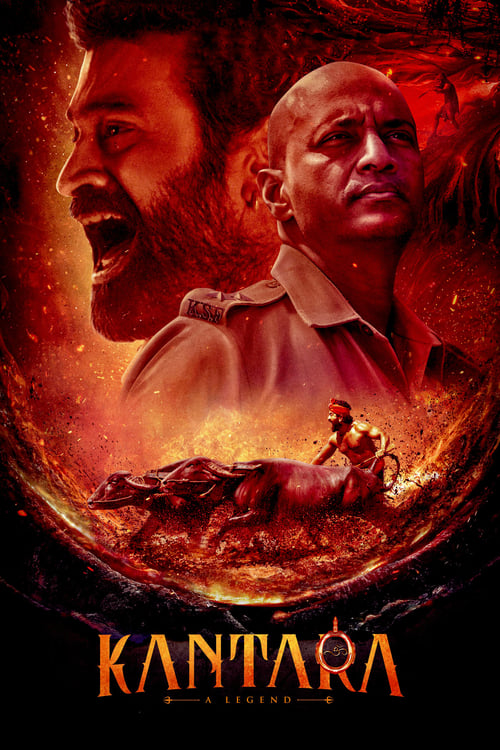
Kantara
2022 · Rishab Shetty
Kantara's divine-folk climax made devotional folk-horror a pan-Indian phenomenon and its prequel a 2025 blockbuster; the center of the "Kannada cinema's arrival" conversation.
For when you want to be swept up — a big communal-experience movie that starts loose and funny and ends somewhere primal. Watch it loud; it's the kind of climax you want to feel in your chest.
What it's about
In a forested hamlet on the Karnataka coast, a nineteenth-century pact — land granted to villagers in exchange for devotion to a spirit-deity — still governs life in 1990. Shiva, a hard-drinking buffalo-race champion, has spent his life dodging the ritual vocation that killed his father. Then a by-the-book forest officer arrives to enforce conservation law, a landlord quietly maneuvers to void the old pact, and Shiva finds himself caught between the state, the land, and a god who hasn't forgotten the deal.
The experience
It shape-shifts — rowdy village comedy, land-rights drama, and folk horror by turns — then gathers everything into an ecstatic, drum-driven ritual finale that audiences came out of theaters raving about. Earthy, rousing, and finally hair-raising.
Performances
Rishab Shetty, who also wrote and directed, gives a ferocious physical performance as Shiva — swaggering and comic for most of the film, then transformed in the ritual sequences into something genuinely uncanny.
The craft
Shetty grounds the film in the real Bhoota Kola ritual tradition of coastal Karnataka — the painted performers, the torchlight, the percussion — and the sound design and score turn the ceremonies into the film's engine. The forest photography and the thunderous final act make a strong case for the biggest screen and best speakers available.
Why it matters
A Kannada-language film that became a pan-Indian phenomenon, it led a wave of rooted, regional storytelling breaking out nationally and made Rishab Shetty a major figure overnight.
Snapshot
Kantara is a film about a land dispute that ends with a god arriving to settle it. Written, directed by and starring Rishab Shetty, it is set in a forested hamlet in the Tulu-speaking coastal belt of Karnataka, where a nineteenth-century pact between a king and a village — land in exchange for a stone idol, sealed before the spirit-deity Panjurli — is still, in 1990, the operative legal instrument. Shiva, the hard-drinking Kambala champion at the film's center, has spent his life refusing the ritual vocation his father died performing; a forest officer arrives to enforce conservation law against the villagers; behind both stands a landlord quietly working to void the pact. The picture that results is part rural comedy, part agrarian procedural, part folk horror, and it resolves not through argument but through possession — the Bhoota Kola, the ritual in which a performer is inhabited by the deity and speaks with the deity's authority, staged as the film's climax and its verdict.
Released in Kannada on 30 September 2022 and dubbed outward into Hindi, Telugu, Tamil and Malayalam over the following weeks, it became one of the defining commercial events of Indian cinema's "pan-Indian" moment, and did so from a position no other film in that cycle occupied: a modest budget, no established star, and material so locally specific that most of its eventual audience had never heard of the ritual it dramatizes. At the 70th National Film Awards it took Best Actor for Shetty and the award for Best Popular Film Providing Wholesome Entertainment.
Industry & production
Kantara was produced by Vijay Kiragandur for Hombale Films, the Bengaluru banner that had just delivered K.G.F: Chapter 1 (2018) and K.G.F: Chapter 2 (2022). That lineage matters, but mostly as contrast. The K.G.F films were built on scale — a star in Yash, a gold-mine mythology, a deliberately denationalised visual grammar of dust and slow motion designed to travel. Kantara was greenlit as the cheaper, stranger companion piece: a director-star with no pan-Indian profile, a story rooted in the daivaradhane traditions of Dakshina Kannada and Udupi districts, and a shoot conducted largely on location in the coastal forests near Kundapura, the region Shetty himself is from. Trade reporting at the time put the production cost in the mid-teens of crores and the eventual worldwide gross in the region of ₹400 crore; Indian box-office figures are not independently audited and these numbers should be read as the industry's own account rather than verified ledger, but the order-of-magnitude disproportion is not in dispute.
The release pattern was as consequential as the film. Rather than the simultaneous multi-language saturation that had become standard after Baahubali (2015–17), Hombale opened Kantara in Kannada first and let it build, releasing the Hindi dub roughly two weeks later into a market that had been primed by word of mouth rather than by campaign spend. The film accumulated audience instead of front-loading it, and the sequencing became a talking point in the trade — evidence that a regional-language film could achieve national reach without first sanding off its regional-ness.
The production also generated the most-litigated music dispute of the year. The song "Varaha Roopam," composed by B. Ajaneesh Loknath and central to the climax, was alleged by the Kerala band Thaikkudam Bridge to infringe their 2017 track "Navarasam." A district court in Kozhikode granted an injunction in November 2022, and the song was removed from the film's streaming version and replaced while proceedings continued — an unusual case of a film's most celebrated sequence being altered after the fact for viewers who came to it late.
A related controversy is worth recording without overstating it. A strand of Indian commentary — in Kannada and Malayalam outlets as much as English ones — argued that the film borrows the iconography of a subaltern, historically caste-marked ritual practice while narrating a story that ultimately reconciles the village to a landowning order, and questioned whether the performance tradition's practitioner communities were served by the film's popularity. Other writers, and many practitioners quoted in the press, read the film as an overdue mainstream assertion of Tulu Nadu's ritual culture. Both readings circulated widely; the film's own position is ambiguous enough to sustain either.
Technology
Kantara was shot digitally on location, and its technical interest lies less in acquisition hardware — the specific camera package is not consistently documented in accessible English-language sources, and it is not worth guessing at — than in what the location demanded. Much of the film takes place under dense canopy, at night, in monsoon-adjacent humidity, lit by fire: torches, oil lamps, bonfires, the flaming headdresses and body-ornament of the Kola itself. Arvind S. Kashyap's images depend on being able to hold detail in a frame whose only motivated light source is a moving flame, and the film's modern sensor latitude is doing quiet, unshowy work throughout. Drone and aerial coverage establishes the forest as a continuous mass rather than a backdrop, and the Kambala buffalo-race sequence is captured largely at ground level in the slush, with the camera taking the punishment.
Visual effects are present but restrained and mostly integrative — fire augmentation, the boar imagery associated with Panjurli, atmospheric work in the forest. The film conspicuously does not use digital transformation to depict the deity's arrival; the possession is carried by performance, sound and light. That restraint is a technological decision as much as an aesthetic one, and it is the reason the climax reads as documentary-adjacent rather than as fantasy.
The film's distribution is a case study in the dubbing pipeline that made the pan-Indian cycle economically possible: a single Kannada negative, re-voiced and re-mixed into four additional languages, each with its own theatrical run and its own marketing, then consolidated onto streaming. That same infrastructure produced the "Varaha Roopam" episode — the digital text proved mutable in a way a struck print never was, and the version most viewers now encounter on demand is not the version that played theatrically.
Technique
Cinematography
Kashyap, who shot both K.G.F films, works here in an almost opposite register. Where the mining saga was stylized to the point of abstraction — crushed blacks, sepia, constant slow motion — Kantara opens in a naturalist mode: available-feeling daylight, green saturation, handheld coverage that stays close to bodies moving through undergrowth. The village comedy is shot loosely, with the camera treating Shiva and his friends almost as an ensemble documentary subject.
The film then escalates its own grammar in stages. The Kambala race introduces velocity and low-angle immersion. The night sequences in the forest introduce the fire-lit palette. And the final movement abandons naturalism outright: as Shiva is taken by the deity, the framing tightens onto face and eyes, the movement becomes untethered and circling, and the flame-light is allowed to blow out and smear across the frame. The progression is legible as an argument — the more the film approaches the divine, the less it pretends to be observing neutrally.
Editing
Pratheek Shetty's cutting is organized around two long prologues and a delayed detonation. The film front-loads exposition — an encounter in the forest in 1847, a court challenge and a fatal Kola in 1970 — before settling into 1990 and slowing down considerably, giving substantial screen time to comic business, village texture, and the slow-burn antagonism with the forest department. Western viewers frequently register this middle stretch as loose; it is better understood as the Indian commercial feature's characteristic tolerance for tonal breadth before the interval, and it is doing the necessary work of making the village a place worth defending. The final twenty minutes then cut at a completely different rate, and the shift is the point: the film's editorial rhythm converts from human time to ritual time.
Mise-en-scène / staging
The controlling decision is that the ritual is staged as ritual, not as spectacle-about-ritual. The Bhoota Kola sequences observe the real form's protocol — the costume assembly, the drums, the circling of the sacred ground, the performer's address to the assembled village — and they are blocked so that the community is always present in frame as witness. The village is populated with faces that read as local rather than cast, and the geography (the landlord's house, the temple ground, the forest boundary, the disputed fields) is established early enough that the third act's movement through it is spatially coherent.
The film's central staging idea is a boundary that keeps getting redrawn: the line between forest and village is at various points a legal fiction, a religious pact, a survey marker and a moral question, and the blocking of confrontations — villagers on one side, uniforms on the other, the landlord moving freely across — makes the dispute visible before anyone argues it.
Sound
Ajaneesh Loknath's contribution is the film's engine. The score is built on the percussion of the region — chende and allied drums, the reedy wind instruments of ritual performance — deployed not as local color but as the film's pulse; the drums are frequently the loudest element in the mix and they are what carries the possession. "Varaha Roopam" fuses that percussive base with an incantatory vocal (sung by Sai Vignesh) and functions as the climax's actual mechanism, the thing the sequence is riding. "Singara Siriye" supplies the film's folk-romantic register in a lighter idiom.
Equally important is the vocal work of the possession itself: the shift in Shiva's voice into the deity's register, the shrieks and glossolalic sounds of the Kola, and the silences that punctuate them. In a theatrical mix these registered as physical events, and a great deal of the film's reported effect on audiences is attributable to sound rather than image.
Performance
Rishab Shetty's performance is the film's argument in a body. For most of the running time he plays Shiva as a slouching, quick-tempered, faintly disreputable rural young man — comic timing, loose physicality, no heroic bearing. The climax requires him to become something else entirely, and he executes the Kola himself: the gait, the tremor, the eyes, the sustained physical transformation. That the same actor performs both, without a cut to hide the transition, is what makes the sequence land as revelation rather than as effect.
Around him, Kishore plays forest officer Murali with a bureaucrat's stiff decency, which is essential — the film needs its ostensible antagonist to be sincerely in the right about conservation law before it can complicate him. Achyuth Kumar's landlord Devendra is genial in a way that makes the eventual reveal retrospectively obvious. Sapthami Gowda (Leela), Pramod Shetty (Sudhakara) and Manasi Sudhir (Shiva's mother Kamala) hold the village register, and the supporting ensemble's comic playing is closer to observed behavior than to broad farce.
Narrative & dramatic mode
The film's structure is a delayed inheritance plot wearing the clothes of a land procedural. Its dramatic question is not "who owns the forest" but "will Shiva accept the role his father died in" — and the land dispute is the mechanism that forces the answer. The two prologues establish a contract with supernatural enforcement; the main body of the film systematically stages every secular way of resolving the dispute (courts, the forest department, protest, violence) and lets each one fail or be corrupted; the climax then invokes the enforcement clause.
This is a genuinely unusual dramatic mode for a contemporary film. The deity is not metaphor, ambiguity, or the villagers' subjective belief — the film commits to it as literal, adjudicating fact, and the misdirection of the villain's identity is engineered so that the audience arrives at the climax having exhausted every rational alternative. The result is closest in shape to a revenge narrative in which the avenger is not the protagonist but something acting through him, which conveniently removes the moral cost of the killing from the human character.
Genre & cycle
Kantara sits at an intersection: the Indian rural action drama, the folk-horror film, and the pan-Indian mass entertainer. From the first it takes the village ensemble, the landlord antagonist, the interval-block escalation. From the second it takes the sense that the landscape is inhabited and that transgression against it is punished — a mode that Indian cinema has long practiced in regional registers and that global audiences increasingly read through the folk-horror label. From the third it takes the release architecture and the climactic scale.
Its position within the pan-Indian cycle is contrarian. Baahubali, K.G.F and RRR traveled by building invented or denationalised worlds. Kantara traveled by refusing to translate — by presenting a hyper-specific Tulu Nadu ritual practice with minimal explanation and trusting that intensity would carry where familiarity could not. That inversion is the single most influential thing about it commercially.
Authorship & method
Rishab Shetty came to Kantara as an established Kannada director rather than a star. He made Ricky (2016) and then Kirik Party (2016), a campus film that became a generational hit in Karnataka, and Sarkari Hi. Pra. Shaale, Kasaragodu (2018), a school-set drama that won the National Film Award for Best Kannada Film — a body of work already marked by attention to Kannada-language identity and to coastal Karnataka specifically. He had earlier worked as an assistant on Rakshit Shetty's Ulidavaru Kandanthe (2014), the Karavali-set ensemble crime film that did much to establish the coastal belt as a distinct cinematic territory.
The method on Kantara was rooted rather than researched from outside: Shetty is from Keradi in Kundapura taluk, grew up around daivaradhane, and shot in that landscape with local participation. He wrote, directed and played the lead, and performed the ritual sequences himself after training — a concentration of roles that is unusual at this scale and that the film's climax depends on.
His key collaborators form a coherent unit. Arvind S. Kashyap brings the K.G.F films' command of scale but subordinates it to naturalism. B. Ajaneesh Loknath, a fixture of the contemporary Kannada industry, supplies a score built from regional instrumentation rather than orchestral pastiche. Pratheek Shetty edits. Vijay Kiragandur's Hombale Films provided the financing and, crucially, the patience for a release that built rather than opened.
Movement / national cinema
Kantara belongs to Kannada cinema, but it is more precisely a Tulu Nadu film made in Kannada. That distinction is the source of most of its interest. Karnataka's art cinema — the Navya-adjacent tradition of Pattabhirama Reddy's Samskara (1970), Girish Karnad and B.V. Karanth's Kaadu (1973), Girish Kasaravalli's Ghatashraddha (1977) and Dweepa (2002) — had for decades taken up precisely this material: village faith, land, caste, displacement, the forest as contested ground. Kantara's achievement, and the thing that makes it historically legible, is to route that material through mass-entertainment form rather than through the festival circuit.
Placed alongside contemporaneous South Indian work, it rhymes with the Malayalam cinema of Lijo Jose Pellissery — Ee.Ma.Yau (2018) and especially Jallikattu (2019) — in its treatment of ritual, community frenzy and the collapse of the human into the animal, though the resemblance is convergent rather than causal. Within the Kannada industry it stands with Thithi (2016) and Ulidavaru Kandanthe as evidence of a regionally grounded new wave that does not read as provincial.
Era / period
The film arrived in the autumn of 2022, at the exact peak of the post-pandemic Indian theatrical recovery and of the pan-Indian thesis — the year of RRR, K.G.F: Chapter 2 and Ponniyin Selvan: I, and a year in which the Hindi industry's own output was performing conspicuously badly. Its success was read at the time, sometimes crudely, as a referendum on rootedness: a film with no stars and a fraction of the budget outperforming national-scale productions. It also arrived in a political climate in which assertions of indigenous and Hindu ritual practice carried charge beyond the cinema, and the film was claimed by constituencies whose readings of it were not identical.
Its 1990 setting is not incidental. The film places its action after India's forest conservation regime had hardened and before the statutory recognition of forest-dwelling communities' rights that came later — a window in which the villagers' claim had religious and customary force but limited legal standing. The dispute the film dramatizes is a real one in Indian jurisprudence, and the film's choice to resolve it supernaturally rather than legally is legible as a comment on how that jurisprudence has treated such communities.
Reception, canon & influence
Critical reception in India was strong and, unusually, largely aligned with the popular response: reviewers praised Shetty's performance, Loknath's score and the climax almost without dissent, while a substantial number flagged the loose middle act and the film's discomfiting gender and caste politics. International notice came later and mostly through streaming, where the film traveled as a curiosity that turned into an enthusiasm. Institutional recognition followed at the 70th National Film Awards — Best Actor for Shetty, and Best Popular Film Providing Wholesome Entertainment — alongside a sweep of the Kannada categories at the major South Indian awards.
Looking backward, the film's inheritances are threefold: the Karnataka village-and-land tradition of Karnad, Karanth and Kasaravalli; the mass-cinema convention of divine intervention as narrative resolution, long established across Tamil, Telugu and Kannada devotional and rural cinema; and, most directly, the Bhoota Kola itself, which is not a cinematic source but a living performance tradition with its own dramaturgy of costume, drum, address and possession. The film's climax is essentially a filmed performance form, and its power derives from a theatrical vocabulary older than the medium.
Looking forward, its influence has been rapid and mostly commercial. It reset the industry's assumptions about what a Kannada production could earn and about how a regional film should be released — build locally, dub outward, let word of mouth do the campaign — and it triggered a visible turn across Indian production toward folk-ritual and regional-mythological material as a source of both spectacle and legitimacy, a turn that has since produced work of very uneven quality. Hombale and Shetty extended it directly with the prequel Kantara: Chapter 1 (2025), which moved the story back into the historical origins of the pact and was mounted at substantially greater scale — an expansion that inevitably trades some of the original's roughness and locality for production value.
The film's longer standing is not yet settled. Its most durable contribution may prove to be neither the box-office record nor the cycle it launched, but the demonstration that a mass audience will accept a ritual it does not understand, presented without translation, if the film itself believes in it completely.
A Deleuzian reading
Every serious argument in *Kantara* happens at a treeline.
The full Deleuzian reading of Kantara →
Reception
Opened quietly in Kannada in late 2022, then word-of-mouth turned it into a pan-Indian phenomenon and one of the biggest Kannada hits ever after KGF 2. Its stature only grew — Rishab Shetty took the National Film Award for Best Actor, and the 2025 prequel Kantara: Chapter 1 arrived as a full-blown event.
How Kantara was received, from release to now →
How to watch Kantara: what to notice on a first viewing
- Watch which side of the treeline each character stands on. Confrontations are blocked with villagers on one side, forest department uniforms on the other, and the landlord moving freely across the line. The dispute is made visible as geography before anyone argues it in words.
- Notice the camera shift from loose handheld daylight to tight firelit framing. Kashyap's images move from documentary-style village coverage through the Kambala race's low angles to a final movement where the frame tightens on face and eyes and light blows out. The camera's own steadiness erodes as the film approaches the divine, an escalation staged as argument.
- Listen for the chende drums driving nearly every scene's rhythm. Ajaneesh Loknath keeps regional percussion as the loudest element in the mix, from village comedy through to the climax. The drums are the film's pulse, and they are what eventually carries the possession.
- Notice how long the film lingers on village comedy first. Two brief prologues set up a supernatural pact, then the film slows into Kambala races, petty jobs, and slow-burn feuding for most of its runtime. That patience makes the village a place worth defending before the story asks you to defend it.
- Watch Shiva's loose, slouching posture in ordinary village scenes. Rishab Shetty plays him as disreputable and quick-tempered, with no heroic bearing, for most of the running time. That ordinary physical baseline is what makes his later transformation register as real change, not effect.
The whole guide to watching Kantara, with the keys for a rewatch →
Influences: the films it descends from and the films it influenced
- Chomana Dudi (1975) — Karanth makes a hand drum the protagonist's entire expressive channel — Choma beats the dudi where dialogue would go — which is the same substitution Kantara performs with chende percussion, letting drum rhythm rather than speech carry a landless coastal-Karnataka man's rage against a landlord.
- Kaadu (1973) — Karnad stages a land feud along a literal forest edge, cutting between village settlement and encroaching kaadu so the boundary itself becomes the dramatic stake — the exact spatial grammar of Kantara's village/forest line, where every confrontation is blocked at a treeline.
- Ghatashraddha (1977) — Kasaravalli films a full ritual — the symbolic death-rite of the title — as unhurried procedure with its own dramaturgy, letting the ceremony deliver the verdict the plot has been building toward; Kantara's Bhoota Kola climax uses the same trust that a correctly-observed rite will do narrative work no dialogue could.
- Nirmalyam (1973) — P.J. Antony's velichappadu oracle sustains an unbroken possession performance to the point of self-wounding with the ritual sword, the camera refusing to cut away or explain — the direct precedent for Shetty performing the daiva's arrival himself in long takes rather than assembling it from coverage.
- Vanaprastham (1999) — Karun builds the film on an actor trained into a codified performance form until the role subsumes the man, shooting Kathakali costume-and-makeup transformation as its own sequence; Kantara adopts that method literally — Shetty trained in Bhoota Kola and the film treats vesha, anklets and face-paint as transformation cinema.
- Nagamandala (1997) — Nagabharana imports Karnad's folk-theater dramaturgy wholesale — direct address, serpent-deity ordeal, community assembled as audience — so a human dispute is settled by a non-human adjudicator; Kantara's climax reproduces that structure with the daiva as final court.
- Ammoru (1995) — Ramakrishna codified the South Indian third-act divine intervention: two hours of realist village grievance resolved by goddess-manifestation with effects work deployed only at the eruption, which is precisely Kantara's economy of VFX restraint followed by one sanctioned rupture.
- Ulidavaru Kandanthe (2014) — Shetty assisted on this Karavali-set ensemble, which established coastal Karnataka as filmable territory — Kundapura Kannada left unsubtitled for the mainland, and a Pili Vesha tiger-dance folded into an action set-piece rather than staged as a folkloric insert.
- Sarkari Hi. Pra. Shaale, Kasaragodu (2018) — Shetty's own prior film set the working method Kantara scales up: shoot in the actual coastal locality, cast non-professionals from it, and let Kannada-language identity be the subject rather than color — the 'rooted, not researched' production discipline.
- Tumbbad (2018) — Barve and DP Pankaj Kumar build a folk-horror entirely on a regional deity outsiders have never heard of, lit almost exclusively by lantern and lamp so firelight is the motivated source; Kantara inherits both the untranslated local pantheon and the flame-as-key-light scheme of its night forest.
- K.G.F: Chapter 1 (2018) — The Hombale Films template Kantara ran on — high-contrast desaturated grading broken by one saturated register, plus a release architecture of building locally in Kannada then dubbing outward and letting word of mouth replace a campaign — Neel's scale command redirected toward naturalism.
- Bāhubali 2: The Conclusion (2017) — Pushes Bāhubali's devotional-chant scoring from underscore into the climax's actual mechanism — the Bhoota Kola possession is staged as a mass-hero entrance where ritual percussion, not orchestration, drives the cut rhythm.
- Kantara: Chapter 1 (2025) — Shetty's own prequel relocates the pact into its period origin and re-mounts the Bhoota Kola vocabulary at epic scale, trading the original's handheld locality and rough textures for constructed sets and heavier VFX — the same craft, tested at the budget the first film's success bought.
- Bramayugam (2024) — Sadasivan lights an entire folk-horror by torch and oil lamp in monochrome and builds it on Kerala's chathan lore with no explanatory scaffolding for outsiders — the clearest post-Kantara instance of firelight-motivated source plus untranslated ritual specificity as a legitimacy strategy.
- Jallikattu (2019) — Pellissery drives crowd staging from the sound mix outward, percussion and massed breath dictating cutting rhythm as a village pursues an animal into the hills until the film abandons naturalism altogether — the same escalation curve from documentary texture to untethered frenzy Kantara runs in its last reel.
- Asuran (2019) — Vetrimaaran withholds his protagonist's violence for two acts of studied deference in a land-grab conflict, then detonates it late and retroactively — the delayed-detonation structure Kantara uses on Shiva, where restraint reads as timidity until it is revealed as containment.
- Karnan (2021) — Selvaraj lets village guardian-deity iconography — sword, headless stone figure, sacrificial animal — operate as literal plot machinery in a caste-and-land action film rather than as symbolism, the same refusal to demote folk belief to metaphor that governs Kantara's daivaradhane.
- Pushpa: The Rise (2021) — Sukumar keeps a thick regional dialect and a forest-extraction economy intact through the pan-Indian dubbing pipeline, staging action inside actual timber-country terrain — the parallel demonstration that untranslated regional specificity travels rather than needing sanding down.
- The Wailing (2016) — Na gives the shaman's gut ritual a full uninterrupted set-piece — drum, chant, costume, no exposition offered — and lets the film's procedural realism collapse into a supernatural verdict it never adjudicates for the viewer; Kantara's climax is the same wager that belief filmed completely needs no gloss.
- Rangi Taranga (2015) — Bhandari shoots coastal Karnataka's night interiors and Yakshagana-inflected village lore as genuine mystery mechanics, proving within the Kannada industry that regional folk material could carry a commercial thriller's plot rather than decorate it.
- RRR (2022) — Shares RRR's move of resolving human conflict through folk-mythic/elemental transformation in the climax — the hero literally embodying a divine-elemental force.
Similar films
- Tumbbad (2018) — influence & lineage
- Asuran (2019) — influence & lineage
- RRR (2022) — same viewing thread
- Viduthalai: Part I (2023) — same viewing thread
- Jigarthanda DoubleX (2023) — same viewing thread
- Manjummel Boys (2024) — same viewing thread
- Vikram (2022) — same viewing thread
- Bāhubali 2: The Conclusion (2017) — shared sensibility
All the films related to Kantara →
Watch it with: curated runs of related films
- First Day, First Show — A run of maximalist, movie-drunk crowd cinema best taken loud and communal — spectacle, folk myth, gangster swagger, and lads-on-a-trip mayhem that all believe in the front row.