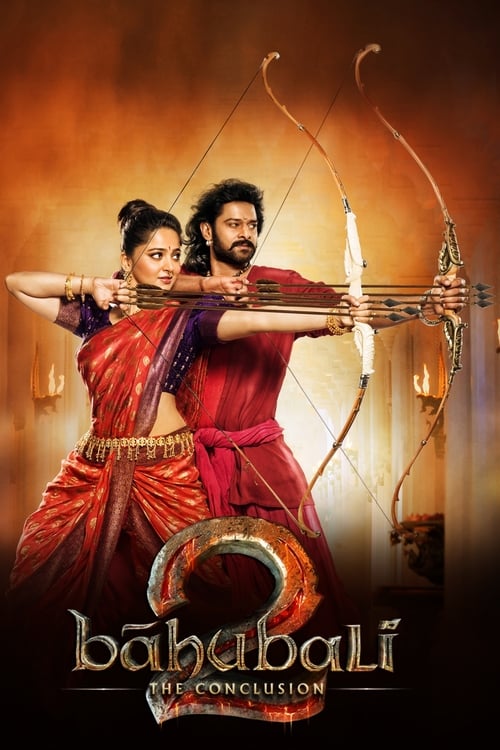
Bāhubali 2: The Conclusion
2017 · S. S. Rajamouli
For when you want pure spectacle — a huge, hearty crowd-pleaser to watch with friends and the volume up. This is comfort food scaled up to a banquet, not a challenge.
What it's about
The second half of a two-part epic set in the mythical kingdom of Mahishmati, where a young man named Mahendra discovers he is heir to a throne he never knew existed. The story sweeps back into the past to unravel palace intrigue — a beloved prince, a scheming rival, an iron-willed queen mother, and a promise whose cost keeps compounding — before returning to the present for a reckoning. Underneath the battles it's a story about legitimacy: who deserves to rule, and what a vow is worth.
The experience
Maximalist in the best sense — every emotion at full volume, every action sequence bigger and stranger than the last. It moves like an opera crossed with a comic book, and its sincerity is total; there's no wink, which is exactly why it lands.
Performances
Prabhas carries a double role across two generations with old-fashioned movie-star magnetism, and Ramya Krishnan's imperious queen mother Sivagami is the film's true center of gravity — a performance of pure command.
The craft
S. S. Rajamouli stages action with an inventiveness that makes physics feel negotiable — siege weapons, waterfalls, and armies deployed like ideas rather than props. Shot simultaneously in Telugu and Tamil with vast effects work and a thundering score, it's built for the biggest screen and loudest speakers you can find.
Why it matters
It shattered Indian box-office records and proved a Telugu-language film could conquer the entire country, effectively inventing the modern pan-Indian blockbuster and redrawing the commercial map of Indian cinema.
Snapshot
Bāhubali 2: The Conclusion is the second half of a two-part Telugu-language epic that closed the narrative loop opened by Bāhubali: The Beginning (2015) and, in doing so, permanently altered the commercial geography of Indian cinema. It answers the question the first film had left dangling — why the loyal slave-general Kattappa killed the beloved prince Amarendra Bāhubali — by rewinding into an extended flashback of court intrigue, and then returning to the present for a siege that restores the rightful heir. The film's real subject is not war but legitimacy: who may rule, what a spoken word costs, and whether a mother's promise outranks justice.
Made simultaneously in Telugu and Tamil and released dubbed into Hindi, Malayalam and other languages, it became the film that taught the Indian industry that a Telugu production could open nationally as an event rather than as a regional import. Its critical standing is genuinely divided — near-universal admiration for its scale and narrative propulsion, sustained scholarly objection to its dynastic and caste politics — and both halves of that reception are essential to understanding it.
Industry & production
The film was produced by Shobu Yarlagadda and Prasad Devineni for Arka Media Works, a Hyderabad company that had backed Rajamouli before but never at anything approaching this cost. Both Bāhubali films were shot largely back-to-back over a multi-year schedule, principally at Ramoji Film City in Hyderabad, where partial physical sets were built and extended digitally. The split into two films was a production decision made when the story outgrew a single release; the resulting cliffhanger became, unplanned, the most effective marketing asset in modern Indian film history. "Why did Kattappa kill Bāhubali?" circulated for nearly two years as meme, T-shirt slogan, news-channel filler and public parlor game — an organic pre-sell no campaign could have bought.
The distribution architecture is the film's most consequential industrial innovation. Rather than releasing in Telugu and letting a Hindi remake follow years later — the long-standing pattern — the producers released the Hindi dub wide and day-and-date, presented in the north by Karan Johar's Dharma Productions with AA Films handling the release. That configuration gave a Telugu film the marketing legitimacy of a Bombay production. The Hindi version's screen count was reported at the time as the largest ever for an Indian film; specific figures varied by trade source and should be treated as approximate.
The same caution applies to the box office. The Conclusion was widely reported as crossing ₹1,500 crore worldwide and was, for a period, described as the highest-grossing Indian film ever made. Indian box-office reporting is unaudited, promotional in origin, and frequently inconsistent between outlets; the film's dominance is not in doubt, but any single number attached to it is a trade claim rather than a verified figure. Its North American run was unusually strong for an Indian release, charting in the upper reaches of the weekend chart — a threshold Indian films had rarely approached.
One release-side friction is worth recording: pro-Kannada organizations in Karnataka objected to old remarks by actor Sathyaraj concerning the Cauvery river dispute and pressed for an apology ahead of the film's release there. The matter was resolved and the release proceeded, but it is a reminder that "pan-Indian" distribution runs through real regional political terrain.
Technology
The film was shot digitally on Arri Alexa-family cameras by K. K. Senthil Kumar, and its images are less photographed than assembled: the majority of frames carry digital work, from full CG environments to set extension, crowd multiplication, and creature and vehicle animation. Visual effects were supervised by V. Srinivas Mohan, with the Hyderabad house Makuta VFX leading a vendor list that ran to dozens of studios across India and abroad. Reported shot counts run into the thousands; the precise figure varies by source.
What matters technically is less the volume than the workflow it represents. Bāhubali was built on a heavily previsualised pipeline — Rajamouli is known for working from exhaustive storyboards and concept art developed with his art department before shooting — which allowed live-action photography to be planned as one layer inside a shot that would be finished months later. This is standard practice in Hollywood tentpole production; in 2015–17 it was not standard in Indian production, and Bāhubali effectively installed it. The film also normalized Hyderabad as a VFX center capable of leading, not merely subcontracting, work on a film of this ambition.
The release engineered scale on the exhibition side too: large-format presentations, a Dolby Atmos mix, and later 3D-converted and re-cut releases, including a combined single-film edit of both parts issued theatrically in 2025. That afterlife — the film returning to cinemas as an event nearly a decade on — is itself a technological and commercial artifact of the era.
Technique
Cinematography
Senthil Kumar, who has shot for Rajamouli since Sye (2004) and through Magadheera (2009) and Eega (2012), works here in a mode closer to illustration than to naturalism. Mahishmati is rendered in burnished golds and bronzes; the forest kingdom of Kuntala in saturated greens; the present-day war in cooler, harder grays. Grading is aggressive and unapologetic, producing surfaces that read as painted plates rather than recorded locations — a choice consistent with the film's derivation from comics and illustrated mythology rather than from historical reconstruction.
The camera's signature move is the impossible one. Because environments are digital, the virtual camera is unconstrained: it cranes off a rampart into a thousand-foot drop, threads between combatants, orbits a hero mid-leap. Low-angle framing on wide glass is the default for the "elevation" shots that Telugu mass cinema has long used to sanctify its stars; Rajamouli and Senthil Kumar take that grammar and inflate it until the hero occupies the frame the way a temple icon occupies a sanctum. Slow-motion ramping punctuates almost every action beat, arresting a gesture at the instant of maximum legibility.
Editing
Kotagiri Venkateswara Rao cuts to a rhythm of accumulation and arrest: rapid, percussive assembly building toward a held slow-motion image, then release. The pattern is so consistent it functions as the film's meter. His larger structural problem was the flashback architecture — the bulk of The Conclusion is Kattappa's testimony to Mahendra about events preceding the first film's climax — and the film manages the hinge cleanly, allowing the past to run long enough to become the primary narrative before snapping back for the siege. Songs are cut into action rather than parked beside it: the mass number "Saahore Bāhubali" is edited as spectacle-montage, and the devotional "Dandaalayyaa" functions as an emotional bridge rather than an interruption.
Mise-en-scène / staging
Sabu Cyril's production design is the film's most sustained authorial achievement after Rajamouli's own. Mahishmati is conceived as a single legible machine: throne room, plaza, walls, gates, waterworks. Rajamouli stages his court scenes with theatrical clarity — sovereign elevated, petitioners below, the crowd as chorus — so that political shifts are readable as blocking. The great court sequence, in which Devasena maims a nobleman who assaults her, Amarendra beheads him in open session, and Sivagami is forced to choose between her word and her son, is staged almost entirely through position and gaze.
The action set-pieces are engineered as escalating physical propositions rather than as fights: the three-arrows sequence in which Amarendra guides Devasena's bow and they fire in impossible unison; the CG swan-boat of "Hamsa Naava," the film's purest fantasy image; the climactic siege in which bent palm trees are used as catapults to launch soldiers over the walls. Each is built on a single visual idea, established, then paid off — a comic-panel logic of one big image per beat.
Sound
M. M. Keeravani's score works on a leitmotif system spanning both films: the Bāhubali theme is introduced with the father and later transferred to the son, so that the finale's musical recognition does the work of an explicit line of dialogue. The idiom is maximalist — massed choir, Sanskritic and Telugu chant, heavy percussion — and closer to devotional performance than to Western symphonic scoring, which aligns the film's emotional peaks with religious rather than martial feeling. "Dandaalayyaa," sung by Kaala Bhairava, is the clearest instance: a hymn placed where a triumph cue would sit. The Atmos mix is dense and front-loaded, prioritizing impact and vocal presence over spatial subtlety.
Performance
Prabhas differentiates father and son largely through carriage and tempo: Amarendra open-faced, courtly, at ease; Mahendra harder and more watchful. Ramya Krishnan's Sivagami is the film's tragic engine — an actress with a long career in Telugu and Tamil cinema, including the formidable Neelambari of Padayappa (1999), playing a matriarch destroyed by her own inability to unsay a sentence. Anushka Shetty carries Devasena across a twenty-five-year span from martial self-possession to captivity and grief. Sathyaraj's Kattappa modulates between comic servility and genuine tragedy, and the film's central moral wound is his. Rana Daggubati plays Bhallaladeva as sculpted physical menace, with Nassar's Bijjaladeva supplying the whispering intelligence behind him. The register throughout is declamatory and frontal — closer to folk theater than to screen realism, and consistent with the film's melodramatic mode rather than a failure of it.
Narrative & dramatic mode
The film is melodrama in the strict sense: a mode in which moral positions are made visible, virtue is legible on the body, and excess is the instrument of ethical clarity rather than a lapse from it. Nothing is ambiguous. The good are radiant, the wicked are corpulent or oily, and the audience's judgment is never solicited — only its assent.
Its dramatic engine is the binding word. Sivagami's promise, once spoken, cannot be withdrawn; Kattappa's hereditary oath binds him to the throne rather than to the man on it; Devasena's vow after her humiliation waits twenty-five years for its discharge. This is the dharma-sankat, the moral impasse, as structural device: characters are destroyed not by villainy but by their own integrity misapplied. Kattappa's murder of Amarendra — the revelation the entire duology was built to deliver — is dramatically satisfying precisely because it is not a betrayal. He kills the man he loves because he was ordered to by the authority he is sworn to, and he is right to be devastated and right to have obeyed.
The frame is testimonial. Kattappa narrates the past to Mahendra, which makes the film's flashback an act of confession and its "conclusion" doubly meant: the end of the story and the settling of an account.
Genre & cycle
Bāhubali is the most consequential revival of the South Indian janapada film — the folkloric costume adventure of kings, sorcerers, forest kingdoms and impossible feats that flourished in Telugu, Tamil and Kannada cinema from the 1950s through the 1970s, in the mythologicals starring N. T. Rama Rao and the fantasy productions of directors like B. Vittalacharya. That cycle had faded by the 1980s. Rajamouli restored its narrative furniture and re-equipped it with contemporary VFX, and the result reads simultaneously as archaic and unprecedented.
Grafted onto it is the vocabulary of the post-2000 Hollywood epic: the stylized phalanx warfare and graphic-novel palette of 300 (2006), the siege scale of the Lord of the Rings films, the arena-and-usurpation plotting of Gladiator (2000). Rajamouli has spoken frequently of formative influence from Amar Chitra Katha comics, Chandamama story magazines, and the Mahabharata as told to him by his father. The combination is the film's genre signature: comic-book panel composition applied to puranic material at Hollywood scale.
Authorship & method
Rajamouli is an auteur of engineering rather than of ambiguity. Across Chatrapathi (2005), Vikramarkudu (2006), Magadheera (2009), Maryada Ramanna (2010 — openly acknowledged as derived from Buster Keaton's Our Hospitality) and Eega (2012), his consistent method is to isolate one high-concept premise and build every scene as a mechanism for delivering emotional payoff. He has described his process as working out the audience's reaction shot by shot, and the films bear that out: they are constructed backwards from effect.
His collaborators are near-permanent. The story is credited to his father, K. V. Vijayendra Prasad, who has supplied the premises for much of Rajamouli's filmography; the composer M. M. Keeravani is his cousin; Senthil Kumar has shot nearly all his features; Kotagiri Venkateswara Rao has cut them. Sabu Cyril's production design and Peter Hein's action choreography complete the core unit. Dialogue was written separately for each language version — Madhan Karky for Tamil, Manoj Muntashir for Hindi — a division of labor that reflects the pan-Indian release model rather than a translation afterthought. This is a family-and-repertory authorship, closer to a studio-era unit than to the solitary director-figure of art cinema, and it accounts for the duology's tonal consistency across four years of production.
Movement / national cinema
The film's significance to Indian national cinema is structural. Before Bāhubali, "Indian cinema" abroad and in domestic policy discourse largely meant Hindi-language Bombay production, with Telugu, Tamil, Kannada and Malayalam cinemas understood as regional. Bāhubali inverted the hierarchy: a Telugu film's Hindi dub outperformed most Hindi originals, and the term "pan-Indian film" entered common industrial use to describe productions conceived from the outset for simultaneous multi-language release. Within five years the balance of commercial power in Indian cinema had visibly shifted southward, and the Hindi industry entered a period of sustained difficulty from which Bāhubali's success is inseparable as both cause and symptom.
Era / period
The Conclusion arrived in April 2017, at the last peak of Indian theatrical exhibition before streaming reorganized the market. It followed the November 2016 demonetisation, and its performance was widely read at the time as evidence that the theatrical business had recovered. It also arrived into a national political climate in which Hindu-majoritarian cultural assertion was ascendant, and its imagery — a Sanskritic kingdom, a divinely sanctioned dynasty, a people united in devotion to a rightful king — was received by some as consonant with that climate and by others as innocent of it. The film makes no explicit political claim; the debate concerns what its unexamined assumptions carry.
Themes
Legitimacy and the word. Sovereignty in Mahishmati flows from designation, not conquest, and designation is enacted in speech. The plot's every reversal turns on an utterance that cannot be retracted.
Loyalty against justice. Kattappa embodies the Bhishma problem: fidelity to an office rather than to a person, sustained past the point where it produces evil. The film treats this as tragic, not as a failure of institutional design.
Matriarchy and its cost. Sivagami rules absolutely and is the film's most powerful figure; she is also its instrument of catastrophe, undone by pride in her own authority. Devasena's arc runs the opposite way, from martial agency to captivity to vindication — a trajectory feminist critics have read both as an improvement on the widely criticized treatment of Avantika in the first film and as its own form of subjection, since her twenty-five years in chains exist to motivate a son's revenge.
Caste and servitude. Kattappa's hereditary bondage is presented as noble and voluntary. This is the film's most contested element: scholars have argued that it aestheticizes caste-coded servitude, and that the surrounding vision of an adoring populace and a rightful bloodline constitutes a feudal fantasy rather than a neutral fairy tale. The critique is substantive and has been made repeatedly in academic and journalistic writing; it does not require assuming intent on the filmmakers' part.
Spectacle as devotion. The film's formal peaks coincide with acts of worship. Its heroes are framed as icons and scored with hymns, and its ultimate proposition is that being ruled well is indistinguishable from being permitted to adore.
Reception, canon & influence
Indian critical reception was strongly favourable, with reservations concentrated on length, the physics of the action, and the gender and caste politics described above. International reception was more mixed: critics who encountered it through the frame of the Hollywood epic praised the invention and sheer momentum while finding the characterization schematic and the ideology unexamined. Its awards record includes recognition at the National Film Awards, notably for special effects; the first film had taken the National Film Award for Best Feature Film two years earlier.
Looking backward, the film's inheritance is triple: the janapada and mythological traditions of mid-century South Indian cinema; the Mahabharata and Ramayana, whose structures it reworks openly — a blind claimant and a rightful heir, a matriarch's fatal vow, a slave bound to the throne, a queen humiliated in open court who swears vengeance, an exiled prince in the forest; and the post-300 Hollywood spectacle idiom in its staging and palette. Rajamouli's own Magadheera is the immediate precursor, a reincarnation epic that rehearsed both the scale and the emotional architecture.
Looking forward, the influence is difficult to overstate. The pan-Indian release model Bāhubali proved became the default ambition for high-budget South Indian production, producing KGF: Chapter 1 (2018) and Chapter 2 (2022), Pushpa (2021), Kantara (2022), Ponniyin Selvan (2022), Salaar (2023) and Kalki 2898 AD (2024). Rajamouli's own RRR (2022) carried the formula to an international audience and won the Academy Award for Best Original Song for "Naatu Naatu," an outcome that would have been implausible before Bāhubali established the category. The property itself expanded transmedia — Anand Neelakantan's The Rise of Sivagami novel, animated series including Baahubali: The Lost Legends and Baahubali: Crown of Blood (2024), comics and games — and returned to cinemas in 2025 as a combined recut of both parts.
Its canonical position is secure but unsettled. It is unambiguously the pivot on which twenty-first-century Indian commercial cinema turns, and it remains the object of serious argument about what, exactly, it asks its audience to want.
Reception
It arrived as an event, not a film — the biggest opening in Indian cinema history, with theaters running 4 a.m. shows — and after RRR broke through globally in 2022, Western viewers came back to it as Rajamouli's first world-conquering epic rather than a regional curiosity.
How Bāhubali 2: The Conclusion was received, from release to now →
How to watch Bāhubali 2: The Conclusion: what to notice on a first viewing
- Notice each kingdom lit in its own dominant color. Senthil Kumar renders Mahishmati in burnished gold and bronze, Kuntala in saturated green, and the present-day war in cold gray, a distinct palette per world. The color coding tells you where you are before a single line of dialogue does.
- Watch the camera crane through impossible drops and orbits. Because the environments are digital, the camera threads between combatants and circles a hero mid-leap in ways no physical rig could achieve. The impossible camera movement is part of the spectacle, not just a way of recording it.
- Watch how the court scenes are staged by position, not speech. Rajamouli places the sovereign elevated and petitioners below, so a shift in who stands where signals a shift in power before anyone says a word. Political change is readable through blocking alone, a visual grammar the film repeats throughout.
- Listen for the same musical theme return, changed. Keeravani introduces the Bāhubali theme with the father early on and transfers it to the son later, so the tune itself marks the handoff. The music does the work of an explicit line of dialogue at the moment of recognition.
- Watch action scenes build to one arrested image, then release. Kotagiri Venkateswara Rao cuts to a rhythm of accumulation and arrest, rapid assembly climbing to a held slow-motion beat before moving on. Each set piece is built around a single big image rather than continuous momentum.
The whole guide to watching Bāhubali 2: The Conclusion, with the keys for a rewatch →
Influences: the films it descends from and the films it influenced
- Pathala Bhairavi (1951) — Fixes the Telugu janapada grammar Bāhubali 2 runs on — the commoner hero proving worth by lifting an impossible object before a court, sorcerer-antagonist staged against painted palace flats, and the feat-of-strength shot built as a single held reveal rather than cut coverage.
- Mayabazar (1957) — Marcus Bartley's in-camera trick photography (the Lahiri Lahiri moonlight boat, the Ghatotkacha scale illusions) established spectacle-by-optical-invention inside a Mahabharata-apocrypha frame — the same contract Rajamouli renegotiates with VFX, where the effect is a magic trick performed for a devotional audience, not a realism claim.
- Chandralekha (1948) — Gemini's simultaneous Tamil/Hindi production with the giant drum-dance set piece is the original budget-as-spectacle pan-Indian release; Bāhubali 2's separately-written per-language dialogue (Karky, Muntashir) revives Vasan's model of shooting one film for multiple language markets rather than dubbing an afterthought.
- Mughal-e-Azam (1960) — The durbar as a symmetrical proscenium — throne on axis, courtiers ranked in depth, the accused woman held in the center of the frame while the ruler is shot from below — is the exact compositional unit Bāhubali 2 reuses for Devasena's humiliation and Sivagami's judgment scenes.
- Daana Veera Soora Karna (1977) — NTR's declamatory dharma-sankat staging — a warrior bound by oath to a throne he knows to be wrong, arguing his own damnation in metered dialogue held in low-angle mid-shot — is the direct template for Kattappa, down to the loyalty-as-tragedy construction of the killing.
- Sholay (1975) — Codified the Indian widescreen-and-stereophonic action epic built around an interval hinge and a withheld flashback that recontextualises the hero's mutilation/loss; Bāhubali's entire two-film architecture is Sholay's deferred-revelation engine stretched across a release gap.
- Ran (1985) — Literal color-coding of clans (yellow, red, blue) so massed armies remain legible in telephoto-flattened long shot without dialogue — the readability system behind Bāhubali 2's Mahishmati-versus-Kuntala palette separation in the siege.
- The Lord of the Rings: The Return of the King (2003) — Layered siege construction — practical stunt performers foreground, real extras midground, agent-based crowd simulation background, all keyed to a bigature fortress — is the pipeline logic of the Mahishmati assault, including the escalating-siege-engine beat structure of Pelennor.
- 300 (2006) — Intra-shot speed ramping — decelerating into the kill, snapping back to real time on impact — plus crushed amber/teal grading over virtual-backlot compositing; Bāhubali 2's one-versus-many combat lifts this ramp rhythm wholesale and marries it to Peter Hein's wire choreography.
- Magadheera (2009) — The immediate rehearsal: Senthil Kumar's desaturated period battle palette, the 100-warriors sequence that worked out the geometry of a lone swordsman against a numbered mass, and the two-era structure that taught the unit to sustain melodramatic payoff across a temporal jump.
- KGF: Chapter 2 (2022) — Takes Bāhubali's low-angle hero elevation to its limit — camera at ankle height, hero framed against sky or fire, cut on the mother's vow — and copies the duology structure of a narrated flashback frame with a Part 1 cliffhanger as the commercial unit.
- RRR (2022) — Same unit (Senthil Kumar, Keeravani, Sabu Cyril, Peter Hein) extends the song-integrated action set piece and one-leitmotif-per-hero scoring, with the two-heroes-as-two-instruments counterpoint literalised in the Naatu Naatu edit.
- Kantara (2022) — Pushes Bāhubali's devotional-chant scoring from underscore into the climax's actual mechanism — the Bhoota Kola possession is staged as a mass-hero entrance where ritual percussion, not orchestration, drives the cut rhythm.
- Ponniyin Selvan: I (2022) — Greenlit into the two-part pan-Indian slot Bāhubali created; adopts faction-coded costume palettes and VFX-extended Chola architecture while substituting Ratnam's overlapping-dialogue intrigue for Rajamouli's melodramatic declamation.
- Salaar: Part 1 – Ceasefire (2023) — Inverts the Kattappa contract — Prabhas again cast as the sworn protector whose violence is licensed by an oath to a friend-king — and reproduces the withheld-motive cliffhanger as the Part 1 ending.
- Kalki 2898 AD (2024) — Transplants the janapada dharma frame into SF by making the bound immortal warrior (Ashwatthama) the literal Mahabharata continuation, using the same virtual-camera previz and Prabhas's now-codified low-angle entrance grammar.
- Eega (2012) — Same repertory unit building an entire film around a CG protagonist forced Senthil Kumar and the previz team into virtual-camera blocking — planning impossible camera moves in software before the plate exists — which is precisely how Bāhubali 2's catapult-launch and shield-ramp shots were designed.
- Padmaavat (2018) — Parallel development of the same device set: kingdom-by-palette color coding (Rajput ochre against Khilji black-green), Atmos-mixed devotional chant under court ritual, and a humiliated queen whose vow drives the third act — arrived at independently from the same Hindi-cinema durbar inheritance.
Similar films
- RRR (2022) — influence & lineage
- Mayabazar (1957) — influence & lineage
- Kantara (2022) — influence & lineage
- Sholay (1975) — influence & lineage
- Bāhubali: The Beginning (2015) — shared sensibility
- Vikram (2022) — shared sensibility
- Black Panther (2018) — shared sensibility
- Maharaja (2024) — shared sensibility