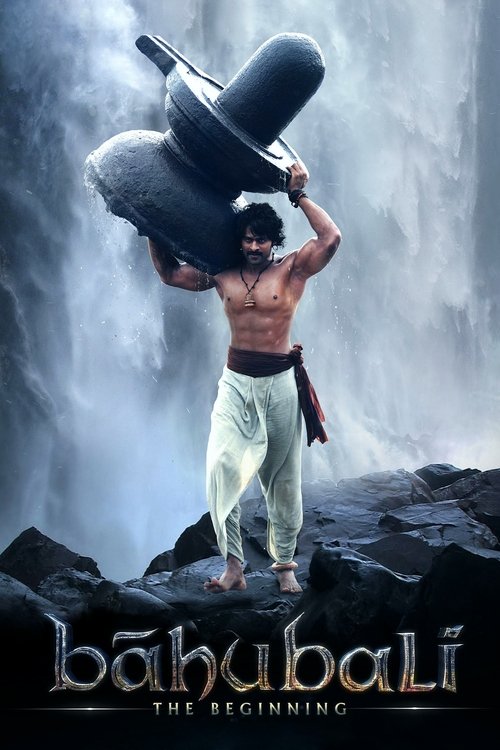
Bāhubali: The Beginning
2015 · S. S. Rajamouli
For when you want pure spectacle — a big, loud, larger-than-life legend to surrender to rather than analyze. Comfort viewing at maximum scale; just know it's part one of two and you'll want the sequel on deck.
What it's about
A foundling raised in a village at the base of a colossal waterfall grows into a young man of almost impossible strength, obsessed with climbing to whatever lies above. When he finally reaches the top he finds the gleaming warrior kingdom of Mahishmati, a masked rebel princess, a queen held captive for twenty-five years — and the first threads of his own hidden origins, which unspool into a generational saga of two royal cousins contending for a throne.
The experience
Huge, unashamed, and operatic — battles staged like myth, emotions turned up to temple-festival volume, and a first half of romance and adventure that hardens into war epic. It ends deliberately mid-story, on a question that hangs in the air, and the cliffhanger genuinely stings in the best way.
Performances
Prabhas carries the double demands of the role with easy physical charisma, and Ramya Krishnan brings genuine regal ferocity to the queen mother.
The craft
S. S. Rajamouli directs with a mythmaker's confidence, staging the waterfall ascent and the massive climactic battle as pure visual storytelling on a then-record Indian budget. The effects are ambitious rather than seamless, but the sheer scale of the imagery and the thundering score make this a film that demands the biggest screen and loudest speakers you can find.
Why it matters
It reorganized the commercial logic of Indian cinema — proving a Telugu-language epic could be a nationwide, all-audiences event and opening the door for the pan-Indian blockbuster era that followed. It won the National Film Award for Best Feature Film and made Rajamouli India's premier big-canvas director.
Snapshot
Bāhubali: The Beginning is the first half of a two-part Telugu-language epic — shot simultaneously in Tamil, dubbed into Hindi and Malayalam — that reorganized the commercial logic of Indian cinema. Its narrative is deliberately incomplete: a foundling raised by a tribal woman below a colossal waterfall climbs it, discovers the kingdom of Mahishmati above, and learns that he is the son of a murdered heir; the film then retreats into a generational flashback and stops, mid-revelation, on a question the audience is not permitted to answer. That structural audacity — releasing what is functionally a prologue as a standalone event film, and betting a record production budget on the audience returning two years later — is inseparable from what the film accomplished. It won the National Film Award for Best Feature Film for 2015, and its Hindi dub, presented by Karan Johar's Dharma Productions, performed at a scale that broke the long-standing assumption that Hindi cinema was India's default national cinema and that South Indian films traveled north only as remakes.
What the film is, formally, is a synthesis: the Telugu mythological-folklore tradition of K. V. Reddy and the Vittalacharya sorcery pictures, run through the vocabulary of post-300 digital spectacle, and structured by the moral grammar of the Mahabharata. It is neither a Hollywood imitation nor a heritage revival. It is a genuinely hybrid object, and its influence has been felt less as a set of images to copy than as a permission structure — proof that a regional-language film could be conceived from the outset as pan-Indian.
Industry & production
The film was produced by Shobu Yarlagadda and Prasad Devineni under Arka Media Works, and was widely reported at the time as among the costliest productions ever mounted in India — the specific figures that circulated in the trade press varied and are not reliable enough to cite. What is not in dispute is the scale of the commitment: two films shot as a single extended production, principally at Ramoji Film City in Hyderabad, across a schedule reported in the hundreds of shooting days. Rajamouli and his producers structured the project so that the sets, the digital assets, the cast contracts and the crew were amortized across both halves — an approach borrowed conceptually from Hollywood's back-to-back franchise shoots, but unprecedented in Telugu cinema at that budget.
The distribution strategy was the second half of the wager. Simultaneous Telugu and Tamil shooting (rather than post-hoc dubbing of the whole) gave the Tamil version a legitimacy dubbed releases usually lack. The Hindi version, however, was a straight dub — and the decision to attach Dharma Productions to it as presenter gave the film a marketing apparatus in the north that South Indian imports had historically never had. The result reframed "pan-Indian" from a distribution afterthought into a production premise. Within five years, films were being greenlit in Telugu and Kannada on the explicit assumption of a national release.
The Telugu industry's own conditions made this possible: a concentration of capital, a vertically integrated studio infrastructure at Ramoji, a mature local VFX labor pool in Hyderabad, and an audience culture that rewards scale and star-worship without embarrassment. Rajamouli had spent a decade building toward it — Chatrapathi (2005), Magadheera (2009), Eega (2012) — each escalating the ratio of effects to budget while keeping the emotional mechanics resolutely simple.
Technology
Bāhubali is a digitally captured, digitally constructed film, shot on Arri Alexa cameras and finished with a very high proportion of visual-effects work — Mahishmati exists almost entirely as digital extension, matte painting and CG environment above modest practical sets. The waterfall, the palace, the statue, the siege topography and the great plains of the Kalakeya battle are composites. V. Srinivas Mohan supervised the effects, and the Hyderabad-based Makuta VFX served as a principal vendor; the National Film Award for Best Special Effects went to Srinivas Mohan for the film.
The technological significance is less about any single tool than about localization. Indian VFX houses had for years worked as service vendors on foreign projects; Bāhubali demonstrated that a domestic production could carry a shot count of that magnitude through domestic facilities, at domestic cost, and hold up on an IMAX-scale screen. It also normalized extensive previsualization: Rajamouli storyboards and pre-visualizes exhaustively, which is what makes a green-screen-heavy shoot economically survivable — the plates are shot to a plan rather than discovered on set.
The mix was engineered for immersive multichannel exhibition, and the film's release coincided with the rapid upgrading of Indian multiplex sound systems — the low-frequency architecture of Keeravani's percussion and the Kiliki war chants were designed to be felt.
Technique
Cinematography
K. K. Senthil Kumar, Rajamouli's regular cinematographer since Magadheera, works in a palette of burnished gold, slate and desaturated earth, with skies pushed toward the bruised. The governing principle is scale legibility: the frame is repeatedly organized so that a human figure is measured against something enormous — a waterfall, a statue, a gate, a rank of soldiers. Extreme wide shots establish the ratio; the camera then moves in fast, often via digitally-assisted moves that ignore the physical constraints of a crane, sweeping through a battlefield or dropping down a cliff face.
Action is shot with the ramping vocabulary that 300 codified — speed shifts within a single shot to isolate an impact, then release. Senthil Kumar's contribution is that the ramps are motivated by the choreography rather than sprayed across it. The waterfall sequences use verticality as a compositional axis in a way that is rare in Indian action cinema, treating the cliff as a stage with a top and a bottom that mean different things: origin above, exile below.
Editing
Kotagiri Venkateswara Rao, a long-standing collaborator, cuts for elevation rather than continuity discovery. Because so much was pre-visualized, the edit is closer to assembly of an intended shape than the sculpting of found material — and the shape is a repeating build: setup, escalation, climactic tableau, hold. The film habitually pauses on an iconic image and lets it sit, a rhythm inherited from mythological cinema and from the poster-frame logic of star entrances.
The macro-structure is the more interesting editorial decision. The first film runs roughly two-and-a-half hours and consists of a foundling's ascent, a rescue mission, and then a hard pivot backward into the previous generation — a flashback that consumes the last act and ends on a withheld answer. This is an unusual proportioning: the "present" story is abandoned before resolution.
Mise-en-scène / staging
Sabu Cyril's production design gives Mahishmati a coherent invented architecture — Chola and Vijayanagara silhouettes inflated past plausibility, with a fondness for the monolithic. The kingdom is imagined vertically: waterfall, gate, palace, throne. Costume design by Rama Rajamouli and Prashanti Tipirneni color-codes the factions, and separates the tribal world below from the courtly world above by texture as much as hue.
Rajamouli stages for maximum readability. Geography in the battle sequences is explained before it is dramatized — the film literally stops to lay out the Kalakeya battle plan with a sand-table exposition, then executes it, so the audience can follow strategy as story. This is a more disciplined approach to large-scale action than most contemporaneous spectacle, and it is one of the film's genuine formal achievements. The statue-raising sequence is the clearest example of the film's method: an engineering problem, a physical solution, a heroic image, in that order.
Sound
M. M. Keeravani's score is built on massed choir, heavy percussion and modal melodic writing that reads as archaic without being ethnographic. The songs are comparatively few for a Telugu commercial film and function as narrative punctuation — "Dhivara" as ascent, the romance number as transformation, "Sivuni Aana" as martial invocation. Lyrics in Telugu are by K. Shiva Shakti Datta.
The film's most distinctive sonic invention is Kiliki, the constructed language spoken by the Kalakeya, devised by Madhan Karky. Giving the antagonists a genuine invented tongue rather than gibberish is a world-building gesture with clear debts to Tolkien adaptation, and it does real dramatic work: the enemy is unintelligible, and the film's sound design uses that unintelligibility as menace.
Performance
Prabhas plays both Shivudu and, in flashback, Amarendra Bāhubali, and the performance is largely a matter of physical construction — mass, stance, the deliberate slowing of movement that signifies royalty. Rana Daggubati's Bhallaladeva is played as appetite rather than cunning. The film's most substantial acting is elsewhere: Ramya Krishnan's Sivagami, the regent whose authority the film takes entirely seriously, and Sathyaraj's Kattappa, the oath-bound slave-general whose loyalty is to the throne rather than to any occupant — a performance of contained grief that the cliffhanger depends on entirely. Anushka Shetty (Devasena) and Tamannaah (Avantika) are given less room; Nassar's Bijjaladeva supplies the poisoned counsel.
A structural caveat: with the film shot in two languages and dubbed into two more, performance is distributed across bodies and voices in ways that vary by version. What a Hindi-language viewer assesses is not, strictly, the same performance a Telugu viewer assesses.
Narrative & dramatic mode
The mode is melodrama in the classical sense — moral legibility, kinship as destiny, coincidence as providence — not realism inflected with spectacle. The narrative spine is the foundling myth: an infant delivered from water, raised outside his inheritance, drawn upward by an unexplained compulsion. The resonances are Karna and Krishna before they are Moses, and Rajamouli's screenplay (from a story by his father, V. Vijayendra Prasad) does not disguise them.
The dramatic engine is the withheld past. Roughly two-thirds through, the film hands narration to Kattappa and the present tense evaporates. This produces the film's signature effect: the audience is watching a prequel embedded inside a sequel, and the emotional stakes of the "current" plot are retroactively subordinated to a story already concluded. The final line — Kattappa's admission of what he did — converted a plot beat into a national pastime for two years, and is probably the most effective use of a cliffhanger in Indian film history. It also exposes the film's limitation: judged alone, The Beginning is a first act. Its characters, particularly its women, are set up rather than developed.
Genre & cycle
The film sits at the junction of three lineages. First, the Telugu jaanapada (folklore) and mythological film — Patala Bhairavi (1951), Mayabazar (1957), the N. T. Rama Rao mythologicals, the Vittalacharya fantasies — with their kingdoms, sorcery, palace intrigue and frank artifice. Second, the Hollywood historical epic, from DeMille through Ben-Hur and Spartacus to Braveheart and Gladiator, from which it takes the arena of scale and the rebellion-against-tyranny plot. Third, the digital-fantasy cycle of the 2000s — The Lord of the Rings for world-building and invented language, 300 for the ramped, painterly battle idiom.
Within Indian cinema it inaugurated a cycle rather than joining one: the post-2015 "pan-Indian" period-spectacle, of which KGF (2018/2022), Ponniyin Selvan (2022), RRR (2022), Kantara (2022) and Kalki 2898 AD (2024) are the visible descendants.
Authorship & method
Rajamouli is an unusually explicit craftsman-auteur: he has described his method as emotion-first, working backward from the reaction he wants an audience to have to the mechanics that will produce it, and he pre-visualizes to a degree that makes the shoot an execution rather than an exploration. His stated formative influences are as much Amar Chitra Katha comics and Chandamama's illustrated serials as they are cinema — which explains the film's panel-like compositions and its comfort with unembarrassed iconography.
The collaboration is notably familial and long-standing. Story and narrative architecture come from his father, V. Vijayendra Prasad. The score is by his cousin M. M. Keeravani, with Telugu lyrics by Keeravani's father K. Shiva Shakti Datta. Costumes are by Rama Rajamouli. Senthil Kumar (camera) and Kotagiri Venkateswara Rao (editing) had by 2015 worked with him for years. Madhan Karky handled the Tamil dialogue and the Kiliki language; Sabu Cyril the production design; Peter Hein led the action choreography. This is a repertory system, and the consistency of Rajamouli's output owes much to it.
Movement / national cinema
Bāhubali is a Telugu film that declined to be a regional one. Its arrival is entangled with the Telugu industry's post-2014 conditions — the bifurcation of Andhra Pradesh and Telangana had reshaped the market and the politics of the region the year before, and critics have read the film's dynastic anxieties, its contested succession and its rhetoric of a rightful ruler against a usurper, against that backdrop. This is a reading rather than an authorial statement, and the film itself offers no direct commentary.
Its more demonstrable national-cinema consequence is structural. By succeeding at scale in Hindi as a dubbed film, it dismantled the hierarchy in which Bombay produced the national product and the South produced regional ones. The subsequent decade's traffic — Hindi-market releases of Kannada, Telugu and Tamil films as first-run events, and a corresponding crisis of confidence in Hindi commercial cinema — is directly traceable to July 2015.
Era / period
The film belongs to the mid-2010s moment when digital production had become cheap enough, and Indian screen infrastructure modern enough, that a domestically financed film could compete visually with imported spectacle in the same multiplex. It also belongs to the era of the franchise event film, the transmedia property and the two-part release — Hollywood habits that Bāhubali imported wholesale and, in the cliffhanger's case, deployed better than most of its models.
Themes
The central preoccupation is legitimacy: whether a throne belongs to the one born to it, the one chosen for it, or the one who can hold it. Sivagami's judgment — that the better man, not the elder, should rule — sets the tragedy in motion, and the film is honest enough to make her choice both correct and catastrophic. Around it cluster the Mahabharata's inherited materials: the cousins who cannot share an inheritance, the mother-figure whose ruling is fatal, and above all Kattappa as a Bhishma figure, bound by an oath to an office rather than a person — the exact mechanism the cliffhanger turns on.
Motherhood is tripled: Sivagami who raises and condemns, Sanga who shelters, Devasena who waits in chains. The film's women hold formal power and narrative significance well beyond genre norms, which makes its treatment of Avantika the more conspicuous failure — the sequence in which Shivudu unilaterally remakes the warrior into an object of desire drew sustained criticism on release, and the objection is not anachronistic hindsight but a contemporaneous one.
A second and equally serious critique concerns the Kalakeya, whose darkened makeup, invented tongue and coded barbarism reproduce a racialized opposition between civilization above and savagery outside. The film's world-building ingenuity and its othering are the same gesture, and a full account has to say so.
Reception, canon & influence
Critical reception was broadly strong, particularly on spectacle, world-building and control of large-scale action; the reservations clustered around thin characterization, the abrupt structural pivot into flashback, the gender politics of the romance, and the depiction of the Kalakeya. Institutional recognition was substantial: the National Film Award for Best Feature Film for 2015, and Best Special Effects for V. Srinivas Mohan.
Backward. The film's debts are legible and largely acknowledged by its maker: the Mahabharata and the Telugu mythological tradition; Amar Chitra Katha and Chandamama's illustrated fantasy; the Hollywood historical epic; 300 and The Lord of the Rings for the digital idiom. Mahishmati itself takes its name from the Puranic capital, an act of borrowed antiquity rather than invention.
Forward. Bāhubali 2: The Conclusion (2017) answered the question and went considerably further commercially. The more durable legacy is threefold. It established the pan-Indian production model, under which regional-language films are conceived, budgeted and marketed for simultaneous national release — the template for KGF, Pushpa, RRR, Kantara and their successors, and for a wave of period-mythological maximalism whose failures (Adipurush, 2023) are as instructive as its successes. It demonstrated that Indian VFX capacity could carry a tentpole domestically. And it initiated transmedia expansion as standard practice for Indian franchises: Anand Neelakantan's prequel novels beginning with The Rise of Sivagami (2017), the animated series Baahubali: The Lost Legends, graphic novels, and a live-action prequel series announced for streaming that was repeatedly reworked.
Its influence on Rajamouli's own work is direct: RRR (2022) applies the same architecture — invented history, two mythically scaled men, emotional mechanics engineered in advance — to a global audience, and won an Academy Award for Keeravani's "Naatu Naatu," a trajectory that begins with the choir and drums of Mahishmati.
Reception
A monster hit on release — its dubbed Hindi version stunned the trade by conquering audiences far outside Telugu cinema's usual reach — and it's now seen as the film that invented the modern 'pan-Indian blockbuster,' the direct ancestor of RRR, KGF and Pushpa.
How Bāhubali: The Beginning was received, from release to now →
How to watch Bāhubali: The Beginning: what to notice on a first viewing
- Count the shots that put one person beside something enormous. Senthil Kumar builds nearly every frame as a ratio. A man against a waterfall, a statue, a gate, a rank of soldiers. The extreme wide establishes the proportion, then the camera rushes in along a path no crane could take. The size of this world is argued by composition rather than dialogue, so you feel the scale before anyone tells you about it.
- Look at the cloth. Compare what people wear below and above. The tribal world under the falls is rough weave, earth, skin. The court of Mahishmati is metal, dye and weight. Rama Rajamouli and Prashanti Tipirneni separate the two worlds by texture as much as by color, and color-code the factions on top of that. You can read who belongs where and who is out of place by fabric alone, which keeps a crowded story legible.
- Listen for the language the Kalakeya speak that nobody translates. Madhan Karky built Kiliki as a real invented tongue rather than noise. It has its own consistent sounds, and the film never subtitles it into sense. The sound design lets the unintelligibility sit as threat. Not understanding the enemy is the point, which is also where the film's world-building and its othering turn out to be the same gesture.
- Watch the film stop and lay out a battle plan before fighting. Rajamouli explains geography before he dramatizes it. A sand table, a diagram, a plan spoken aloud. Then the battle executes that plan and you can follow the strategy as story rather than as noise. Knowing the map turns spectacle into something you can track, which is why a huge battle here stays readable.
- Notice the speed changing inside a single shot during a fight. The action uses the ramping idiom that 300 codified. Motion slams into slow motion to isolate one impact, then releases back. Senthil Kumar ties each ramp to a beat in the choreography instead of spraying them over the sequence. The speed shifts tell you what the film wants you to register as the blow that matters.
The whole guide to watching Bāhubali: The Beginning, with the keys for a rewatch →
Influences: the films it descends from and the films it influenced
- Patala Bhairavi (1951) — Codified the Telugu jaanapada grammar Bāhubali runs on — lowborn hero, sorcerer-antagonist, and an episode structure in which each ordeal is a discrete, rule-bound set piece the audience is taught the rules of before it begins.
- Mayabazar (1957) — K. V. Reddy's optical trickery and painted-glass palaces taught the Telugu mythological how to build impossible architecture that still reads as inhabitable space, presented frontally in held tableaux of unembarrassed divine iconography — the compositional habit Sabu Cyril and Senthil Kumar continue digitally.
- Mughal-e-Azam (1960) — Asif's Sheesh Mahal was a set built to be photographed rather than a reconstruction of any real palace, legitimizing invented antiquity as production design — the identical move by which 'Mahishmati' borrows a Puranic name for a wholly fabricated capital.
- Ben-Hur (1959) — The chariot race establishes the entire circuit in wide masters before cutting inside it, so every close-up stays spatially placed — the orientation discipline governing Rajamouli's Kalakeya battlefield, where each tactic is diagrammed in a wide before it is executed.
- Conan the Barbarian (1982) — Stages the hero's constructed physique as narrative evidence (the wheel of pain) while Poledouris scores it with choral-and-drum ostinato rather than melody — Prabhas's body and Keeravani's massed Mahishmati chant reproduce both halves of that pairing.
- The Lord of the Rings: The Return of the King (2003) — Supplies the digital idiom of crowd simulation plus tiered vertical siege architecture, and the virtual camera that dives down Minas Tirith's levels — the vocabulary behind Mahishmati's terraced city and the plunging descents over the waterfall.
- 300 (2006) — The in-shot speed ramp — accelerating and decelerating within one continuous take to isolate a single kill as a legible beat — plus the composited backlot and the held heroic tableau; Rajamouli applies the ramp wholesale to Peter Hein's choreography.
- Apocalypto (2006) — Sustains feature-length subtitled dialogue in a language no audience speaks, carrying antagonist menace through phonetics and performance rather than semantics — precisely the device of the Kalakeya's Kiliki scenes, and the source of the same representational problem.
- Avatar (2009) — Cameron's virtual camera let shots be composed inside a fully synthetic environment after capture, and Paul Frommer's commissioned Na'vi established the linguist-built constructed language — the twin templates for Rajamouli's vertical-axis camera moves and Madhan Karky's Kiliki.
- Magadheera (2009) — Rajamouli's own trial run: the hundred-man continuous-flow sword melee with Senthil Kumar's swooping camera, an embedded past-life flashback that retroactively reframes the present-day romance, and the Keeravani–Kotagiri–Vijayendra Prasad repertory already fully assembled.
- Eega (2012) — Proved a Telugu film could carry an entire narrative on a domestically built VFX pipeline under shot-by-shot previsualization, making the shoot an execution rather than an exploration — the exact production method scaled up under V. Srinivas Mohan.
- Baahubali 2: The Conclusion (2017) — Extends the emotion-first engineering into set pieces designed backward from a target reaction — the palm-tree catapult siege staged as a solvable physics puzzle the audience can follow move by move — and discharges the cliffhanger the first film's embedded flashback deferred.
- K.G.F: Chapter 1 (2018) — Transplants the structural apparatus — a long-deferred hero introduction resolved in a held tableau, and a chronicler's framing narration that encases the whole past — onto a Kannada production released simultaneously in five languages on Bāhubali's distribution template.
- RRR (2022) — Reapplies the identical architecture — invented history, two mythically scaled bodies, mechanics reverse-engineered from the intended audience reaction — with Keeravani's choral-percussive engine, begun with Mahishmati's drums, carried to 'Naatu Naatu'.
- Kantara (2022) — Takes the jaanapada-folklore strand rather than the mythological one, building its climax on Bhoota Kola ritual performance as literal physical possession — pursuing Bāhubali's demonstration that regionally specific folk material could carry a national release.
- Adipurush (2023) — Instructive failure of the same template: renders environments, armies and creatures almost entirely in CG without the practical anchors — real cloth, real elephants, real crowd extras cut into the wides — that give Bāhubali's synthetic scale its weight and legibility.
- Kalki 2898 AD (2024) — Grafts Mahabharata material onto invented architecture with Prabhas again as the mythically scaled body, structured as a part-one withhold, and financed as an Indian-led VFX tentpole on the domestic capacity Bāhubali proved existed.
- Ponniyin Selvan: I (2022) — A two-part historical epic split on a cliffhanger at a budget Bāhubali's market made available, but inverting the craft — practical locations, real Chola-era referents and dense political plotting where Rajamouli used invented architecture and deliberately simplified stakes.
Similar films
- RRR (2022) — influence & lineage
- Kantara (2022) — influence & lineage
- Mayabazar (1957) — influence & lineage
- Avatar (2009) — influence & lineage
- Bāhubali 2: The Conclusion (2017) — shared sensibility
- Black Panther (2018) — shared sensibility
- Thalapathi (1991) — shared sensibility
- Nuvvostanante Nenoddantana (2005) — shared sensibility