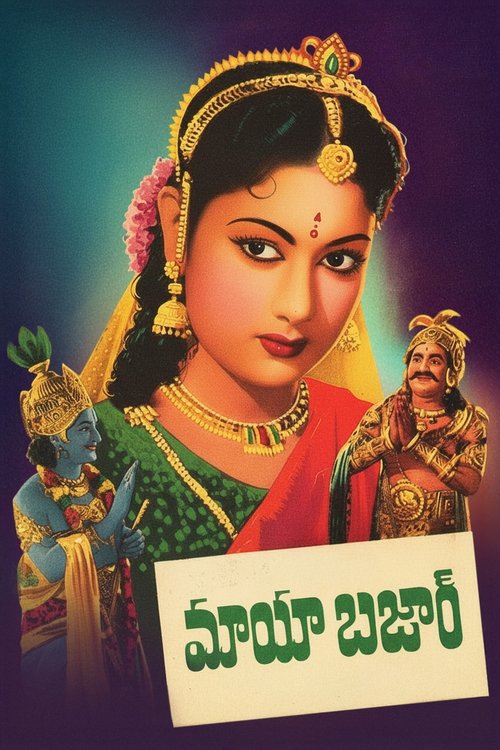
Mayabazar
1957 · Kadri Venkata Reddy
For a family movie night when you want enchantment and belly laughs in equal measure — pure comfort viewing, the kind of classic you put on to feel that old-fashioned storybook delight.
What it's about
A promised wedding falls apart when politics intervenes: Balarama vowed his daughter Sasirekha would marry Abhimanyu, son of Arjuna, but once the Pandavas lose their kingdom the match is called off in favor of a more advantageous one. Enter Ghatotkacha, Krishna's mischievous demigod nephew, who deploys a whole bazaar of magical illusions to reunite the young lovers and humiliate the schemers who broke the promise. It's a folk episode grafted onto the Mahabharata, played as pure fantasy-comedy rather than solemn scripture.
The experience
Playful from the first trick to the last — a mythological where the gods wink at you. The pranks escalate with glee, the songs land like set pieces, and even the villains' comeuppance feels affectionate rather than cruel. Three generations of families have watched it together for a reason.
Performances
S.V. Ranga Rao's Ghatotkacha is one of Indian cinema's great comic creations — a giant of appetite and mischief who steals the film — with N.T. Rama Rao's serenely sly Krishna and Savitri's sparkling Sasirekha around him.
The craft
This is the crown jewel of the Madras studio era: lavish Vijaya Productions sets, beloved songs, and trick photography that still charms — objects flying, feasts vanishing, illusions stacked on illusions, all done in-camera decades before digital effects. The craft is the point: it's a film about magic that was itself a magic trick of 1950s filmmaking.
Why it matters
Routinely voted the greatest Indian film ever made in national polls, it set the standard for the mythological genre and remains the most beloved Telugu film of its studio golden age.
Snapshot
Mayabazar is the crowning achievement of Telugu mythological cinema's studio era: a bilingual fantasy-comedy produced by Vijaya Productions in Madras, released in Telugu and Tamil in 1957. It dramatizes Sasirekha Parinayam ("The Wedding of Sasirekha"), a folk episode grafted onto the Mahabharata rather than found in Vyasa's canonical text. The betrothal of Abhimanyu (son of Arjuna) and Sasirekha (daughter of Balarama) is broken under political pressure once the Pandavas fall on hard times; the mischievous demigod Ghatotkacha, nephew to Krishna, engineers a cascade of illusions—the "maya bazar," or bazaar of illusions—to reunite the lovers and humiliate the schemers. The film fuses devotional spectacle, romance, slapstick, and trick photography into a work that has proven unusually durable: in a 2013 CNN-IBN online poll marking the centenary of Indian cinema, Mayabazar was voted the greatest Indian film of all time, and its 2010 digital colorization returned it to theaters to substantial popular response. It is remembered above all for S. V. Ranga Rao's Ghatotkacha, for Ghantasala's score, and for Marcus Bartley's celebrated "moonlight" cinematography.
Industry & production
The film was produced by Vijaya Productions, the banner run by B. Nagi Reddy and Aluri Chakrapani, then among the most powerful and disciplined studios in South Indian cinema. Vijaya operated out of the Vijaya Vauhini Studios in Madras (Chennai), for a time reputedly the largest studio complex in Asia, and the company's house style prized elaborate sets, strong music, and tight narrative craftsmanship. Mayabazar extended a successful partnership: director K. V. Reddy had already delivered the folkloric blockbuster Pathala Bhairavi (1951) for Vijaya, and the studio's ambition to top that spectacle is evident throughout.
Like many major South Indian productions of the period, Mayabazar was made simultaneously as a bilingual—shot in Telugu and Tamil to serve two large markets from a single production base. The core cast of bilingual stars carried both versions, though some roles were recast for the Tamil edition; by most accounts Abhimanyu, played by Akkineni Nageswara Rao in Telugu, was taken by a different actor in Tamil, and the specifics of the Tamil supporting cast are recorded less consistently than the Telugu, so exact substitutions should be treated with some caution. The scale of the sets, the number of songs, and the volume of optical effects made this an expensive, long-gestating production; precise budget and box-office figures vary between sources and are not reliably documented, so no specific numbers are claimed here.
Technology
Mayabazar was made in black-and-white on 35mm, and much of its reputation rests on how inventively its makers pushed the available optical and photographic technology. The signature technical set piece is the song "Lahiri Lahiri Lahiro," in which Abhimanyu and Sasirekha drift in a boat under moonlight. Cinematographer Marcus Bartley is widely credited with manufacturing the moonlight illusion in daylight through controlled reflected light—an effect achieved on set and in camera rather than through the tinting or day-for-night conventions then common—and the sequence became a textbook example of atmospheric monochrome lighting in Indian cinema.
The "maya bazar" and the demonic-magical sequences depend on a battery of trick effects: superimpositions, matte work, in-camera dissolves, disappearances and multiplications, and the enlargement and shrinking of figures. The film is frequently cited for early, imaginative use of stop-motion and animation in the comic banquet song "Vivaha Bhojanambu," where food appears, moves, and is consumed at impossible speed as Ghatotkacha's forces feast. These effects were labor-intensive optical achievements of the studio era rather than the product of any single proprietary technology.
The film's most consequential later technological chapter came in 2010, when Goldstone Technologies of Hyderabad released a digitally restored and fully colorized version of the Telugu film for theatrical release—one of the more prominent Indian film colorization projects of its time, and part of what renewed Mayabazar's public profile for a new generation.
Technique
Cinematography
Marcus Bartley, the Anglo-Indian cinematographer long associated with Vijaya, is the film's decisive visual author after the director. Beyond the famed moonlight sequence, his work gives Mayabazar a luminous, high-contrast clarity that flatters both the intimate romantic passages and the crowded, effect-laden spectacle scenes. His lighting has to serve two very different registers—devotional grandeur and comic illusion—and the coherence of the film's look across those registers is a large part of why the effects read as enchanting rather than merely mechanical.
Editing
The film's editing sustains a long running time (roughly three hours) across shifts between court intrigue, romance, comedy, and set-piece spectacle without losing momentum, and the trick sequences in particular required precise cutting to sell their optical gags. The editing is generally credited to C. P. Jambulingam and G. Kalyanasundaram; as with several technical credits of the period, attributions can vary between sources, so these should be read as the commonly cited names rather than as certainties.
Mise-en-scène / staging
Art direction is credited to Madhavapeddi Gokhale and Kaladhar, and the production design is central to the film's identity. The "maya bazar" itself, the palace interiors, and the mythological spaces are staged with the theatrical amplitude of the studio mythological—large painted and constructed sets, symmetrical processional blocking, and costuming and ornamentation that signal the divine and the royal. The staging deliberately alternates scale: grand tableaux for the gods and courts, and tighter, more physical comic framing for Ghatotkacha's disguises and the banquet mayhem.
Sound
The film is built around its songs, and sound is inseparable from its dramaturgy. Ghantasala's compositions and the recorded playback are foundational, and the comic sequences depend heavily on synchronized sound effects to sell the magical gags. As a studio-era production, the film relied on playback singing and post-synchronized sound typical of the industry at the time.
Performance
Performance is where Mayabazar has aged most gracefully. S. V. Ranga Rao's Ghatotkacha is the film's engine—a towering, warm, mischievous comic-heroic turn that is routinely named among the greatest performances in Indian cinema. N. T. Rama Rao's Krishna established a template that he would return to across his career; his serene, knowing divinity anchors the film's moral universe. Savitri, as Sasirekha, moves fluidly between tenderness, wit, and the mimicry demanded by the impersonation plot, and is often singled out for the film's emotional credibility. Akkineni Nageswara Rao brings a lyric romanticism to Abhimanyu, and the ensemble of comic and character players fills out a densely populated world.
Narrative & dramatic mode
The dramatic mode is romantic fantasy-comedy layered over mythological melodrama. The engine of the plot is a broken promise: a betrothal honored in good times is repudiated when the Pandavas lose their fortune, exposing the gap between dharmic obligation and worldly expedience. The film's satisfaction comes from watching a wrong righted not by battle but by trickery—illusion deployed in the service of justice and love. Ghatotkacha's interventions turn the second half into a comedy of disguise and deception, in which the villains are undone by their own greed and gullibility. Krishna presides as the benevolent orchestrator whose apparent passivity conceals a governing design, a structure that lets the film be both a rollicking entertainment and a devotional affirmation that a divine order ultimately prevails.
Genre & cycle
Mayabazar sits at the confluence of two dominant South Indian genres: the mythological (stories drawn from the epics and Puranas) and the folklore/fantasy film of magic and trick photography that Vijaya and K. V. Reddy had helped popularize with Pathala Bhairavi. What distinguishes it within the mythological cycle is its comic register—it treats sacred material with affection and humor rather than solemnity—and its emphasis on romance and spectacle over doctrinal exposition. It belongs to the mid-century golden age of Telugu and Tamil studio cinema, when mythologicals and folklore fantasies were prestige productions rather than marginal fare.
Authorship & method
The film is a studio-authored work in the fullest sense, but K. V. Reddy's directorial control gives it a distinct signature: meticulous pre-planning, a gift for pacing spectacle, and an ability to marry effects to emotion. His collaboration with the Vijaya production heads—Nagi Reddy's production discipline and Chakrapani's story sense—shaped the project's ambitions.
The writing is inseparable from Pingali Nagendra Rao, who supplied the dialogues and song lyrics. Pingali's verbal invention—coinages, playful compounds, and quotable comic and devotional lines—is a major reason the Telugu version is so deeply embedded in cultural memory; several of his phrasings passed into common usage. Ghantasala's music direction produced a song suite that has outlived the film's other elements in everyday circulation. Marcus Bartley's cinematography, the Gokhale–Kaladhar art direction, and the effects and editing teams complete a rare instance of nearly every department operating at peak form simultaneously. The film is thus best understood as the product of a well-oiled studio at its zenith, coordinated by a director with exceptional command of tone.
Movement / national cinema
Mayabazar is a landmark of South Indian cinema specifically and of the Indian studio system generally. It belongs to no avant-garde "movement" but rather exemplifies the commercial-artistic peak of the Madras studio mythological/folklore tradition, and it demonstrates the bilingual production model that allowed South Indian studios to serve multiple linguistic markets efficiently. Within Telugu cinema it is canonical to the point of being foundational; within the broader national story it stands as evidence that popular genre filmmaking could achieve enduring artistic stature.
Era / period
Made in 1957, the film sits in the confident middle of the post-Independence studio era, before the star-and-outdoor spectacle economy of later decades reshaped the industry. It captures a moment when large integrated studios like Vijaya Vauhini could marshal in-house talent across every craft, when the mythological was still a prestige genre, and when technical innovation was pursued in-camera by ingenious craftspeople rather than outsourced. Its later colorization and re-release place it in a second period of reception, in which classic Indian cinema became an object of heritage restoration.
Themes
At its center the film weighs promise and betrayal, and the tension between social ambition and moral duty—the broken betrothal is a small domestic wrong that stands in for larger questions of loyalty and honor. It celebrates love that persists against the manipulations of the powerful. It thematizes maya, illusion itself: the film delights in the idea that appearances can be bent, and it makes the manipulation of reality a moral instrument, wielded by the just to expose the deceit and greed of the unjust. Running beneath the comedy is a devotional affirmation of Krishna's providence—the notion that a benevolent divine intelligence quietly authors events toward a righteous end. And in Ghatotkacha it offers a warm vision of the outsider-hero: the half-demon nephew whose loyalty and appetite for mischief make him the story's most humane figure.
Reception, canon & influence
Mayabazar was a major popular success on release and has only grown in stature. Its performances, songs, dialogues, and effects entered the permanent vocabulary of Telugu popular culture, and it is routinely placed at or near the top of lists of the greatest Telugu and Indian films; the 2013 CNN-IBN centenary poll naming it the greatest Indian film of all time is the most frequently cited marker of that canonical standing. The 2010 colorized re-release confirmed its cross-generational appeal.
Looking backward, the film draws on a pre-existing tradition: the Sasirekha Parinayam folk episode had already been filmed in the 1930s (including earlier Telugu and Tamil versions bearing the Mayabazar title), so the 1957 film is a definitive reworking of familiar material rather than a first adaptation. It also builds directly on the folklore-fantasy idiom K. V. Reddy and Vijaya had established with Pathala Bhairavi.
Looking forward, its influence is broad but diffuse: it set a benchmark for the mythological and fantasy genres in South Indian cinema, helped fix N. T. Rama Rao's enduring association with the role of Krishna, and demonstrated that trick photography and lavish design could be marshaled in service of a beloved popular classic. Its songs remain in active circulation, and its images—the moonlit boat, Ghatotkacha at the banquet—function as shorthand for the golden age of Telugu cinema. The precise chains of technical influence on later filmmakers are more often asserted than documented, and specific claims of direct homage should be treated cautiously; what is beyond dispute is the film's status as a touchstone against which subsequent Telugu and Tamil fantasy spectacle has been measured.
Reception
A blockbuster on release in 1957 and never really out of favour — but its stature kept climbing, capped in 2013 when a CNN-IBN poll for Indian cinema's centenary named it the greatest Indian film of all time.
How Mayabazar was received, from release to now →
How to watch Mayabazar: what to notice on a first viewing
- Notice moonlight that was actually filmed at noon. Marcus Bartley builds the boat sequence's silvery night glow with reflected light and filters in broad daylight, an illusion achieved entirely on set and in camera. The trick is invisible until you know it's there, which is exactly how the whole film wants its magic to work.
- Watch for figures appearing, vanishing, or changing size. Superimpositions, matte work, and in-camera dissolves let people multiply, shrink, or disappear entirely, all achieved without any effect you'd recognize as modern. Every illusion was built by hand in front of the camera, which is part of why it still delights.
- Notice the staging shift from grand halls to tight comedy. Symmetrical processional blocking and painted sets mark the scenes with gods and courts, while the comic disguise and banquet scenes tighten into busier, more physical framing. The staging itself tells you whether you're in a devotional moment or a comic one.
- Listen for how often the story pauses for a song. Ghantasala's compositions and playback singing carry romance, devotion, and comedy alike, so the songs are never decoration but the dramaturgy's main vehicle. The music is doing structural work, not just filling space between scenes.
- Watch how much warmth Ranga Rao brings to Ghatotkacha. S. V. Ranga Rao plays the half-demon nephew as towering, mischievous, and genuinely warm, making him the film's most human figure despite his size and trickery. His warmth is what turns pure spectacle into a character you actually care about.
The whole guide to watching Mayabazar, with the keys for a rewatch →
Influences: the films it descends from and the films it influenced
- RRR (2022) — The foundational Telugu mythological-spectacle film whose trick-photography 'wonder' set pieces and NTR-scale mythic staging RRR consciously channels into its interval and pre-climax tableaux.
- Bāhubali 2: The Conclusion (2017) — Marcus Bartley's in-camera trick photography (the Lahiri Lahiri moonlight boat, the Ghatotkacha scale illusions) established spectacle-by-optical-invention inside a Mahabharata-apocrypha frame — the same contract Rajamouli renegotiates with VFX, where the effect is a magic trick performed for a devotional audience, not a realism claim.
- Bāhubali: The Beginning (2015) — K. V. Reddy's optical trickery and painted-glass palaces taught the Telugu mythological how to build impossible architecture that still reads as inhabitable space, presented frontally in held tableaux of unembarrassed divine iconography — the compositional habit Sabu Cyril and Senthil Kumar continue digitally.
- Pathala Bhairavi (1951) — The film Mayabazar directly extends: K.V. Reddy and the Vijaya team's folklore-fantasy template of trick-photography set-pieces welded to a comic-heroic lead (SVR/NTR) and quotable Pingali dialogue, established here first.
- Mayabazar (1936) — Earlier Telugu filming of the same Sasirekha Parinayam episode, supplying the comedy-of-disguise armature (Ghatotkacha impersonating Sasirekha) that the 1957 film definitively reworks rather than invents.
- Chandralekha (1948) — Set the Madras-studio benchmark for spectacle pacing and massive built tableaux — the drum-dance/arena logic of staging scale for its own sake that Mayabazar's banquet and durbar sequences inherit.
- Bhakta Prahlada (1932) — As the first Telugu talkie it founded the mythological genre's grammar of devotional song-staging and divine-intervention tableaux that Mayabazar operates within a generation later.
- Sant Tukaram (1936) — Pioneered optical-effect 'miracle' shots (the aerial chariot, materializing deities) that made trick photography a legitimate devotional device, a precedent for Mayabazar's magical apparitions.
- Dhoop Chhaon (1935) — Introduced playback singing to Indian cinema — the recording technique that makes Ghantasala's pre-recorded song suite (lip-synced by NTR/Savitri) possible.
- The Thief of Bagdad (1940) — Model for compositing a fantasy world in-camera: traveling mattes and forced-perspective giants (the genie) as the Western template behind Mayabazar's scale-shifting Ghatotkacha trick shots.
- Metropolis (1927) — Its Schüfftan-process mirror-and-miniature compositing established how to fuse actors with impossible built space in high-contrast monochrome, the optical logic underlying Mayabazar's illusory bazaar.
- King Kong (1933) — Canonized stop-motion and miniature creature/scale spectacle integrated with live actors, the international reference point for animating an oversized figure into a dramatic scene.
- Mayabazar (Tamil) (1957) — Simultaneously shot sibling version sharing the same sets, effects rigs, and Bartley cinematography — a bilingual studio-system practice of amortizing one spectacle across two markets.
- Nartanasala (1963) — Extends the studio-mythological tableau of the Mahabharata cycle — painted-backdrop durbars and stylized declamatory performance — carrying forward Mayabazar's post-independence mythological staging.
- Jagadeka Veeruni Katha (1961) — K.V. Reddy reprises his own folklore-fantasy method with NTR — episodic trick-photography quests and optical apparitions paced as spectacle — a direct continuation of Mayabazar's craft.
Similar films
- The Thief of Bagdad (1940) — influence & lineage
- Bāhubali 2: The Conclusion (2017) — shared sensibility
- Bāhubali: The Beginning (2015) — shared sensibility
- RRR (2022) — shared sensibility
- Tumbbad (2018) — shared sensibility
- Superboys of Malegaon (2025) — shared sensibility
- Goopy Gyne Bagha Byne (1969) — shared sensibility
- Nayakan (1987) — shared sensibility