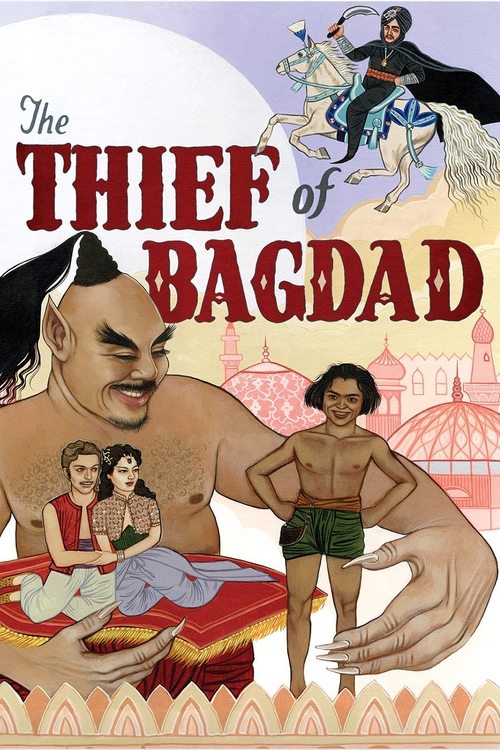
The Thief of Bagdad
1940 · Michael Powell
For family movie night, a rainy Sunday, or whenever you want to feel eight years old again — total comfort viewing, the kind of film you put on to remember why you love movies.
What it's about
A young prince is blinded and thrown from power by his treacherous vizier Jaffar, a sorcerer with designs on both the throne of Bagdad and a beautiful princess. The prince's fortunes rest with Abu, a fearless little thief with a genius for trouble, whose adventures sweep in a giant djinn freed from a bottle, a flying carpet, a mechanical horse, and a spider the size of a room.
The experience
Pure storybook wonder — bright, swift, and openly magical, with a villain you love to hiss and set pieces that still make you grin at their nerve. It has the unhurried, campfire rhythm of a tale being told, and it's a joy at any age.
Performances
Sabu is irresistible as Abu — quick, cocky, and completely natural — while Conrad Veidt's Jaffar is one of the screen's great villains, all silken menace and burning eyes, and Rex Ingram plays the djinn with booming, mischievous grandeur.
The craft
This is Technicolor at its most ravishing — Oscar-winning color cinematography, art direction, and special effects that conjured flying carpets and giant genies decades before computers, all in production-designed hues that look like illuminated manuscript pages. On a big bright screen it's still astonishing.
Why it matters
The high-water mark of pre-war fantasy filmmaking, it set the template for screen Arabian Nights adventures and directly inspired generations of effects artists and fantasy filmmakers — its fingerprints are on decades of blockbuster spectacle, including Disney's own tellings of the genie story.
Snapshot
The Thief of Bagdad is the most lavish fantasy British cinema produced before the war interrupted it, and one of the strangest authorship problems in the medium: a film with three credited directors, at least three uncredited ones, two countries of production, and a single unmistakable sensibility — Alexander Korda's — presiding over all of it. Begun at Denham Studios in 1939 and finished in Hollywood and the American Southwest in 1940, it arrived in cinemas at the end of that year, as Britain was being bombed, offering audiences a three-strip Technicolor Arabian Nights in which a usurping tyrant is undone by a boy who refuses to be governed.
It won three Academy Awards — for Georges Périnal's color cinematography, Vincent Korda's art direction, and the special effects of Lawrence Butler and Jack Whitney — and it earned Miklós Rózsa his first Oscar nomination. Its technical achievements, particularly its blue-backing traveling mattes, became foundational to the grammar of screen fantasy. Its politics, particularly its imperial-Orientalist idiom and its casting, are equally foundational and considerably less comfortable. Both facts have to be held at once.
Industry & production
The film belongs to Korda's London Films, the enterprise through which a Hungarian émigré producer tried to build a British cinema that could compete internationally rather than fill quota obligations. Korda had already run a cycle of Technicolor imperial adventures — The Drum (1938), The Four Feathers (1939) — and had made a star of Sabu Dastagir in Elephant Boy (1937). The Thief of Bagdad was conceived at the top of that ambition, drawing openly on the 1924 Douglas Fairbanks vehicle directed by Raoul Walsh and designed by William Cameron Menzies. Menzies himself worked on the 1940 film, uncredited.
Production began in England in 1939 and was overtaken by the outbreak of war in September. Denham's resources were requisitioned by other priorities; Korda turned the studio's energies briefly toward The Lion Has Wings (1939), a rapid propaganda feature, and then moved The Thief of Bagdad to the United States, where it was completed at rented Hollywood facilities with exteriors shot in the American Southwest — the Grand Canyon and desert locations standing in for the lands the Djinni carries Abu across. Earlier British coastal work had already been shot on the Cornish and Devon coasts. The film is therefore a genuine transatlantic hybrid, and part of Korda's broader relocation to America, where he continued producing and cultivating British interests through the early war years.
Credited direction went to Ludwig Berger, Michael Powell and Tim Whelan. Berger, a German émigré, was Korda's original choice; Korda grew dissatisfied and brought in Powell and Whelan alongside him rather than firing him outright. Powell's memoir A Life in Movies gives the fullest surviving account of the arrangement, and it is Powell's version — including the famous maneuver of commissioning music from Rózsa that effectively boxed Berger in — that has shaped the historical record. It should be read as an interested account. Zoltan Korda and Alexander Korda himself also directed material, as did Menzies. Precise scene-by-scene attribution is genuinely contested; the most defensible statement is that Powell handled a substantial share of the fantasy set-pieces involving Sabu, the Djinni and the flying horse, and that Korda supervised the whole with a producer's authority closer to a studio-era Selznick than to a hands-off financier.
Budget and returns are often quoted loosely in the literature. The reliable claim is comparative: it was among the most expensive British productions of its era, and its costs were inflated by the interruption and transatlantic move.
Technology
The film is a landmark in optical effects. Lawrence Butler's unit developed and deployed blue-backing traveling mattes at a scale and quality not previously attempted, and the film is widely credited as the production that established the blue-screen composite as a practical tool for feature work rather than a laboratory curiosity. The Academy's special effects award — split then between photographic and sound achievement, and shared here by Butler and Jack Whitney — recognized precisely this.
Three-strip Technicolor is the second technological fact. Britain had only recently begun making color features, and Korda had committed to the process ahead of most of his domestic competitors. Technicolor at this date imposed heavy lighting loads, a bulky camera blimp, and the supervisory presence of Technicolor's own color consultants — constraints that shaped both the palette and the staging.
The rest of the toolkit is pre-digital craft at its peak: glass shots and matte paintings supervised by W. Percy Day, whose work would later underwrite the illusions of A Matter of Life and Death and Black Narcissus; hanging miniatures; forced perspective; wire work for the magic carpet; a mechanical flying horse; and forced-perspective and scale-double compositing for the Djinni, so that Rex Ingram's giant and Sabu's boy occupy the same frame without either reading as a cut-out.
Technique
Cinematography
Périnal's Technicolor is not naturalistic and does not pretend to be. He and Vincent Korda treat color as a dramatic instrument: cobalt and turquoise for the magical register, hot golds and reds for the courts of Bagdad and Basra, near-monochrome desaturation for the beggar sequences. The Technicolor of the period tended toward the garish in less disciplined hands; here the palette is organized, with large fields of a single saturated hue against which a contrasting costume or object reads as an event. Osmond Borradaile, Korda's regular exteriors specialist, contributed location photography. The camera is generally stable and composed rather than restless — partly a Technicolor constraint, partly a design decision, since the frames are built to be looked into.
Editing
Charles Crichton cut the film, under the supervising editorship of William Hornbeck; Crichton would shortly become one of Ealing's defining directors. The editing problem here is unusual: a large proportion of the picture had to be pre-visualised because the composites, mattes and scale effects could not be improvised in the cutting room. The result is a film that alternates between long, held, pictorial shots — the reveal of the Djinni, the ascent to the Temple of the Dawn — and brisk, almost farcical cutting in the marketplace and escape sequences. The nested flashback structure, in which the blind beggar Ahmad narrates his fall before the film returns to the present, is managed cleanly enough that the device rarely calls attention to itself.
Mise-en-scène / staging
Vincent Korda's designs are the film's most durable achievement. He builds spaces at deliberately inhuman scale — Jaffar's palace stairs, the temple interior, the vault of the All-Seeing Eye — so that human figures are dwarfed by architecture, which is both a fairy-tale effect and a political one. The Silver Maid, the mechanical dancer with six arms that Jaffar deploys as a murder weapon, and the great toy horse are objects designed to be simultaneously beautiful and sinister: the film's recurring idea that craft in the service of tyranny becomes monstrous. Staging favours the tableau, with figures arranged in depth against painted or matted backgrounds, in a manner descended from silent-era spectacle.
Sound
The sound design's central task is scale — making the Djinni's voice and laughter belong to a body forty feet tall, and making the wind, smoke and stone of the fantasy sequences convincing enough to carry the composites. Whitney's share of the effects Oscar acknowledges this work. Rózsa's score is the dominant sonic element throughout; the film is nearly wall-to-wall music, with dialogue scenes frequently underscored. Sabu's song and the film's other vocal numbers are integrated as diegetic performance rather than as musical-comedy interruptions.
Performance
The performances run on three quite different registers. Conrad Veidt's Jaffar is the film's center of gravity: a controlled, sorrowful, erotically frustrated tyrant, played with the stillness Veidt had refined since The Cabinet of Dr. Caligari and his UFA years. Sabu's Abu is all velocity and appetite, an acrobatic performance descended directly from Fairbanks. Rex Ingram's Djinni is the film's most complicated element — a huge, roaring, mocking presence, and the only figure in the picture who explicitly negotiates the terms of his own servitude. John Justin's Ahmad and June Duprez's Princess are the conventional romantic leads, deliberately less interesting than the forces around them; Miles Malleson, who also wrote the screenplay, gives the toy-collecting Sultan of Basra a genuinely eccentric comic turn.
Narrative & dramatic mode
The film is a picaresque built on an Arabian Nights frame: a story told by a fallen prince, opening into episodes that operate more by wonder than by causality. Its dramatic mode is romance in the older sense — a hero displaced from his rightful place, tested by trials, restored by magical assistance — crossed with a trickster comedy that keeps puncturing the romance's solemnity. The two protagonists are split by design: Ahmad carries the love plot and the legitimacy plot, Abu carries the adventure and the wish-fulfilment. That split is what makes the ending work. When Ahmad, restored to his throne, offers Abu an education and a place at court, Abu steals the magic carpet and flies off to find adventure instead — a refusal of the settled order that reads as far more than a gag.
Genre & cycle
The Thief of Bagdad sits at the confluence of three cycles. The first is the Hollywood-and-European Orientalist fantasy descending from the 1924 Fairbanks film, itself indebted to Fritz Lang's Der müde Tod (1921) and to Lotte Reiniger's silhouette feature The Adventures of Prince Achmed (1926). The second is Korda's own imperial adventure cycle, in which Sabu functions as a recurring figure of the loyal, charming colonial youth. The third is the Technicolor fantasy boom of 1939–40 — The Wizard of Oz, Gulliver's Travels, Pinocchio, Fantasia — in which color and effects technology arrived simultaneously at a level that made large-scale enchantment commercially plausible.
Authorship & method
This is a textbook case against naïve auteurism and, paradoxically, a useful case for a modified version of it. No single director can be credited with the film; the coherence comes from the production apparatus — Korda as producer-author, Vincent Korda as designer, Périnal as cinematographer, Butler as effects supervisor, Rózsa as composer, Miles Malleson and Lajos Bíró on story and dialogue. Rózsa's contribution deserves particular emphasis: he later recalled being permitted to compose certain sequences in advance so that they could be shot and cut to playback, an inversion of normal practice that gave the music unusual structural authority. His leitmotivic, orchestrally lush idiom here launched a career that ran through The Jungle Book, film noir, and the biblical epics.
For Powell the film was a laboratory. Coming off The Spy in Black (1939) and Contraband (1940) — his first two collaborations with Emeric Pressburger — and heading toward 49th Parallel (1941), he absorbed here the conviction that color, design and music could carry meaning independent of dialogue. The composed artificiality of Black Narcissus and The Red Shoes is unimaginable without it, and Percy Day and Vincent Korda's methods traveled directly into the Archers' films.
Movement / national cinema
The film is a monument of émigré cosmopolitanism operating under a British flag: Hungarians (the Kordas, Bíró, Rózsa), Germans (Berger, Veidt), Americans (Whelan, Menzies, Butler), an Indian star, and a French cinematographer, making a British picture about Iraq, finished in California. It belongs to the strand of 1930s British cinema that aimed at international quality production rather than domestic quota filling, and it is inseparable from the imperial imaginary of that moment. Postcolonial criticism has rightly read the film's Bagdad as a Western fantasy space, its white leads in brownface, its Indian star made to embody a generic "Eastern" boyhood, and its Black genie as a figure whose enormous power is repeatedly re-subordinated. These readings do not dissolve the film's beauty; they describe part of how it was made.
Era / period
Released at the close of 1940, into the Blitz, the film's story of a usurper who seizes a throne by force and rules by fear was legible to contemporary audiences without any need for allegorical instruction. Jaffar is not a caricature dictator — he is too melancholy for that — but the film's structure, in which tyranny is defeated by ordinary courage and an unbiddable free spirit, is wartime morale material as surely as anything Korda produced deliberately for the purpose. Its very existence, completed abroad while Britain was under attack, made it a demonstration that British production had not been extinguished.
Themes
Sight and blindness organize the film: the eye painted on Jaffar's ship, Ahmad's blinding, the All-Seeing Eye that Abu must steal from the temple, the recovery of vision as the recovery of justice. Against this runs the theme of possession — Jaffar can command everything except the Princess's love, and his failure is precisely that desire cannot be compelled, only counterfeited, as the mechanical Silver Maid literalises. A third strand concerns the ethics of making: the toys, automata and machines in the film are marvels that turn lethal in a tyrant's hands. And running beneath all of it is the anarchic freedom of the thief — a figure outside property, outside court, outside the family, who ends the film by declining every reward offered to him.
Reception, canon & influence
Contemporary reception was strong, particularly for the visuals and effects, and the Academy's three awards ratified that judgment; Rózsa's nomination for the score confirmed the film's musical standing. Critical estimation has if anything risen, aided by the film's restoration and its long availability in the Criterion Collection, and by the retrospective reassessment of Powell that Martin Scorsese and others drove from the 1970s onward.
Backward, the film's debts are clear: the 1924 Fairbanks-Walsh-Menzies Thief, Lang's Der müde Tod, Reiniger's Prince Achmed, the Burton-era English Arabian Nights, and Fairbanks's own athletic performance style transposed onto Sabu.
Forward, its influence is enormous and easy to trace. It set the visual template for the Arabian fantasy for half a century: Ray Harryhausen's Sinbad cycle beginning with The 7th Voyage of Sinbad (1958) works from its vocabulary of giants, magicians and impossible creatures. Disney's Aladdin (1992) borrows from it structurally and nominally, down to a monkey called Abu and a villain called Jafar. Its blue-screen work became standard practice, and the composite grammar it established governs effects filmmaking to this day. Within British cinema its most important issue is the Archers' own color films, where the artifice pioneered here — design, matte, palette and music working as one expressive system — is turned from spectacle into psychology.
A Deleuzian reading
Smoke comes out of a bottle on a shore and keeps coming.
The full Deleuzian reading of The Thief of Bagdad →
Reception
A hit in 1940 that won three Oscars (color cinematography, art direction, special effects), it's since climbed from 'lavish matinee entertainment' to sacred-text status — the Technicolor fantasy that Scorsese and Coppola both champion as a formative favorite.
How The Thief of Bagdad was received, from release to now →
How to watch The Thief of Bagdad: what to notice on a first viewing
- Notice the color change with each register of the story. Périnal and Korda use cobalt and turquoise for magic, hot gold and red for the royal courts, and near-monochrome for the beggars' world. A single color can tell you what kind of scene you're in before anything happens.
- Notice how tiny the people look against the architecture. Vincent Korda builds palace stairs, temple interiors, and the vault of the All-Seeing Eye at a deliberately inhuman scale, dwarfing every human figure inside them. The buildings themselves argue for how much power the tyrant holds.
- Watch how still Conrad Veidt holds his Jaffar. Veidt plays the tyrant through controlled stillness broken by single, precise gestures, a register he had refined since silent-era German cinema. A villain built from stillness reads as more dangerous than one who shouts.
- Notice the Silver Maid and the giant toy horse. Jaffar's mechanical dancer and the great toy horse are objects built to be simultaneously beautiful and lethal, craft turned into instruments of tyranny. Beautiful, cleverly made objects turn monstrous in the wrong hands here.
The whole guide to watching The Thief of Bagdad, with the keys for a rewatch →
Influences: the films it descends from and the films it influenced
- The Thief of Bagdad (1924) — William Cameron Menzies built sets deliberately oversized against a mirror-polished black floor so the hero read as a speck in an infinite palace, and the 1940 film reconstructs that scale strategy plus Fairbanks's vaulting, hand-over-hand climbing choreography, transposed wholesale onto Sabu.
- Der müde Tod (1921) — Lang's Oriental episode supplied the trick repertoire Fairbanks licensed for 1924 and Korda's unit inherited by descent — the composited flying carpet and the miniature army conjured in-frame — along with the nested tale-within-a-frame structure that Powell's flashback architecture repeats.
- Das Wachsfigurenkabinett (1924) — Leni's Haroun al-Raschid episode builds Baghdad entirely from bulbous forced-perspective architecture and painted shadow rather than location, while Veidt's immobile Ivan in the same film rehearses the staring, gesture-starved tyranny he brings to Jaffar.
- Das Cabinet des Dr. Caligari (1920) — Veidt's Cesare established the performance grammar of suspended stillness broken by a single unfurling gesture, with the eyes carrying the scene — the exact technique behind Jaffar's hypnotic immobility, and Ahmad's blinding is Cesare's somnambulism turned outward.
- Die Abenteuer des Prinzen Achmed (1926) — Reiniger assembled fantasy images from separately photographed flat planes on a multiplane rig — the flying horse, the sorcerer's shape-shifting duel — establishing the layered-element compositing logic that Lawrence Butler's blue-screen traveling matte executes photographically.
- Things to Come (1936) — The Korda apparatus in rehearsal: Vincent Korda's inhuman-scale architecture and Ned Mann's glass-shot effects unit, plus Bliss composing sections in advance at Wells's insistence so footage could be cut to the music — the precise precedent for Rózsa's score-to-playback authority.
- The Drum (1938) — Korda's first three-strip production, where Périnal and Borradaile worked out the saturated exterior Technicolor palette and Sabu's barefoot-athlete persona that the Bagdad unit then transplanted into a wholly studio-built world.
- King Kong (1933) — Willis O'Brien's miniature and rear-projection compositing proved a giant and a human could occupy one frame convincingly, and the beast's voice — animal cries slowed and reversed — is the direct model for the djinn's processed, register-lowered vocal boom.
- A Matter of Life and Death (1946) — Percy Day's matte and glass-shot methods, carried over from Bagdad, build the Stairway and celestial amphitheatre at deliberately non-human scale, with the composite seam hidden by static composed framing exactly as the djinn shots were.
- Black Narcissus (1947) — Day's glass shots and Junge's Himalaya constructed at Pinewood turn the Bagdad artifice inward: Cardiff's Technicolor palette shifts from spectacle to psychological state, color and matte painting doing the work dialogue is denied.
- The Red Shoes (1948) — Easdale's ballet was composed and recorded before shooting so the seventeen-minute sequence could be staged and cut to playback — Rózsa's inversion of normal scoring practice expanded from isolated cues into an entire set-piece.
- The 7th Voyage of Sinbad (1958) — Harryhausen's Dynamation split-matte compositing takes over the Bagdad job of putting a giant genie, a cyclops and a shrunken princess in frame with actors, and Herrmann's leitmotivic score assumes the Rózsa function of naming each creature musically.
- The Adventures of Baron Munchausen (1988) — Picaresque episodic romance told through a nested storyteller's frame, with giants and scale reversals achieved by practical forced perspective and in-camera scale doubles rather than optical work — the Bagdad method chosen deliberately over the digital option.
- Aladdin (1992) — Structural and nominal lifting — the monkey Abu, the vizier Jafar, the lamp genie, the flying carpet as a character — plus the genie's constant scale-shifting as a comic engine, which is Rex's shape-changing djinn rendered in animation.
- The Fall (2006) — Rebuilds the nested-flashback armature — a bedridden storyteller's tale cut against its frame, the two protagonists split between teller and told — over symmetrical tableau compositions and a hard-keyed saturated palette that treats real locations as designed sets.
- Time Bandits (1981) — Korda's child's-eye Arabian fantasy whose in-camera scale trickery (the towering genie beside a small boy) is the direct optical lineage of the giant rising from the sea with a ship as a hat.
- The Life and Death of Colonel Blimp (1943) — Powell's immediate Technicolor apprenticeship with cinematographer Georges Périnal and designer Vincent Korda, learning to control saturated color on constructed sets — the craft team and palette carried directly into Blimp.
- The Thief and the Cobbler (1993) — Its glass-shot matte painting, miniature framing and giant mechanical spectacle model the Thief's miniature-painting compositional framing and war-machine set-piece.
- Great Expectations (1946) — Vincent Korda's deliberately oversized and undersized set pieces fix a figure's power by proportion within the frame — the scale-relations vocabulary Bryan applies when Pip is dwarfed by Satis House's doors, table and ceiling height.
- Labyrinth (1986) — Pioneered forced perspective and oversized-prop scale illusion to put a giant and a human in one frame in camera — the same trick Labyrinth uses for Ludo and the Helping Hands instead of optical compositing.
- The Wizard of Oz (1939) — The parallel experiment in treating three-strip Technicolor as a designed dramatic register rather than reproduction, with a Kalmus-supervised palette keyed differently per sequence so color marks a shift in narrative reality.
- The Adventures of Robin Hood (1938) — Korngold's operatic leitmotivic scoring over Technicolor adventure — themes attached to character and reprised in development rather than underscoring mood — is the symphonic-romantic practice Rózsa works in parallel, and against which his advance-composed cues were a further step.
- The Jungle Book (1942) — The same unit reassembled around Sabu — Vincent Korda's design, Butler's effects, Rózsa's leitmotivic writing — and Rózsa's score so structurally dominant that it became the first film music issued as a commercial narrated recording, continuing the Bagdad experiment in music as primary structure.
- Mayabazar (1957) — Model for compositing a fantasy world in-camera: traveling mattes and forced-perspective giants (the genie) as the Western template behind Mayabazar's scale-shifting Ghatotkacha trick shots.
Similar films
- The Adventures of Prince Achmed (1926) — influence & lineage
- Aladdin (1992) — influence & lineage
- The Adventures of Robin Hood (1938) — influence & lineage
- The Wizard of Oz (1939) — influence & lineage
- A Matter of Life and Death (1946) — influence & lineage
- The Fall (2006) — influence & lineage
- The Thief and the Cobbler (1993) — shared sensibility
- Fantasia (1940) — shared sensibility