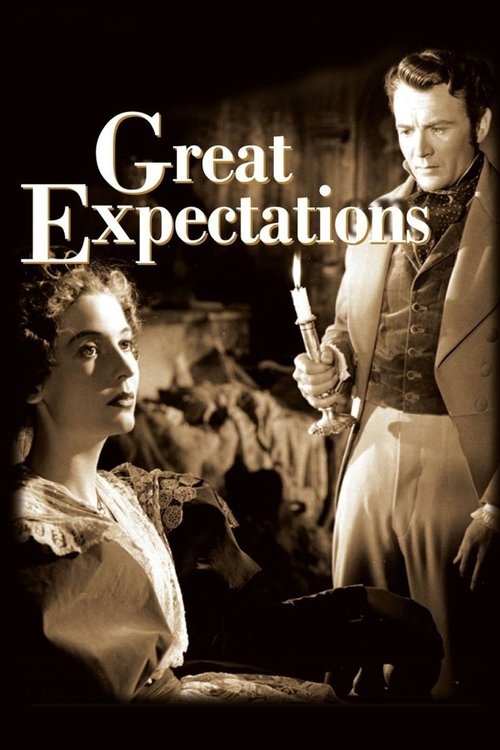
Great Expectations
1946 · David Lean
For when you want to sink into a classic story told supremely well — a fireside, rainy-Sunday kind of film with more darkness and bite than you'd expect from a period piece.
What it's about
Pip, an orphan raised in the Kent marshes, has two childhood encounters that mark him for life: a terrifying meeting with an escaped convict in a graveyard, and a summons to the decaying mansion of Miss Havisham, a jilted bride frozen in time, where he falls for her beautiful, cold ward Estella. Years later a mysterious benefactor's fortune transforms him into a London gentleman — and he has to discover what that money, and his great expectations, really rest on.
The experience
It grips like a thriller from its first minutes — the graveyard opening is one of the great scares in classic cinema — then settles into a rich, atmospheric tale of ambition, snobbery, and first love. Gothic shadows and brisk storytelling keep two hours moving fast.
Performances
John Mills makes Pip's climb both charming and quietly damning, Martita Hunt is unforgettable as the cobwebbed Miss Havisham, Finlay Currie is terrifying then heartbreaking as the convict Magwitch, and a young Alec Guinness, in his first major screen role, is pure delight as Herbert Pocket.
The craft
David Lean compresses the sprawling novel into two taut hours by holding tight to Pip's point of view, and the Oscar-winning black-and-white cinematography and production design turn Victorian England into a landscape of the mind — wind-bent marshes, a wedding feast rotting under dust. It looks magnificent on the biggest screen you can find.
Why it matters
The film that turned Lean from a skilled craftsman into a director of world standing, and it remains the benchmark against which every screen Dickens is measured.
Snapshot
David Lean's Great Expectations is the film that converted a gifted British technician into a director of international standing, and it remains the benchmark against which screen Dickens is measured. Produced by Cineguild for J. Arthur Rank's Independent Producers and released in Britain in December 1946, it compresses Dickens's 1860–61 serial novel into roughly two hours of first-person narrative, holding tight to Pip's point of view and jettisoning whole tracts of subplot to do it. Its reputation rests on two things: an opening five minutes of graveyard terror that few British films of the period could match for sheer control of atmosphere, and a production design by John Bryan that treats Victorian England as a set of psychological spaces rather than a museum reconstruction. The film won Academy Awards for cinematography (Guy Green) and art direction (Bryan, with set decorator Wilfred Shingleton), and drew nominations for picture, director and screenplay. It also introduced Alec Guinness in his first substantial screen role and gave the teenaged Jean Simmons her breakthrough. Nearly eighty years on, its images — the gibbet on the marsh, the stopped clocks, the cobwebbed wedding cake — function less as one interpretation of the novel than as the default visual memory of it.
Industry & production
The film was made by Cineguild, the production unit formed by Lean, cinematographer-turned-producer Ronald Neame and producer-writer Anthony Havelock-Allan out of their collaboration with Noël Coward on In Which We Serve (1942). Cineguild sat within Independent Producers Ltd, the Rank Organisation's umbrella for semi-autonomous units — the arrangement that also housed Michael Powell and Emeric Pressburger's The Archers. Rank's model granted its filmmakers unusual creative latitude and financing in exchange for a slate of prestige pictures aimed at breaking into the American market. Great Expectations was Cineguild's first film after Brief Encounter (1945), and it was conceived at exactly the moment Rank's ambitions were at their most expansive.
Neame produced; Lean directed; the screenplay is credited to Lean and Neame with Havelock-Allan, Kay Walsh and Cecil McGivern. The precise division of that labor is one of the genuinely murky points in the record — memoirs and later interviews assign credit inconsistently — though the account most often repeated holds that Walsh, then Lean's wife, argued for the redemptive ending the film adopts. Shooting took place at Denham Studios, with location work on the Kent marshes of the Thames estuary; accounts differ on how much of the opening churchyard was estuary and how much was built at Denham, and the film blends the two so thoroughly that the seam is not visible.
The project's immediate origin was theatrical. Alec Guinness had adapted the novel for a 1939 stage production in London, playing Herbert Pocket, with Martita Hunt as Miss Havisham. Lean saw it; both performers were carried into the film, Hunt effectively reprising a role she had already built. Francis L. Sullivan came from a different lineage — he had played Jaggers in Stuart Walker's 1934 Universal adaptation, making him the rare actor to define a Dickens part twice on screen.
The film opened in Britain in December 1946 and reached America in 1947 through Universal-International under Rank's US distribution arrangement, which is why it competed at the Academy Awards for 1947 rather than 1946. It was a popular success at home; specific grosses circulate in secondary sources with enough variance that no figure should be treated as settled.
Technology
Great Expectations is a black-and-white Academy-ratio picture made under the material constraints of immediate postwar Britain — a period of raw-stock allocation, timber shortages and studio space at a premium. Its technical achievement is largely one of ingenuity within limits rather than novelty. Denham's stages and Bryan's carpenters produced the marsh, the forge, the Satis House interiors and the London streets; forced perspective and scaled construction did the work that money and space would otherwise have done. The church in the opening sequence is built small so that the boy running past it reads as smaller still; interiors recede into corridors that are shorter than they appear.
Green's lighting works at the level of contrast rather than technical exhibitionism. The film is not a deep-focus picture in the Toland sense — the depth is architectural, achieved by set geometry and by staging figures at extreme distances from each other, not by stopping down. Optical work, miniature and matte elements carry the Thames escape sequence at the climax. Sound is monophonic optical recording, and the film's most distinctive technical gesture on that side is negative: long stretches with no music at all, where wind, water and the creak of the gibbet post do the scoring.
Technique
Cinematography
Guy Green had come up through the camera department, operating for Neame on the Coward-Lean productions before stepping up to director of photography here; the Oscar he won made his name and, in time, launched a second career as a director. His work on Great Expectations is built on hard, directional key light and deep blacks, with figures frequently isolated in pools of illumination inside otherwise unlit volumes. Satis House is lit almost entirely by candle-motivated sources, so that Miss Havisham's yellowed dress and the gray ruin of the cake seem to generate their own faint glow while the room around them dissolves.
The opening is the showpiece. Low camera heights place the horizon high, dwarfing the child; the trees on the marsh are shot so that a bent trunk reads unmistakably as a hanged man; the wind moves everything in frame. When Magwitch appears, he does so as a sudden intrusion into a composition the audience has been reading as empty — the shock is structural, a matter of where the camera has taught you not to look. It is one of the most frequently cited jump scares in British cinema, and it is achieved without a cut to a monster, only a hand and a face arriving where there was nothing.
Editing
Lean had been one of Britain's most accomplished editors before he directed — cutting newsreels, then features including Pygmalion (1938), 49th Parallel (1941) and One of Our Aircraft Is Missing (1942) — and Great Expectations is the film where that training becomes an authorial signature rather than a résumé line. Working with Cineguild's regular editor Jack Harris, Lean solves the adaptation's central problem — a very long novel, a fixed running time — by ruthless elision. Years pass in a dissolve. Journeys are reduced to a departure and an arrival. Exposition that Dickens delivers across chapters is handed to a single scene, often a single line.
The cutting is disciplined rather than flashy: cuts land on movement, and the film sustains long takes where the staging can carry the scene, then accelerates hard in the shock and action passages. The transition from the boy Pip to the man is handled as a graphic and gestural match rather than an announcement, one of several places where the editing assumes the audience will keep up.
Mise-en-scène / staging
John Bryan's design is the film's other authorial center. Rather than reproduce the period, Bryan builds spaces that externalize states of mind, and he does it with a mildly expressionist tilt that stops short of caricature — the tilt would go further in Oliver Twist two years later. Satis House is the case study: a house arrested at twenty minutes to nine, the bridal table furred with cobweb, the cake collapsing into its own decay, sunlight excluded absolutely. Jaggers's chambers are dominated by death masks; the forge is warm, low and cluttered, the only interior in the film that behaves like a home.
Lean stages within these sets with a strong sense of scale relations — Pip is repeatedly small in the frame at Satis House and in London, and comparatively large only at the forge, which the film understands as the thing he betrays. The recurring device of doorways, arches and corridors framing a figure at depth gives the film its sense of a boy always being looked at, judged, summoned.
Sound
Walter Goehr's score is used with real restraint. The marsh sequences run substantially on effects — wind, the estuary, the creak of the gibbet, the boom of the hulks' guns — and music tends to enter at emotional consolidations rather than running underneath continuously. Pip's first-person voiceover, spoken by John Mills, is the film's most important sonic decision: it preserves Dickens's retrospective narration and licenses the compression, letting the film summarize where it cannot dramatize. The film opens on the novel itself, hands turning to the first page, the narration reading the reader in — an unusually candid admission that this is an adaptation, and a framing device that grants the picture permission to be selective.
Performance
The performances split between the naturalistic and the frankly theatrical, and the film is largely unembarrassed by the mixture. Martita Hunt's Miss Havisham, carried over from her stage reading, is pitched high — imperious, brittle, and finally pitiable. Finlay Currie's Magwitch is granite: a terrifying apparition in the first reel who slowly, without softening his physical presence, becomes the film's most wounded figure. Francis L. Sullivan's Jaggers is a study in bulk and forensic evasion; Bernard Miles's Joe Gargery supplies the film's moral floor with almost no rhetorical assistance. Guinness plays Herbert Pocket light and fast, a genuinely comic performance in a film with little comedy, and the ease of it announced a screen career.
The casting of the leads is more contested. John Mills, who was thirty-eight, plays a Pip who should be barely into his twenties, and the strain shows in the London sequences. Jean Simmons, seventeen, gives the young Estella a cold, amused hauteur that most viewers find the film never quite recovers once Valerie Hobson takes over the adult role — a common critical observation rather than a settled judgment.
Narrative & dramatic mode
The film is a Bildungsroman filtered through subjective retrospection: a first-person memoir in which the narrator's shame organizes what we see. Structurally it is a three-part shape — the marsh and forge; Satis House and the arrival of the expectations; London, the revelation and the reckoning — with the mystery of the benefactor operating as the engine that keeps a coming-of-age story moving like a thriller. Lean and his collaborators cut aggressively to protect that engine: Orlick disappears, Wopsle and Pumblechook shrink to sketches, and the intricate Compeyson machinery is reduced to what the climax strictly requires.
The most consequential departure is the ending. Dickens wrote two, and neither resembles what the film does: Pip returns to Satis House, finds Estella installed in Miss Havisham's chair and repeating her pattern, tears down the rotting curtains to admit daylight, and leads her out. It converts a novel of chastened ambiguity into a redemption, and it is the single change critics most often hold against the picture — a legitimate charge, though it is also the change that makes the film's dramatic architecture close cleanly.
Genre & cycle
The film belongs to the postwar British "quality" literary adaptation, a category Rank was actively cultivating for export, but it is more generically restless than that label suggests. Its first act is Gothic horror in everything but classification; its middle is a novel of manners; its climax is a river-chase thriller. That mixture positions it interestingly against the other dominant British period cycle of the moment, the Gainsborough costume melodramas — The Wicked Lady and its kin — which were commercially enormous and critically disdained. Great Expectations offers period spectacle and Gothic charge while retaining respectability, and its success helped establish that combination as a viable British house style.
Authorship & method
Lean's method here is that of an editor promoted: he plans coverage tightly, shoots for the cut, and trusts elision. He is not yet the director of landscape and duration he became after Lawrence of Arabia, but the discipline is continuous — the later epics are built from the same conviction that a sequence should communicate through arrangement rather than explanation.
The film is, however, decisively a unit achievement. Neame produced and co-wrote and had been Lean's cinematographer; Havelock-Allan co-founded Cineguild and shaped the script; Guy Green established the lighting grammar; John Bryan supplied the film's most durable images; Jack Harris cut it; Walter Goehr scored it with deliberate reticence. Green, Bryan, Harris and Guinness all reassembled for Oliver Twist (1948), which is essentially the same creative machine running at higher expressionist voltage. The Cineguild partnership did not long survive: Havelock-Allan departed within a couple of years, and Lean's subsequent films moved steadily away from collective authorship.
Movement / national cinema
Great Expectations is a central document of British cinema's postwar confidence — the moment when the industry, flush with wartime audiences and Rank's capital, believed it could compete with Hollywood on its own terms. It sits alongside Powell and Pressburger's Technicolor extravagances and Ealing's emerging comedies as one of three distinct answers to the question of what a British national cinema might look like. Where The Archers pursued baroque color fantasy and Ealing pursued the vernacular community, Cineguild pursued craft, restraint and literary prestige.
It is also worth noting what the film is not doing. In 1946, Italian neorealism was inventing an oppositional cinema out of scarcity; Great Expectations, made under comparable material constraints, responded by building an entirely artificial world in a studio. The two impulses — documentary austerity and constructed atmosphere — ran through British filmmaking of the period as competing legacies of the wartime documentary movement, and Lean here comes down firmly on the side of construction.
Era / period
British cinema attendance reached its all-time peak in 1946, and the film met an audience with a habit of weekly cinemagoing and a country living under rationing and reconstruction. That context colors the material. A story about a working boy lifted into gentility by invisible money, in the year after the Labor landslide, carried an obvious charge about class mobility — and equally obvious ambivalence, since the film's moral verdict falls on the forge Pip abandons. Its Victorian setting also functioned as a form of national self-inspection at a moment when Britain's imperial position was visibly ending; the source of Pip's money, after all, is a transported convict's labor in Australia.
Themes
The film's governing subject is manufactured identity: the gentleman as a product with an unacknowledged supply chain. Pip's rise is financed by exactly the class of person his new status requires him to despise, and the film's central irony is that his refinement is inseparable from the marsh, the leg-iron and the file. Running against that is the theme of arrested time — Miss Havisham's stopped clocks, the un-eaten cake, a wedding dress worn until it rots — a refusal of duration that the film treats as a form of death-in-life and finally punishes by fire.
Shame is the connecting emotion, and it is what the first-person structure exists to convey: Pip's narration is a confession of embarrassment about Joe, about the forge, about his own gratitude. Estella carries a related theme of cruelty as inheritance, raised as an instrument of another woman's revenge. Where the film thins Dickens is in the social critique — the novel's institutional satire, its lawyers and prisons as a system, survives mainly as atmosphere — and in the substitution of redemption for the novel's harder, more equivocal close.
Reception, canon & influence
Contemporary British reviews were strong, and the film was quickly established as the standard by which Dickens on film would be judged. Its American reception, aided by Rank's distribution deal, produced five Academy Award nominations and two wins. The critical consensus has proved unusually stable: the first act's atmosphere and the design are near-universally admired, the ending near-universally questioned, and Mills's age routinely noted. In the BFI's 1999 poll of the hundred best British films of the twentieth century, it placed fifth.
Looking backward, the film draws on three lineages. The novel itself, serialized in All the Year Round in 1860–61, supplies the architecture. The 1939 Guinness stage adaptation supplies two performances and, arguably, the model of aggressive compression. And the visual sensibility owes a debt to the German expressionist and Gothic traditions — the marsh sequence in particular works with a vocabulary of silhouette, distorted natural form and sudden apparition that belongs as much to horror cinema as to literary adaptation. Earlier screen versions existed, including a 1917 American silent and Stuart Walker's 1934 Universal production, but Lean's film effectively erased them from cultural memory.
Looking forward, its influence operates on several levels. Most immediately it produced Oliver Twist, which pushed the same team's methods further and ran into serious controversy over Guinness's Fagin, delaying and altering its American release. More broadly, it fixed the iconography of Dickens for the century that followed: virtually every subsequent Satis House on film or television — through the various BBC serials and up to Mike Newell's 2012 adaptation — is a response to Bryan's. Alfonso Cuarón's 1998 modernization defines itself substantially by refusing the Lean template, and Armando Iannucci's The Personal History of David Copperfield (2019) reads as a deliberate rebuttal of the hushed reverence the Lean tradition installed.
Its formal legacy is broader than Dickens. The marsh opening remains a standard reference point in discussions of how to construct dread through composition and sound rather than revelation, and its decayed-mansion Gothic runs directly into later films built on the same idea of a house as a preserved wound. And for Lean personally, the film and its successor established the craft credibility and industrial trust that made the later epics possible — a line running, without much interruption of method, from a studio-built Kentish marsh to the deserts of Lawrence of Arabia.
A Deleuzian reading
A boy runs along a flat marsh at dusk and the wind does everything: bends the grass, moves the trees, works the crossbar of a gibbet until it creaks.
The full Deleuzian reading of Great Expectations →
Reception
An instant triumph in 1946 — Best Picture nominee, two Oscar wins — and it never really left the pantheon: while Lean's later epics went in and out of critical fashion, this one has stayed 'the greatest Dickens film' for nearly eighty years.
How Great Expectations was received, from release to now →
How to watch Great Expectations: what to notice on a first viewing
- Watch the horizon sit high above a tiny running boy. Lean and Green keep the camera low on the marsh, so the sky fills most of the frame and the child is reduced to a small figure at the bottom of it. The composition makes the boy feel exposed and unprotected before anything actually happens to him.
- Notice Satis House lit only by what looks like candlelight. The room's light source stays motivated by candles throughout, so the dress and the wedding cake seem to give off their own faint glow while everything around them goes dark. The lighting makes the room feel sealed off from ordinary daylight entirely, which is exactly what it is.
- Watch how small Pip looks inside doorways and halls. He is dwarfed by the architecture at Satis House and in London, but shot at a comparatively large scale inside the cramped, warm forge. Where he looks big or small in the frame is telling you something about power before the plot does.
- Listen for the narrator's voice opening over turning pages. The film begins on the novel itself, hands turning to the first page, with John Mills's retrospective narration framing everything that follows as a told story. The film admits upfront that it is a selective retelling, which gives it permission to skip and compress.
- Listen for wind and water instead of music on the marsh. Long stretches of the opening run on effects alone, wind, the estuary, the creak of the gibbet, with Goehr's score entering only at emotional high points. The absence of music makes the marsh feel like a real, indifferent place rather than a scene being told what to feel.
The whole guide to watching Great Expectations, with the keys for a rewatch →
Influences: the films it descends from and the films it influenced
- Sunrise: A Song of Two Humans (1927) — Rochus Gliese's forced-perspective marsh and city sets — scaled-down backings and undersized extras built entirely on stage — are the direct precedent for John Bryan's practice of building the Kentish marsh and Satis House to false scale so the lens, not the location, does the dramatizing.
- Wuthering Heights (1939) — Gregg Toland lit a studio-built Yorkshire moor with hard key, wind machines and smoke so weather reads as psychology rather than geography — the model for Guy Green treating the opening marsh as an emotional space with no establishing topography.
- Rebecca (1940) — Opens on a first-person retrospective voiceover carried over a slow approach to a great house preserved as a wound — the precise structural pairing (narrating survivor + arrested, decaying interior) Lean reuses for Pip's narration and the stopped clocks of Satis House.
- The Thief of Bagdad (1940) — Vincent Korda's deliberately oversized and undersized set pieces fix a figure's power by proportion within the frame — the scale-relations vocabulary Bryan applies when Pip is dwarfed by Satis House's doors, table and ceiling height.
- Citizen Kane (1941) — Supplies three habits at once: Toland's floor-level camera under ceilinged sets, hard key printed down to true blacks, and Robert Wise's breakfast-montage elision — low camera height, deep blacks and narrative compression arrive in Lean's film as a single inherited package.
- Jane Eyre (1943) — Keeps the novel's first-person narration as voiceover while George Barnes lights Gothic interiors strictly from candle and hearth sources — the Victorian-adaptation grammar of motivated flame plus retained literary 'I' that Lean inherits and tightens.
- Brief Encounter (1945) — The immediately preceding Cineguild film established Lean's confessional first-person voiceover played against images that outrun or contradict it, and Jack Harris's habit of cutting on a sound cue rather than an action — both transposed here from suburban interior to Gothic marsh.
- Oliver Twist (1948) — The same unit — Green, Bryan, Harris, Guinness — reruns the method at higher expressionist voltage: the storm-lit opening walk to the workhouse is a direct restaging of the marsh prologue's silhouette-against-sky construction with wind and effects standing in for score.
- The Night of the Hunter (1955) — Stanley Cortez shoots a studio-built river landscape as silhouette against hard-lit sky from a child's eye height, generating dread from composition and an effects track rather than revelation — the marsh prologue's logic extended to a whole film.
- The Innocents (1961) — Freddie Francis lights a decaying English great house from candle and window motivation only, holding true blacks at the edges of the CinemaScope frame, and stages the house as a preserved wound in explicitly Satis House terms.
- Lawrence of Arabia (1962) — The match-blown-out-to-sunrise cut is the mature form of the graphic match Lean and Harris practice here — the editor's principle of cutting on shape and sound survives intact into the epics, with the studio simply removed.
- Barry Lyndon (1975) — Pushes candle-motivated lighting from convention to literal practice with the f/0.7 Zeiss lenses, pursuing to its physical limit the claim Green made — that a period interior must be lit by the sources visible inside the frame.
- The Elephant Man (1980) — Freddie Francis shoots Victorian London in black and white with hard key and crushed blacks while Lynch's steam-and-machinery track replaces conventional scoring — the Lean–Green grammar of effects-as-score transplanted into a horror register.
- Great Expectations (1998) — Defines itself by point-for-point refusal of the Lean template: Lubezki's saturated green Florida daylight and a sun-bleached Gulf-coast Paradiso invert Bryan's monochrome, cobwebbed, candle-lit Satis House rather than restaging it.
- Crimson Peak (2015) — Builds a full-scale practical mansion sinking into red clay as a house that bleeds its own history, using forced-perspective corridors and doorway framings that dwarf the heroine — Bryan's decayed-mansion scale relations rebuilt in color.
- The Personal History of David Copperfield (2019) — Rebuts the reverent Lean voiceover by keeping first-person narration and then breaking it — the narrator steps physically into his own projected memories — dismantling the authoritative, elliptical retrospection Lean installed as the default for screen Dickens.
- The Bridge on the River Kwai (1957) — Lean's first sustained collaboration with Guinness — then as Herbert Pocket — established the director's technique of eliciting controlled-surface performance through sustained medium close-ups and precise blocking, the exact method later applied to Nicholson's obsessive rigidity.
- The Go-Between (1971) — Model for the faithful prestige adaptation of a canonical English novel filtered through a child's limited, dawning comprehension of adult class machinery.
- Scrooge (1951) — Established the deep-shadow, expressionist chiaroscuro template for prestige Dickens (Guy Green/Robert Krasker lighting of fog and cavernous interiors) that Pennington-Richards' photography directly echoes.
- Odd Man Out (1947) — Robert Krasker's hard-key, deep-black night exteriors and delirium inserts pursue the same postwar British project of lighting a studio-built Britain with Weimar contrast ratios, on the same Rank money and within months of Lean's film.
- Black Narcissus (1947) — Alfred Junge's forced-perspective sets and glass shots, lit by Cardiff with hard key against deep shadow, argue the identical Rank-era proposition — that a wholly fabricated interior world beats location, with in-frame scale carrying the drama.
Similar films
- Oliver Twist (1948) — influence & lineage
- Brief Encounter (1945) — influence & lineage
- The Innocents (1961) — influence & lineage
- Rebecca (1940) — influence & lineage
- The Night of the Hunter (1955) — influence & lineage
- Barry Lyndon (1975) — influence & lineage
- Scrooge (1951) — shared sensibility
- City Lights (1931) — shared sensibility