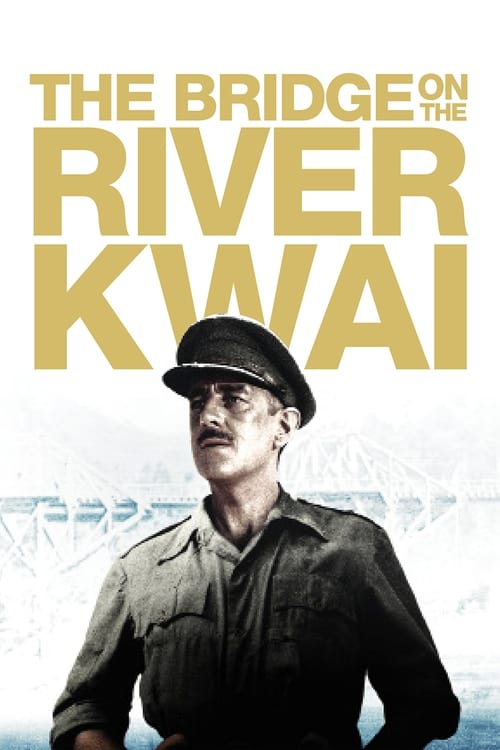
The Bridge on the River Kwai
1957 · David Lean
For a long, immersive evening when you want a genuine classic that earns its length — a big canvas with real ideas underneath. More challenge than comfort, but never a chore.
What it's about
In a Japanese POW camp deep in the Burmese jungle during World War II, a British colonel wages a battle of wills with the camp commandant over the treatment of his men — then pours himself into building the railway bridge his captors demand, determined to prove British soldiering superior even in captivity. Meanwhile, Allied intelligence dispatches a commando team through the jungle with orders to destroy the very bridge he's perfecting.
The experience
A slow-building epic that works as both grand adventure and creeping tragedy — you watch pride curdle into madness over two and a half hours, and the mounting irony tightens like a vice. The final stretch is almost unbearably suspenseful.
Performances
Alec Guinness won the Oscar for Colonel Nicholson, a man whose decency and delusion are inseparable — one of the great studies of principle become pathology — and Sessue Hayakawa matches him as a commandant caught in his own trap of honor. William Holden brings cynical American ballast.
The craft
David Lean shot it on real locations in Ceylon at enormous physical scale — real jungle, a real bridge — and the widescreen images have a weight no soundstage could fake. The whistled march that opens the film became one of cinema's most recognizable themes. It swept seven Academy Awards, including Best Picture, and demands the biggest screen you can find.
Why it matters
It stands at the hinge between the 1950s roadshow epic and the morally ambiguous war films that followed — proof a blockbuster could be anti-war in its bones — and it launched Lean's run of large-scale masterworks.
Snapshot
David Lean's adaptation of Pierre Boulle's 1952 novel is a film of spectacular ironies: it is anti-war in its moral logic yet intoxicating in its celebration of scale and craft; it honors British character while diagnosing its fatal pathology; it was written by blacklisted Americans and credited to a Frenchman who could not write English; it was shot in Ceylon to depict Burma. The Bridge on the River Kwai won seven Academy Awards including Best Picture and remains a fulcrum between two eras of Hollywood filmmaking — the widescreen roadshow epic of the 1950s and the increasingly ambiguous war film of the decade to come. Its last spoken word is "Madness," and the film earns it.
Industry & production
The film was produced by Sam Spiegel under his Horizon Pictures banner for Columbia Pictures. Spiegel — a Polish-born independent who had already produced The African Queen (1951) and On the Waterfront (1954) — brought considerable packaging instinct to the project. He secured David Lean as director after Lean had established himself in British prestige pictures, and assembled an international cast anchored by Alec Guinness, William Holden (whose Hollywood profile was required by the American distributor), and the silent-era Japanese-American star Sessue Hayakawa, whose casting as Colonel Saito amounted to a major screen comeback after decades of diminished opportunity in Hollywood.
The screenplay carries one of the most notorious credit frauds in film history. Carl Foreman, who had written the initial draft, was effectively forced off the production when his refusal to cooperate with the House Un-American Activities Committee made him a liability; he had already been blacklisted when he completed his work on High Noon (1952). Michael Wilson, himself also blacklisted, was brought in to revise and complete the script. Because both men were unemployable under their own names, sole screenplay credit was assigned to Pierre Boulle — the novel's author — even though Boulle wrote in French and had not written the screenplay. When the film won the Academy Award for Best Adapted Screenplay, the statuette went to Boulle, who accepted it and gave a brief speech in French, apparently without remarking on the absurdity of the situation. The Writers Guild of America corrected the record formally in 1984; the Academy followed with a posthumous correction in 1985, by which time Foreman had died.
Principal photography took place in Ceylon (present-day Sri Lanka), primarily near Kitulgala on the Kelani River. The choice was practical — Ceylon offered the jungle density, the available labor force, and the colonial infrastructure of a location that could plausibly double for the Thai-Burmese border region. The actual bridge over the Khwae Noi in Thailand — the historical site of the Burma-Thailand Railway's notorious "Death Railway" — was not used. A full-scale working timber bridge was constructed on location, an engineering undertaking that mirrored, with deliberate irony, the fiction being filmed.
Technology
The film was shot in CinemaScope anamorphic widescreen and photographed in Technicolor, positioning it squarely within the roadshow exhibition format that major studios adopted in the early-to-mid 1950s as a competitive response to television. The 2.55:1 aspect ratio (slightly narrower in some release prints with optical soundtracks) demanded a compositional grammar suited to horizontal breadth, and Lean and his cinematographer Jack Hildyard responded by treating the frame as a landscape canvas — the jungle canopy, the river valley, the bridge's growing silhouette against the sky all function as environment rather than backdrop.
The production's most audacious technical commitment was the decision to photograph the bridge's destruction as a single, unrepeatable practical event. A real bridge was detonated in a controlled demolition timed to coincide with a train crossing it; multiple cameras were positioned to capture the explosion simultaneously. The logistics were formidable, the insurance exposure enormous, and the margin for error nonexistent. The resulting footage — the bridge collapsing in a cascade of timber and water as the locomotive plunges into the river — remains one of the most consequential practical effects sequences in film history, achieved without digital intervention and, by definition, without a second take.
Technique
Cinematography
Jack Hildyard, who won the Academy Award for Best Cinematography for this film, brought a controlled formality to the widescreen frame that resists spectacle for its own sake. His jungle photography maintains a quality of oppressive enclosure even within the CinemaScope ratio: the canopy presses down, the light filtering through in columns and patches. Against this, the river and the clearing where the bridge rises are open and almost clinical. Hildyard's approach to the POW camp scenes emphasizes the strange orderliness that Nicholson imposes — straight lines, military formation — within the surrounding organic chaos of the tropical landscape. The famous opening sequence, the British prisoners marching in to the whistled "Colonel Bogey March," establishes this visual grammar immediately: men forming a geometric pattern in a world that has no use for geometry.
The film's action sequences — the commando approach through the jungle, the climactic sabotage attempt — are shot with practical urgency, handheld where necessary, the widescreen frame working against the jungle's resistance to clarity. The final convergence of plot lines at the bridge is an exercise in cross-cutting and spatial legibility that rewards the camera's prior investment in the location's geography.
Editing
Peter Taylor's editing operates according to the film's dual structure: the war-film adventure plot (the commando mission) and the psychological drama (Nicholson's escalating obsession). Taylor manages the film's substantial running time — 161 minutes — by maintaining clear tonal distinctions between the two plot strands, so that shifts between them register as changes in register rather than merely in location. The climactic sequence, in which the sabotage attempt and Nicholson's interference converge at the bridge, is edited with considerable precision: the geography of who is where, what each character knows, and what the detonator plunger represents must all remain legible under increasing narrative pressure.
Mise-en-scène / staging
Lean's staging throughout belongs to the tradition of theatrical pictorialism rather than psychological realism. Characters are placed in compositions that declare their dramatic relationships: Nicholson and Saito face each other across power-laden geometries; Nicholson at the bridge's construction site commands the frame's center with increasing imperial certainty. The famous scene of Nicholson emerging from "the oven" — the corrugated metal box used as punishment — is a tableau of British endurance staged for maximum iconographic legibility. Lean directs Alec Guinness to embody institutional rigidity through posture and containment, reserving the character's interior life for the later, more disturbing moments of pride and self-deception.
The production design by Donald M. Ashton achieves an important tonal balance: the camp is credibly brutal without becoming exploitative, the bridge itself is genuinely impressive without being glamorized beyond what the narrative requires.
Sound
Malcolm Arnold's score incorporates, and transforms, the existing cultural resonance of "Colonel Bogey March," a British military march composed by Lieutenant F. J. Ricketts and published in 1914, long associated in the British military tradition with sardonic, ribald lyrics unsuitable for attribution here. Arnold's arrangement — the prisoners whistling it in unison as they march into camp — converts what might have been a jingoistic flourish into something stranger: defiant, hollow, and faintly absurd. The whistling is unaccompanied, which strips the march of its brass-band pomp and makes it a vocal act of collective endurance rather than celebration. Arnold won the Academy Award for Best Original Score, and the "River Kwai March" he composed to underscore the film's adventure elements became one of the most recognizable themes in postwar cinema. The use of silence in the final sequence — as Clipton surveys the carnage — is equally deliberate.
Performance
Alec Guinness's performance as Colonel Nicholson is among the most formally controlled in postwar British cinema. Guinness plays the character's dangerous quality through surfaces: the precision of military diction, the physical composure that never loosens, the way conviction reads identically to delusion in a man of this formation. The film requires the audience to admire and then recoil from the same performance, and Guinness calibrates this arc with precision — the horrifying recognition in Nicholson's dying moments ("What have I done?") is made possible by how thoroughly he has inhabited the character's self-righteousness.
Sessue Hayakawa, as Colonel Saito, delivers a performance of great intelligence in a role that could have been one-dimensional. Saito's own honor complex — his private shame, the tears he allows himself only in solitude — gives the film a second study in military pride, and Hayakawa's physicality throughout is entirely his own: compressed, watchful, with a quality of contained force. William Holden's Shears functions as the film's skeptical American witness, a cynic dragooned back into danger, and Holden plays the role with characteristic dry authority, though the character is structurally the least resolved of the three leads.
Narrative & dramatic mode
The film operates in two registers simultaneously and keeps them in formal tension until the final sequence forces them to collide. The adventure register — the commando mission, the physical ordeal, the mechanics of sabotage — propels the narrative with genre clarity. The psychological register — Nicholson's progressive identification with his captors' project, his transformation of the bridge from forced labor to professional pride to monument — operates as a study in institutional madness conducted within the adventure's forward momentum.
Pierre Boulle's novel already contained this ambiguity, though Boulle's own wartime experience as a resistance operative in Asia gave it a different personal weight than the screenwriters' transposition suggests. The film's dramatic mode is ultimately tragic rather than heroic: Nicholson achieves his objective (the bridge is built to specification, on schedule) and this is the catastrophe. The final line — Major Clipton's "Madness! Madness!" — is not a condemnation from outside the military world but from within it, spoken by the medical officer who has watched British institutional virtue become indistinguishable from collaboration.
Genre & cycle
The film belongs to the cycle of British and Anglo-American prestige war films produced in the decade following the Second World War — a cycle that includes The Dam Busters (1955), The Cruel Sea (1953), and Reach for the Sky (1956), films that processed collective wartime experience through dramatizations of endurance, sacrifice, and professional excellence. Within this cycle, Kwai is distinctive for introducing a systematic irony that those films largely avoid: the British qualities celebrated by the genre (discipline, perseverance, engineering competence, refusal to yield) are shown to be capable of producing outcomes indistinguishable from defeat.
The film also sits at the threshold of the roadshow epic cycle — Lawrence of Arabia (1962), Doctor Zhivago (1965), Ryan's Daughter (1970) — that Lean would largely define over the following fifteen years. Its combination of adventure spectacle, psychological complexity, and landscape-scale cinematography established a template for the production values and tonal register that characterized that cycle.
Authorship & method
David Lean arrived at Kwai following a career of considerable range: he had cut his teeth as an editor (he edited In Which We Serve, Brief Encounter, Major Barbara), then directed a series of films that moved fluidly between intimate domestic drama (Brief Encounter, 1945; Hobson's Choice, 1954) and literary adaptation of scope (Great Expectations, 1946; Oliver Twist, 1948). Kwai marks the transition to his "epic" phase — a commitment to scale, duration, and the widescreen landscape as expressive instrument that would define his subsequent work.
Lean's method on location was known to be exacting and prolonged; the Ceylon shoot was arduous, and relations with Guinness were reportedly tense — the details of their friction have been described variously in subsequent accounts, though the nature and extent of their disagreements remains a subject of some interpretive dispute among film historians. What is documented is that Lean's directorial authority over performances and composition was absolute, and that the film's visual and tonal coherence bears the marks of a single controlling intelligence.
Jack Hildyard's collaboration with Lean here was a singular engagement; Lean would go on to work primarily with Freddie Young as his cinematographer on subsequent epics. Malcolm Arnold's score was a major contribution not merely as accompaniment but as structural argument — the "Colonel Bogey" motif returns at the film's end with entirely altered emotional valence. Carl Foreman's and Michael Wilson's uncredited screenplay represents a substantial creative contribution that the film's critical legacy has only partially accounted for; Foreman had already demonstrated his ability to encode political ambiguity within genre form in High Noon.
Movement / national cinema
The film occupies an ambivalent position in national cinema terms. It is British in its sensibility — the cultural materials it works with (the British officer class, the public-school ethos, the colonial relationship to Asia) are recognizably products of British postwar self-examination — but it was financed and distributed by Columbia Pictures, produced by an American-born independent, and made in a widescreen format conceived to address American exhibitors and audiences. Its blacklisted American screenwriters, writing anonymously, brought their own understanding of institutional conformity and political complicity to material that the British literary tradition had framed differently.
The film can be read as a late entry in the postwar British cinema of national reckoning — alongside the Ealing comedies that quietly subverted the class order, and the kitchen-sink films that were about to emerge — but its scale and its production circumstances place it outside the strictly domestic tradition. It is a British story made by an international production apparatus, which is perhaps appropriate for a story about what happens when British institutional identity confronts the world on terms that no longer belong to it.
Era / period
Kwai arrives at a specific historical junction. Produced in 1957, it sits between the postwar period's structured heroism and the cultural turbulence of the 1960s. The Suez Crisis of 1956 — in which Britain's pretension to independent imperial power was comprehensively dismantled — provides a political atmosphere in which a film about British military pride producing catastrophic self-deception carried meanings that reviewers at the time would have registered without needing to articulate. The film does not engage Suez directly, but it shares the historical moment in which the terms of British global authority were being renegotiated.
Simultaneously, the film participates in the roadshow exhibition format at its height — reserved-seat engagements, overtures, intermissions, souvenir programs — a system that positioned certain films as events rather than entertainment. This commercial framework shaped the film's pacing, its investment in spectacle, and the seriousness with which it was received.
Themes
The film's central preoccupation is with the institutional formation of the self — the degree to which military identity can colonize judgment, displace ethical clarity, and convert professional pride into moral catastrophe. Nicholson is not a villain; he is the British officer class operating as designed, and the design proves lethal. His pride in the bridge is, from within his own formation, entirely coherent; it is only from outside that formation — and the film carefully positions Clipton and Shears as outside observers — that it registers as madness.
The film also thinks seriously about honor as a cross-cultural pathology: Nicholson and Saito are mirror images, each imprisoned by a code of conduct that forbids accommodation with reality. Their antagonism gives way to a kind of grim professional kinship as the bridge becomes the shared object of investment for both men.
Collaboration — political, moral, practical — runs through the film as an unresolved anxiety. The bridge is built by the British for the Japanese; it is destroyed by the Americans with British assistance; the final image is of wreckage and bodies. The film refuses to stabilize a position on who is right. Clipton's "Madness!" is the film's moral verdict, but it is the verdict of exhaustion rather than clarity.
Reception, canon & influence
Backward influences. Boulle's source novel drew on the historical record of the Burma-Thailand "Death Railway," constructed between 1942 and 1943 under Japanese direction by Allied POWs and conscripted Asian laborers under conditions of extreme brutality; some sixty thousand Allied prisoners and an estimated 90,000 to 100,000 Asian laborers died in the construction. Boulle fictionalized considerably — the novel's bridge is not the real bridge, and the moral mechanics are his own invention — and the film departs further still. The British war film tradition of the early 1950s — particularly its investment in professional stoicism as dramatic subject — provided the generic vocabulary that Lean could then subvert.
Critical reception. The film was a major commercial and critical success on release. Its seven Academy Awards — Best Picture, Director, Actor (Guinness), Cinematography, Editing, Score, and Adapted Screenplay (to Boulle) — represented the consensus of the American film establishment. Critical response in Britain was similarly positive, though some reviewers noted the film's departures from historical record as a limitation; the Japanese and Asian dimensions of the Death Railway are largely absent from the film's imaginative universe. Feminist and postcolonial scholarship has subsequently examined the film's treatment of its Asian characters and its centering of European military experience in a story whose historical casualties were overwhelmingly Asian — a legitimate critical line that the film's canonical status has not suppressed.
Forward legacy. The film's most direct influence is on Lean's own subsequent career: Sam Spiegel produced Lawrence of Arabia (1962), on which Lean, Hildyard (replaced by Freddie Young), and Robert Bolt elaborated the epic psychological portrait into something still more extreme. The two films together constitute the defining template for the prestige epic of the 1960s — the spectacle of landscape, the duration, the central study in obsession.
More broadly, Kwai contributed to the gradual erosion of the heroic war film as the default American and British mode. Its institutional irony — the competent, honorable officer whose honor becomes catastrophe — provided one available grammar for the darker war films of the 1960s and 1970s, from King Rat (1965) to Apocalypse Now (1979), in which the relationship between military virtue and military madness would be examined with increasing explicitness. The "Colonel Bogey" whistling has become one of cinema's most durable sound-images, reproduced and quoted in contexts ranging from satire to tribute, its original irony now so thoroughly absorbed into cultural memory that it operates as a kind of shorthand for the gap between institutional confidence and catastrophic outcome.
A Deleuzian reading
The prisoners come up the road whistling.
The full Deleuzian reading of The Bridge on the River Kwai →
Reception
A colossal hit from day one — 1957's top grosser and winner of seven Oscars including Best Picture — it never needed rescuing; the reappraisal came instead for its blacklisted writers, whose names were only restored to the credits decades later.
How The Bridge on the River Kwai was received, from release to now →
Influences: the films it descends from and the films it influenced
- In Which We Serve (1942) — As co-director and principal editor, Lean built the governing grammar of the British naval ensemble war film — professional stoicism as identity, institutional loyalty dramatized through sustained close-ups of controlled faces — the template Kwai would inherit wholesale before ironizing.
- Brief Encounter (1945) — Lean's deployment of Rachmaninoff's Second Piano Concerto as recurring structural punctuation — not continuous underscoring but a motif that frames and ironizes the action — is the direct formal model for 'Colonel Bogey's' role in Kwai, where the whistled march performs the identical irony-marking function.
- Great Expectations (1946) — Lean's first sustained collaboration with Guinness — then as Herbert Pocket — established the director's technique of eliciting controlled-surface performance through sustained medium close-ups and precise blocking, the exact method later applied to Nicholson's obsessive rigidity.
- Twelve O'Clock High (1949) — Gregory Peck's General Savage established the dramatic template of the obsessive commanding officer whose professional exactitude produces both military effectiveness and psychological collapse — the Nicholson archetype in embryo, transferred from American bomber group to British POW camp.
- The Dam Busters (1955) — Anderson's film codified the British prestige war film's treatment of precision military engineering as moral and dramatic subject, with Eric Coates's march deployed as a recurring structural-ironic motif — the immediate formal precursor to Lean's identical use of 'Colonel Bogey.'
- The Searchers (1956) — Ford and Hoch's deployment of the Monument Valley widescreen panorama as psychological register of Ethan's obsessive interior — landscape as expressive correlative to character rigidity — gave Lean the template for Hildyard's treatment of the Ceylonese jungle as both physical setting and mirror of Nicholson's mental landscape.
- The African Queen (1952) — Sam Spiegel produced both films; the craft debt is structural — the Anglo-American independent prestige model, UA release, location shooting in difficult tropical terrain (Ceylon), and wartime engineering as narrative spectacle. Spiegel applied the African Queen blueprint at expanded scale.
- Grand Illusion (1937) — Builds its drama on the mutual code-of-honor respect between captor and captured officer (Nicholson/Saito), a direct elaboration of the Boeldieu–von Rauffenstein aristocratic-fraternity bond across enemy lines.
- The Caine Mutiny (1954) — Colonel Nicholson is the Queeg study writ large — an officer whose rigid devotion to code and command curdles into self-destructive obsession.
- Lawrence of Arabia (1962) — Sam Spiegel's direct continuation extends Kwai's CinemaScope landscape-canvas method — Freddie Young replacing Hildyard — into pure abstraction: the desert horizon as psychological register of obsession, Robert Bolt's script amplifying the Nicholson irony into Lawrence's full portrait of imperial self-destruction under the roadshow duration format.
- The Great Escape (1963) — Sturges inherits Kwai's ensemble British stoicism in captivity and deploys Elmer Bernstein's march theme as a recurring structural motif in deliberate formal parallel — the hummed military air as ironic counterpoint to confinement — explicitly citing Lean's 'Colonel Bogey' device.
- Doctor Zhivago (1965) — Lean's third roadshow epic with Spiegel — Young's CinemaScope landscape, Maurice Jarre's recurring Lara leitmotif replacing 'Colonel Bogey' as structural anchor, dual-register editing of public epic and private psychology — demonstrates how completely Kwai codified Lean's mature production method.
- King Rat (1965) — Forbes's adaptation of Clavell's Changi POW novel extends Kwai's 'military pride as collaboration' theme into explicit black-market complicity: the British officer's institutional honor now nakedly entangled with the captors' system, the anti-war irony transposed from engineering to economics.
- Apocalypse Now (1979) — Coppola restructures Kwai's formal grammar — mission journey terminating in confrontation with a militarily effective but institutionally deranged commander — through Storaro's landscape cinematography, inheriting the central irony that the system producing Kurtz is identical to the system dispatching Willard to destroy him.
- Gallipoli (1981) — Weir inherits Kwai's anti-war institutional irony — military pride as catastrophe — and deploys it through Russell Boyd's anamorphic widescreen landscape canvas, the Australian desert and Gallipoli cliffs serving the same expressive function as Lean's Ceylonese jungle, with the fatal charge echoing Kwai's demolition finale beat for beat.
- Merry Christmas Mr. Lawrence (1983) — Oshima explicitly revisits the Hayakawa tradition — the Japanese camp commander as tragic antagonist whose honor-code mirrors the British prisoner's — with Sakamoto's controlled-surface performance enacting precisely the cross-cultural, controlled-affect grammar that Lean and Hayakawa pioneered together.
- Empire of the Sun (1987) — Spielberg deploys Allen Daviau's anamorphic 2.39:1 frame to render the Shanghai countryside and Suzhou Creek camp as psychological landscape — a direct application of Lean and Hildyard's Ceylonese grammar — with Jim's admiring mimicry of Japanese military ritual echoing Nicholson's fatal structural accommodation to captivity logic.
- Toy Story 3 (2010) — Lean, himself an editor-turned-director, codified the POW-camp-with-institutional-authority drama and its charismatic-tyrant hierarchy that Lotso's regime inherits.
- War for the Planet of the Apes (2017) — Models the POW forced-labor camp as a moral arena governed by a commander's fixed obsession, the staging War borrows for the Colonel's wall-building prison.
- Planet of the Apes (1968) — Adapts the same Pierre Boulle satirical source-novel via the (then-secretly blacklisted) Michael Wilson, the exact author/adapter craft pairing that produced Apes's screenplay.
- The Dirty Dozen (1967) — Precedent for the diegetic marching refrain as a unifying sonic motif and for anti-heroic irony that frames disciplined military purpose as folly.
- Paths of Glory (1957) — Released the same year, Kubrick pursues the identical formal argument — institutional military pride as catastrophe, professional honor enabling atrocity — through Georg Krause's trench-tracking shots rather than CinemaScope landscape, sharing Kwai's dual-register irony of official dignity masking institutional murder.
- Stalag 17 (1953) — Uses the POW camp as a moral pressure chamber testing collaboration versus survival, extending Stalag 17's ethics-of-survival into the question of duty under captivity.
Similar films
- Paths of Glory (1957) — influence & lineage
- Lawrence of Arabia (1962) — influence & lineage
- Apocalypse Now (1979) — influence & lineage
- The Great Escape (1963) — influence & lineage
- The Caine Mutiny (1954) — same viewing thread
- One Flew Over the Cuckoo's Nest (1975) — same viewing thread
- The Bridge (1959) — shared sensibility
- The Burmese Harp (1956) — shared sensibility
All the films related to The Bridge on the River Kwai →
Watch it with: curated runs of related films
- Discipline and Defiance — A run of men pitted against total institutions — prisons, wards, camps, the state — where the only freedom left is refusing to break.