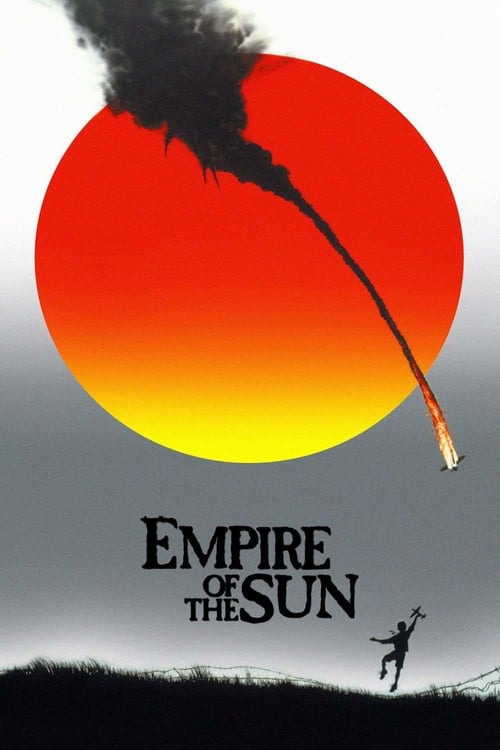
Empire of the Sun
1987 · Steven Spielberg
For when you want a big, transporting Sunday-afternoon epic that actually has something aching underneath — a film to sink into for two and a half hours and come out of a little changed. More emotionally demanding than a comfort watch, but never punishing.
What it's about
A pampered English boy is living the colonial high life in Shanghai when the Japanese invade in 1941, and in the chaos he's separated from his parents. He ends up interned for the duration of the Pacific War in a prison camp beside a military airfield, where a scrappy American sailor becomes his reluctant protector and teacher in the art of survival. It's a war epic seen entirely through a child's eyes — one who half-understands the catastrophe around him and turns it into adventure, obsession, and myth.
The experience
Sweeping and strange at once: the spectacle of a David Lean-scale epic wrapped around something raw and disorienting, a boy's wonder colliding with genuine horror. It builds to images of real awe, and it leaves you moved in a way that's more complicated than a simple cry.
Performances
A thirteen-year-old Christian Bale carries nearly every frame in his breakout role, going from bratty privilege to feral survival with a ferocity almost no child performance matches; John Malkovich is slippery and magnetic as the American sailor whose charm you can never quite trust.
The craft
Spielberg working in his prestige-epic register: enormous crowd scenes of Shanghai in collapse, images built for the biggest screen you can find, and a John Williams score with a choral theme that lodges in you. The staging keeps the camera at a child's height and lets planes, crowds, and light take on the outsized glow they'd have in a boy's memory.
Why it matters
The film that launched Christian Bale and marked Spielberg's deliberate turn toward adult, literary material between his adventure blockbusters — underappreciated on release, now widely considered one of his richest films.
Snapshot
Empire of the Sun is Steven Spielberg's adaptation of J.G. Ballard's 1984 semi-autobiographical novel, a war epic filtered entirely through the consciousness of a child. It follows Jamie "Jim" Graham, a pampered English boy in the International Settlement of Shanghai, who is separated from his parents amid the Japanese invasion of 1941 and interned for the duration of the Pacific War at a camp near a military airfield. The film is a hinge work in Spielberg's career: made between The Color Purple (1985) and Indiana Jones and the Last Crusade (1989), it belongs to his deliberate reach toward adult, literary, "prestige" material, and it launched the thirteen-year-old Christian Bale, who carries nearly every frame. Reverent toward the David Lean tradition of the intimate epic, it is at once one of Spielberg's most visually ambitious films and one of his least commercially successful, a discrepancy that has shaped its reputation as an underrated, gradually rehabilitated work.
Industry & production
The film was produced by Amblin Entertainment and released by Warner Bros., with Spielberg producing alongside his long-standing partners Kathleen Kennedy and Frank Marshall, and Robert Shapiro. Its path to the screen ran through David Lean, who was attached to direct an adaptation of Ballard's novel; when the project passed to Spielberg, he initially expected to produce and hand the reins to Lean before deciding to direct it himself. This lineage matters, because the finished film openly courts the Lean idiom of scale-with-intimacy. Tom Stoppard is the credited screenwriter, distilling Ballard's dense, associative prose into a dramatized arc while preserving its detachment and its strange, ecstatic imagery.
Production was notable for its access: Empire of the Sun was among the first major Western features permitted to shoot in Shanghai after 1949, staging large-scale sequences of the 1941 evacuation on the historic Bund with thousands of extras. Additional photography took place in Spain — the arid country near Jerez and Trebujena standing in for the camp and airfield exteriors — and at Elstree Studios in England. The scale of the crowd work, period dressing of Shanghai streets, and construction of the Lunghua-style camp made it a logistically demanding shoot. Commercially, the film underperformed in the United States relative to expectations for a Spielberg picture, though it was received more warmly in some overseas markets and by critics; specific grosses should be checked against a reliable database rather than asserted here. Its awards profile — multiple Academy Award nominations in craft categories, including cinematography, original score, art direction, costume design, sound, and editing, with no wins, and conspicuously no Best Picture or Director nod — became part of the recurring narrative about Spielberg being honored for spectacle but withheld the industry's top prizes in this period.
Technology
The film was shot photochemically on 35mm color negative, in the anamorphic widescreen format that its epic ambitions demand, giving the compositions their broad horizontal sweep. Its most conspicuous "technology" is old-fashioned and physical: full-scale and miniature aircraft, pyrotechnics for the airfield attack, and the marshalling of very large numbers of extras and period vehicles for the Shanghai sequences. This is a pre-digital effects film in which spectacle is achieved through in-camera scale, model work, and staging rather than computer imagery. Its optical and mechanical craft — the P-51 Mustang strafing run, the fireball of the raid, the flare of light on the horizon that Jim reads as an atomic flash — represents late-1980s practical filmmaking at a high level of resource and coordination, executed by an Amblin production apparatus then at the peak of its capabilities.
Technique
Cinematography
Allen Daviau, Spielberg's cinematographer on E.T. and The Color Purple, shot the film and earned an Academy Award nomination for it. His work is the picture's signature: a palette that moves from the burnished, storybook luxury of the Grahams' Shanghai villa into the dust, haze, and hard light of internment, organized around recurring motifs of backlight, lens flare, and the "white light" of explosions and dawn. Daviau repeatedly frames Jim as a small figure against vast spaces — crowds, runways, skies — using the anamorphic width to dwarf and isolate the boy. Light functions almost theologically: shafts through camp windows, the blaze off aircraft canopies, and the climactic flash on the horizon all treat illumination as revelation and menace at once, the visual grammar of a child who finds terrible beauty in war.
Editing
Michael Kahn, Spielberg's regular editor, cut the film and was Oscar-nominated. The editing sustains a long, episodic structure — roughly two and a half hours spanning years — by anchoring rhythm to Jim's subjectivity: cutting on his gaze, his fixations (planes, food, Basie), and his misreadings of events. Set pieces such as the Shanghai evacuation and the airfield raid are built with escalating cross-cutting, while the camp passages breathe more slowly, marking the erosion of time in captivity. Kahn's shaping keeps the film legible as a coming-of-age throughline even as it accumulates incident.
Mise-en-scène / staging
Production designer Norman Reynolds (a veteran of the Star Wars films and Raiders of the Lost Ark) built the film's worlds, and costume designer Bob Ringwood dressed them; both contributed to its Oscar-nominated craft. The staging is organized as a descent through social orders: the hermetic privilege of the European settlement, the chaos of the invaded city, and the improvised hierarchy of the camp, where scavenged goods and black-market barter form a shadow economy. Spielberg stages the film around thresholds and enclosures — gates, fences, windows, the shell of the derelict aircraft Jim adopts — that externalize confinement while the boy's imagination keeps escaping upward toward the planes.
Sound
The soundscape juxtaposes the din of war — engines, gunfire, crowds — against passages of unnerving quiet, and it leans heavily on John Williams's score and choral voices to lyricize violence. The recurring use of a boys'-choir vocal, built on the Welsh lullaby "Suo Gân," gives Jim's world its ache of lost innocence; sound and music together transform the P-51 attack into something Jim experiences as rapture rather than terror. The film was Oscar-nominated for its sound work.
Performance
Christian Bale, in his first major film role, gives one of the great child performances in American cinema — required to age emotionally from a coddled boy into a hollowed survivor while remaining almost continuously on screen. His Jim is neither cute nor merely victimized; he is calculating, adaptable, and disturbingly enthralled by power and machinery. John Malkovich plays Basie, the American merchant-sailor and opportunist who becomes Jim's ambiguous mentor — a con man whose survivalism the boy both learns from and is used by. The supporting ensemble — Miranda Richardson and Nigel Havers as fellow internees, Joe Pantoliano, Masatō Ibu, and others — populates the camp with a credible social texture. Ballard himself appears in a brief cameo at the fancy-dress party in the opening act.
Narrative & dramatic mode
The film's defining formal choice is restricted narration: with rare exceptions, we know only what Jim knows, and the war reaches us as he perceives it — fragmentary, glamorized, misunderstood. This produces a coming-of-age story crossed with the survival epic, but tilted away from sentiment by the boy's unreliability and his morally unsettling fascinations. Its dramatic mode is elliptical and episodic rather than tightly goal-driven; motifs (aircraft, the promise of light, hunger, the search for parents) recur and accrete meaning instead of resolving through conventional plot mechanics. The emotional climax is deliberately ambiguous — a reunion that reads less as catharsis than as the confirmation of something irretrievably lost — which is one reason contemporary audiences expecting Spielbergian uplift found it withholding.
Genre & cycle
Empire of the Sun sits at the intersection of the war film, the historical epic, and the coming-of-age drama, but it belongs most specifically to the sub-tradition of war-through-a-child's-eyes — a lineage that includes René Clément's Forbidden Games, John Boorman's Hope and Glory (released the same year, also drawing on a British childhood in WWII), and later works such as Grave of the Fireflies. Within Spielberg's own output it inaugurates a cycle of serious WWII and historical films that runs forward to Schindler's List (1993) and Saving Private Ryan (1998), and it anticipates his lifelong preoccupation with imperiled or abandoned children. As an "intimate epic" it consciously invokes David Lean, translating the roadshow historical scale of Lawrence of Arabia into a story with a single small consciousness at its center.
Authorship & method
The film is a dense collaboration among Spielberg's core artisans and a literary source of unusual pedigree. Steven Spielberg directs it as a personal reach for adult respectability and as an exercise in restraint, suppressing (not always successfully) his instinct for reassurance in favor of Ballard's cooler vision. Tom Stoppard, credited with the screenplay, supplies the film's verbal economy and its capacity to hold irony and wonder in the same frame. J.G. Ballard, whose novel drew directly on his own boyhood internment at Lunghua camp outside Shanghai, is the ghost in the machine — the film's strangeness, its aestheticizing of catastrophe, is his. Allen Daviau (cinematography), John Williams (score), Michael Kahn (editing), and Norman Reynolds (production design) form the craft spine, most of them Spielberg regulars whose fluency with him enabled the film's scale. The method is one of large-scale location realism married to a subjective, almost dreamlike visual and musical register.
Movement / national cinema
The film resists neat national categorization: an American studio production, directed by the era's defining Hollywood filmmaker, adapting an English novelist's memoir of a British colonial childhood in China, shot on three continents. Its aesthetic allegiance, however, is to the British epic tradition of David Lean more than to any American new wave. It also occupies a distinctive place in production history as one of the earliest large Western features to gain access to post-1949 Shanghai, making it a small landmark in the opening of location filmmaking in mainland China during the 1980s.
Era / period
Made at the height of the New Hollywood generation's consolidation into blockbuster-era studio power, Empire of the Sun reflects the late-1980s appetite among that generation's most successful directors to convert commercial capital into prestige. It arrives in a moment of renewed interest in WWII from the vantage of memory rather than combat heroics — the same cultural current that produced Boorman's Hope and Glory and, in animation, Isao Takahata's Grave of the Fireflies, both 1987–88. Diegetically, of course, it inhabits 1941–1945, from Pearl Harbor's shockwave in Shanghai to the war's end and the atomic flash on the horizon, and it is quietly a film about the collapse of European empire in Asia, glimpsed at the exact moment the old colonial order is swept away.
Themes
At its core the film is about the death of innocence — not as gentle loss but as a corrosive education in power, hunger, and survival. Jim's arc traces how a child assimilates to catastrophe: he learns to barter, to flatter authority, to admire the very forces destroying his world. Aviation is the governing symbol — planes as objects of transcendence and worship, culminating in the ecstatic "Cadillac of the sky" welcome Jim gives the American Mustangs mid-raid, where terror and rapture fuse. The film meditates on empire and its collapse (British, Japanese, and the rising American order embodied in Basie's mercenary pragmatism), on the ambiguity of mentorship and exploitation, and on light itself as a recurring emblem of both revelation and annihilation — most hauntingly in the distant flash Jim associates with the atomic bomb, a moment where a child's private mythology brushes against history's most consequential event.
Reception, canon & influence
Critical reception at release was respectful and often admiring of the film's craft, particularly Daviau's cinematography, Williams's score, and Bale's performance, even as many reviewers judged it long, cool, or emotionally elusive by Spielberg's standards; its disappointing American box office reinforced a perception that Spielberg's most personal reach of the decade had failed to connect with a mass audience. The Academy's recognition of its craft categories, alongside its exclusion from the top awards, crystallized the era's ambivalence toward Spielberg as artist. Over subsequent decades the film's stock has risen: it is now frequently cited as one of Spielberg's underappreciated works and a crucial bridge to his mature historical films.
Its lines of influence run backward to Ballard's autobiographical novel and to the David Lean epic tradition Spielberg consciously honors, and forward within Spielberg's own career, where it functions as the essential rehearsal for the moral seriousness and WWII subject matter of Schindler's List and Saving Private Ryan and for the recurring figure of the endangered child (A.I., War Horse). Its most tangible legacy may be Christian Bale, for whom it was a career-making debut leading to one of the most significant acting careers of the following decades. The claim, sometimes made, that the film seeded a wider cycle of child's-eye war cinema should be treated cautiously — parallel films appeared contemporaneously rather than in demonstrable imitation — but as a demonstration that a mass-audience filmmaker could stage history through a single unreliable young consciousness, Empire of the Sun remains quietly influential and, in the long revision of Spielberg's canon, increasingly esteemed.
A Deleuzian reading
A flight of Mustangs comes in low over the airfield, sunlight sliding off the canopies, and John Williams hands the strafing run to a boys' choir.
The full Deleuzian reading of Empire of the Sun →
Reception
A rare Spielberg box-office disappointment in 1987, shrugged off by many critics as overproduced prestige — it's since been reappraised so thoroughly that 'Empire of the Sun is his most underrated film' is now practically Spielberg-fan orthodoxy.
How Empire of the Sun was received, from release to now →
How to watch Empire of the Sun: what to notice on a first viewing
- Notice how small Daviau keeps Jim inside the wide frame. The anamorphic width is used to shrink him. Crowds on the Bund, runways, dust, sky. Spielberg gives the boy the whole horizon and almost never lets him fill it. Scale is doing the storytelling. A boy who cannot change anything is photographed at the size of his power over it.
- Watch the light come from behind people and flare the lens. Daviau builds the picture out of backlight, flare, and white: shafts through camp windows, glare off canopies, blasts that blow the frame out. The same beam blesses and threatens. Light here is not telling you where the sun is. It is telling you what Jim feels, and he feels awe at terrible things.
- Listen for the boys' choir arriving over the violence. Williams sets the Welsh lullaby Suo Gan against engines, gunfire, and crowds. The voice enters exactly where a war film would normally hand the scene to noise. The music takes the boy's side. It converts what you are seeing into rapture, and nothing on the soundtrack argues back.
- Count how often the camera shows Jim looking at something. Kahn cuts on the boy's gaze and his fixations: planes, food, Basie. You spend the film not simply seeing what Jim sees but watching him see it. The film's account of the war is a boy's account, and it keeps showing you the boy so you never forget whose it is.
- Watch the gates, fences, and windows Jim stands behind. Spielberg stages nearly every passage against a barrier: the villa's walls, the crowd's crush, wire, shutters, the shell of a derelict plane. The boy keeps looking upward and outward through them. Confinement is built into the compositions, so you feel the camp before the camp arrives and long after he adapts to it.
The whole guide to watching Empire of the Sun, with the keys for a rewatch →
Influences: the films it descends from and the films it influenced
- Lawrence of Arabia (1962) — The template Spielberg and Daviau consciously reproduce — anamorphic horizon compositions with heat-shimmer and backlight, scaling vast landscape to the psychology of a single morally ambiguous protagonist.
- The Bridge on the River Kwai (1957) — Supplies the POW-internment structure: Western dignity and self-delusion studied under Japanese captivity, the moral-ambiguity-in-a-camp architecture Empire inherits.
- Doctor Zhivago (1965) — Filters cataclysmic history through one swept-along private consciousness; Williams's recurring choral leitmotif carrying the epic mirrors Jarre's single-melody scoring method.
- Forbidden Games (1952) — Founding grammar of war-through-a-child's-eyes — a child ritualizing death as play to metabolize catastrophe she cannot comprehend, the mode Jim's survival-games extend.
- Ivan's Childhood (1962) — Subjective dream-cutting that renders a boy's war as interior reverie, the fever-vision editing register Michael Kahn adopts for Jim's imagined flight and the atomic-flash mirage.
- The 400 Blows (1959) — Restricted narration locked to a single child's limited comprehension, refusing the adult overview — the point-of-view discipline Stoppard's script imposes on Jim.
- The Tin Drum (1979) — A child as uncanny, grotesque witness who aestheticizes wartime horror rather than moralizing it — prefiguring Ballard's cool strangeness Spielberg tries to preserve.
- The Color Purple (1985) — Spielberg's next Daviau-shot film extends the golden child's-POV lighting and confirms the decisive turn toward the historical drama that Color Purple inaugurated.
- Schindler's List (1993) — The rehearsal paid off — moral seriousness toward WWII atrocity and the red-coat child deployed as a restricted moral focal point, the technique first tested on Jim.
- Saving Private Ryan (1998) — Extends the large-scale location realism and subjective-cutting-under-chaos first staged in Empire's Shanghai stampede and air-raid sequences into full combat.
- A.I. Artificial Intelligence (2001) — Carries forward the endangered-child figure and the aviation/ascension-as-transcendence yearning, structured again around a child's uncomprehending point of view.
- War Horse (2011) — Explicit return to the Lean anamorphic epic and Williams's choral scale, imperiling innocence in war with the same intimate-epic proportioning learned here.
- Atonement (2007) — Structures a WWII narrative around a child's unreliable perception in anamorphic widescreen, inheriting Empire's restricted-narration-through-a-young-consciousness.
- Life Is Beautiful (1997) — Reframes camp internment as a game to shield a child's comprehension — the survival-through-fantasy mechanism of Jim's aestheticizing gaze made explicit and structural.
- The Boy in the Striped Pyjamas (2008) — Sustains an entire WWII narrative through a boy's partial, romanticizing comprehension, using boy-scaled framing and awe where the audience supplies the dread the child cannot.
- Innocent Voices (2005) — Shows Hollywood-scaled emotional direction and clean coverage applied to a child-in-wartime survival arc — exactly the mainstream fluency Mandoki carries over from his American period and redirects toward political testimony.
- Hope and Glory (1987) — Contemporaneous autobiographical WWII-childhood film staging the Blitz as a boy's wonder-filled adventure playground, the same death-of-innocence-as-exhilaration tone.
- Come and See (1985) — Uses immersive subjective sound design and a child's face as the film's atrocity barometer, the same strategy of measuring history through one young consciousness.
- The Last Emperor (1987) — Storaro's anamorphic intimate-epic of a vanishing colonial Asia, with threshold-and-enclosure staging of a protagonist imprisoned by history — released the same year on parallel craft.
- Grave of the Fireflies (1988) — Children surviving the collapse of wartime society rendered through their restricted vantage, death-of-innocence delivered without Spielbergian consolation.
- E.T. the Extra-Terrestrial (1982) — Spielberg and Williams pursue the same child's-eye-of-wonder framing and load-bearing choral scoring, the camera again organizing the world around a boy's perception.
Similar films
- The Last Emperor (1987) — influence & lineage
- Schindler's List (1993) — influence & lineage
- Hope and Glory (1987) — influence & lineage
- Ivan's Childhood (1962) — influence & lineage
- Grave of the Fireflies (1988) — influence & lineage
- Saving Private Ryan (1998) — influence & lineage
- Pearl Harbor (2001) — shared sensibility
- Indiana Jones and the Temple of Doom (1984) — shared sensibility