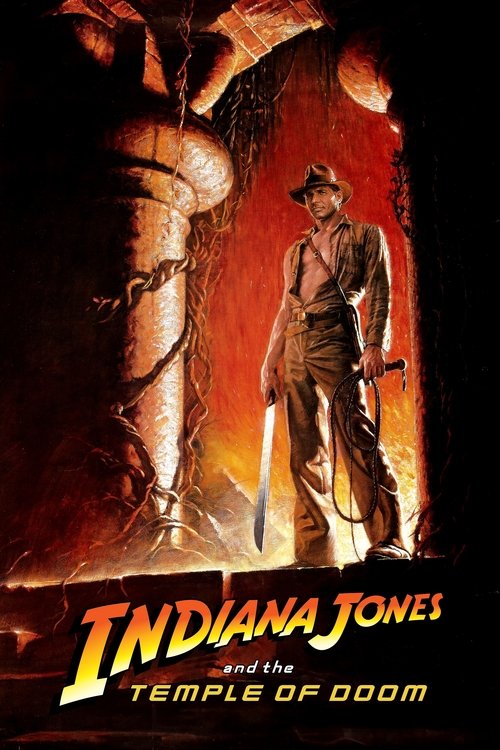
Indiana Jones and the Temple of Doom
1984 · Steven Spielberg
For an adrenaline night when you want pure spectacle and set pieces — but know it's the dark, mean one of its kind, better for thrill-seekers than for a gentle family evening.
What it's about
It's 1935, and a nightclub deal gone wrong sends Indiana Jones tumbling out of Shanghai with a lounge singer and a wisecracking kid sidekick, crash-landing in India. A desperate village begs him to recover a sacred stone stolen along with their children, and the trail leads to a palace where an ancient cult is at work in the catacombs below. What follows is a plunge into genuinely dark territory: secret rituals, enslaved children, and one legendary escape after another.
The experience
Relentless — a rollercoaster that opens with a musical number and barely stops for breath, but with a streak of real horror and cruelty that makes it far more intense than its reputation as matinee fun suggests. It's thrilling, gross, funny, and occasionally nightmare-fuel, sometimes within the same scene.
Performances
Harrison Ford is at his most physical and game, and young Ke Huy Quan steals scenes outright as Short Round, one of the most beloved kid sidekicks ever put on screen.
The craft
Spielberg engineers set pieces — the nightclub opening, the plane escape, the mine-cart chase — with a clockwork inventiveness that still gets studied, all driven by John Williams at full roar and effects work with real physical weight. It's built for the biggest screen and loudest speakers you can find.
Why it matters
Its intensity was so controversial it helped prompt the creation of the PG-13 rating, and its set pieces became a template for decades of action-adventure filmmaking.
Snapshot
Indiana Jones and the Temple of Doom is the second Indiana Jones film to reach screens and the first chronologically — a prequel set in 1935, a year before the events of Raiders of the Lost Ark (1981). It is also, by broad critical consensus and by the subsequent testimony of its makers, the darkest and most divisive entry in the series: a Saturday-matinee serial homage that turns toward horror, child slavery, human sacrifice, and sustained physical cruelty. The film opens in a Shanghai nightclub with an all-out musical number, escalates through a poisoning, a shootout, a plane crash and a raft descent, then settles into a long subterranean sequence beneath Pankot Palace where the Thuggee cult performs a heart-extraction ritual before an audience of chanting worshippers. It ends with a mine-cart chase and a rope-bridge standoff — two of the most imitated action set pieces in the American cinema of the 1980s.
Produced by Lucasfilm and released through Paramount, the film was a substantial commercial success and, together with Gremlins (also 1984, executive-produced by Spielberg), directly precipitated the creation of the PG-13 rating by the Motion Picture Association of America — one of the few instances in which specific films visibly restructured the American classification system. That fact has become inseparable from the film's reputation, and rightly so: Temple of Doom marks the point at which the Spielberg–Lucas adventure mode collided with its own appetite for intensity, and the industry built a new box to hold it.
Its other durable legacy is a critical one. The film's depiction of India — a village of starving supplicants, a palace banquet of eyeball soup and chilled monkey brains, a bloodthirsty cult, and a white American hero who restores order — has made it a standing case study in postcolonial film criticism, and the film was reportedly refused permission to shoot in India, relocating principally to Sri Lanka and to Elstree Studios. Any serious account of the film has to hold both things at once: its extraordinary command of kinetic craft, and the imperial adventure grammar it revives without irony.
Industry & production
The film sits at a specific moment in the Lucasfilm–Spielberg relationship. Raiders of the Lost Ark had been an enormous success in 1981, and the Indiana Jones property was structured from the outset as a multi-picture arrangement with Paramount, with George Lucas as executive producer and story originator and Spielberg directing. Frank Marshall and Kathleen Kennedy produced, as they had on Raiders — the Marshall/Kennedy team being, in this period, effectively Spielberg's production apparatus and later the nucleus of Amblin Entertainment.
Lucas devised the story; the screenplay is credited to Willard Huyck and Gloria Katz, the writing team best known for co-writing American Graffiti (1973) with Lucas. Lawrence Kasdan, who had written Raiders, did not return, and the shift in writing sensibility is legible in the finished film: less of the wry, hard-boiled construction of Raiders, more sensation and set-piece, and a comic register that runs to slapstick and screaming.
Both Lucas and Spielberg were going through personal difficulty during development — a fact both have discussed publicly in retrospect — and both have subsequently attributed the film's darkness in part to their moods at the time. Spielberg has said on multiple occasions that the film is his least favorite of the series and that he was not entirely proud of how bleak it became; he has also noted, with characteristic wryness, that the production introduced him to Kate Capshaw, whom he later married. These are among the better-documented authorial disavowals in modern Hollywood, and they have shaped how the film is discussed.
Production was materially difficult. Denied permission to film in India — the record indicates objections to the script's portrayal of Indian culture and religion — the production shot exteriors principally in Sri Lanka, with Macau standing in for elements of the opening, and completed the bulk of the film on stages at Elstree Studios in England, where the vast Temple of Doom set and the mine tunnels were built. Harrison Ford suffered a serious back injury during the shoot that required him to be off the film for a period; second unit and a double covered a significant amount of action work in his absence, and the mine-cart sequence in particular was assembled substantially through miniatures and stage work rather than around the star.
The film was a major commercial performer in 1984 — one of the year's biggest releases worldwide. Precise figures vary across sources and I won't assert a specific gross here, but its success was never in doubt; the controversy attached to the film was about content, not returns.
Technology
Temple of Doom is a late-analogue spectacle, and much of its interest lies in how completely it achieves its effects without digital tools. Industrial Light & Magic handled visual effects, with Dennis Muren supervising — ILM at this point being the most advanced optical-effects house in the world, coming directly off the Star Wars trilogy.
The signature technical achievement is the mine-cart chase, executed principally through go-motion and miniature work rather than live-action photography. ILM built extensive miniature tunnel sets and used motion-control camera rigs and stop-motion-derived techniques to produce the carts' movement, then intercut this with live-action stage photography of the actors on gimballed carts against process backgrounds and with a limited amount of practical track. The seamlessness of the intercutting is the point: the sequence reads as continuous velocity, and the audience's inability to locate the seams is a large part of why it became a template. Go-motion — ILM's blur-introducing refinement of stop-motion, developed on The Empire Strikes Back and Dragonslayer — was central to making miniature motion read as photographic.
Other effects work is similarly analog and physical: matte paintings for Pankot Palace and the mountain vistas, forced-perspective and miniature work for the rope bridge, and practical mechanical and makeup effects for the ritual sequences, including the heart-extraction gag, which combines prosthetic work, sleight-of-hand staging and editorial concealment rather than any single revealing effect. The insect sequence used enormous quantities of live insects on stage — a practical-effects decision with real consequences for the performers, and one that would almost certainly be handled digitally today.
Kate Capshaw's Willie sequence in the spike chamber, the collapsing ceiling, and the raft drop are all built from physical rigs, stage water and miniature composites. The film is a good index of exactly what the state of the art could deliver in 1984 — and, by implication, of the ceiling that computer-generated imagery would break less than a decade later on Spielberg's own Jurassic Park.
Technique
Cinematography
Douglas Slocombe, the veteran British cinematographer who had shot Raiders, returned — as he would for Last Crusade — and his contribution is one of the strongest continuities across the trilogy. Slocombe's background reaches back to Ealing (Kind Hearts and Coronets, The Lavender Hill Mob) and forward through The Servant and The Great Gatsby; his Indiana Jones work is characterized by hard, sculpted key light, deep shadow, and a willingness to let large areas of frame go black.
In Temple of Doom that approach is pushed further than in Raiders. The Shanghai opening is saturated and stagey — reds, golds, the deliberate artifice of a nightclub number. The Sri Lankan exteriors are bright and flat by contrast, and the village sequence is deliberately drained of color and warmth. The temple interior is where Slocombe's style is most fully deployed: an enormous set lit largely by apparent firelight, with shafts and pools of orange picking figures out of blackness, silhouetted crowds, and lava-glow underlighting that turns faces into masks. It is expressionist lighting used at blockbuster scale, and it does most of the work of making the ritual sequence frightening — you see less than you think you do.
Slocombe was known for working without a light meter, judging exposure by eye, and for a fast, economical approach; on a production of this size and difficulty that pragmatism mattered.
Editing
Michael Kahn, Spielberg's principal editor from Close Encounters of the Third Kind onward, cut the film. Kahn's contribution to the Spielberg action mode is foundational and often under-credited: the legibility of Spielberg's set pieces — the sense that however fast the cutting goes, you always know where everyone is and what they want — is an editorial achievement as much as a directorial one.
Temple of Doom is Kahn's most sustained demonstration of that principle. The mine-cart chase alternates between geography-establishing wide shots, cart-level traveling shots, character reactions, and cutaways to the pursuers, at a rate fast enough to generate velocity but structured enough to preserve spatial continuity. The rope-bridge climax does something similar with static geography: the bridge is established as a complete space early, so that every subsequent cut is read against a mental map.
Kahn also handles the film's tonal switchbacks, which are severe — the cut from the eyeball-soup banquet to the bedroom-corridor comedy to the sacrificial chamber is a whiplash the film asks the editing to absorb. Not everyone thinks it succeeds; the tonal management is the most frequently criticized aspect of the film's construction.
Mise-en-scène / staging
Elliot Scott's production design gives the film its two defining spaces: Pankot Palace, all cool marble and courtly restraint above ground, and the temple below, a cathedral of black rock, chasms, cages and lava. The vertical arrangement is the film's central design idea — civility above, atrocity beneath — and it is an old Gothic figure (the house with something in the cellar) rendered at enormous scale.
Spielberg's staging within these spaces is classical: long lenses compressed against wide masters, characters placed in depth, and a consistent preference for showing the whole geography of a space before fragmenting it. The ritual chamber is introduced with a slow revelation — the crowd, the altar, the pit — that gives the audience the layout before the horror begins.
The opening number, "Anything Goes," staged in Mandarin with Capshaw fronting a full musical production, is a deliberate rupture: a self-conscious homage to the Busby Berkeley musical grafted onto the front of an adventure film, announcing that this entry will be more overtly theatrical than its predecessor.
Sound
John Williams's score is the film's other continuity with Raiders, and it does substantial structural work. The "Raiders March" returns as Indy's leitmotif, but the new material is what characterizes the film: a chanting, percussive Thuggee motif built around low male voices and driving rhythm, and a lyrical theme for Short Round and the children. Williams's willingness to write genuinely ugly, menacing music for the cult sequences — dissonant brass, ritual percussion — is central to how frightening those scenes play.
Ben Burtt supervised the sound design, as on Raiders. The film's sound is dense and physical: the crunch of the mine carts, the insect chamber's layered chittering, whip cracks, the temple's reverberant vastness. The film was released in Dolby Stereo and, in its 70mm presentations, six-track magnetic sound; it belongs to the period in which Lucasfilm was actively pushing exhibition sound standards, and the THX program was established at Lucasfilm around this time.
Performance
Harrison Ford's Indiana Jones is grimmer here than in Raiders — more physically punished, and for a long central stretch under the Blood of Kali, actively villainous. Ford plays the possession sequence with genuine menace rather than camp, and the film's most disturbing moments are his.
Kate Capshaw's Willie Scott is the film's most contested performance. Written as a screaming, complaining comic foil — a deliberate inversion of Karen Allen's capable, combative Marion — the character has aged badly, and Capshaw has spoken about the limitations of the role. The performance is committed and skilled within the terms it was given; the terms are the problem.
Ke Huy Quan, cast as Short Round at eleven or twelve, gives the film its warmth. The Indy–Shorty relationship is the most emotionally functional thing in the picture, and Quan's unforced comic timing and physical confidence carry a great deal. Amrish Puri's Mola Ram — a major figure in Indian cinema playing a cult priest for a Hollywood production — is a genuinely imposing screen presence, and the film's central irony is that its most charismatic antagonist is also the vehicle of its worst caricature.
Narrative & dramatic mode
Structurally the film is a serial: a chain of escalating set pieces linked by minimal connective tissue, with a MacGuffin (the Sankara stone) that functions almost entirely as motivation rather than mystery. This is deliberate — the Indiana Jones films are explicit homages to the 1930s and 1940s adventure serials Lucas and Spielberg grew up on, and the serial's episodic, cliffhanger-driven construction is the model.
Where Temple of Doom departs from Raiders is in dramatic mode rather than structure. Raiders is a quest with a supernatural payoff, played largely as adventure comedy with a horror coda. Temple of Doom is a descent narrative — an underworld journey — and it commits to horror as its dominant register for a long central act. The Thuggee sequences are staged as ritual horror; Indy's possession is a body-horror/possession trope; the children in cages and the whipping of Short Round are cruelty played straight.
The prequel structure has a curious consequence: because we know Indy survives to Raiders, tension has to be relocated onto the peripheral characters — the children, Shorty, Willie — which further intensifies the cruelty, since the film must threaten the vulnerable to generate stakes.
The three-act architecture is unusually clean: Shanghai (prologue), village and palace (investigation), temple and escape (climax). What it lacks is Raiders' sense of a coherent antagonist plot; Mola Ram's scheme is sketched rather than dramatized.
Genre & cycle
The film belongs to the post-Star Wars Hollywood blockbuster cycle that Spielberg and Lucas jointly defined: high-concept, effects-driven, structured around set pieces, aimed at a family audience but calibrated for intensity. Within that cycle, Temple of Doom is the entry that pushed the intensity envelope until it broke.
Genealogically it draws on the imperial adventure film — Gunga Din (1939) is the most frequently and most persuasively cited antecedent, sharing the Thuggee cult, the colonial Indian setting, and several structural beats. Behind that lie the Republic and Universal serials, H. Rider Haggard's lost-world fiction, and the whole nineteenth-century apparatus of the imperial romance. The film also draws on the Universal and Hammer horror traditions in its temple sequences, and on the Hollywood musical in its prologue.
Its position in the action cycle is influential in a very specific way: the mine-cart chase established the "vehicle-on-rails through hazardous terrain" set piece as a genre staple, and the film's structure — chained escalating stunts with comic beats between — became the standard blockbuster template, visible in everything from the Mummy revivals to Pirates of the Caribbean to a generation of theme-park dark rides (Disney's own Indiana Jones Adventure attraction is a direct descendant).
Authorship & method
The film is best understood as a collaboration between two authorial systems. Lucas supplies the story architecture and the serial-homage frame; Spielberg supplies the staging, the camera, and the comic-horror tonal calibration. The Huyck–Katz screenplay serves Lucas's premise.
Spielberg's method here is the one he had refined across Jaws, Close Encounters and Raiders: extensive storyboarding, precise pre-visualisation of action geography, and a preference for solving problems in staging rather than in post. The regular collaborators are the story: Slocombe on camera, Kahn on the cut, Williams on the score, Burtt on sound, Marshall and Kennedy producing, ILM on effects. This is a stable authorial unit, and it is worth noting how much of what we call "Spielbergian" is actually the product of that unit operating over a decade.
The film is also the clearest case in Spielberg's career of a director working somewhat against his own instincts. His subsequent statements about disliking the film's darkness, and his immediate pivot to The Color Purple (1985) and Empire of the Sun (1987), suggest a filmmaker who had reached the end of a mode. Last Crusade (1989) reads in part as a deliberate correction — lighter, funnier, family-centred.
Movement / national cinema
Temple of Doom is squarely a product of New Hollywood's second phase — the moment when the film-school generation's personal cinema of the early 1970s had converted into the corporate blockbuster of the late 1970s and 1980s. Lucas and Spielberg are the pivotal figures in that conversion, and this film is one of its purest expressions: an American studio picture, financed and controlled by a filmmaker-owned company (Lucasfilm), shot largely in British studios with British craft personnel, using effects technology developed in-house in California.
Its relationship to Indian cinema is entirely one of appropriation rather than exchange. The film borrows Indian settings, religion and iconography, casts prominent Indian actors (Amrish Puri, Roshan Seth) in roles that serve a Western adventure narrative, and was denied Indian location access. It is a text about India made from outside it, and the film's reception in India and among Indian and diasporic critics has been correspondingly hostile — the depiction of Kali worship in particular bears no meaningful relationship to actual Hindu practice, resurrecting instead a colonial-era British construction of "Thuggee" as an organized murder cult.
Era / period
Released in May 1984, the film sits at the center of a specific American moment: the Reagan-era blockbuster summer, the height of Lucasfilm's cultural power, and the pre-digital peak of practical effects. 1984 was an extraordinarily dense summer — Ghostbusters, Gremlins, The Karate Kid, Beverly Hills Cop later that year — and the industry's confidence in the family-adventure product was total.
That confidence is precisely what the film disrupted. The complaints about Temple of Doom and Gremlins — both PG-rated, both containing material many parents found unsuitable for young children — produced sufficient pressure that the MPAA introduced PG-13 in the summer of 1984. The rating's creation is generally credited to Spielberg having proposed an intermediate category to Jack Valenti amid the controversy; the causal chain from these two films to the new rating is one of the better-documented instances of specific pictures reshaping industry regulation.
Set in 1935, the film's diegetic period is the same interwar zone as Raiders, but without the Nazi antagonists it uses the British Raj as its political frame — and treats British colonial authority, in the person of the closing cavalry, as straightforwardly benign.
Themes
The film's overt thematic material is simple: the recovery of a stolen sacred object, the liberation of enslaved children, and the redemption of a mercenary adventurer into someone who acts for others. Indy begins the film pursuing "fortune and glory" and ends it returning the Sankara stone to a village that has no material use for it — a genuine, if schematic, moral arc.
Beneath that sits a more troubling structure. The film's horror derives almost entirely from the racialised depiction of non-Western religion: Kali worship as blood cult, Indian nobility as decadent and complicit, Indian villagers as helpless supplicants awaiting a white deliverer. The banquet scene — snakes, insects, eyeballs, monkey brains — is a set piece of culinary othering with no basis in any actual Indian cuisine. The film is, in the fullest sense, an imperial adventure narrative, and it reproduces that form's logic without the ironic distance its serial homage might have provided.
Read alongside Spielberg's other 1980s work, the film's preoccupation with endangered children is striking, and it connects to a persistent Spielbergian concern — children in peril, adults who fail them, surrogate families. Indy and Shorty constitute one of the earliest of Spielberg's improvised father–son pairings.
Finally, the film thematizes appetite: for treasure, for spectacle, for sensation. It is a film about wanting too much, made by filmmakers who, on their own later account, wanted too much from it.
Reception, canon & influence
Contemporary critical reception was sharply split. Many reviewers praised the film's technical command and relentless pacing while objecting to its violence and tonal cruelty; a significant strand of criticism found the film mean-spirited and, in its treatment of India, indefensible. The commercial performance was very strong regardless, and the film's set pieces entered popular culture immediately.
The influences running into the film are legible: Gunga Din above all, the Republic serials, the imperial romance tradition, Universal and Hammer horror, and the Hollywood musical prologue. The Thuggee material derives from British colonial accounts rather than from any Indian source.
The influences running out of it are considerable. The mine-cart chase is the film's most copied sequence, spawning direct imitations across action cinema, video games (the rail-cart level became a genre convention), and theme-park design. The film's structural template — escalating chained set pieces with comic relief and a horror center — became standard blockbuster grammar. Its regulatory legacy, the PG-13 rating, arguably reshaped the American film industry more than any single film of the decade: PG-13 became the dominant rating for blockbusters and altered how studios calibrated content for decades.
Critically, the film has had two afterlives. In popular reassessment it has been partially rehabilitated as the series' most distinctive and formally daring entry — the one that takes real risks. In academic film studies it has become a standard teaching text for postcolonial critique of Hollywood, cited alongside films like Gunga Din and The Man Who Would Be King as an index of how imperial narrative forms persist in commercial cinema.
Its cast members' later careers have added a further layer: Ke Huy Quan's return to prominence in the 2020s brought renewed attention to Short Round as one of the few substantial Asian-American child roles of the era, and to the double-edged nature of that achievement — a warm, funny, capably played character embedded in a film that treats Asia as a horror set.
A Deleuzian reading
A face lit from below.
The full Deleuzian reading of Indiana Jones and the Temple of Doom →
Reception
In 1984 it was a hit but a scolded one — critics (and plenty of parents) recoiled at how dark and gruesome it was compared to Raiders. Decades on, its reputation has climbed among fans who prize exactly that nastiness, even as its portrayal of India has aged into the franchise's most uncomfortable conversation.
How Indiana Jones and the Temple of Doom was received, from release to now →
How to watch Indiana Jones and the Temple of Doom: what to notice on a first viewing
- Watch the temple lit only by firelight from below. Slocombe lights the ritual chamber with orange pools rising out of blackness, faces underlit until they read as masks rather than people. You see less of the ritual than you think, and the shadow does the frightening.
- Notice the palace above and the temple below it. Elliot Scott builds cool marble civility at ground level and a black-rock cathedral of chasms and cages underneath, the whole film organized as a vertical drop. The design states the film's whole shape before a single line explains it.
- Listen for the chanting Thuggee motif enter a scene. Williams keeps the Raiders March for Indy but writes low male voices and dissonant brass for the cult, music built to sound genuinely ugly rather than merely exciting. The score tells you which scenes are dangerous before the picture confirms it.
- Watch how Short Round keeps pace with Indy physically. Ke Huy Quan plays the character with unforced comic timing and real physical confidence, and the partnership is the warmest, most functional relationship in the film. Their double act is what keeps the film's darker stretches bearable.
- Track how clearly you always know where everyone is. Kahn cuts the mine-cart chase between wide establishing shots, cart-level shots, and reaction cutaways fast enough to feel wild but structured enough that the space never gets lost. The speed never costs you the map of where anyone stands.
The whole guide to watching Indiana Jones and the Temple of Doom, with the keys for a rewatch →
Influences: the films it descends from and the films it influenced
- Gunga Din (1939) — The acknowledged structural template: Stevens's Thuggee sequence supplies the subterranean temple, the raised gallery from which the guru harangues a prostrate congregation, and the three-hero comic-heroic banter that Huyck and Katz redistribute across Indy, Willie and Short Round.
- Spy Smasher (1942) — Witney's Republic method — rehearse the fight to a numbered beat sheet, then shoot each blow as its own screen-direction-locked setup — is the grammar Spielberg storyboards into the rope-bridge and conveyor-belt fights, along with the chapter-play habit of ending each unit on an unresolved fall.
- The Mask of Fu Manchu (1932) — Cedric Gibbons's sacrificial chamber — idol above, torture apparatus below, uplit celebrant working a crowd — is the blueprint for the Kali temple, down to the mechanized descending altar and the yellow-peril framing of Asian ritual as a horror attraction.
- The Mummy (1932) — Freund's under-lit close-up of the hypnotist's eyes, with the frame's only key sourced from a brazier below the actor, is the exact optical figure Slocombe reproduces on Mola Ram and on Ford under the Black Sleep.
- Footlight Parade (1933) — The 'Anything Goes' prologue is a shot-for-shot Berkeley pastiche: the overhead crane top-shot resolving chorines into a rotating kaleidoscope, and the gag of a stage that impossibly deepens past its own proscenium into pure soundstage space.
- Dead of Night (1945) — Douglas Slocombe's Ealing training in source-motivated low-key — firelight and candle as the sole practical, faces modeled by flicker rather than fill — is carried intact into the Pankot corridors and the temple, thirty-nine years later with the same operator's eye.
- Black Narcissus (1947) — Establishes the studio-built Himalayan palace as a vertical psychological machine — matte-painted cliff drops, a bell tower over an abyss, interiors dressed as erotic-menacing survivals of an older regime — which Elliot Scott's Pankot rebuilds as gothic verticality with a descent shaft at its center.
- Jason and the Argonauts (1963) — Harryhausen's Dynamation — frame-by-frame animation married to split rear-projection plates so live actors and puppets share a floor — is the direct technical parent of ILM's go-motion, which adds a computer-driven blur pass to fix precisely the strobing Harryhausen could never eliminate.
- Raiders of the Lost Ark (1981) — Fixes the unit and its rules: Slocombe's hard backlit dust beams, Kahn cutting action on matched movement so screen direction never breaks across a chase, Burtt building creature and mechanism sound from organic recordings, and the pre-title set piece that closes on a hook rather than an ending.
- The Goonies (1985) — Spielberg's own story transplants the booby-trapped-tunnel geography and the chained-escape rhythm into a kids' picture, and carries Ke Huy Quan over intact — the same overlapping-dialogue, gadget-babbling comic register Short Round established a year earlier.
- Indiana Jones and the Last Crusade (1989) — A deliberate correction by the same unit: the horror center is replaced by a father-son two-hander, Slocombe's palette returns to daylight desert, and the vertical descent is rebuilt as a puzzle of three tests rather than an underworld of human sacrifice.
- Arachnophobia (1990) — Directed by Temple of Doom's producer using the live-arthropod wrangling protocols developed for the insect tunnel — cooled and barrier-herded real specimens shot on macro lenses, with animatronics reserved only for contact beats — as the film's entire effects philosophy.
- The Mummy (1999) — Rebuilds the template beat for beat — comic-relief sidekick, escalating chained set pieces, a scarab-swarm horror center lifted straight from the insect corridor — substituting ILM's CG for practical wrangling while keeping the same chase-to-temple-to-collapse architecture.
- Pirates of the Caribbean: Dead Man's Chest (2006) — The runaway waterwheel is the mine-cart chase's direct heir: a self-propelled rig carrying combatants through a continuously legible space, cut so the audience always knows who is ahead, with gags escalating from the machine's own physics rather than from added threats.
- The Adventures of Tintin (2011) — The Bagghar chase is Spielberg and Kahn extending the mine-cart principle into a virtual camera — one apparently unbroken descent through a town, motorcycle, hawk and flood staged as a single continuous vector, freed from the cart's rails but built on the same rule of unbroken spatial continuity.
- Everything Everywhere All at Once (2022) — Built around the performance Temple of Doom created: the Daniels cast Ke Huy Quan for the Hong Kong-trained stunt physicality he learned as a child actor and for Short Round's earnest-comic register, then split it into a character whose whole arc is the collision of those two modes.
- Gremlins (1984) — Released weeks apart under the same Spielberg production banner and calibrated on the same wager — comic tone as the carrier for genuine horror imagery aimed at children — the two films' complaints jointly forced the MPAA to invent PG-13 that summer.
- Big Trouble in Little China (1986) — Takes the descent structure whole — trapdoor into a lit-from-below sorcerer's underworld beneath a mundane surface, an escalating chain of set pieces, a Western hero repeatedly demoted to comic incompetent — and stages it in Carpenter's static anamorphic long takes rather than Spielberg's storyboarded cutting.
Similar films
- Indiana Jones and the Last Crusade (1989) — influence & lineage
- Raiders of the Lost Ark (1981) — influence & lineage
- The Adventures of Tintin (2011) — influence & lineage
- Pirates of the Caribbean: Dead Man's Chest (2006) — influence & lineage
- Jurassic Park (1993) — shared sensibility
- Star Wars (1977) — shared sensibility
- Return of the Jedi (1983) — shared sensibility
- King Kong (2005) — shared sensibility
All the films related to Indiana Jones and the Temple of Doom →