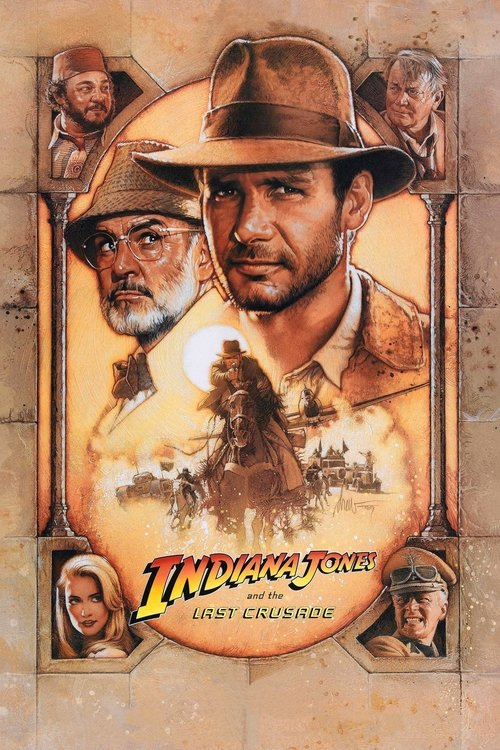
Indiana Jones and the Last Crusade
1989 · Steven Spielberg
For when you want pure, grinning adventure — a Saturday-afternoon movie that delivers spectacle and a surprising amount of heart. Reliable comfort for almost any crowd.
What it's about
In 1938, archaeologist Indiana Jones is drawn into the race for the Holy Grail when the medieval scholar who vanished hunting it turns out to be his own estranged father, Henry Jones Sr. Following clues in the old man's mailed notebook, Indy chases the trail from Venice's catacombs to Nazi Germany and beyond — with the Third Reich hunting the same prize.
The experience
Buoyant, funny, and relentlessly paced — a matinee adventure that swings from boat chases to zeppelins to tank battles, with the father-son bickering supplying as many laughs as the stunts. It's thrilling without ever turning grim.
Performances
Sean Connery's Henry Jones Sr. is the masterstroke — a fussy, umbrella-wielding scholar whose chemistry with Harrison Ford turns an action serial into a genuinely funny and touching two-hander. Ford, meanwhile, has never worn the fedora more lightly.
The craft
Spielberg stages set-pieces with the clean geography and escalating invention that defined the series, and the globe-trotting production gives every chapter a distinct texture. It's big-screen filmmaking in the classic sense — practical stunts, sweeping score, images built to play to a full house.
Why it matters
A deliberate return to the sunny register of the original after the series' dark second chapter, it closed out the classic Indiana Jones cycle for many years and stands as a model of how to end a blockbuster trilogy warmly. The father-son pairing became one of the most imitated dynamics in adventure cinema.
Snapshot
The third and, for many years, the concluding chapter of the original Indiana Jones cycle, The Last Crusade is a deliberate act of course-correction and reconciliation. Where Indiana Jones and the Temple of Doom (1984) had veered into darkness, gore, and grotesquerie — drawing censure that helped occasion the creation of the PG-13 rating — The Last Crusade returns the series to the buoyant, serial-inflected register of Raiders of the Lost Ark (1981): Nazis as villains, a Judeo-Christian relic as the MacGuffin, globe-trotting set-pieces, and a fundamentally sunny moral universe. Its decisive innovation is emotional rather than formal: the introduction of Henry Jones Sr., played by Sean Connery, converts the quest for the Holy Grail into a story about a son and a distant father. The film thus doubles as adventure spectacle and generational reckoning, and it closes the trilogy on a note of literal and figurative sunset.
Industry & production
The film was produced by George Lucas's Lucasfilm and released through Paramount, the arrangement that had governed the franchise from the outset. It arrived in the summer of 1989 into one of the most crowded blockbuster seasons of the decade, and it performed strongly at the international box office; precise grosses vary by source, so it is safest to say only that it ranked among the year's top commercial successes worldwide and reaffirmed the franchise's viability.
Its development history is unusually tangled. Lucas, who conceived the stories and served as executive producer, spent years circling the right premise for a third film. An early screenplay by Chris Columbus, sometimes described under the working title Indiana Jones and the Monkey King, was set aside, as was work by Menno Meyjes, who retains a story credit alongside Lucas. Jeffrey Boam ultimately wrote the shooting script. Spielberg has spoken of undertaking the film partly to make amends for the tonal excesses of Temple of Doom, and of resisting a second sacred-relic plot until the father-son dimension gave him a reason to return. Lucas's insistence on the Grail and Spielberg's insistence on the paternal story are, by their own accounts, the two poles that shaped the finished film.
Principal photography ranged across Spain (the Tabernas desert and other Almería locations standing in for the American Southwest and the Middle East), Venice, and additional European and studio work, with interiors at Elstree. The Grail temple's celebrated exterior is the Al-Khazneh (the "Treasury") at Petra in Jordan, one of the most recognizable location choices in the series. Casting Connery — only twelve years Ford's senior, and thus a knowingly implausible father — was itself a piece of pop-cultural wit, trading on Connery's status as the original screen James Bond, a franchise the Indiana Jones films openly admire and gently parody.
Technology
The Last Crusade is a late example of large-scale, largely photochemical adventure filmmaking executed before digital tools reshaped the craft. Visual effects were supplied by Lucasfilm's Industrial Light & Magic, working in the optical-and-mechanical idiom of the period: matte paintings, miniatures, and, most memorably, the physical and optical wizardry behind the climax, in which the false grail-choosers age and disintegrate. These decay effects combined prosthetic makeup, articulated models, and optical compositing rather than the computer-generated imagery that would dominate a decade later. The sequence remains a touchstone of practical effects showmanship precisely because it predates the CGI era.
The film was shot on 35mm in a widescreen scope format consistent with the trilogy's house style. Its imagery favored deep, saturated compositions achievable with the fast film stocks and lighting resources of a major studio production. Sound was a particular locus of technical ambition; the film's sound design and effects editing were recognized at the highest level (see below).
Technique
Cinematography
The cinematographer was Douglas Slocombe, the veteran British director of photography who had shot all three original Indiana Jones films and whose career reached back to Ealing Studios. The Last Crusade was his final theatrical feature before retirement, lending the film a valedictory significance in the history of classical craft. Slocombe was celebrated for judging exposure largely by eye rather than by meter, and his work here is warm, legible, and unfussy — golden desert light, burnished interiors, and a clean, storybook clarity that suits the film's return to an innocent register. The camera serves action and geography above self-conscious style: it establishes space cleanly so that the elaborate set-pieces read without confusion.
Editing
Michael Kahn, Spielberg's long-standing editor, cut the film, as he did essentially the director's entire body of work in this era. The editing sustains the propulsive, chapter-by-chapter rhythm the series inherited from movie serials, orchestrating the tank chase and the Venetian catacombs-and-speedboat sequence with a clarity of cause and effect that keeps spatial relationships intelligible amid chaos. Kahn's work is characteristically invisible in the best sense: it privileges momentum and comic timing, particularly in the interplay between father and son, without calling attention to the cut.
Mise-en-scène / staging
Elliot Scott's production design furnishes the film's period-adventure world: libraries and catacombs, Nazi rallies, a Zeppelin interior, the booby-trapped approach to the Grail. Spielberg stages action with his customary geometric legibility — obstacles introduced, then paid off — and repeatedly builds set-pieces around a comic reversal (the biplane, the rats, the "no ticket" Zeppelin gag). The final trials, in which Indy must decipher penitence, the name of God, and a leap of faith, translate abstract religious tests into concrete, filmable spatial puzzles, a hallmark of the series' design sensibility.
Sound
Sound is among the film's most decorated achievements. Ben Burtt and Richard Hymns received the Academy Award for Best Sound Effects Editing, and the film was additionally recognized in the sound categories of that awards season. The soundscape — whips, gunfire, engines, collapsing stone, and the visceral textures of the decay climax — is dense and precisely characterized, extending the franchise's serial-adventure aural vocabulary.
Performance
The performances are built around a comic-dramatic duet. Harrison Ford's Indiana is loosened and made vulnerable by being placed in a son's role; his exasperation and yearning give the character new dimensions. Connery plays Henry Sr. as a fussy, unworldly medievalist whose bookish distraction is both a running joke and the source of the film's emotional weight; the chemistry between the two men is the film's true special effect. Denholm Elliott (Marcus Brody) and John Rhys-Davies (Sallah) return as comic-supporting anchors, Alison Doody plays the duplicitous Dr. Elsa Schneider, and Julian Glover plays the collaborator Walter Donovan. River Phoenix appears in the prologue as the teenage Indy, calibrating his mannerisms to a young Ford with enough conviction that the casting later helped seed a television spin-off.
Narrative & dramatic mode
The film operates in the mode of the cliffhanger serial reborn as A-list spectacle: episodic, forward-driving, punctuated by escalating physical predicaments and comic beats. Its most distinctive structural gesture is the 1912 prologue, which functions as an origin myth, retroactively "explaining" the whip, the hat, the fear of snakes, and the chin scar in a single bravura sequence before the main 1938 narrative begins. Beneath the adventure architecture lies a classical quest romance grafted onto a father-son reconciliation drama; the search for the Grail — the vessel of eternal life — is repeatedly rhymed with Henry Sr.'s neglect and Indy's need for his father's attention, so that the film's spiritual payoff ("let it go") is simultaneously the resolution of the emotional plot.
Genre & cycle
The Last Crusade is a keystone of the 1980s revival of the adventure serial, the sub-genre Spielberg and Lucas essentially reinvented for the blockbuster age with Raiders. It belongs to a lineage running back through the Saturday-matinee serials of the 1930s and 1940s, the Republic and Universal cliffhangers, and the boys'-adventure literature and radio dramas those serials drew upon. Within its own cycle it is explicitly restorative — a return to the Raiders template of Nazi antagonists and a Judeo-Christian relic after the Indian-set, occult darkness of Temple of Doom (which was, in franchise chronology, a prequel). The film also engages in affectionate dialogue with the James Bond series through Connery's presence, folding one archetype of British screen adventure into another.
Authorship & method
The film is a product of the Spielberg-Lucas partnership operating at maturity: Lucas the story architect and franchise steward, Spielberg the director-executor translating pulp premises into humane, precisely engineered entertainment. Spielberg's authorial signatures are abundant — the fascination with fathers and sons, the reconciliation of a wounded parental bond, the child's-eye sense of wonder, and the ability to nest genuine feeling inside kinetic spectacle. His method here is notably economical and confident, reflecting a director working fast within a well-understood idiom and a trusted team.
That team is central to the authorship. Douglas Slocombe's photography, Michael Kahn's editing, and above all John Williams's score are as constitutive of the film's identity as Spielberg's direction. Williams, who had composed the "Raiders March" and the franchise's musical DNA, supplies new themes here, including material associated with the Grail and with the father-son relationship, while weaving in the established fanfares; his score earned an Academy Award nomination. Jeffrey Boam's screenplay supplies the film's brisk wit and its emotional through-line. The result is a strong instance of blockbuster authorship as collaboration among long-standing partners rather than the vision of a single hand.
Movement / national cinema
The film is a mainstream product of the American New Hollywood generation's transformation into the architects of the modern blockbuster. Spielberg and Lucas, who had emerged from the film-school-educated cohort of the 1970s, here consolidate the high-concept, franchise-driven model of studio filmmaking they had done so much to establish. Though thoroughly American in sensibility and industrial base, the production is transnational in execution — British crew heritage (Slocombe, Elliott, Elstree), European and Middle Eastern locations, and a Scottish co-lead — reflecting the globalized production practices of top-tier Hollywood by the late 1980s.
Era / period
The Last Crusade sits at the close of the 1980s, a moment when the Lucas-Spielberg blockbuster paradigm was fully dominant but still executed with largely pre-digital tools. It is simultaneously a period film, set on the eve of the Second World War in 1938, with the Nazi menace and a book-burning rally serving as historical backdrop. That 1930s setting is not incidental: the Indiana Jones series is itself a nostalgic evocation of the popular culture of the 1930s and 1940s, so the film's era of setting and its era of homage coincide. It is, in retrospect, among the last great adventure spectacles produced entirely within the classical practical-effects tradition before CGI's ascendancy.
Themes
The film's governing theme is the reconciliation of father and son — the healing of a bond damaged by absence, obsession, and emotional reticence. This is braided with the theme of faith versus proof: Henry Sr.'s scholarly life's work and the Grail trials both demand a leap of belief, and the climax literalizes faith as the physical act of stepping into apparent nothingness. Related motifs include the danger of desire — the Grail grants eternal life but destroys those who covet it wrongly, and the film's final moral is the renunciation of the object ("let it go") in favor of the human relationship. Knowledge and its custody recur throughout: libraries, notebooks, and the inheritance of the father's learning. And, as across the series, the film stages a clear anti-fascist moral opposition, with Nazism figured as the will to possess and weaponize the sacred.
Reception, canon & influence
Critically and popularly, The Last Crusade was received as a satisfying, warmly humorous return to form after Temple of Doom, with particular praise reserved for the Ford-Connery pairing, which gave the franchise an emotional center it had previously lacked. Its principal awards recognition came in sound, where it won the Academy Award for Best Sound Effects Editing and drew further nominations in the sound and original-score categories; readers should treat any more granular tally as subject to verification.
Its influences run backward to the movie serials and boys'-adventure fiction of the 1930s and 1940s that the whole series venerates, to the Grail literature of medieval romance and its many popular retellings, and, through Connery, to the James Bond films that Lucas and Spielberg had long cited as a model for globe-trotting spectacle. Forward, its most concrete legacy is the young-Indiana-Jones conceit of the prologue, which River Phoenix embodied and which directly seeded the television series The Young Indiana Jones Chronicles (1992), an ambitious educational-adventure experiment in the franchise's expansion. More broadly, the film reinforced the father-son reconciliation drama as a durable core of the blockbuster, a template Spielberg would revisit repeatedly. Within the franchise itself, it long stood as the trilogy's capstone — a status underscored by its literal closing image of the heroes riding into the sunset — until the series was revived years later. Its practical-effects climax and its clean, legible action staging remain reference points for a mode of adventure filmmaking that the industry has since largely traded for digital spectacle.
A Deleuzian reading
A whip snaps back and opens a boy's chin.
The full Deleuzian reading of Indiana Jones and the Last Crusade →
Reception
A massive hit on release — the top-grossing film worldwide in 1989 — and widely read as a course-correction after Temple of Doom's darker reception. Decades on it's settled into the eternal number-two spot behind Raiders, though a vocal contingent has always insisted the Ford–Connery chemistry makes it the best of the series.
How Indiana Jones and the Last Crusade was received, from release to now →
Influences: the films it descends from and the films it influenced
- Raiders of the Lost Ark (1981) — Established the film's entire craft grammar — Michael Kahn's geographically legible, momentum-preserving action cutting, Ben Burtt's percussive punch-and-whip sound design, and Williams's 'Raiders March' leitmotif — which Last Crusade recycles and extends rather than reinvents.
- Secret of the Incas (1954) — Charlton Heston's Harry Steele — fedora, leather jacket, satchel, unshaven treasure-hunter framed against ruins — was the direct visual template costume designer Deborah Nadoolman screened while building Indy's silhouette, carried forward here.
- Gunga Din (1939) — Lucas cited it directly for its boys'-adventure comic-trio dynamic and cliffhanger set-piece staging, whose tone of humane humor nested inside imperial-romp spectacle underwrites the Ford-Connery duet.
- The Adventures of Robin Hood (1938) — Korngold's wall-to-wall symphonic leitmotif scoring — a distinct musical signature per character and locale — is the Golden Age model from which Williams derives his practice of assigning new Grail and father-son themes woven against established fanfares.
- From Russia with Love (1963) — The Bond template of globe-trotting espionage spectacle Lucas and Spielberg openly modeled the series on, made literal by casting Connery himself so his Bond persona is knowingly inverted into a tweedy, umbrella-wielding father.
- Lawrence of Arabia (1962) — Lean's epic desert cinematography — figures dwarfed in golden low-angle sunlight across vast widescreen sand — is the compositional and lighting reference behind Slocombe's Jordanian tank-chase and canyon approach to Petra.
- Zorro's Fighting Legion (1939) — The Republic chapter-serial's cliffhanger architecture — self-contained peril set-pieces chained by escalating escape — is the narrative engine Spielberg and Lucas explicitly revive as the film's episodic serial rhythm.
- The Searchers (1956) — Ford's iconography of the reconciled hero riding into the horizon supplies the film's literal closing image — the four leads silhouetted riding into the sunset — as a deliberate Western-genre coda to the trilogy.
- Indiana Jones and the Temple of Doom (1984) — A deliberate correction by the same unit: the horror center is replaced by a father-son two-hander, Slocombe's palette returns to daylight desert, and the vertical descent is rebuilt as a puzzle of three tests rather than an underworld of human sacrifice.
- The Young Indiana Jones Chronicles (1992) — Directly seeded by River Phoenix's origin-prologue conceit, it industrializes the young-Indy framing device into an episodic educational-adventure format built on the same in-medias-res-then-flashback structure.
- The Rocketeer (1991) — Johnston, an ILM art director and effects veteran of the series, transplants the 1930s pulp-serial period aesthetic — practical model work, art-deco Americana, earnest square-jawed heroism — directly out of the Indy toolkit.
- The Mummy (1999) — Explicitly revives the adventure-serial revival mode — tomb-raiding archaeologist, comic sidekick, ancient-curse mysticism, and Burtt-style kinetic sound punctuation — as a near-direct structural clone of the Indy formula.
- National Treasure (2004) — Inherits the Grail-quest procedural — decoding cryptic historical clues toward a religious/mythic relic guarded by ancient traps — that Last Crusade foregrounds with its diary, three trials, and knight's tomb.
- Uncharted (2022) — Descends from the film's set-piece traversal design — treasure-hunter navigating booby-trapped ancient architecture through legible physical puzzle-and-escape choreography — the template its source games lifted wholesale from Spielberg's staging.
- Captain America: The First Avenger (2011) — Direct model for HYDRA's arc: Nazis weaponizing a supernatural relic, plus the father-son/mentor-artifact structure and the treasure-hunt momentum grafted onto WWII iconography.
- Star Wars (1977) — The shared Lucasfilm craft nexus — Burtt's library-built sound editing, Williams's leitmotif scoring, and ILM's optical/mechanical compositing — is the same technical apparatus deployed on the Grail-temple climax and aerial dogfight.
- Jurassic Park (1993) — The same core team (Kahn, Williams, ILM) executes the identical practical-effects-plus-emerging-digital pipeline, staging suspense through legible spatial geography that descends from the tank chase's clean action grammar.
- Catch Me If You Can (2002) — Extends Spielberg's father-son reconciliation engine — a son chasing a fugitive, distant father's approval — the exact emotional through-line Boam's script gives the Henry-and-Indy relationship, proving it a portable authorial device.
Similar films
- Raiders of the Lost Ark (1981) — influence & lineage
- Jurassic Park (1993) — influence & lineage
- Star Wars (1977) — influence & lineage
- Return of the Jedi (1983) — same viewing thread
- The Adventures of Tintin (2011) — same viewing thread
- The Lord of the Rings: The Return of the King (2003) — same viewing thread
- Pirates of the Caribbean: The Curse of the Black Pearl (2003) — same viewing thread
- The Lord of the Rings: The Fellowship of the Ring (2001) — same viewing thread
All the films related to Indiana Jones and the Last Crusade →
Watch it with: curated runs of related films
- Studio-Sized Mythmaking — A run of blockbuster quest epics — fellowships forged, dark lords faced, and long roads home — that rhyme on scale, world-building, and the pull of a saga you can lose a weekend inside.