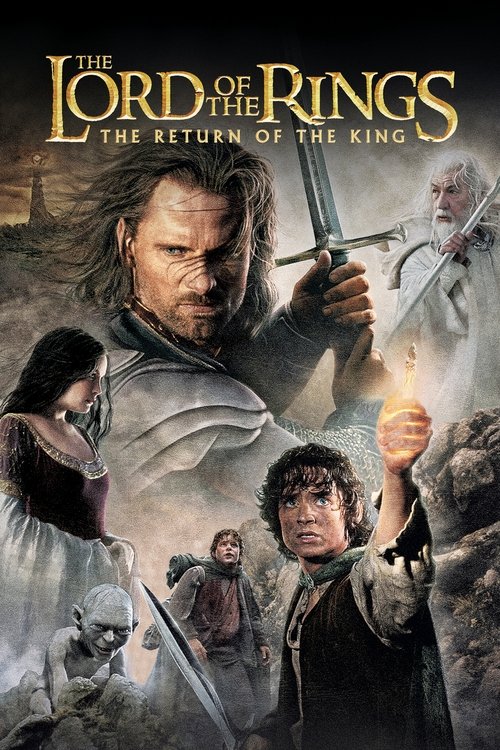
The Lord of the Rings: The Return of the King
2003 · Peter Jackson
For when you want to be swept away completely — a full-evening epic, ideally as the payoff of a trilogy marathon with friends. Comfort viewing on a grand scale: you'll cheer, you'll cry, you'll want to hug somebody.
What it's about
The final chapter of the trilogy: as massive armies converge for the battle that will decide the fate of Middle-earth, a reluctant heir must step up to claim the throne of men. Meanwhile everything actually hinges on two small hobbits, Frodo and Sam, crawling toward an enemy volcano to destroy the Ring, with the treacherous creature Gollum as their guide.
The experience
Overwhelming in the best sense — three-plus hours that swing from thunderous, city-shaking battle to intimate scenes of loyalty and exhaustion that will wreck you. It earns every one of its emotional payoffs, and the finale lands with the weight of a whole trilogy behind it.
Performances
Sean Astin's Sam is the emotional core, turning steadfast decency into something heroic; Andy Serkis's Gollum remains a landmark — a fully felt, pitiable, frightening character delivered through performance capture; and Viggo Mortensen gives the king's arc quiet gravity.
The craft
A summit of practical-plus-digital filmmaking: enormous real sets and miniatures blended with groundbreaking effects, all scored by Howard Shore's monumental themes. The siege sequences are still a benchmark for scale, and the whole thing is built for the biggest screen and loudest speakers you have.
Why it matters
It swept all eleven Oscars it was nominated for — a record-tying haul and a perfect sweep — finally winning the fantasy genre full respectability. It set the template for how Hollywood mounts blockbuster sagas.
Snapshot
The capstone of Peter Jackson's unprecedented simultaneous adaptation of J.R.R. Tolkien's trilogy, The Return of the King resolves two converging storylines — the political and martial contest for the throne of Gondor and the covert mission of Frodo Baggins to destroy the One Ring in the fires of Mount Doom — into what remains the most decorated fantasy film in Academy Award history. Winning all eleven of the categories for which it was nominated, it joined Ben-Hur (1959) and Titanic (1997) as the only films to achieve eleven wins; unlike those predecessors, it converted every nomination into a win without a single loss. Theatrically, the film runs approximately 201 minutes; the extended edition released on home video runs approximately 251 minutes. Its commercial and critical reception effectively closed the argument, ongoing since the first film's release two years earlier, about whether literary epic fantasy could sustain serious cinematic treatment.
Industry & production
All three Lord of the Rings films were produced in a single overlapping production period, with principal photography conducted in New Zealand from October 1999 through December 2000, followed by substantial pick-up and insert shoots in 2001 and 2003. New Line Cinema's decision to green-light the trilogy as a simultaneous venture, rather than sequentially as is conventional, was a significant gamble: the studio was committing to a franchise before any entry had been released. Producer Barrie Osborne worked alongside Jackson and co-producers Fran Walsh and Tim Sanders to manage a production infrastructure that at its height employed thousands of New Zealand crew and craftspeople. The productions were based at Miramar in Wellington, anchoring what would become a durable New Zealand film industry hub.
The films were financed and distributed by New Line Cinema in partnership with WingNut Films, Jackson's own production company. The combined budget for all three films has been reported in the vicinity of $280–300 million, though precise per-film breakdowns were not always publicly disaggregated; The Return of the King is generally understood to have been among the costlier of the three due to its scale of digital and practical effects work. The theatrical run generated over $1 billion worldwide, making it at its release one of the highest-grossing films ever produced. That commercial result, combined with the awards sweep, altered studio calculations about prestige fantasy for the decade that followed.
Technology
The technological contribution most distinctively associated with the trilogy — and most visible in The Return of the King — is MASSIVE (Multiple Agent Simulation System In Virtual Environment), crowd-simulation software developed by Stephen Regelous in association with Weta Digital. Each digital agent within MASSIVE possessed a rudimentary artificial intelligence enabling independent decision-making based on visual and auditory input from its simulated environment: soldiers could respond to the battlefield around them rather than simply following scripted animation paths. The system made possible the Battle of Pelennor Fields, which required tens of thousands of digital combatants behaving with sufficient variability to appear organic. MASSIVE became commercially available after the trilogy and was subsequently adopted on numerous large-scale productions.
Weta Digital, co-founded by Jackson and partner Richard Taylor (Weta Workshop), was responsible for the film's digital visual effects, including the continued development of Gollum as a photo-realistic performance-capture character. Weta Workshop handled the physical production design: the tens of thousands of practical weapons, armor pieces, prosthetic makeups, and creature suits that coexist with the digital work. The interaction between practical and digital elements — neither subsuming the other — gives the film a material texture that later effects-heavy productions have often failed to replicate.
The films were shot on 35mm anamorphic film. Digital intermediate processing was used in post-production but the acquisition remained photochemical, giving the trilogy a grain and tonal range consistent with the Panavision anamorphic format.
Technique
Cinematography
Andrew Lesnie, ACS, ASC, served as director of photography across all three films, and his approach to The Return of the King extended and intensified the grammar established in The Fellowship of the Ring (for which he won the Academy Award for Cinematography). The New Zealand locations — particularly the volcanic plateau of Mount Ruapehu standing in for the approaches to Mordor, and the Pelennor exteriors shot across the South Island — were treated as character-bearing landscapes rather than backdrops. Lesnie and Jackson used the anamorphic frame's horizontal width to emphasize the smallness of figures against geography, a compositional rhyme between the epic scale of armies and the intimate isolation of Frodo and Sam.
For Mordor, Lesnie largely drained the image of saturated color, moving toward an ashen, sulphurous palette that contrasts with the amber warmth of the Shire bookending the trilogy. The cinematography participates in the film's emotional architecture: light as hope, warmth as home, and the gray-black wastes as the negation of both. Interior and night sequences lean on practical torchlight and a desaturated blue that had become established as the trilogy's nocturnal register in earlier films.
Editing
Jabez Olssen served as editor on The Return of the King (receiving the Academy Award for Film Editing), working from the extensive material assembled by Jamie Selkirk across all three films. The editing challenge unique to this installment was managing the convergence of two narratives running at entirely different emotional tempos — the operatic sweep of the War of the Ring versus the almost claustrophobic intimacy of Frodo, Sam, and Gollum — while sustaining momentum across a running time that would have been considered unmanageable by standard studio logic. Cross-cutting between these two strands is disciplined: the film never allows the audience to forget either thread for so long that reorientation is required.
The film's celebrated multiplication of endings — in which the narrative resolves, or appears to resolve, and then continues across several successive codas — was a genuine editorial choice with a literary basis: Tolkien's novel concludes similarly, with the destruction of the Ring followed by an extended return through the Shire and the Grey Havens. Whether this structure reads as indulgent or as earned emotional completion has remained a critical crux.
Mise-en-scène / staging
Jackson's staging of large-scale sequences draws on a tradition of epic blocking derived in part from Kurosawa (particularly Ran and Kagemusha) and in part from David Lean's desert and geography-centred compositions. The charge of the Rohirrim at Pelennor is composed as a series of escalating horizon-scans before the cavalry descends into the frame — a staging that privileges spatial orientation over kinetic spectacle, allowing the audience to understand the geography before it dissolves in close-quarter action.
The intimate scenes between Frodo and Sam, and Frodo's increasingly desperate subjection to the Ring's influence, are staged with economy: close framings, constrained blocking, the volcanic geography pressing in from every angle. Andy Serkis's performance as Gollum, delivered on set in motion-capture suit and then replaced in post-production by Weta's digital character, was played against Elijah Wood and Sean Astin in real time. Jackson maintained the performance-capture sessions on-set rather than isolating Serkis in post-production, which contributed to the coherence of eyeline and spatial relationship between Gollum and the other performers.
Sound
Sound designer David Farmer built on work developed across the trilogy, extending his vocabulary of creature, battle, and atmospheric sound design into the volcanic wastelands of Mordor. The distinction between the sonic worlds of Middle-earth — the wind and living ambience of the Shire, the industrial clangour of Isengard's absence in this film, the dead air and geological rumble of Mordor — was treated as part of the dramatic argument. Sound mixing (the film won the Academy Award for Sound Mixing) sought to place the audience physically within these environments.
Howard Shore's score, continuous in its thematic architecture from The Fellowship of the Ring through The Return of the King, reaches its fullest complexity here. Shore organized the score around leitmotifs associated with peoples, places, and objects in a manner explicitly derived from Wagnerian music drama. The use of thematic transformation — degraded or minor-key variants of Hobbit-associated material as Frodo succumbs to the Ring, resolution and major-key return at the Grey Havens — constitutes one of the more rigorously organized leitmotif structures in mainstream film scoring since the classic Hollywood era. Shore won the Academy Award for Best Original Score. Annie Lennox performed "Into the West," which won Best Original Song.
Performance
The ensemble performances are, by common critical consensus, unevenly treated across the trilogy's demands: the final film's requirements are weighted toward Wood's increasingly physical deterioration and Sean Astin's steadfast loyalty as Sam, against Ian McKellen's more ceremonial final act for Gandalf. Viggo Mortensen's Aragorn resolves across the trilogy from haunted exile to reluctant king, a performance arc that required considerable calibration of register between the intimate and the ceremonial. Bernard Hill's Théoden and Miranda Otto's Éowyn carry the film's most conventionally heroic material, with Otto's revelation of Éowyn's identity during the battle given emphasis by Jackson that aligns closely with Tolkien's text.
Andy Serkis's Gollum remained the subject of persistent debate in awards and critical discourse about what constituted a performance in performance-capture work: Serkis played every scene on location and in studio, with Weta's animators translating his physical and facial performance into Gollum's digital body. The degree to which the final Gollum represents Serkis's performance versus the animators' craft was — and remains — unresolved territory.
Narrative & dramatic mode
The film operates simultaneously in the registers of the political epic, the quest narrative, and the intimate psychological study. Tolkien's structural decision to run the war narrative and the Ring-bearer narrative in parallel books rather than alternating chapters required Jackson, Walsh, and Boyens to convert sequential literary material into intercutting cinematic syntax — a decision with consequences for pacing and tonal coherence throughout.
The Ring itself functions as a dramatic device that operates in classical temptation-narrative terms while also carrying psychological weight more characteristic of literary modernism: it amplifies what is latent in the bearer, magnifying desire and ego, and its destruction is not heroic triumph but accident enabled by obsession. The film is, unusually for a fantasy epic, partly a tragedy of will — Frodo cannot destroy the Ring of his own volition, and the resolution arrives through betrayal and catastrophe rather than virtuous action. This undermining of the conventional heroic arc is one reason the film retains critical interest beyond its spectacular achievements.
Genre & cycle
The Return of the King arrives at a historically specific convergence: the early 2000s fantasy revival, principally constituted by the Jackson trilogy and the Harry Potter series (2001–2011), which together rehabilitated literary epic fantasy as viable prestige studio cinema after the genre's relative dormancy through the 1990s. The film belongs to the cycle of turn-of-millennium digital epics — alongside Gladiator (2000), Troy (2004), and Kingdom of Heaven (2005) — in which large-scale historical or fantastical conflict was rendered through the combination of location photography and digital mass-simulation. It is the definitive example of that cycle, and its awards result effectively canonized the fantasy genre in an institution (the Academy) that had previously been resistant to it.
Authorship & method
Peter Jackson's authorial signature across the trilogy is inseparable from his long-term collaborations with co-writer and partner Fran Walsh and co-writer Philippa Boyens. Walsh has been a consistent creative partner since the early 1990s and her contribution to the screenplay — condensing and restructuring Tolkien while preserving tone — is as central to the films as Jackson's direction. The screenwriting credits for The Return of the King shared by Jackson, Walsh, and Boyens won the Academy Award for Adapted Screenplay.
Jackson's trajectory from splatter-comedy micro-budgets (Bad Taste, 1987; Braindead, 1992) through the prestige breakthrough of Heavenly Creatures (1994) is relevant to understanding his approach to the trilogy. The effects pragmatism developed on no-budget productions, combined with an undisguised enthusiasm for genre spectacle and a New Zealand filmmaker's default resourcefulness, shaped a production culture in which problem-solving creativity was institutionalized. Weta Workshop and Weta Digital grew directly from Jackson's earlier productions and were by The Return of the King among the world's leading effects facilities.
Andrew Lesnie's cinematography, Howard Shore's score, Jamie Selkirk and Jabez Olssen's editing, Grant Major's production design (Academy Award recipient), and Ngila Dickson and Richard Taylor's costume and creature design collectively constitute the collaborative infrastructure through which Jackson's vision was realized. The trilogy is, more than most comparable productions, a demonstrable argument for the auteur-as-orchestrator: Jackson as the unifying intelligence directing a collaborative industrial machine.
Movement / national cinema
The Lord of the Rings trilogy transformed New Zealand's film industry in structural, economic, and reputational terms. Production was concentrated in Wellington, particularly at Jackson's Miramar facilities, and the sheer scale of employment — thousands of crew, craftspeople, performers, and technicians over several years — created a professional infrastructure that had not previously existed at this scale in the country. The New Zealand government subsequently formalized support structures for large international productions, partly in response to the trilogy's economic precedent.
Jackson had been the primary figure of international recognition in New Zealand cinema since Heavenly Creatures; the trilogy made New Zealand's locations — the Southern Alps, the volcanic plateau of the central North Island, the farmland of Waikato — internationally synonymous with a specific visual grammar of epic landscape. The long-term tourism and cultural consequences of this identification are well-documented, if outside the scope of film-historical analysis.
Era / period
The Return of the King is a product of the first decade of digital blockbuster cinema: the period following Jurassic Park (1993) and The Matrix (1999) in which digital visual effects became normalized as the primary means of constructing impossible spectacle, and before the photorealistic CGI environments of the following decade began to generate the "uncanny" discussions that persist. The film occupies a middle period in which digital effects were deployed alongside substantial practical production design, and the conversation between the two — rather than the replacement of one by the other — defines its visual character.
It also arrived during the post-September 2001 moment in which themes of fellowship against annihilating darkness, sacrifice, and the preservation of ordinary life against overwhelming force carried particular cultural freight. The degree to which audiences and critics registered this alignment explicitly varied; it is a feature of the film's reception rather than a declared authorial intention.
Themes
The film's central thematic opposition is between the will to dominate — concentrated in the Ring and its maker Sauron — and the forms of devotion that resist domination without seeking power in return. Sam Gamgee's loyalty to Frodo, and his willingness to carry the Ring-bearer himself up the slopes of Mount Doom, is the film's moral argument made embodied and physical.
The film is also sustained by an elegy for the passing of ages: Tolkien's mythology is structured around loss and diminishment, and the departure of the Elves and the fading of magic from the world is woven into the film's visual and musical texture. The Grey Havens sequence, in which Frodo departs Middle-earth and the surviving Fellowship members part, closes the trilogy on a note of authentic melancholy that resists easy consolation. The wound that cannot be healed — Frodo is marked permanently by his ordeal in a way that precludes full return to ordinary life — complicates the ostensibly triumphant narrative frame.
Reception, canon & influence
Critical reception at release was largely celebratory, with reviewers across both mainstream and critical press treating the film as the successful culmination of an unprecedented achievement. The awards sweep validated this consensus institutionally. Some critical dissent centered on the film's length, its multiplication of endings, and the perceived underdevelopment of certain characters; these were minority positions at the time and remain so. Subsequent critical reappraisal has largely sustained the film's canonical status, though academic film studies has engaged the trilogy somewhat unevenly — more extensively with its production economics, its use of landscape and national identity, and its digital-effects innovations than with its formal properties as a film.
Influences on the film (backward): Tolkien's source text (1954–55) is the obvious and primary ancestor. David Lean's landscape epic — particularly Lawrence of Arabia (1962) — established a model for using geography as dramatic material that Jackson explicitly drew on. Akira Kurosawa's late military epics, Kagemusha (1980) and Ran (1985), provided a template for staging large-scale battle sequences with spatial legibility. The Ralph Bakshi animated adaptation (1978) and the Rankin-Bass productions (The Hobbit, 1977; The Return of the King, 1980) were part of Jackson and Walsh's cultural formation, even where the trilogy consciously departs from them. Classic Hollywood production design — the articulation of distinct visual vocabularies for distinct fictional civilizations — informs the world-building through Grant Major's and Alan Lee and John Howe's design work; both Lee and Howe came directly from careers as Tolkien illustrators.
Legacy and influence (forward): The trilogy established the template for prestige literary fantasy adaptation that dominated studio production in the following two decades: large budgets, extended running times, simultaneous-production models, location photography combined with digital environments, and the expectation of a serious authorial voice attached to genre material. The Hobbit trilogy (2012–2014), also directed by Jackson, can be understood as an attempt to replicate the conditions of the original production that largely illustrated the limits of formula. Amazon's The Rings of Power (2022–) demonstrates the continuing commercial appeal of Tolkien-adjacent world-building while operating in a television context in which the trilogy's cinematic grammar is a constant reference point.
More broadly, the film's commercial and critical success altered the calculation of risk for fantasy as a genre. The subsequent superhero-film dominance of Hollywood production is not simply caused by the Jackson trilogy, but the demonstrated viability of extended, faithful literary adaptation of genre source material at scale was a condition of possibility for the production cultures that followed. The film's eleven Academy Awards remain the genre's high-water mark in institutional recognition, and have not been approached since.
A Deleuzian reading
Watch what the camera does right before the Rohirrim charge at Pelennor.
The full Deleuzian reading of The Lord of the Rings: The Return of the King →
Reception
No reappraisal needed — it arrived as a coronation, sweeping all 11 of its Oscar nominations in a night widely understood as the Academy rewarding the whole trilogy at once. Twenty years on its standing has only hardened, with the extended cut now treated as the default text among fans.
How The Lord of the Rings: The Return of the King was received, from release to now →
Influences: the films it descends from and the films it influenced
- Ran (1985) — Kurosawa's battle-camera grammar — telephoto lenses pulled back to the scale where individual soldiers become illegible but army-as-organism becomes readable — is the direct compositional model for ROTK's Pelennor Fields; Jackson's crane-and-telephoto shots of the mûmakil charges replicate the specific logic of making a battlefield comprehensible only at distance, treating mass movement as abstract choreographic pattern.
- Kagemusha (1980) — Kurosawa's system of color-coding opposing armies through banner and uniform — allowing viewers to track military situation through color-field rather than individual figure across chaotic terrain — is the formal precedent for ROTK's use of gold Rohirrim, white Gondor, and black Mordor as legible political identities within Pelennor Fields' visual complexity.
- Lawrence of Arabia (1962) — Freddie Young's Super Panavision compositions of figures reduced to near-invisibility against desert terrain established the landscape-as-character grammar Andrew Lesnie applied to New Zealand's volcanic plateaus for Mordor; Lean's extended multi-part denouement — Lawrence's disillusionment resolved across three discrete act-endings — is the structural precedent for ROTK's multiple codas.
- Ben-Hur (1959) — Yakima Canutt's chariot-race staging established the grammar of embedding cameras within the physical spectacle rather than observing from a remove — placing lenses at wheel-level, inside the action — a principle Jackson applies in the Rohirrim cavalry charge, with ground-level and in-formation cameras tracking the assault rather than recording it from elevated safety.
- Excalibur (1981) — Boorman's non-ironic translation of Arthurian myth through practical forged armor, real Irish forest as mythological terrain, and a refusal of both camp and kitchen-sink realism established the tonal register Jackson inherited: fantasy grounded in photographed physical objects and real geography, treating literary myth as legitimate dramatic material without distancing quotation marks.
- Star Wars (1977) — John Williams established the modern Hollywood model of Wagnerian leitmotif structure — assigning discrete orchestral themes to characters, objects, and locations within a fantasy-adventure context — that Howard Shore directly inherited; Shore's system of separate identifiable themes for the Shire, the One Ring, the Ringwraiths, and the Fellowship is Williams's compositional methodology applied to Tolkien's mythology.
- Metropolis (1927) — Lang's invention of the Schüfftan process to composite small numbers of extras with miniature sets to simulate impossible crowd scales established the foundational technological problem — convincing mass human simulation — that MASSIVE's agent-AI solved computationally; ROTK's self-organizing digital armies are the direct technological heir to Lang's optical trick.
- Apocalypse Now (1979) — Walter Murch's intercutting between Willard's intimate close-quarters river journey and the full-scale military spectacle of the Air Cavalry sequence models the specific editorial problem ROTK faces: converging two narratives operating at incompatible emotional tempos and spatial scales — Frodo's private psychological ordeal and Aragorn's public war — without either register overwhelming the other.
- Return of the Jedi (1983) — Builds its finale on Jedi's three-front parallel-climax cross-cutting and Howard Shore's leitmotif system, scaling the monomyth-resolution-plus-battlefield structure to trilogy close.
- Waterloo (1970) — The Pelennor Fields deployment of Massive crowd-simulation software is repeatedly framed against Waterloo as the digital answer to Bondarchuk's real drilled thousands, inheriting the aerial formation-choreography while replacing the bodies.
- King Kong (2005) — Jackson directly extended the on-set performance-capture workflow developed for Gollum — motion-capture suit integrated with practical set performance, with Weta Digital building the digital skin around the actor's skeletal data — to create Kong, again with Andy Serkis as the suited performer; the film is the immediate institutional continuation of ROTK's Weta Digital pipeline.
- Pirates of the Caribbean: Dead Man's Chest (2006) — ILM's Davy Jones directly extends the Gollum model — a fully digital character built from the on-set performance of a suited actor via motion capture, integrated into scenes with live performers sharing the same physical space — with the production team explicitly citing Gollum as the technical and aesthetic benchmark for photo-realistic digital performance.
- The Chronicles of Narnia: The Lion, the Witch and the Wardrobe (2005) — The Battle of Beruna directly deployed MASSIVE crowd-simulation software, and the production's formula — literary fantasy epic with practical creature suits augmented by digital characters, real New Zealand landscape as mythological terrain — replicates ROTK's technical and production template almost without modification, functioning as the first explicit industry attempt to replicate Jackson's workflow.
- Troy (2004) — The production deployed MASSIVE for the Greek beach-landing sequences, applying the Pelennor Fields formula of software-generated armies to an ancient epic context; the staging grammar of opposing forces massed across open terrain, composed in wide telephoto shots that read formation rather than individual, is the ROTK battle vocabulary transplanted to Homer.
- Avatar (2009) — Cameron absorbed both the on-set performance-capture methodology developed for Gollum and MASSIVE-derived digital crowd simulation into a unified virtual production pipeline — Cameron explicitly named Gollum as the proof of concept that made Avatar's production model possible — extending ROTK's practical-digital synthesis to its endpoint by replacing the photographed practical element itself with a virtual camera environment.
- The Hobbit: An Unexpected Journey (2012) — Jackson's prequel trilogy extended every technical vocabulary item from ROTK intact — MASSIVE for goblin-tunnel sequences, Weta Digital's digital-character pipeline now applied to Azog, Andrew Lesnie's anamorphic New Zealand landscape grammar — while adding 48fps HFR acquisition as an experimental variable, making it the direct institutional and aesthetic continuation of ROTK's craft at a decade's remove.
- Avengers: Endgame (2019) — Demonstrated the multi-strand epic finale: elegiac, valedictory closure achieved by intercutting converging battlefronts and stacking multiple emotional 'endings' — the template for Endgame's extended denouement.
- World War Z (2013) — Weta's Massive crowd-simulation software made emergent, agent-driven swarming masses renderable — the direct technical lineage of WWZ's fluid-dynamics horde pouring over walls.
- Avengers: Infinity War (2018) — Modeled crosscutting a scattered fellowship across multiple battlefronts into simultaneous converging climaxes at blockbuster scale.
- Harry Potter and the Deathly Hallows: Part 2 (2011) — Set the blueprint for the fantasy-saga finale as a wall-to-wall siege climax, using massive-scale crowd-simulation VFX to make an army-versus-army battle the emotional culmination that the Battle of Hogwarts directly emulates.
- Alice in Wonderland (2010) — Cements the post-LOTR blockbuster convention of resolving a fantasy quest in a massed CGI battle against a single monster — the Jabberwocky climax that critics said betrays Carroll imports this wholesale.
- The Hobbit: The Battle of the Five Armies (2014) — The Pelennor Fields sequence established the MASSIVE agent-based crowd-simulation software plus the multi-front cross-cutting battle grammar this film reprises almost wholesale.
- Gladiator (2000) — Mill Film's digital crowd-replication technique for the Colosseum sequences ran parallel to MASSIVE's development at Weta; both films solved the digital-mass-spectacle problem contemporaneously with different software solutions, making Gladiator the technological sibling that proved the digital army viable as a production tool before ROTK scaled it to unprecedented complexity.
Similar films
- The Hobbit: An Unexpected Journey (2012) — influence & lineage · same viewing thread
- Avatar (2009) — influence & lineage · same viewing thread
- King Kong (2005) — influence & lineage
- The Chronicles of Narnia: The Lion, the Witch and the Wardrobe (2005) — influence & lineage
- Pirates of the Caribbean: Dead Man's Chest (2006) — influence & lineage
- The Lord of the Rings: The Two Towers (2002) — same viewing thread
- The Lord of the Rings: The Fellowship of the Ring (2001) — same viewing thread
- The Hobbit: The Battle of the Five Armies (2014) — same viewing thread
All the films related to The Lord of the Rings: The Return of the King →
Watch it with: curated runs of related films
- Studio-Sized Mythmaking — A run of blockbuster quest epics — fellowships forged, dark lords faced, and long roads home — that rhyme on scale, world-building, and the pull of a saga you can lose a weekend inside.