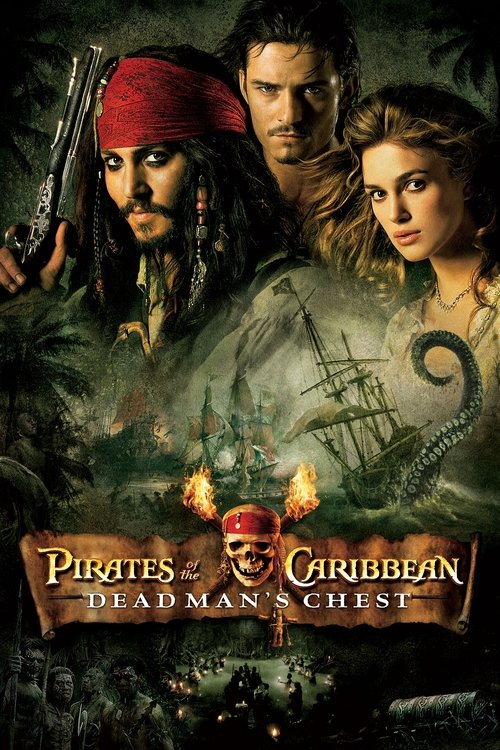
Pirates of the Caribbean: Dead Man's Chest
2006 · Gore Verbinski
For a popcorn night when you want maximum spectacle and swashbuckling silliness — great with family or a rowdy group. Pure escapism; bring snacks and low stakes.
What it's about
Captain Jack Sparrow owes a blood debt to Davy Jones, the tentacle-bearded ruler of the ocean depths, and the bill has come due: his soul, payable aboard the ghostly Flying Dutchman. His only way out is to find the chest holding Jones's still-beating heart — a hunt that drags Will Turner and Elizabeth Swann away from their own wedding and into cannibal islands, voodoo shacks, sword fights atop runaway mill wheels, and the crushing grip of the Kraken.
The experience
Big, loud, and gleefully overstuffed — a rollercoaster of escalating set pieces with a darker, stranger undertow than the first film. It's exhausting in the fun way, and it ends on a cliffhanger that dares you not to watch the next one.
Performances
Johnny Depp's swaying, scheming Jack Sparrow is in full flower here, but the revelation is Bill Nighy, who acts through a face of digital tentacles and still makes Davy Jones the saga's most memorable figure — wounded, menacing, and weirdly soulful.
The craft
Davy Jones and his barnacled crew remain a high-water mark of digital character effects — creatures so tactile you forget they aren't practical — and Gore Verbinski stages action as elaborate slapstick machinery, gag stacked on gag. Between the Kraken attacks and Hans Zimmer's thundering score, this is emphatically a big-screen, big-speakers film.
Why it matters
One of the biggest box-office hits of its decade, it turned a surprise hit into a global franchise and helped cement the modern template of the pre-planned blockbuster trilogy shot back-to-back — while raising the bar for what a digital character could be.
Snapshot
Dead Man's Chest is the second installment of Walt Disney's Pirates of the Caribbean saga and the film that transformed a surprise 2003 hit into a global tentpole franchise. Where The Curse of the Black Pearl had to prove that a swashbuckler adapted from a theme-park ride could work at all, Dead Man's Chest was built as spectacle at maximum scale — a middle chapter that deliberately withholds resolution, ending on a cliffhanger that hands off directly to At World's End (2007), which was shot back-to-back with it. Its lasting significance is twofold: commercially, it became one of the highest-grossing films of its era and cemented the modern practice of the pre-planned blockbuster trilogy; technologically, its rendering of Davy Jones and the barnacled crew of the Flying Dutchman set a new benchmark for photorealistic, performance-driven digital characters, work that won the Academy Award for Best Visual Effects.
Industry & production
The film sits squarely in the Jerry Bruckheimer–Disney machine of the mid-2000s. After The Curse of the Black Pearl grossed far beyond expectations and earned Johnny Depp an Oscar nomination, Disney committed to two sequels produced simultaneously — an ambitious, expensive gamble that spread production costs across two films while locking in cast and crew for an extended shoot. Screenwriters Ted Elliott and Terry Rossio returned to script both sequels as a continuous story, and Gore Verbinski directed both. Principal photography ranged across Caribbean and Bahamian locations (including work in the Bahamas and on Dominica, whose jungle interiors stand in for the cannibal-island sequences) as well as controlled studio and tank work.
The back-to-back model created enormous logistical strain: the second and third films were being written, revised, and shot in overlapping windows, and the scale of the visual-effects program required lead time that pressed against the release calendar. The production is widely understood to have been budgeted at the very top of the studio range for its moment. Dead Man's Chest was released in the summer of 2006 and became the year's dominant box-office performer, grossing over one billion dollars worldwide — a threshold only a handful of films had crossed at that time. That result validated the franchise strategy and made Pirates a foundational property in Disney's shift toward serialized, effects-driven event filmmaking in the decade before it acquired Marvel and Lucasfilm.
Technology
Technologically, Dead Man's Chest is best remembered for Industrial Light & Magic's creation of Davy Jones. Rather than perform Bill Nighy's role on an isolated motion-capture stage and composite him in later, ILM developed an image-based, on-set capture approach (often referred to as iMoCap) that let Nighy act in costume alongside the other performers on location, wearing a marked suit, with his performance later used to drive the fully computer-generated, cephalopod-featured character. This mattered because it preserved the eyeline, lighting, and ensemble chemistry of a real set while still delivering a wholly synthetic face capable of the fine muscular detail — the writhing tentacle "beard," the crab-claw hand, the weeping eye — that made Jones read as a living performance rather than a creature effect.
The achievement extended to the entire Flying Dutchman crew, each fused with a different sea organism (coral, hammerhead, starfish, hermit crab), which required per-character rigging and simulation at a density unusual for its time. The other headline effect is the Kraken, an enormous animated sea monster whose attacks demanded large-scale water simulation, destruction of practical ship sets, and the integration of digital tentacles with physical actors and rigging. The film's technology profile is thus a hybrid: aggressively practical stunt and ship work photographed on real water, married to state-of-the-art digital character animation and simulation. It won the Academy Award for Best Visual Effects and was recognized in the sound and art-direction categories as well.
Technique
Cinematography
Dariusz Wolski, who shot all of Verbinski's Pirates films, gives Dead Man's Chest a saturated, high-contrast look that balances tropical daylight with the greenish, storm-lit murk of the Dutchman world. Wolski's camera favors sweeping crane and aerial moves over open water and dense, layered compositions in the jungle and swamp interiors, all of which had to accommodate the later insertion of digital characters and creatures — meaning lighting and framing were planned around effects that would not exist on set. The visual grammar leans toward warm gold for the "human" world of Port Royal and cold, desaturated tones for the supernatural sea, reinforcing the film's split between mortal and cursed.
Editing
Cut by Craig Wood and Stephen Rivkin, the film is built as a series of escalating set pieces threaded by cross-cutting among Jack, Will, and Elizabeth as their goals diverge and converge. The editing's signature is the three-way, continuously escalating action sequence — most famously the sword fight that migrates onto a runaway water-mill wheel — where the cutting sustains multiple simultaneous objectives and comic reversals without losing spatial legibility. The pacing is maximalist and long by blockbuster standards, and some contemporary criticism found it overstuffed; the counter-argument is that the film's density is a deliberate mode, layering slapstick, stunt, and exposition into single unbroken movements.
Mise-en-scène / staging
Production design (led by Rick Heinrichs) and the art department construct a tactile, weathered world — rotting hulks, a bone cage, a jungle village, and the encrusted, ship-as-organism interior of the Flying Dutchman, where the vessel and its crew appear literally grown together. Verbinski stages action as elaborate mechanical comedy: bodies swinging in a suspended bone cage, a fight conducted atop and inside a rolling wheel, a church-organ played by a monster. The staging consistently converts environment into apparatus, turning ships, cliffs, and machines into playgrounds for choreographed chaos.
Sound
The sound design foregrounds the Dutchman's world with a distinctive sonic identity — the wet, clicking, breathing texture of Davy Jones's face, the groan of a living ship, the roar and suction of the Kraken. The film earned Academy recognition in the sound categories, reflecting the integration of these designed creature and ocean sounds with the score and dialogue across huge dynamic action scenes.
Performance
Johnny Depp's Jack Sparrow is the film's engine, extending the mannered, unstable, Keith Richards–inflected comic invention he introduced in the first film into a more anxious, cornered register as the debt to Jones closes in. Orlando Bloom and Keira Knightley give Will and Elizabeth greater agency and moral ambiguity than in the original, particularly Elizabeth, whose ruthlessness begins to surface. Bill Nighy's Davy Jones is the standout: a fully digital character whose theatrical bearing, Scottish lilt, and wounded grandeur come entirely through Nighy's captured performance, demonstrating that motion-capture acting could carry pathos, not just spectacle. Stellan Skarsgård (Bootstrap Bill), Tom Hollander (the coldly bureaucratic Cutler Beckett), Naomie Harris (Tia Dalma), and Jack Davenport (a fallen Norrington) round out an expanded ensemble.
Narrative & dramatic mode
Dead Man's Chest operates in the mode of the serialized adventure serial updated for the modern blockbuster: a propulsive quest structure (the search for the key, the chest, the still-beating heart) layered with a web of competing debts, betrayals, and double-crosses. Its most notable structural choice is that it is unmistakably a middle chapter — it resolves little, complicates everyone's loyalties, and ends on an outright cliffhanger with a shocking death and the promise of a rescue mission. Tonally it fuses broad physical comedy, horror-tinged supernatural menace, and romance, holding these registers in the same scenes. The dramatic engine is moral compromise: nearly every character makes a self-interested bargain, and the plot mechanics of souls, curses, and contracts literalize the theme of what one owes and to whom.
Genre & cycle
The film belongs to the swashbuckler / pirate-adventure lineage — a genre that had been commercially dormant for decades and that the Pirates series single-handedly revived. It draws on the classical Hollywood adventure tradition (Errol Flynn–era pirate romps) while grafting on supernatural horror and Disney theme-park iconography. Within its own cycle, Dead Man's Chest marks the franchise's pivot from self-contained adventure to sprawling mythology, introducing the cosmology of Davy Jones, the Dutchman, and the wider pirate world that the sequels would expand. It also stands as a defining example of the mid-2000s effects-driven summer tentpole and of the emerging Hollywood practice of shooting sequels simultaneously.
Authorship & method
Gore Verbinski brought to the Pirates films a background in music and in commercial and genre filmmaking — he had directed the family comedy Mouse Hunt, the caper The Mexican, and, crucially, the horror hit The Ring (2002). That combination of comic timing, mechanical slapstick sensibility, and command of dread and the uncanny is legible throughout Dead Man's Chest, whose creatures owe as much to horror as to adventure. Verbinski's authorship here is inseparable from a tight core of collaborators: cinematographer Dariusz Wolski, whose look defines the trilogy; editors Craig Wood and Stephen Rivkin; production designer Rick Heinrichs; and writers Ted Elliott and Terry Rossio, who architected the two-film story. The composer is Hans Zimmer, working out of his Media Ventures / Remote Control production model — the same shop from which Klaus Badelt's score for the first film emerged under Zimmer's supervision; for Dead Man's Chest Zimmer developed the franchise's themes into the driving, brass-and-strings identity (including Davy Jones's plaintive music-box motif) that became one of the most recognizable scores of the decade. Producer Jerry Bruckheimer's fingerprints — scale, momentum, spectacle — are a structuring authorial force as much as any director's.
Movement / national cinema
As a Hollywood studio production, the film does not belong to an art-cinema movement so much as to the industrial tradition of the American event blockbuster in its most globalized phase. Its relevant "movement" is the digital-effects revolution centered on ILM and the wider visual-effects industry, and the broader turn toward international co-financing and worldwide release strategy. The film's identity is transnational by design — Caribbean settings, a globe-spanning marketing and distribution machine, and a story engineered to travel across language markets through spectacle and physical comedy.
Era / period
Dead Man's Chest is a product and emblem of the mid-2000s, a moment when studios were consolidating around franchise IP, when photorealistic CGI characters were becoming viable as leads rather than accents, and when the billion-dollar global gross moved from near-impossible to a strategic target. It arrived alongside the maturation of the modern trilogy model and helped normalize the back-to-back sequel shoot and the deliberately non-resolving middle chapter. In cultural memory it is bound to the peak of Depp's Jack Sparrow as a pop-culture icon and to the last pre-Marvel-era template for what a Disney tentpole could be.
Themes
The film's governing theme is debt and bargained-away freedom: Jack owes his soul; the Dutchman's crew have traded servitude for escape from death; Davy Jones cut out his own heart to escape the pain of love. Around this circle several linked ideas — the corrupting reach of institutional power (Beckett and the East India Company treating piracy, and life itself, as commodities to be regulated), the instability of loyalty and identity, and love as both a wound and a lure (Jones literalized as a man who removed his own capacity to feel). Mortality and the sea recur as the great equalizers; the film repeatedly stages the ocean as an underworld and its monsters as the return of things buried. Beneath the comedy is a persistent moral cynicism: survival is purchased through compromise, and almost no one's hands stay clean.
Reception, canon & influence
Critical reception was mixed-to-positive and notably divided. Reviewers widely praised the visual effects — especially Davy Jones — and the ambition of the action, while a significant strand of criticism found the film overlong, narratively congested, and self-indulgent compared to the fleeter first installment. Depp's performance and Nighy's motion-captured Jones were the most consistently celebrated elements. Commercially the reception was unambiguous: it was a global phenomenon and one of the top-grossing films of its time, and it won the Academy Award for Best Visual Effects with additional nominations in the sound and art-direction categories.
Looking backward, the film's influences run through the classical Hollywood swashbuckler, the Disneyland attraction that originated the property, and the horror-inflected creature tradition Verbinski knew from The Ring; its mythology borrows freely from maritime folklore (the Flying Dutchman legend, the Kraken, Davy Jones's Locker). Looking forward, its legacy is substantial. Technically, the Davy Jones work advanced the case that a fully digital character could carry a nuanced dramatic performance, feeding directly into the lineage of performance-capture leads that ran through the following decade of effects filmmaking. Industrially, it helped entrench the simultaneously-shot sequel, the cliffhanger middle chapter, and the billion-dollar franchise as standard studio strategy. Within its own series it set the mythological and tonal template that the remaining films would follow, and it kept the pirate-adventure genre — which it had almost single-handedly resurrected — commercially alive well into the 2010s. The scholarly record on the production's finer internal details is uneven and often filtered through studio publicity; where specific budget figures, workflow claims, or behind-the-scenes accounts circulate, they should be treated with appropriate caution.
A Deleuzian reading
A mill wheel tears loose from its housing and starts rolling downhill through the jungle.
The full Deleuzian reading of Pirates of the Caribbean: Dead Man's Chest →
Reception
Critics in 2006 grumbled it was bloated and a cliffhanger-shaped half-movie, but audiences made it only the third film ever to cross $1 billion worldwide. Now it's widely reclaimed as the best Pirates sequel — and Davy Jones as maybe the greatest CGI character ever put on screen.
How Pirates of the Caribbean: Dead Man's Chest was received, from release to now →
How to watch Pirates of the Caribbean: Dead Man's Chest: what to notice on a first viewing
- Watch the mill wheel roll while the sword fight continues inside. Verbinski turns settings into machines: a bone cage becomes a climbing frame, a wheel becomes a floor that rearranges underfoot. Three men want three different things on the same moving object. Nothing anyone does changes the wheel. The set piece exists for itself, closer to a fairground turn than to a plot beat.
- Watch Davy Jones's face when the heart is mentioned. Nighy performed in a marked suit on location, in the real light and inside the other actors' eyelines, and ILM built the face on top. The beard writhes, the eye weeps, the claw flexes. A wholly digital face holds a close-up and carries feeling. That was new, and the film leans a great deal of weight on it.
- Look at the gold of Port Royal against the green sea. Wolski keeps the human world warm and saturated and the Dutchman's world cold, storm-lit and drained. The film tells you which side of its cosmology a scene belongs to by temperature alone. The color marks where one world opens into another. Ordinary places keep giving onto something older and hungrier.
- Listen to Davy Jones's face: wet clicks and breathing. The Dutchman carries its own sonic identity: a groaning living ship, the suction and roar of the Kraken, the clicking of tentacles. Zimmer's music-box motif runs underneath whenever Jones is alone. You could tell which world a scene belongs to with your eyes shut. The creature sounds are doing character work.
- Count how many separate goals one set piece juggles. Wood and Rivkin cross-cut Jack, Will and Elizabeth as their aims pull apart and cross again. Each sequence carries several objectives and a run of reversals while you still always know where everyone is. The density is the design rather than the problem. Follow who wants what and the chaos reads as choreography.
Influences: the films it descends from and the films it influenced
- Captain Blood (1935) — Established the studio-era pirate-swashbuckler template of the roguish gentleman-outlaw and choreographed shipboard duel that Dead Man's Chest revives wholesale.
- The Adventures of Robin Hood (1938) — Its three-strip Technicolor high-saturation adventure palette and athletic fencing choreography are the direct forebears of Wolski's saturated, warm-toned action staging.
- The Crimson Pirate (1952) — Fused acrobatic swashbuckling with self-aware comedy, the tonal blueprint for Sparrow's comic-hero swordplay and slapstick set-piece geography.
- The Ring (2002) — Verbinski's horror command of dread and uncanny bodies — with DP Dariusz Wolski and designer Rick Heinrichs — supplies the creature-horror register beneath Davy Jones.
- The Abyss (1989) — ILM's CG water pseudopod pioneered photoreal fluid-surface simulation, the technical seed later scaled up for the Kraken and the Flying Dutchman's churning seas.
- Terminator 2: Judgment Day (1991) — The T-1000's fully digital morphing figure first proved a CG character could act convincingly opposite live performers in the same frame.
- Jurassic Park (1993) — Set the compositing standard for seamlessly integrating a photoreal digital creature into live-action plates and lighting that Davy Jones inherits.
- The Lord of the Rings: The Two Towers (2002) — Andy Serkis and Weta's Gollum established motion-capture-driven dramatic pathos, the immediate precedent for Bill Nighy's performance-captured Davy Jones.
- The Empire Strikes Back (1980) — Canonized the downbeat middle-chapter cliffhanger for a planned trilogy — the structural model Dead Man's Chest adopts with Jack's death and the unresolved arc.
- Pirates of the Caribbean: The Curse of the Black Pearl (2003) — Originated Depp's improv-built Jack Sparrow and Wolski's trilogy look that this sequel directly extends and complicates.
- The Lord of the Rings: The Return of the King (2003) — ILM's Davy Jones directly extends the Gollum model — a fully digital character built from the on-set performance of a suited actor via motion capture, integrated into scenes with live performers sharing the same physical space — with the production team explicitly citing Gollum as the technical and aesthetic benchmark for photo-realistic digital performance.
- Star Wars: Episode I - The Phantom Menace (1999) — Davy Jones's crew are CG performance-capture characters replacing costumed actors, continuing the Jar Jar precedent of a fully digital principal cast member.
- Pirates of the Caribbean: At World's End (2007) — Shot back-to-back with this film, it completes the two-part story architected in a single conception by Ted Elliott and Terry Rossio.
- The Curious Case of Benjamin Button (2008) — Digitally reconstructed a lead actor's performing face frame-by-frame, extending the digital-character-as-nuanced-lead case Davy Jones advanced.
- Avatar (2009) — Built entire lead performances on facial performance capture, scaling to feature-wide the motion-capture-pathos argument Davy Jones made in supporting form.
- Rise of the Planet of the Apes (2011) — Serkis's Caesar carried a blockbuster as a fully performance-captured protagonist, the endpoint of the digital-character-lead lineage Jones helped legitimize.
- Rango (2011) — Verbinski, Depp and ILM apply performance-capture-informed animation and environment-as-apparatus staging to an animated western.
- The Lone Ranger (2013) — Reunites Verbinski, Depp and Zimmer for a multi-objective runaway-train climax built on the same parallel cross-cutting set-piece grammar.
- Life of Pi (2012) — Married photoreal CG water simulation to a digital animal lead, jointly extending the water-sim and creature-integration crafts perfected here.
- Good Luck, Have Fun, Don't Die (2026) — The waterwheel sequence is the studio-scale prototype for this film's action design: a multi-party continuous apparatus built as a real rig first and digitally extended second, which is the same practical-reference-for-everything-digital discipline that let a $20m negative carry VFX density.
- King Kong (2005) — Serkis and Weta's performance-captured Kong pursued the very same year's goal of an emotionally legible, dramatically leading digital creature.
Similar films
- Pirates of the Caribbean: At World's End (2007) — influence & lineage
- Pirates of the Caribbean: The Curse of the Black Pearl (2003) — influence & lineage
- Jurassic Park (1993) — influence & lineage
- King Kong (2005) — influence & lineage
- Avatar (2009) — influence & lineage
- Life of Pi (2012) — influence & lineage
- The Lord of the Rings: The Two Towers (2002) — influence & lineage
- Jurassic World Rebirth (2025) — shared sensibility
All the films related to Pirates of the Caribbean: Dead Man's Chest →