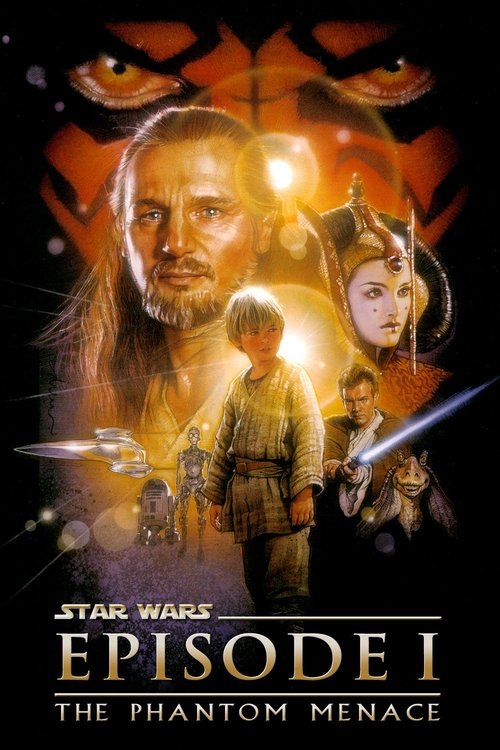
Star Wars: Episode I - The Phantom Menace
1999 · George Lucas
For a nostalgic weekend rewatch, a saga marathon with kids, or genuine curiosity about the most debated blockbuster of its generation — go in for spectacle and history rather than airtight storytelling.
What it's about
Decades before the original trilogy, two Jedi sent to settle a trade blockade of the peaceful planet Naboo find themselves protecting its young queen and uncovering the first moves of a hidden Sith plot. On desert Tatooine they discover Anakin Skywalker, a slave boy unusually strong with the Force — a child whose future the whole saga hinges on. It's galactic politics, podraces, and lightsaber duels on an enormous canvas.
The experience
A strange, fascinating mix: stretches of senate procedure and stiff dialogue sit beside some of the most spectacular set pieces in the saga, including a podrace built for pure velocity and a climactic three-way lightsaber duel that still thrills. Watching it now means watching the film and the argument around it at the same time.
The craft
George Lucas used it as a laboratory: groundbreaking digital effects, one of the first fully computer-generated main characters, and design work — cities, ships, costumes — of staggering density. John Williams' score, crowned by the choral 'Duel of the Fates,' is among his most celebrated, and the whole thing demands the biggest screen and sound system available.
Why it matters
One of the defining commercial events of its decade, it pushed digital filmmaking forward while igniting a still-running debate about franchise stewardship and fan expectation — the prequel backlash it triggered has since curdled into affection for a generation who grew up on it.
Snapshot
The Phantom Menace was the first Star Wars feature in sixteen years and the first chapter of a prequel trilogy that George Lucas had long described, in various forms, as part of the saga's original conception. Written and directed by Lucas — his first directing credit on a feature since the original Star Wars in 1977 — the film returned to the galaxy roughly three decades before the events of A New Hope, dramatizing the boyhood discovery of Anakin Skywalker, the trade-blockade crisis on the planet Naboo, and the covert re-emergence of the Sith. It arrived on a wave of extraordinary anticipation and became one of the defining commercial events of its year. Critically, it proved deeply divisive, and it remains the pivot around which arguments about digital filmmaking, franchise stewardship, and the aesthetics of the blockbuster continue to turn. Whatever one's verdict, the film is historically consequential: it is one of the clearest early demonstrations of what fully computer-assisted, effects-saturated studio filmmaking would look like in the coming decade.
Industry & production
The film was produced by Lucasfilm and distributed by 20th Century Fox, continuing the distribution relationship that had run through the original trilogy. Crucially, Lucas financed the production himself through Lucasfilm rather than relying on studio money, which preserved the near-total creative control he had sought since the 1970s. Principal photography took place in the late 1990s, with locations including Tunisia (again standing in for Tatooine, as it had in 1977), Italy's Caserta Royal Palace (used for Naboo's Theed interiors), and stage work at Leavesden Studios in England. The production was mounted at a scale that reflected both Lucas's ambitions and the accumulated infrastructure of his companies — Industrial Light & Magic for visual effects, Skywalker Sound for audio post — which by this point constituted a vertically integrated filmmaking apparatus rare in Hollywood.
The commercial context is essential to understanding the film. Star Wars had been revived in the culture by the "Special Edition" theatrical reissues of the original trilogy in 1997, which reintroduced the property to theaters and demonstrated appetite for more. The Phantom Menace was accordingly one of the most heavily anticipated releases of the decade, accompanied by a vast merchandising and licensing program that had long been central to the Star Wars business model. The film was a major box-office success worldwide; precise figures should be checked against authoritative sources rather than asserted here, but its standing among the top-grossing releases of its era is well established. Its performance confirmed the commercial logic of event filmmaking and franchise revival that would dominate the 2000s.
Technology
The Phantom Menace is perhaps most important as a technological landmark. It was among the most ambitious deployments of computer-generated imagery in a live-action feature to that date, integrating fully digital characters, environments, and creatures on a scale not previously attempted. Jar Jar Binks, the Gungan performed via motion reference by Ahmed Best and realized as a CG character by ILM, is frequently cited as one of the first major fully computer-generated supporting characters to share extended screen time and dialogue with live actors — a genuine technical milestone whatever one thinks of the creative result. Digital set extensions, synthetic crowds, and elaborate CG vehicles and creatures pervade the film.
The production is also a pivotal moment in the transition from photochemical to digital cinema. Lucas was among the most vocal advocates for digital acquisition and exhibition, and The Phantom Menace was associated with early public demonstrations of digital projection in commercial theaters — a preview of the format shift that would reshape distribution over the following fifteen years. While the film was shot largely on traditional film stock, it functioned as a proof of concept and advocacy platform for the all-digital pipeline Lucas would push further with the subsequent prequels. In this sense the film is a hinge: it belongs to the last era of the photochemical blockbuster while actively arguing for the digital one.
Technique
Cinematography
Cinematography was by David Tattersall. The visual approach favors clarity, saturated color, and a certain formal stateliness suited to the film's pageantry — the ceremonial spaces of Naboo, the vertiginous cityscape of Coruscant, the desert flats of Tatooine. Because so much of the frame is destined for digital extension and compositing, the photography frequently serves as a foundation layer to be augmented rather than a self-sufficient image, which gives portions of the film a bright, evenly lit, plate-like quality. The most celebrated set piece, the podrace on Tatooine, is built from rapid, kinetic coverage stitched together with extensive effects work, aiming at a sense of velocity and spatial danger.
Editing
Lucas has long worked closely with editors across his career, and the prequels are associated with an editorial method heavily dependent on digital post-production, in which sequences were assembled and reworked extensively using computer-based tools and pre-visualization. The cross-cutting climax — interleaving the Gungan-droid ground battle, the aerial assault on the Trade Federation control ship, the queen's palace infiltration, and the lightsaber duel — is a characteristic Lucas construction, echoing the parallel-action finale of the original Star Wars but multiplied into four simultaneous fronts. The technique privileges momentum and thematic rhyme over sustained tension in any single strand.
Mise-en-scène / staging
The production and costume design are among the film's genuine strengths. The designs draw on a deliberately eclectic visual vocabulary — the Naboo royal wardrobe evokes historical court dress and non-Western ceremonial traditions; Theed's architecture suggests a stylized classicism; the Jedi are costumed in monastic simplicity. The staging tends toward frontal, symmetrical, ceremonial compositions in the political and courtly scenes, contrasted with the busier, more chaotic staging of the action sequences. The sheer density of designed detail — vehicles, droids, alien species, architecture — is consistent with Lucas's world-building instincts, even where critics have found the human drama within these spaces underpowered.
Sound
Sound was handled through Skywalker Sound, with Ben Burtt — the sound designer whose work defined the sonic identity of the original trilogy — again central to the film's audio world. The film extends the established Star Wars sound palette (lightsaber hums, blaster reports, droid vocalizations, engine textures) into new creatures and machines, and the podrace in particular is a showcase of sound design as spectacle. The mix is dense and aggressive, in keeping with the film's role as a demonstration of contemporary theatrical audio capability.
Performance
The performances have been among the film's most contested elements. Liam Neeson plays the Jedi Qui-Gon Jinn with a grave steadiness that anchors much of the film; Ewan McGregor plays a young Obi-Wan Kenobi, consciously inflecting the role toward Alec Guinness's original performance; Natalie Portman plays Queen Amidala; and Jake Lloyd plays the child Anakin. Much of the criticism directed at the acting has, in retrospect, been redirected toward the direction and the demands of performing against extensive bluescreen and unfinished digital environments, which offered actors little to react to. Ian McDiarmid returns as Palpatine, seeding the political intrigue that the trilogy would develop. The vocal and physical performance of Jar Jar Binks by Ahmed Best became a lightning rod for criticism in ways that later commentators have often reframed as unfair to the performer.
Narrative & dramatic mode
Dramatically, The Phantom Menace is unusual among blockbusters in its emphasis on political machinery — trade disputes, blockades, senatorial procedure, and votes of no confidence — as the engine of its plot. This reflects Lucas's stated interest in how republics decay into empires and how democratic institutions can be maneuvered toward authoritarian ends, a concern that gives the prequel trilogy its through-line. The mode is that of mythic adventure grafted onto political prelude: the film must simultaneously function as a stand-alone quest (rescue the queen, resolve the crisis, win the battle) and as the first movement of a longer tragedy whose ending — Anakin's fall — the audience already knows. This dramatic irony is the trilogy's defining structural feature, and it shapes The Phantom Menace as an origin story haunted by foreknowledge. Critics have noted a resulting tonal instability: the film oscillates between solemn prophecy, broad comedy, and children's-adventure register, and the "chosen one" mythology introduced here (including the much-debated midi-chlorian explanation of the Force) reframes the saga's spirituality in more literal, quasi-biological terms.
Genre & cycle
The film sits at the confluence of several genres Lucas has always braided together: the space opera, the swashbuckling adventure serial, the mythic hero's journey, and — newly prominent here — the political thriller. It belongs to the Star Wars cycle it helped extend, but it also belongs to the broader late-1990s cycle of effects-driven franchise tentpoles. Within the saga, it inaugurates the prequel sub-cycle, defined by digital production, denser world-building, and a more overtly tragic arc than the original trilogy's romantic optimism.
Authorship & method
The Phantom Menace is an unusually pure authorial statement for a blockbuster of its scale: Lucas wrote it alone, directed it, and financed it, working with collaborators drawn largely from companies he founded or controlled. The key creative partners include cinematographer David Tattersall; composer John Williams, whose return provided crucial continuity with the original trilogy and who contributed the standout "Duel of the Fates" choral setting for the climactic lightsaber battle; sound designer Ben Burtt; producer Rick McCallum, Lucas's principal production partner across the prequel era; and the artists of ILM under visual-effects supervision. Williams's score is widely regarded as one of the film's least contested achievements, extending the saga's leitmotivic method into new material. Lucas's method here — heavy pre-visualization, extensive digital post, control over the full production chain — represents the fullest expression of the independent, technologically self-sufficient filmmaking model he had been building since the 1970s. It also exposes the risks of that model: with few institutional checks on his choices, the film's weaknesses read as directly authorial.
Movement / national cinema
As an American studio production, the film does not belong to a national-cinema movement in the art-house sense. Its more meaningful affiliation is with the tradition of American blockbuster spectacle that Lucas and his contemporaries (Steven Spielberg above all) helped establish in the mid-1970s, and which by 1999 had become the dominant mode of Hollywood's commercial output. If there is a "movement" here, it is the digital-cinema movement Lucas was consciously trying to lead — an aesthetic and technological program rather than a regional or ideological school.
Era / period
The Phantom Menace is a quintessential turn-of-the-millennium Hollywood object. It emerged at the end of the 1990s, amid a broader boom in computer-generated effects (the same period as The Matrix, also released in 1999, and the CGI-heavy tentpoles that followed). It reflects the era's confidence in digital tools, its escalating merchandising economies, and its appetite for franchise revival — all tendencies that would intensify in the 2000s. The film thus reads as both a product and a harbinger of the effects-driven, franchise-centric studio era that came to define twenty-first-century Hollywood.
Themes
Several themes recur. The corrosion of democratic institutions and the quiet, procedural birth of tyranny form the trilogy's central political concern, introduced here through the Naboo crisis and Palpatine's manipulations. Fate and prophecy — the "chosen one," the balance of the Force — introduce a deterministic, tragic dimension absent from the original trilogy's more open sense of choice. Slavery and freedom recur in Anakin's origins on Tatooine. And the film is preoccupied, as all Star Wars is, with mentorship and lineage: the passing of knowledge from master to apprentice, and the way that chain can be corrupted. Running beneath these is a meta-theme the film embodies more than states: the promise and peril of technology, mirrored in its own status as a technological showcase.
Reception, canon & influence
Critical reception was sharply divided and, on balance, disappointed relative to the expectations that preceded it. Praise concentrated on the podrace sequence, the climactic three-way lightsaber duel with Darth Maul, John Williams's score, and the ambition of the production and creature design. Criticism concentrated on the flat human drama, the tonal unevenness, the reliance on political exposition, and above all the Jar Jar Binks character, which became one of the most discussed and derided figures in modern popular cinema. The film became a touchstone in debates about fan expectation, franchise stewardship, and whether spectacle had displaced storytelling in the blockbuster.
Looking backward, the film's influences are the same wellsprings Lucas had always drawn on: the Flash Gordon serials, Akira Kurosawa's samurai films, Joseph Campbell's monomyth, classical mythology, and the original trilogy's own established grammar, now extended and complicated. The Jedi-as-monastic-order conception and the courtly world-building deepen source material Lucas had used more sparingly before.
Looking forward, its legacy is substantial and double-edged. Technologically, it accelerated the industry's shift toward CGI-integrated production and digital cinema, and it functioned as an advocacy platform for digital projection that helped normalize the format. As franchise practice, it demonstrated both the immense commercial power of legacy revival and its creative hazards — a lesson later franchise custodians studied closely. Culturally, its reputation has undergone significant reassessment: the generation that grew up with the prequels has, in many cases, reclaimed the film, while "Duel of the Fates," Darth Maul, and the prequel-era design language have become durable and beloved parts of Star Wars iconography. Its influence on subsequent Star Wars media — animated series, later films, and expanded storytelling that mined the prequel era's political and Jedi lore — has proven especially deep. The Phantom Menace endures, then, less as a critical success than as a historically decisive film: a work whose ambitions, achievements, and failures together mark a turning point in how blockbusters are made, sold, and argued about.
A Deleuzian reading
Look at the parade Lucas ends on.
The full Deleuzian reading of Star Wars: Episode I - The Phantom Menace →
Reception
Arrived in 1999 on a tidal wave of hype as the first Star Wars film in 16 years, then became the poster child for fan disappointment — Jar Jar, midi-chlorians, trade disputes. A generation that grew up on it has since mounted a genuine nostalgic rehabilitation, and 'Duel of the Fates' was never anything but beloved.
How Star Wars: Episode I - The Phantom Menace was received, from release to now →
How to watch Star Wars: Episode I - The Phantom Menace: what to notice on a first viewing
- Follow the blockade, the vote, and the committee talk. Lucas puts senatorial procedure at the motor of a blockbuster. A trade dispute forces a vote of no confidence, and nobody fights any of it with a sword. The force actually shaping the galaxy works through paperwork. It has no body to swing at, which is why the Jedi only sense unease.
- Notice how often Lucas centers the frame and lines people up. Throne rooms, courts, and council chambers are staged frontally and symmetrically, with ranks squared to the lens. The action scenes then break into deliberate clutter by contrast. A children's adventure is being staged in the grammar of a rally, and the ceremony keeps telling you who is being obeyed.
- Notice how evenly lit and flat the big environments look. Tattersall photographs much of the film as a foundation layer for digital extension. Light falls without much direction or shadow, and depth arrives later in compositing rather than on set. You are watching the moment the shot stops being a place and becomes a surface that other images get projected onto.
- Listen to the podrace engines instead of watching the racers. Ben Burtt built the Star Wars sound world in 1977 and extends it here into new machines and creatures. Each pod has its own pitch, so you can track the field with your eyes closed. Sound is doing the spatial work the effects cannot. The race is legible because it is scored by engines, not by geography.
- Listen for Alec Guinness in Ewan McGregor's voice. McGregor pitches vowels, rhythm, and dryness toward Guinness's 1977 Obi-Wan. Neeson plays Qui-Gon dead level beside him, which makes the borrowed voice stand out more. The performance is a bridge to a film made twenty-two years earlier. You hear the older actor arriving inside the younger one.
The whole guide to watching Star Wars: Episode I - The Phantom Menace, with the keys for a rewatch →
Influences: the films it descends from and the films it influenced
- Flash Gordon (1936) — The serial's optical wipe transitions, cliffhanger episode pacing, and expository opening titles are the grammar Lucas transplants directly into the film's scene-to-scene wipes and roll-up crawl.
- The Hidden Fortress (1958) — Kurosawa's low-angle samurai staging and telling of grand events from the vantage of bickering lowly retainers underwrite both the Jedi-as-swordsman duel choreography and the film's droid/servant point-of-view.
- Ben-Hur (1959) — The chariot race — a multi-competitor arena circuit cross-cut between drivers, crashes, and spectator galleries — is the direct staging template for the Boonta Eve podrace.
- Metropolis (1927) — Lang's vertically stacked Art Deco megacity and gleaming humanoid Maschinenmensch supply the retro-futurist design vocabulary for Coruscant's tiered skyline and the saga's protocol-droid silhouette.
- Triumph of the Will (1935) — Riefenstahl's frontal, axially symmetrical mass-formation compositions are quoted in the closing Naboo victory parade and the ceremonial throne-room framings.
- Star Wars (1977) — Establishes the leitmotivic scoring method, the opening crawl, and the Force cosmology that this film extends into new choral (‘Duel of the Fates') and midichlorian material.
- Young Sherlock Holmes (1985) — ILM's photorealistic stained-glass knight here was the first fully computer-generated character composited into live action, establishing the CG-character pipeline that Jar Jar Binks would scale to a lead role.
- Willow (1988) — Lucas-produced showcase for ILM's morph software, the digital-transformation R&D that fed the studio's late-'90s photoreal CG capability.
- Jurassic Park (1993) — ILM's photoreal CG dinosaurs, motion-blurred and lit to sit inside live plates, proved the integration standard that made a wholly CG creature cast plausible.
- The Lord of the Rings: The Two Towers (2002) — Gollum takes Jar Jar's breakthrough as a fully CG performing character and advances it via on-set performance capture driving the animation.
- Star Wars: Episode II - Attack of the Clones (2002) — Shot entirely on Sony/Panavision HD digital cameras, it converts this film's digital-projection advocacy into full end-to-end digital capture.
- Sky Captain and the World of Tomorrow (2004) — Extends the bluescreen-acting model to its limit, with performers working entirely on empty stages against wholly synthetic digital-backlot environments.
- Sin City (2005) — Builds every location as a greenscreen digital backlot, inheriting the film's demonstration that principal photography can be staged almost entirely inside the computer.
- Pirates of the Caribbean: Dead Man's Chest (2006) — Davy Jones's crew are CG performance-capture characters replacing costumed actors, continuing the Jar Jar precedent of a fully digital principal cast member.
- Star Wars: The Clone Wars (2008) — An animated series that mines this film's prequel-era political machinery and expanded Jedi lore, deepening the world-building it introduced.
- Avatar (2009) — Pairs performance-captured CG lead characters with an aggressive digital-projection (and 3D) rollout, carrying forward this film's twin bet on synthetic performers and exhibition-format change.
- The Matrix (1999) — A turn-of-millennium digital-effects spectacle released the same year, pushing the same fusion of composited CG environments and choreographed action into the mainstream blockbuster.
- Gladiator (2000) — Reconstructs a vanished antique arena epic through CG set-extension and digital crowd replication, the same digitally-augmented spectacle logic applied to a historical rather than fantastical world.
Similar films
- Star Wars (1977) — influence & lineage · same viewing thread
- Star Wars: Episode II - Attack of the Clones (2002) — influence & lineage · same viewing thread
- The Matrix (1999) — influence & lineage
- Jurassic Park (1993) — influence & lineage
- Gladiator (2000) — influence & lineage
- The Empire Strikes Back (1980) — same viewing thread
- Star Wars: The Force Awakens (2015) — same viewing thread
- Rogue One: A Star Wars Story (2016) — same viewing thread
All the films related to Star Wars: Episode I - The Phantom Menace →
Watch it with: curated runs of related films
- The Blockbuster Sci-Fi Canon — A run of the effects-driven epics that taught modern audiences what a movie could feel like — from the desert planets of Star Wars to the rain of Blade Runner and the sands of Arrakis.