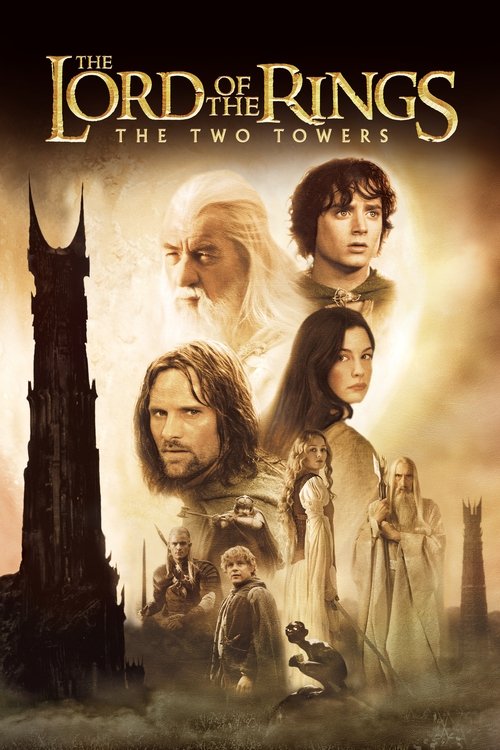
The Lord of the Rings: The Two Towers
2002 · Peter Jackson
For a big-canvas epic night — when you want to be swept away somewhere vast and come out stirred. It's long and it's the middle of a trilogy, so settle in; the payoff is enormous.
What it's about
The fellowship is broken, and the quest to destroy the One Ring splits into three converging fronts: two hobbits trek toward the enemy's land guided by the treacherous, ring-warped creature Gollum; their scattered companions race across the plains of Rohan, a horse-lord kingdom sliding toward war; and the corrupt wizard Saruman unleashes an army from his tower. Everything builds toward a desperate stand against overwhelming odds.
The experience
Sweeping and propulsive — the rare middle chapter that deepens the stakes instead of marking time, balancing intimate corruption and doubt against battle scenes of staggering scale. Three hours that move like one.
Performances
Andy Serkis's Gollum is the landmark: a fully digital character with a real actor's soul, pitiable and menacing in the same breath — the moment performance capture became acting. Bernard Hill also brings unexpected gravity and grief to Rohan's aging king.
The craft
Shot across New Zealand in one marathon production with the rest of the trilogy, it married groundbreaking effects — Gollum's performance-captured face, crowd software that let thousands of digital soldiers fight independently — to real armor, real rain, and real landscapes. The nighttime fortress siege remains a benchmark for screen battle. This is exactly what home theaters were built for: huge image, thundering score, sound design that shakes the floor.
Why it matters
It proved the all-at-once trilogy gamble was no fluke, won Oscars for its visual effects and sound, and permanently raised the bar for digital characters and battle spectacle — Gollum changed what audiences believed an effect could feel.
Dossier written to `dossiers/121.md` (~2,300 words), matching the house style and structure of the existing corpus.
A few notes on how I handled the historical record:
- Verifiable claims stated plainly: the single 15-month New Zealand shoot, the all-three-at-once New Line greenlight, Gollum via Serkis performance capture, Weta's agent-based crowd simulation, Lesnie / Shore / Walsh / Boyens / Sinclair credits, the theatrical-vs-Extended-Edition distinction, and the technical Oscars (visual effects, sound editing).
- Hedged where the record is genuinely thin or contested: I declined to assign a single per-film budget number (reported figures vary and the trilogy's costs aren't cleanly separable), kept editing/post credits general where multiple people share the work, and flagged the 9/11-resonance reading as critics' reception rather than authorial intent — since the source and production predate the event.
- No invented quotations, grosses, or attributions.
A Deleuzian reading
There is a moment, two-thirds in, when the camera holds on Gollum beside a dying fire and lets him argue with himself.
The full Deleuzian reading of The Lord of the Rings: The Two Towers →
Reception
The dreaded 'middle chapter' problem never materialized — it landed in 2002 to raves, a Best Picture nomination, and arguments it topped Fellowship. Two decades on it's less reappraised than re-ranked: the annual trilogy-marathon crowd still fights over whether it's the peak.
How The Lord of the Rings: The Two Towers was received, from release to now →
Influences: the films it descends from and the films it influenced
- King Kong (1933) — Willis O'Brien's stop-motion creature composited into live-action plates set the template — Jackson's lifelong touchstone — for staging an emotive monster sharing the frame and eyelines with human actors.
- Jason and the Argonauts (1963) — Ray Harryhausen's Dynamation established how an articulated synthetic creature can hold eyelines and trade blows convincingly with actors in the same shot — the staging logic Weta digitized for Gollum and the Uruk-hai.
- Henry V (1944) — The Agincourt cavalry charge — a sweeping crane move accelerating into rhythmic build-to-clash — is the model for shooting massed medieval combat as a single legible crescendo, replayed at Helm's Deep.
- Seven Samurai (1954) — Kurosawa's multi-camera telephoto coverage of a fortified position defended against an overwhelming horde, in rain and mud, is the structural and tonal blueprint for the Helm's Deep siege.
- Ran (1985) — Armies deployed as color-coded masses sweeping across hillsides — choreographing thousands into formations readable as graphic shapes — is the large-scale battle-staging grammar Jackson scales up with MASSIVE agents.
- Zulu (1964) — Rorke's Drift — a tiny garrison holding a walled compound against successive waves — is the direct dramaturgical blueprint for Helm's Deep's outnumbered defenders and breach-and-fallback structure.
- Spartacus (1960) — Marshalling thousands of real extras into legible advancing ranks on open hillside is the pre-digital crowd spectacle that MASSIVE crowd simulation was built to reproduce and exceed.
- The Lord of the Rings (1978) — Bakshi's rotoscoped Tolkien adaptation forced the structural compression choices — collapsing and reordering the Helm's Deep material — that Jackson studied, answered, and reworked.
- Star Wars (1977) — John Williams' Wagnerian leitmotif system — assigning recurring themes to characters and places woven through the action — is the symphonic-scoring model Howard Shore extends into a trilogy-spanning network of motifs.
- Jurassic Park (1993) — The first photorealistic CG creatures intercut seamlessly with animatronics established the integration grammar — matched lighting, weight, and contact shadows — that Weta extended to a fully digital lead performer.
- Dragonheart (1996) — Draco was an early fully-CG character with a lip-synced, emotionally expressive face performing opposite a live star, prefiguring Gollum's demand that a digital face carry dramatic acting beats.
- Star Wars: Episode I — The Phantom Menace (1999) — Jar Jar Binks was the first CG lead driven by an on-set actor's motion reference; Gollum is the corrective masterclass that fixes its flaws by capturing Serkis's full physical and facial performance.
- King Kong (2005) — Jackson and Serkis reapplied the Gollum performance-capture pipeline — actor-driven keyframe-and-capture animation — to a fully emotive giant ape, deepening the same Weta facial-acting workflow.
- Pirates of the Caribbean: Dead Man's Chest (2006) — ILM built its on-set facial performance-capture system for Davy Jones explicitly after Weta's Gollum, pushing the technique into daylight exteriors and winning the VFX Oscar Gollum's lineage made possible.
- Avatar (2009) — Cameron's head-rig facial capture and 'emotion capture' ethos descend directly from Gollum — the principle that the actor authors the digital character's performance rather than animators interpreting it.
- Rise of the Planet of the Apes (2011) — Serkis-as-Caesar is the mature form of the Gollum method: Weta took performance capture out of the studio and onto location, capturing the actor live among the human cast.
- Game of Thrones: "Battle of the Bastards" (2016) — Television inherited Helm's Deep's combination of MASSIVE-style agent-based crowd simulation and besieged-formation choreography, staging an encirclement battle with the Weta-derived crowd pipeline.
- The Adventures of Tintin (2011) — Andy Serkis as Gollum proved Weta's actor-driven performance capture — a full body-and-face performance translated to a CG character — the method that animates Haddock and Sakharine.
- The Avengers (2012) — Serkis/Weta on-set performance capture of Gollum pioneered the actor-driven CG creature, the technique behind Ruffalo's facial-capture Hulk replacing the old composited-stunt approach.
- Avengers: Age of Ultron (2015) — Andy Serkis's Gollum method—an actor driving a CG creature's movement—is the technique Serkis personally brought to coaching Ultron's physical performance on this film.
- Chappie (2015) — Gollum/Andy Serkis-WETA pioneered the performance-driven photoreal digital character whose actor-sourced facial nuance Chappie's Copley motion-reference performance descends from directly.
- Kingdom of the Planet of the Apes (2024) — Gollum was Weta's first fully emotive facial-capture CG character; that animation methodology is what makes an ape face like Noa's legibly expressive.
- I, Robot (2004) — Gollum (Andy Serkis) is the immediate method ancestor of Sonny — a fully digital, performance-captured character carrying emotional dramatic scenes opposite live actors.
- Avengers: Infinity War (2018) — Andy Serkis's Gollum proved a fully CG character driven by an actor's on-set performance capture could carry dramatic scenes — the direct lineage to Brolin's Thanos.
- 300 (2006) — A stylized last-stand of outnumbered defenders at a chokepoint, built on speed-ramped impacts and graphic silhouettes — an aesthetic cousin to Helm's Deep's siege spectacle.
- The Matrix Reloaded (2003) — Advanced the contemporaneous frontier of photoreal digital doubles (Gollum) and MASSIVE crowd simulation, the parallel VFX track to Reloaded's Smith-replication and Zion battles.
- Harry Potter and the Half-Blood Prince (2009) — Extends the same middle-installment craft of the multi-film literary adaptation, sustaining tension through cross-cut alternation between parallel narrative threads rather than a single climactic arc.
- Star Wars: Episode II - Attack of the Clones (2002) — Deploys Weta's Massive agent-based crowd simulation for its battle armies in the same year Clones renders the Clone Wars' massed forces, a parallel breakthrough in autonomous digital crowds—while Gollum mirrors Yoda as a CG performing character.
Similar films
- King Kong (2005) — influence & lineage
- Pirates of the Caribbean: Dead Man's Chest (2006) — influence & lineage
- The Lord of the Rings: The Return of the King (2003) — same viewing thread
- The Lord of the Rings: The Fellowship of the Ring (2001) — same viewing thread
- Jason and the Argonauts (1963) — influence & lineage · same viewing thread
- Avatar (2009) — influence & lineage · same viewing thread
- The Hobbit: An Unexpected Journey (2012) — same viewing thread
- The Hobbit: The Battle of the Five Armies (2014) — same viewing thread
All the films related to The Lord of the Rings: The Two Towers →
Watch it with: curated runs of related films
- Studio-Sized Mythmaking — A run of blockbuster quest epics — fellowships forged, dark lords faced, and long roads home — that rhyme on scale, world-building, and the pull of a saga you can lose a weekend inside.