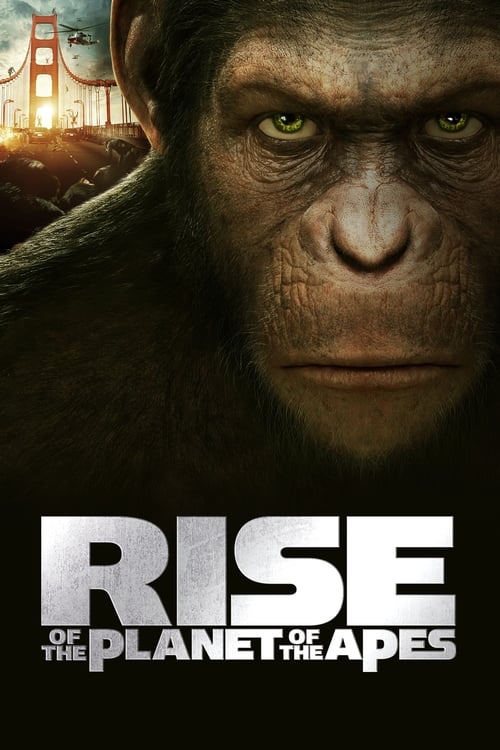
Rise of the Planet of the Apes
2011 · Rupert Wyatt
For when you want a smart blockbuster with a heart — spectacle you don't have to switch your brain off for, and one that might leave you unexpectedly moved on behalf of a chimpanzee.
What it's about
A San Francisco scientist testing an experimental Alzheimer's therapy — partly to save his own failing father — ends up raising Caesar, a chimpanzee born with startling intelligence. Caesar grows up loved in a suburban home, but he isn't human, and the day the human world decides to treat him as an animal, everything he is gets put to the test. It's the origin story of a revolt, told from the ape's side.
The experience
Surprisingly emotional for a summer blockbuster — the middle section plays like a prison drama, and by the finale you're fully on the side of the apes. It builds patiently and then pays off with real momentum and a Golden Gate Bridge set piece that earns its scale.
Performances
Andy Serkis's performance-capture work as Caesar is the landmark here — a full dramatic arc from curious child to betrayed prisoner to leader, conveyed almost entirely without speech, that changed how the industry regarded motion-capture acting.
The craft
The digital apes were a leap forward: Caesar's face carries the film's biggest emotional beats, and the effects hold up because they serve character first. Long wordless passages trust the audience to read eyes and body language, and the escalation to the bridge finale is cleanly, classically staged. Absolutely worth a big screen.
Why it matters
The reboot that revived a dormant franchise by taking it seriously, launching one of the most acclaimed blockbuster trilogies of its decade and making the case that a performance-capture role could be awards-worthy.
Snapshot
Rise of the Planet of the Apes is the film that resurrected a dormant franchise by reimagining it as an intimate origin tragedy rather than a far-future spectacle. Where the 1968 original opened on a ruined Earth already lost to its simian inheritors, Rupert Wyatt's film begins in the present-day Bay Area and asks a quieter, more wrenching question: how would such a world actually begin? Its answer is Caesar (Andy Serkis), a chimpanzee whose mother is dosed with an experimental Alzheimer's therapy, who is born preternaturally intelligent, raised in a San Francisco home by the scientist who created the drug, and ultimately betrayed by the human institutions that confine and abuse him. The film is at once a corporate reboot engineered to revive valuable intellectual property and a genuine artistic gamble — one staked almost entirely on the proposition that a fully digital, performance-captured character could carry a major studio film as its emotional and dramatic center. That gamble paid off so decisively that it reset both the franchise and the industry's understanding of what virtual performance could achieve. Built around a near-wordless protagonist and a slow accumulation of dignity and grievance, Rise is a science-fiction parable of oppression and revolt that earns its uprising through character rather than carnage.
Industry & production
The film was produced and distributed by 20th Century Fox, the studio that owned the Planet of the Apes property and had every commercial reason to revive it. The franchise had a long and uneven history: the original 1968 picture spawned four sequels, two television series, and a substantial merchandising legacy, but the brand had stalled after Tim Burton's poorly received 2001 "re-imagining." Rise represented Fox's second attempt to relaunch the series, this time as a ground-up origin story divorced from any continuity with Burton's film. The screenplay was written by the married writing team of Rick Jaffa and Amanda Silver, who also served as producers and are generally credited with originating the conceptual hook — telling the story from the apes' point of view and grounding the apocalypse in contemporary biotechnology rather than space travel and time paradox.
The choice of director was the production's most striking bet. Rupert Wyatt was a British filmmaker with only one prior feature, the well-regarded prison drama The Escapist (2008); handing him a tentpole reboot signaled Fox's willingness to pair franchise scale with a relatively untested but character-focused sensibility. Production was based largely in Vancouver, with the narrative set in San Francisco and its environs, culminating in a set-piece battle on the Golden Gate Bridge. The most consequential production decision, however, was creative-technological: Fox engaged Weta Digital, the New Zealand effects house, to render the apes entirely through performance capture and computer animation, with no actors in prosthetic makeup or suits. This was a deliberate and total break from the franchise's defining tradition — John Chambers's Oscar-honored ape makeup had been the visual signature of the 1968 film — and it placed the entire production on the success of digital characters.
I will not assert exact budget or box-office figures, but the record is clear that the film was a substantial commercial success, decisively outperforming expectations, and that its profitability is what immediately green-lit a continuing series.
Technology
Technologically, Rise of the Planet of the Apes is a landmark, and it is the film's single most important contribution to cinema history. Weta Digital, fresh from its work on Avatar (2009), extended performance-capture technique in two crucial directions. First, the apes were realized as wholly digital creations driven by actors' captured performances — facial and bodily — rather than by suits or makeup, allowing a fidelity of expression, musculature, and movement that prosthetics could never reach. Second, and more novel, Weta and the production pioneered performance capture outside the controlled volume of a sound stage, conducting motion capture on location and outdoors so that Andy Serkis and his fellow ape performers could act on the actual sets alongside the human cast. Reflective marker systems and on-body camera rigs were adapted for this exterior, on-set capture, a significant departure from the enclosed, sensor-lined stages that had previously defined the technique.
The effect of this work was not merely cosmetic. By capturing performances in situ, the production preserved the eyeline, scale, and interaction between Serkis's Caesar and the live actors, which in turn allowed the digital character to read as a genuine scene partner rather than an inserted effect. The achievement reignited a long-running industry debate about whether performance-capture acting should be eligible for awards recognition, with many critics arguing that Serkis's work constituted a genuine performance that the existing categories were ill-equipped to honor. Whatever its awards outcome, the film established a new baseline: after Rise, the photorealistic, emotionally legible digital primate became an accepted protagonist, and the technique it refined underwrote the increasingly ambitious sequels.
Technique
Cinematography
The cinematography is by Andrew Lesnie, the Australian director of photography best known for shooting Peter Jackson's Lord of the Rings and King Kong — a pedigree directly relevant to a film built on digital creatures and Weta's effects pipeline. Lesnie's photography balances naturalistic, present-day realism in the human-world scenes with a more expressive register for Caesar. Particular care is given to the framing of the ape's face and eyes, since the film's emotional information is so heavily concentrated in a non-speaking character; close-ups on Caesar do the narrative work that dialogue ordinarily would. The film's geography is rendered with a strong sense of place — the suburban home, the primate "sanctuary" that is effectively a prison, the redwood canopy, and the fog-wrapped Golden Gate Bridge of the climax — and Lesnie modulates light and palette to track Caesar's journey from domestic warmth to institutional cruelty to wild liberation.
Editing
The editing, by Conrad Buff IV and Mark Goldblatt — both seasoned cutters of large-scale studio action — manages an unusual structural challenge: a film whose first two acts are deliberately patient and character-driven, and whose third act erupts into kinetic spectacle. The cutting honors the slow build of Caesar's consciousness and resentment, lingering on incremental moments of comprehension, before accelerating into the orchestrated jailbreak and bridge battle. The editors also had to integrate fully digital characters into live-action coverage seamlessly, sustaining the illusion that audiences are watching real interaction; the rhythm of the action finale, in particular, keeps the apes legible as individuals rather than an undifferentiated mass.
Mise-en-scène / staging
Wyatt's staging is organized around spaces of confinement and their thresholds: the cage, the attic window through which Caesar glimpses the wider world, the sanctuary enclosure, and finally the open forest. The film repeatedly frames Caesar looking — at the suburban street, at a leashed dog, at the redwoods — so that his developing self-awareness is staged as an act of seeing and comparing his own captivity to others' freedom. The uprising is choreographed with attention to tactics and intelligence rather than mere force; Caesar's leadership is communicated through how he organizes the other apes in space. A recurring visual motif is the symbol Caesar scratches into the wood of his cell, and the gesture of a single stick that breaks easily against a bundle that does not — a staged parable of collective strength that the mise-en-scène makes literal.
Sound
Patrick Doyle's score supplies much of the film's emotional architecture, ranging from tender, lyrical writing for Caesar's domestic upbringing to driving, percussive material for the revolt. Sound design carries an especially heavy load given the protagonist's near-silence: the grunts, screams, and breathing of the apes are central expressive instruments, and the film withholds Caesar's first spoken word for maximum impact, making his eventual utterance a sonic climax. The aural design of the primate facility — echoing concrete, clanging bars — reinforces the carceral reading of the space.
Performance
The film's reputation rests above all on Andy Serkis's performance as Caesar, widely regarded as a high-water mark of performance-capture acting. Serkis builds the character across a wordless arc from infant dependency through dawning intelligence to wounded dignity and, finally, moral authority, conveying an interior life almost entirely through physicality and gaze. Among the human cast, James Franco plays Will Rodman, the scientist-father whose love for Caesar is genuine but whose science precipitates catastrophe; John Lithgow gives a moving performance as Will's father Charles, an Alzheimer's sufferer whose illness motivates the research; Freida Pinto plays a primatologist; Brian Cox and Tom Felton are the proprietor and cruel keeper of the sanctuary; and David Oyelowo plays a profit-driven biotech executive. Felton's keeper delivers a pointed callback to Charlton Heston's most famous line from the 1968 film, a deliberate intertextual nod inverting the original's human-victim perspective.
Narrative & dramatic mode
The narrative mode is tragedy in the guise of an origin story. Because the audience already knows the franchise's endpoint — a world ruled by apes — the film operates with dramatic irony: every act of human cruelty and hubris is freighted with the foreknowledge of where it leads. Yet the film resists nihilism by making Caesar's revolt sympathetic and largely restrained; his explicit aim is freedom, not extermination, and the human apocalypse is set in motion almost incidentally, through a mutating airborne pathogen (the "Simian Flu") whose spread is signaled in a coda rather than dramatized as the central event. The structure is a slow-burn character study that withholds spectacle, investing instead in the moral logic of an uprising, so that when violence finally comes it reads as earned consequence rather than genre obligation. The dual storyline — Caesar's captivity and Will's compromised science — lets the film hold sympathy and culpability in tension.
Genre & cycle
Rise belongs to the contemporary cycle of franchise reboots and origin stories that dominated Hollywood in the late 2000s and 2010s, in which studios revived dormant properties by returning to first causes. Within science fiction it sits in the lineage of the "uplift" and biotech-cautionary tale, and within the Planet of the Apes saga specifically it functions as a reboot that reorients the series around the apes' perspective. It is also a contribution to the long tradition of the cinema of revolt and the creature-as-protagonist film, drawing implicitly on the King Kong lineage (a connection underscored by the Weta/Lesnie Kong personnel) and on the prison-break and slave-uprising film. The film helped legitimize the idea that a tentpole could be built on a non-human, digitally rendered lead, influencing the texture of the spectacle cycle that followed.
Authorship & method
Authorship here is genuinely collaborative, distributed across director, writers, lead performer, and effects house. Rupert Wyatt's contribution was a commitment to character and restraint, insisting that the audience's investment in Caesar precede any action spectacle; his method favored emotional grounding over the bombast typical of the form. The screenplay by Rick Jaffa and Amanda Silver supplied the conceptual reframing — apes' point of view, biotech origin, Alzheimer's as the human stakes — that defines the film. Cinematographer Andrew Lesnie and composer Patrick Doyle shaped its visual and emotional registers, while editors Conrad Buff and Mark Goldblatt managed its tonal architecture. But the film's true co-authors are Andy Serkis and Weta Digital, led by senior visual-effects supervisor Joe Letteri: Caesar is the product of Serkis's performance and Weta's rendering working as a single creative act, an authorship that the film itself implicitly argues should be understood as performance, not effect.
Movement / national cinema
The film is a product of mainstream American studio filmmaking, financed and distributed by a Hollywood major, but its making is transnational in a way characteristic of contemporary blockbuster production: a British director, an Australian cinematographer, a multinational cast, Canadian shooting locations, and — decisively — a New Zealand effects house whose post-Lord of the Rings expertise was indispensable. Rise thus exemplifies the globally dispersed mode of production in which "Hollywood" cinema is assembled across continents, with creative labor and technological capacity sourced wherever it is strongest. Weta's involvement in particular ties the film to the New Zealand digital-effects industry that Jackson's productions had built into a world center.
Era / period
Rise is firmly a film of its early-2010s moment. Its anxieties are biotechnological — genetic engineering, gene therapy, pharmaceutical profit motives, and pandemic contagion — reflecting a period acutely conscious of laboratory science's promise and peril. The Alzheimer's storyline taps a contemporary cultural preoccupation with neurodegenerative disease and the search for a cure. Its sympathies also align with a rising animal-rights consciousness and a skepticism of corporate science, and the Simian Flu coda anticipates the pandemic dread that would intensify across the following decade. Technologically, it captures the precise moment after Avatar when performance capture and photorealistic digital characters became viable as the foundation of mainstream cinema.
Themes
The film's governing theme is oppression and the moral legitimacy of revolt: Caesar's arc traces the transformation of a captive into a liberator, and the film frames his uprising as a response to cruelty rather than an act of malice. Closely related is the theme of scientific hubris — the recurring fable of humanity engineering its own undoing in pursuit of a cure, with the same drug that promises to heal human minds elevating the species that will supplant us. Family and fatherhood run throughout: Will's relationships with his ailing father and with Caesar mirror each other, and Caesar's eventual choice between his human family and his own kind is the emotional crux. The film also meditates on identity and belonging — Caesar is neither fully wild nor truly domestic, and his discovery that he is "property" rather than family is the wound from which the revolt grows. Beneath all of it lies the franchise's foundational inversion: the unsettling of human exceptionalism, the suggestion that the line between human and animal is one of circumstance and power rather than essence.
Reception, canon & influence
Critical reception was strongly positive, and notably warmer than the franchise's recent history had led many to expect. Reviewers singled out Andy Serkis's performance and Weta's effects work as the film's triumph, and praised Wyatt for grounding spectacle in genuine emotion. The film's release intensified an industry-wide conversation about whether performance-capture acting deserved formal awards recognition — a debate that became one of its most cited cultural effects, even though the major acting categories did not, at the time, accommodate such work.
Looking backward, the film draws on Pierre Boulle's 1963 novel La Planète des singes and, more directly, on the 1968 film and its sequels — above all Conquest of the Planet of the Apes (1972), the entry that first dramatized an ape uprising led by a chimpanzee named Caesar, from which Rise borrows both its protagonist's name and its central event. It nods explicitly to Franklin J. Schaffner's 1968 original through Heston's famous line and through a recurring background detail tracking a lost Mars mission, seeding the premise of the earlier film. The King Kong tradition of the sympathetic captive ape, mediated through the Weta and Lesnie connection to Jackson's 2005 version, is a further clear influence.
Looking forward, Rise proved enormously consequential. Commercially and creatively it relaunched the Planet of the Apes series, leading directly to Dawn of the Planet of the Apes (2014) and War for the Planet of the Apes (2017), both directed by Matt Reeves with Serkis returning as Caesar and widely regarded as among the strongest blockbuster trilogies of their era, and subsequently to Kingdom of the Planet of the Apes (2024). More broadly, the film's pioneering of outdoor, on-set performance capture and its success in centering a tentpole on a fully digital, performance-driven lead helped normalize techniques and ambitions that reverberated across the effects-heavy cinema of the 2010s. Its most durable legacy may be the elevation of performance capture from a supporting curiosity to a recognized vehicle for serious dramatic acting — a shift for which Caesar became the defining emblem.
A Deleuzian reading
Start with the window.
The full Deleuzian reading of Rise of the Planet of the Apes →
Reception
Arrived in summer 2011 with rock-bottom expectations — the franchise was radioactive after Tim Burton's 2001 remake — and became the season's surprise critical hit. It's now credited with launching one of the most acclaimed blockbuster trilogies of the 2010s, though fans increasingly treat it as the warm-up act to Matt Reeves' sequels.
How Rise of the Planet of the Apes was received, from release to now →
Influences: the films it descends from and the films it influenced
- Planet of the Apes (1968) — John Chambers's articulated foam-latex ape makeup let actors emote through a non-human face — the analog problem (a recognizable performance under a simian mask) that Rise re-solves digitally, and which it quotes via Heston's line and the lost-Mars-mission detail.
- Conquest of the Planet of the Apes (1972) — Roddy McDowall plays a chimp named Caesar who leads the first ape uprising — Rise lifts the protagonist's exact name and its central event, restaging the slave-to-liberator arc as origin tragedy rather than dystopian sequel.
- King Kong (1933) — Willis O'Brien's stop-motion gave a wholly artificial captive ape enough gestural pathos to redirect audience sympathy from captors to creature — the sympathetic-captive-ape template Rise inherits whole.
- Frankenstein (1931) — Karloff builds a created being's tragedy through wordless gesture and the eyes, the withheld/broken speech making sympathy precede comprehension — the mute-pathos blueprint behind Caesar's staged 'No!' first word.
- The Lord of the Rings: The Two Towers (2002) — Serkis and Weta invented the workflow where an on-set actor's performance drives a fully digital face (Gollum), establishing the literal pipeline and the 'capture is acting, not effect' argument Rise extends to a lead role.
- King Kong (2005) — The exact creative nucleus — Serkis performing an ape via mocap, Weta/Joe Letteri rendering it, Andrew Lesnie shooting — rehearses Rise's collaboration, and reprises the captive-ape-as-emotional-center structure.
- Avatar (2009) — Cameron's head-mounted facial-capture rig and full-performance pipeline proved a digital protagonist could carry sustained dramatic emotion, normalizing the tentpole-with-synthetic-lead ambition Rise then anchors to a single non-human character.
- 2001: A Space Odyssey (1968) — The 'Dawn of Man' sequence is a wordless primate-POV drama built on studied ape physicality and a tool-as-threshold beat — the kind of mute, gesture-first staging and stick/bone parable Rise echoes in Caesar's bundle-of-sticks lesson.
- Greystoke: The Legend of Tarzan (1984) — Rick Baker's expressive ape suits staged real primate behavior and ape-human kinship as drama, a pre-digital commitment to apes as characters-with-interiority that Rise's biotech-uplift premise reanimates.
- I, Robot (2004) — Caesar (Serkis) carries on the motion-captured-emotion lead inside live-action — a digital non-human protagonist whose face does the dramatic heavy lifting, as Sonny's did.
- Pirates of the Caribbean: At World's End (2007) — Weta's Caesar carries the photoreal, actor-driven facial-capture creature forward from Davy Jones's proof-of-concept into a fully emotive CG lead.
- Pirates of the Caribbean: Dead Man's Chest (2006) — Serkis's Caesar carried a blockbuster as a fully performance-captured protagonist, the endpoint of the digital-character-lead lineage Jones helped legitimize.
- Dawn of the Planet of the Apes (2014) — Carries Caesar's performance-capture lead into rain-soaked outdoor wilderness, extending Rise's on-location mocap innovation past the controlled set and deepening the near-silent, signing-driven ape dialogue.
- War for the Planet of the Apes (2017) — Pushes capture into snow and full exteriors and asks Serkis's Caesar to carry a largely wordless, close-up-driven dramatic lead — the apotheosis of the 'capture as serious acting' case Rise opened.
- Kingdom of the Planet of the Apes (2024) — Continues the franchise on next-generation Weta performance capture for an all-digital primate cast, inheriting Rise's premise that an entire blockbuster can rest on captured ape performers rather than human leads.
- The Jungle Book (2016) — Builds a film almost entirely from photoreal digital animals reacting and 'performing' against a single live actor, descending from Rise's demonstration that audiences will accept rendered creatures as emotionally legible co-leads.
- Alita: Battle Angel (2019) — Weta's facial-capture, pushed to micro-expression and eye detail to make a fully digital protagonist read as a real performance, directly extends Rise's claim that capture-rendered faces can anchor a tentpole emotionally.
- Avengers: Endgame (2019) — Andy Serkis's Caesar proved on-set facial performance capture in live-action lighting, the direct precedent for Thanos as a fully digital yet performance-driven antagonist.
- Guardians of the Galaxy Vol. 2 (2017) — Serkis-school performance capture in which a fully CG character (Caesar) carries dramatic lead weight — the motion-reference-plus-vocal method behind Rocket's performance.
- Better Man (2024) — Established the Wētā FX pipeline—markerless on-set facial capture driving a fully digital ape (Serkis's Caesar) whose micro-expressions read as interior emotion rather than creature spectacle, the exact technical substrate Better Man inherits for Robbie's face.
- The Adventures of Tintin (2011) — A same-year Weta/Serkis full-performance-capture feature pushing the technology toward photoreal expressiveness — the contemporaneous proof-of-concept against which Rise's on-set, daylight capture reads as the more radical bet.
- The Hobbit: An Unexpected Journey (2012) — Refines the Gollum capture with HFR and improved facial solving in the immediate wake of Rise, a parallel Weta/Serkis advance in driving a digital face from a live performance.
- Chappie (2015) — Serkis's Caesar is a performance-captured non-human protagonist who learns language and earns empathy as the emotional center via a nature-vs-nurture rearing arc — the same craft Chappie attempts.
- The Hobbit: The Battle of the Five Armies (2014) — Weta's on-location performance-capture of a non-human protagonist (Serkis's Caesar) refined the exact creature-capture pipeline used contemporaneously for the Hobbit's beasts.
Similar films
- Dawn of the Planet of the Apes (2014) — influence & lineage
- War for the Planet of the Apes (2017) — influence & lineage
- Kingdom of the Planet of the Apes (2024) — influence & lineage
- Planet of the Apes (1968) — influence & lineage
- King Kong (2005) — influence & lineage
- King Kong (1933) — influence & lineage
- Avatar (2009) — influence & lineage
- Jurassic Park (1993) — shared sensibility