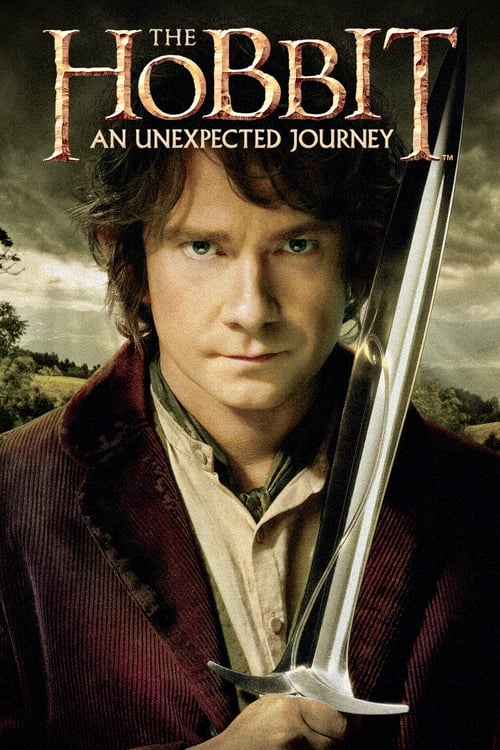
The Hobbit: An Unexpected Journey
2012 · Peter Jackson
For a long comfort-watch evening when you want to disappear into another world — a blanket-and-big-bowl-of-something movie, all comfort and wonder rather than challenge.
What it's about
Bilbo Baggins is a hobbit with a comfortable armchair, a full pantry, and no intention of going anywhere — until the wizard Gandalf and thirteen dwarves crowd into his home and enlist him, as their designated burglar, on a quest to reclaim the dwarves' mountain kingdom and its treasure from the dragon Smaug. The road out of the Shire runs through trolls, goblins, storm-wracked mountains, and a riddle game in the dark, with the exiled dwarf prince Thorin Oakenshield carrying the weight of a lost homeland.
The experience
It's a warm, unhurried epic — more fireside storybook than war saga, with real spectacle when the set pieces arrive and a playful streak the darker Middle-earth films didn't allow themselves. At nearly three hours it takes its time, and it wants you to settle in and enjoy the road.
Performances
Martin Freeman is the anchor: his fussy, put-upon, quietly brave Bilbo makes reluctance itself funny and touching, and Ian McKellen slips back into Gandalf like he never left. Andy Serkis's return as Gollum turns one extended two-hander into the film's unmistakable high point.
The craft
Peter Jackson rebuilds Middle-earth on a lavish scale — New Zealand landscapes, elaborate production design, and a full-orchestra score that reprises familiar themes while giving the dwarves a stirring song of their own. The motion-capture work on Gollum remains startlingly expressive, and the mountain and cavern sequences are built for the biggest screen and loudest speakers you have.
Why it matters
It reopened Middle-earth for a new decade, launching a second blockbuster trilogy and stirring a debate — about high frame rates, digital spectacle, and stretching a slim book across three films — that the industry is still having.
Snapshot
The Hobbit: An Unexpected Journey is the first installment of Peter Jackson's three-film adaptation of J.R.R. Tolkien's 1937 children's novel The Hobbit, and a deliberate return to the Middle-earth that Jackson and his New Zealand collaborators had established a decade earlier with The Lord of the Rings (2001–2003). Conceived as a prequel set some sixty years before the events of the earlier trilogy, the film follows the home-loving hobbit Bilbo Baggins, recruited by the wizard Gandalf the Gray to join thirteen dwarves under the exiled prince Thorin Oakenshield on a quest to reclaim their ancestral kingdom of Erebor — the Lonely Mountain — and its treasure from the dragon Smaug. An Unexpected Journey covers roughly the opening third of Tolkien's slim novel, carrying the company from the Shire through troll country, the elven refuge of Rivendell, and the goblin tunnels of the Misty Mountains, and culminating in Bilbo's fateful encounter with the creature Gollum and the riddle-game that wins him the One Ring. The film is significant on three counts that have little to do with its modest source: it was a landmark experiment in high-frame-rate digital cinema, projected at 48 frames per second; it represented the troubled, much-delayed revival of one of the most lucrative franchises in film history; and it marked the point at which Jackson's expansive, appendices-driven approach to Tolkien adaptation tipped from acclaimed compression into widely debated padding. It is a work of enormous craft and considerable commercial muscle whose reputation has always been entangled with the questions of frame rate and length that surrounded its release.
Industry & production
The film's production history is unusually fraught and is one of the better-documented troubled gestations of a modern blockbuster. After the success of The Lord of the Rings, an adaptation of The Hobbit was an obvious property, but the rights and financing were complicated by the involvement of multiple studios — New Line Cinema and Metro-Goldwyn-Mayer jointly held film rights — and by litigation between Jackson and New Line over Rings profits, which was eventually settled. For an extended period Jackson was attached only as producer, and the Mexican director Guillermo del Toro was engaged to direct. Del Toro spent roughly two years (around 2008–2010) developing the project and co-writing the screenplay before departing, citing the open-ended delays; those delays were driven substantially by MGM's severe financial distress and eventual bankruptcy reorganization, which froze the picture's greenlight. When del Toro left, Jackson stepped in to direct what he had been shepherding as producer.
A second, distinct controversy attended the production in New Zealand. A labor dispute involving actors' unions over the terms of engagement on the film escalated into a public confrontation, and the New Zealand government passed legislation — popularly dubbed the "Hobbit law" — amending employment rules in a way that clarified the status of film workers as contractors and helped keep the production in the country, alongside additional financial incentives. The episode is well documented and remains a politically charged case study in the leverage large productions hold over national film policy; the precise details and motivations are contested between the parties, and I note the dispute's existence and outcome without adjudicating its competing accounts.
The films were ultimately produced by Jackson's WingNut Films with New Line and MGM, and distributed by Warner Bros. The single novel was first planned as two films and then, late in production, expanded to three — a decision that drew on the extensive appendices Tolkien appended to The Lord of the Rings and on invented connective material, and which became the central critical complaint against the trilogy. An Unexpected Journey was a major commercial success on release in December 2012, grossing very strongly worldwide; because precise figures vary across sources and reporting standards I decline to assert an exact total, but its standing as one of the year's highest-earning films is firmly established.
Technology
An Unexpected Journey is, above all, a technological statement, and its most consequential claim on film history is that it was the first major feature film shot and theatrically projected at a high frame rate of 48 frames per second — double the century-old cinematic standard of 24. Jackson championed HFR (used in tandem with native stereoscopic 3D) as a solution to the strobing and motion blur that afflict fast movement and 3D in particular, arguing that the higher rate produced a smoother, more lifelike, less fatiguing image. The film was captured digitally on RED Epic cameras in a large multi-camera 3D rig, and select theaters were equipped to show the HFR 3D version while most audiences saw conventional 24fps presentations in 2D and 3D.
The reception of the format was sharply divided and became the defining talking point of the film's release. Many viewers and critics reported that the 48fps image looked uncannily crisp and "video"-like — frequently compared to the "soap opera effect" of motion-smoothing on consumer televisions, or to behind-the-scenes footage — flattening the painterly illusion audiences associate with film and making sets, costumes, and makeup read as more obviously constructed. Defenders praised its clarity in motion and depth. Whatever one's verdict, the experiment was historically real and influential as a test case: HFR did not become the new norm, but the film forced a serious industry and critical conversation about frame rate as an expressive variable rather than a fixed given, a conversation later directors (notably Ang Lee) would continue to push. Beyond frame rate, the production deployed the full apparatus of Weta Digital and Weta Workshop — large-scale digital creatures, environments, and performance-capture pipelines — extending tools refined on the original trilogy and on Avatar and King Kong.
Technique
Cinematography
Cinematography is credited to Andrew Lesnie, the Australian director of photography who shot the entire original Lord of the Rings trilogy and whose visual signature is fundamental to the look of Jackson's Middle-earth. (Lesnie died in 2015.) Lesnie's task on An Unexpected Journey was complicated by the dual demands of digital HFR capture and stereoscopic 3D, both of which constrain lighting and exposure. The photography preserves continuity with the earlier films' postcard-grand New Zealand landscapes — sweeping aerial and crane vistas of mountains, plains, and the green Shire — while adopting a brighter, higher-key, more saturated palette than the often-darker Rings films, partly a consequence of the brightness needs of 3D and the revealing clarity of the high frame rate. Compositionally the film favors the same vocabulary of scale Jackson established before: forced-perspective and digital size manipulation to place the small hobbit and dwarves convincingly among taller men, elves, and wizards, and grand symmetrical framings of architecture such as Rivendell and the dwarven halls.
Editing
The film was edited by Jabez Olssen, who had worked in the editorial department of the original trilogy. The editorial challenge is structural: a thin, episodic novel has been expanded with interpolated material — a lengthy prologue establishing Erebor and Smaug, a prologue framing device set on the eve of Bilbo's later birthday, and a subplot involving the wizard Radagast and a gathering darkness that ties forward to The Lord of the Rings. The cutting must sustain a near-three-hour runtime out of comparatively modest narrative incident, and the most common critical charge against the film concerns pacing — that scenes are extended and episodes lingered over in ways that test patience. Within set-pieces, however, the editing is muscular and clear, marshaling the goblin-tunnel chase and the stone-giant battle with the legibility Jackson's large action sequences demand. The "Riddles in the Dark" sequence between Bilbo and Gollum is the film's most disciplined passage, edited as a tense two-hander of close-ups and reaction.
Mise-en-scène / staging
The production design, art direction, and creature work — the domain of Weta Workshop and a large design team carried over from the earlier films — constitute the film's deepest strength. Middle-earth is realized with extraordinary density of detail: the burrows and gardens of Hobbiton, the layered Elvish architecture of Rivendell, the cavernous and grotesque Goblin-town, the gilded ruin of Erebor. Each of the thirteen dwarves is individuated through silhouette, costume, prosthetic, and prop so that a large ensemble remains visually distinct — a substantial design accomplishment given how easily thirteen bearded figures could blur together. Staging leans on Jackson's established method of mixing practical sets, miniatures ("bigatures"), prosthetic makeup, and digital extension, and on the company's signature use of scale-doubling and perspective tricks to stage interactions across the wide range of body sizes in Tolkien's world.
Sound
Sound design and the score are central to the film's identity. Composer Howard Shore returned from the original trilogy and built the music on the same leitmotif system, weaving in established Middle-earth themes while introducing new material — most prominently the dwarves' theme associated with the song "Misty Mountains," sung diegetically by the dwarf company in Bilbo's home, a brooding melody that becomes the film's musical spine. The continuity of Shore's voice across both trilogies is one of the strongest threads binding the prequel to its predecessors. Sound design renders the franchise's familiar sonic textures — the timbres of orc and goblin speech, the cavernous acoustics of underground kingdoms, the whisper-and-hiss of Gollum — with Weta's accustomed detail.
Performance
Performance ranges from the broadly comic to the genuinely affecting. Martin Freeman anchors the film as Bilbo, bringing a precise, reactive English comic register — fussiness, exasperation, reluctant courage — that critics widely judged ideal casting. Ian McKellen reprises Gandalf with the authority and warmth he established a decade earlier, and Richard Armitage gives Thorin a brooding gravity that supplies the film's nominal dramatic weight. The standout sequence belongs to Andy Serkis, returning as Gollum through Weta's performance-capture pipeline; the riddle scene is frequently singled out as the film's finest, a showcase for the technology and for Serkis's craft. Returning players including Cate Blanchett (Galadriel), Hugo Weaving (Elrond), and Christopher Lee (Saruman) reinforce the bridge to the earlier films. The thirteen dwarves are necessarily uneven in their individual definition, but the ensemble is energetically played.
Narrative & dramatic mode
The film's dramatic mode is the episodic quest-adventure, structured as a journey of discrete encounters — trolls, elves, goblins, the meeting with Gollum — strung along a road toward a distant goal. Tonally it is lighter and more comic than The Lord of the Rings, in keeping with the more whimsical, child-addressed register of Tolkien's source, though Jackson layers in darker, weightier material to harmonize the prequel with the epic gravity of the later films. The narrative is double-tracked: Bilbo's coming-into-courage arc — the timid homebody who discovers nerve and resourcefulness — runs alongside Thorin's tragic-heroic quest to reclaim a lost homeland and avenge his line. The film also functions, structurally, as setup, withholding its dragon and laying connective groundwork for two sequels; this prequel-and-installment logic is responsible both for its rich sense of a continuous world and for the criticism that it is more vestibule than complete story.
Genre & cycle
An Unexpected Journey sits squarely within the high-fantasy epic, a genre that Jackson's own original trilogy had done more than any other modern work to legitimate as prestige blockbuster cinema. It belongs to the post-Rings cycle of expensive franchise fantasy and to the broader 2010s studio strategy of expanded universes and multi-film adaptations of single properties — the same impulse that split novels into multiple films across the Harry Potter, Twilight, and Hunger Games franchises. As a prequel trilogy returning to a beloved world, it also participates in the era's franchise-revival logic. Within Jackson's body of work it is plainly a companion cycle to the original trilogy, sharing personnel, locations, design language, and musical vocabulary so thoroughly that the two trilogies form a single continuous screen mythology.
Authorship & method
The film is the product of a remarkably stable creative unit. Peter Jackson directed and, with his long-time writing partners Fran Walsh and Philippa Boyens, co-wrote the screenplay; Guillermo del Toro retains a screenplay credit for his developmental work before departing the project. Jackson's authorial method — the fusion of practical New Zealand craft with cutting-edge digital effects, the appendix-mining expansion of Tolkien, the marshaling of vast ensembles and landscapes — is fully continuous with his Rings work, and the prequel can be read as a doubling-down on that method's expansive tendencies. The key collaborators reconstitute the original trilogy's authorship: cinematographer Andrew Lesnie, composer Howard Shore, the Weta Digital and Weta Workshop teams, and a returning design and costume corps. The principal new authorial variable is technological — Jackson's personal advocacy for high-frame-rate capture, which makes An Unexpected Journey as much a director's format experiment as a literary adaptation. The collaborative continuity is so deep that authorship here is best understood as institutional: a New Zealand filmmaking apparatus, built over fifteen years, returning to its founding subject.
Movement / national cinema
The film is a flagship of New Zealand cinema as a global production force — perhaps the clearest case of a single body of work putting a national film industry on the world map. Shot in New Zealand using its landscapes, crews, and the Wellington-based Weta facilities, the Hobbit films extended the infrastructure and international branding that The Lord of the Rings had established, reinforcing the country's identity as Middle-earth and as a premier destination for large-scale effects-driven production. The "Hobbit law" episode underscores how central the production was understood to be to national economic and cultural policy. While not part of an art-cinema movement, the film is a landmark in the story of how a small national industry leveraged a literary property, tax and labor policy, and homegrown technical expertise into a sustained position in global blockbuster filmmaking.
Era / period
An Unexpected Journey is firmly of the early-2010s blockbuster moment. It belongs to the period when digital capture had fully displaced film for tentpole production, when 3D — revived by Avatar (2009) — was at its commercial peak and studios pursued premium-format surcharges, and when the multi-film expansion of single properties had become standard franchise economics. Its HFR gamble is characteristic of an industry searching, in the post-Avatar years, for the next technological premium that might draw audiences from home screens into theaters. Watched today, it is a period document of that brief high-water mark of 3D and of frame-rate experimentation, a road largely not taken by the wider industry.
Themes
The film's thematic concerns are Tolkien's, filtered through Jackson's sensibility. The central theme is the unexpected heroism of the small and ordinary: Bilbo, the comfortable homebody, embodies the idea that courage and consequence reside in unlikely figures, and the film repeatedly contrasts the value of "home" and ordinary life against the lure of adventure, treasure, and glory. Exile and the longing to reclaim a lost homeland drive Thorin and the dwarves, introducing a theme of dispossession and the corrupting pull of inherited grievance and gold — a thread the trilogy develops toward the dragon-sickness of greed. Mercy and its consequences receive their seminal statement in the Gollum sequence, where Bilbo's choice not to kill — and his acquisition of the Ring — plants the moral and narrative seed that the entire Lord of the Rings will later harvest. Friendship, loyalty, and the binding of a fellowship recur as in the earlier films. These themes are sincerely held but lightly carried, in keeping with the more genial register of the source.
Reception, canon & influence
Critical reception was decidedly mixed, and notably cooler than the rapturous response to the original trilogy. Reviewers praised the craft, the world-building, the return of beloved performers, and especially Freeman's Bilbo and the Gollum sequence, while frequently faulting the film on two grounds: the perceived over-extension of a slender novel into a long first chapter of a three-film cycle, and the divisive high-frame-rate presentation, which many found alienating. I characterize this reception in general terms rather than citing specific scores or verdicts I cannot quote precisely; the broad shape — commercially triumphant, critically respectful but qualified, format-controversial — is well established. The film was a substantial box-office success regardless of the critical reservations.
Looking backward, the film's influences are overwhelmingly Tolkien's 1937 novel and its appendices, and, just as decisively, Jackson's own Lord of the Rings trilogy, whose visual, musical, and design language it inherits wholesale; behind these lie the longer traditions of literary high fantasy and the epic-adventure film. Looking forward, its legacy is twofold and somewhat paradoxical. As franchise filmmaking it completed and extended one of cinema's most successful properties, spawning two sequels (The Desolation of Smaug, 2013; The Battle of the Five Armies, 2014) and sustaining New Zealand's production economy. As a technological intervention its influence is more cautionary than generative: the 48fps experiment did not establish high frame rate as a new norm, but it permanently introduced frame rate into the industry's vocabulary of creative and commercial choices, prefiguring later HFR work and informing ongoing debates about motion, realism, and the "look of film." Its place in the canon is that of a hugely accomplished but contested blockbuster — admired for its craft and its world, debated for its length and its frame rate, and inseparable from the larger, monumental achievement of Jackson's Middle-earth.
A Deleuzian reading
Begin with the thing everyone argued about.
The full Deleuzian reading of The Hobbit: An Unexpected Journey →
Reception
Landed in 2012 to a shrug-and-a-billion-dollars: huge box office, middling reviews, and instant unfavourable comparisons to Lord of the Rings. A decade on it hasn't been rehabilitated so much as accepted — the 'flawed but cozy' lesser Middle-earth trilogy people still rewatch.
How The Hobbit: An Unexpected Journey was received, from release to now →
Influences: the films it descends from and the films it influenced
- The Lord of the Rings: The Fellowship of the Ring (2001) — Directly bequeaths the entire production apparatus — Lesnie's high-key New Zealand landscape lensing, Shore's leitmotif system, and the Weta forced-perspective hobbit/wizard scaling rigs that An Unexpected Journey reuses wholesale.
- The Lord of the Rings: The Return of the King (2003) — Establishes the appendix-mining expansion method and the massed-ensemble battle staging (Massive crowd simulation) that the prequel doubles down on to inflate a slender novel into epic scale.
- King Kong (2005) — Jackson's performance-capture pipeline with Andy Serkis matures here — the emotive facial-capture workflow that produces Gollum's riddle scene in An Unexpected Journey was refined on Kong.
- Avatar (2009) — Pioneered the stereoscopic-3D-native, performance-capture-driven blockbuster and the technical argument for higher capture fidelity that emboldened Jackson's 48fps experiment.
- The Polar Express (2004) — Earlier full performance-capture feature whose 'uncanny' hyperreal motion anticipates the divisive too-clear realism that HFR 48fps produced in the Hobbit.
- The 39 Steps (1935) — Foundational two-hander cutting between a reluctant everyman and pursuers — the rhythm Olssen's editing echoes in Bilbo-vs-Gollum and the dwarves' episodic encounters.
- The Wizard of Oz (1939) — Template for the episodic quest-as-journey structure with a homebound reluctant traveler and a road of discrete set-piece encounters, plus diegetic song punctuating the road.
- Willow (1988) — Pre-digital forced-perspective and matte work to stage small heroes against an epic high-fantasy adventure — the practical scaling tradition Jackson industrializes.
- Snow White and the Seven Dwarfs (1937) — Model for ensemble-individuation of a dwarf company — differentiating a large group through silhouette, costume, and comic business, exactly Jackson's task with Thorin's thirteen.
- Excalibur (1981) — High-fantasy epic establishing the lush, saturated high-key landscape palette and mythic-grandeur staging that the Middle-earth films inherit and digitize.
- Harry Potter and the Deathly Hallows: Part 1 (2010) — Extended the split-the-book economics further, stretching one volume into a multi-part fantasy event in the wake of Deathly Hallows' commercial proof.
- The Desolation of Smaug (2013) — Continues the prequel-setup and 48fps HFR experiment, extending Shore's leitmotifs and the bigatures-plus-digital staging into the trilogy's middle chapter.
- The Battle of the Five Armies (2014) — Completes the franchise-expansion arc, pushing the massed-battle staging and performance-capture Smaug to their conclusion under the same Weta apparatus.
- Gemini Man (2019) — Inherits Jackson's HFR gambit explicitly, shooting at 120fps to chase the same hyper-clear motion that An Unexpected Journey introduced to the industry's vocabulary.
- The Adventures of Tintin (2011) — Shares Weta Digital's full performance-capture production directly preceding the Hobbit; both use motion-capture stages and virtual cinematography for a stylized adventure aesthetic.
- The Hobbit (animated) (1977) — Prior adaptation of the same novel sharing the diegetic-song device (dwarves' chant) and episodic-quest beats that Jackson reinterprets in live action.
- The Hobbit: The Battle of the Five Armies / Planet of the Apes (Rise) (2011) — Concurrent Weta-Serkis performance-capture landmark (Caesar) developing the same facial-capture-to-creature pipeline that animates Gollum and later Smaug.
- Rise of the Planet of the Apes (2011) — Refines the Gollum capture with HFR and improved facial solving in the immediate wake of Rise, a parallel Weta/Serkis advance in driving a digital face from a live performance.
- Avatar: Fire and Ash (2025) — The other major HFR theatrical gamble, releasing at 48fps to test whether audiences would embrace high-frame-rate projection, the same exhibition frontier Fire and Ash contests.
Similar films
- The Lord of the Rings: The Fellowship of the Ring (2001) — influence & lineage · same viewing thread
- The Lord of the Rings: The Return of the King (2003) — influence & lineage · same viewing thread
- The Adventures of Tintin (2011) — influence & lineage · same viewing thread
- King Kong (2005) — influence & lineage
- The Hobbit: The Battle of the Five Armies (2014) — same viewing thread
- Avatar (2009) — influence & lineage · same viewing thread
- The Lord of the Rings: The Two Towers (2002) — same viewing thread
- Pirates of the Caribbean: The Curse of the Black Pearl (2003) — same viewing thread
All the films related to The Hobbit: An Unexpected Journey →
Watch it with: curated runs of related films
- Studio-Sized Mythmaking — A run of blockbuster quest epics — fellowships forged, dark lords faced, and long roads home — that rhyme on scale, world-building, and the pull of a saga you can lose a weekend inside.