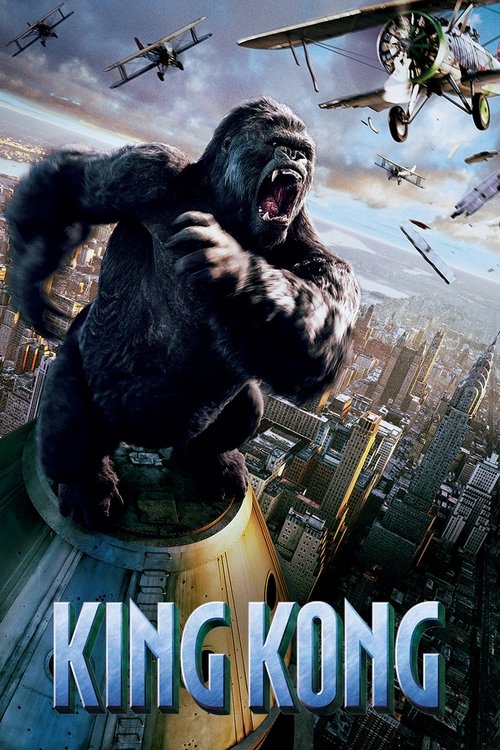
King Kong
2005 · Peter Jackson
For a long, lights-off movie night when you want old-fashioned adventure with a real heart — spectacle you can cry at. Good when you're in the mood to be swept away rather than challenged.
What it's about
New York, 1933: a reckless movie producer lures a struggling vaudeville actress and a hired ship's crew to uncharted Skull Island to shoot his picture, and finds the island already has a star — Kong, a colossal ape who takes an immediate, fierce interest in his leading lady. What starts as a jungle survival adventure becomes a strange, doomed bond between the actress and the creature, with the showman scheming all the while about what a wonder like Kong could be worth back in civilization.
The experience
A big, unashamedly emotional epic that swings from Depression-era melancholy to white-knuckle creature mayhem to genuine tenderness. At three hours it's a full evening's immersion — thrilling, sometimes scary, and finally very sad in the way great monster romances are.
Performances
Naomi Watts grounds the whole spectacle as Ann Darrow, doing much of her best acting opposite a creature added later — her scenes with Kong are wordless and genuinely moving. Andy Serkis's performance-capture work gives Kong a battered, expressive soul that makes the effects feel like acting.
The craft
Peter Jackson rebuilds 1930s New York and dreams up a Skull Island teeming with prehistoric horrors, staging some of the most elaborate creature set pieces ever filmed — including a dinosaur stampede and an insect pit of legendary nastiness. The digital character work on Kong was a landmark, and the scale demands the biggest screen and best sound you have.
Why it matters
Made straight off the Lord of the Rings trilogy as Jackson's love letter to the 1933 film that made him want to direct, it pushed performance-capture and digital-creature technology forward and set the bar for how a remake can honor its source while expanding it.
Snapshot
Peter Jackson's King Kong is a three-hour, lavishly capitalized remake of the 1933 RKO landmark that made Jackson want to become a filmmaker in the first place. Released by Universal in December 2005, immediately on the heels of his triumphant Lord of the Rings trilogy, it is at once a monster picture, a doomed romance, a period reconstruction of Depression-era New York, and an extended meditation on spectacle and showmanship. The film hews closely to the 1933 plot — an unscrupulous filmmaker leads a voyage to an uncharted island, captures a colossal ape, and brings him to Manhattan, where the creature breaks free and dies atop the Empire State Building — but inflates every element to maximalist scale and adds psychological interiority, particularly to the relationship between the ape and the actress Ann Darrow. It is best understood as a work of devout adaptation: a filmmaker at the peak of his industrial power using that power to honor, expand, and emotionally rescore a foundational text of his own cinephilia. Kong himself, realized through Andy Serkis's performance-capture work and Weta Digital's effects, represents one of the most significant digital-character achievements of the mid-2000s, a direct evolutionary step between Gollum and the wholly synthetic worlds Jackson's collaborators would help enable later in the decade.
Industry & production
The film's production history is, in effect, two histories. Jackson first attempted a King Kong remake at Universal in the mid-1990s, developing it with his writing partners before the project collapsed around 1996–97 amid a glut of competing creature and disaster pictures. The astronomical success of The Lord of the Rings gave him the leverage to revive it, and Universal greenlit the new production on terms that made it one of the most expensive films yet mounted, with a reported budget in the region of $207 million. (Such figures are studio-reported and should be treated as approximate.) Jackson again produced with Fran Walsh, and the picture was made through his New Zealand infrastructure — shot largely at and around Wellington, with the same craft ecosystem (Weta Digital, Weta Workshop) that had been built up for the trilogy.
Commercially, the film was a substantial earner — grossing on the order of half a billion dollars worldwide — yet it was widely framed at the time as a relative disappointment against its enormous cost and the expectations set by Jackson's prior run, and its long runtime was a recurring point of trade-press commentary. It won three Academy Awards, for Visual Effects, Sound Mixing, and Sound Editing, confirming its status as a technical showcase even as critical opinion on its length and pacing was divided.
Technology
King Kong is a landmark of performance-capture and digital-creature technology. Weta Digital built Kong as a fully digital character driven by Andy Serkis's motion-captured performance, advancing the facial-capture and body-animation pipelines first proven on Gollum. Where Gollum was a slight, sinuous figure, Kong demanded the mass, musculature, and behavioral specificity of a silverback gorilla rendered at giant scale — requiring sophisticated muscle, skin, and fur simulation so that the animal read as a credible, aging primate rather than a movie monster. The result is a creature whose performance carries the film's emotional climax, a then-novel proposition for a synthetic character.
The film also leaned on the studio's crowd- and environment-simulation tools developed during the trilogy to populate Skull Island's stampedes and battles, and on extensive digital set extension to reconstruct 1933 Manhattan. Shot photochemically by Andrew Lesnie in anamorphic widescreen, the picture married traditional large-format filmmaking with cutting-edge compositing. In the broader arc of digital cinema, King Kong sits between the Rings films and the performance-capture-driven productions of the following years, and several of its technical achievements fed directly into that lineage.
Technique
Cinematography
Andrew Lesnie, Jackson's regular cinematographer and an Academy Award winner for The Fellowship of the Ring, shoots in a 2.39:1 anamorphic frame that emphasizes both the horizontal sweep of Skull Island and the vertical drama of the Manhattan climax. The visual scheme is consciously period-inflected: the Depression-era New York sequences favor desaturated, sooty tones and the burnished amber of theater and tenement interiors, evoking the look of 1930s urban realism, while Skull Island is rendered in dank, fog-shrouded greens and grays that recall the studio-bound jungles of classic Hollywood adventure. Lesnie's camera is highly mobile in the action set-pieces — sweeping with the brontosaur stampede and circling the Kong–V-rex combat — yet settles into stillness for the intimate exchanges between Ann and Kong, where the photography turns almost pastoral, most famously in the Central Park ice sequence.
Editing
The picture is a notably long one (the theatrical cut runs over three hours, with a still-longer extended version released subsequently). The editing — credited to Jamie Selkirk and collaborators in Jackson's Wellington post house — is structured as a slow build: roughly the first hour is devoted to New York and the sea voyage before the company reaches the island. This deliberate, accretive design has been the most debated aspect of the film, read by admirers as character-building patience and by detractors as indulgence. Within set-pieces, however, the cutting is propulsive and densely layered, intercutting multiple threats and characters across the island's escalating dangers. The Manhattan climax cross-cuts ground-level pursuit with the aerial assault in classical fashion, building to the Empire State Building's vertical isolation.
Mise-en-scène / staging
Production designers Grant Major and Dan Hennah (with Weta Workshop) reconstruct 1933 in exhaustive material detail — vaudeville houses, Hoovervilles, the Venture's cramped decks, and a meticulously realized Times Square. Skull Island is staged as a Gothic, decaying ecosystem: ruined cyclopean architecture, a degraded native population presented in genuinely nightmarish terms, and a layered food chain of dinosaurs, insects, and vermin. Jackson's staging is maximalist and horror-inflected — the infamous insect-pit sequence, in which crew members are devoured by oversized invertebrates, is a deliberate reconstruction of the legendary "spider-pit" scene cut from the 1933 film, an act of restorative homage built into the new work's design.
Sound
Sound is central to the film's achievement, recognized with both sound Oscars. Kong's vocalizations — built from manipulated animal sources into a vocabulary of roars, grunts, and quieter, almost conversational sounds — give the creature much of his expressive range and personality. The Skull Island soundscape is dense and immersive, layering insect drone, distant roars, and environmental menace, while the Manhattan sequences contrast the city's mechanical clamor against moments of hushed intimacy. The sound design consistently works to humanize Kong, scaling his audible presence to the emotional register of each scene.
Performance
Naomi Watts anchors the film as Ann Darrow, a vaudeville performer whose wordless rapport with Kong carries the central relationship; much of her work is reactive, pantomimic, and physically exposed, and it gives the digital creature a human counterpart to play against. Jack Black plays the showman-director Carl Denham as a charismatic, monomaniacal opportunist, a casting choice that imports the actor's comic energy into a morally compromised role. Adrien Brody is the playwright Jack Driscoll, reconceived from the 1933 first mate into a sensitive writer. The decisive performance, however, is Andy Serkis's: as Kong he supplies the motion-captured physical and facial acting that the animators built upon, and he also appears on camera as Lumpy, the ship's cook. Serkis's Kong — studied from real gorilla behavior — is the film's emotional and technical center of gravity.
Narrative & dramatic mode
Jackson's King Kong operates in the register of romantic tragedy grafted onto adventure spectacle. The narrative is tripartite — New York and the voyage out; Skull Island; the return and Manhattan finale — and its dramatic engine is the displaced love story between Ann and Kong, which the 2005 version develops far beyond its 1933 source. Where the original treated the ape largely as a force of nature, the remake insists on his subjectivity: he is lonely, the last of his kind, capable of tenderness, play, and grief. This interiority reframes the climax as the death of a sentient, sympathetic being rather than the defeat of a monster, and it sharpens the story's critique of the human characters who exploit him. Denham's closing line about beauty killing the beast — preserved from 1933 — becomes, in this telling, an indictment of showmanship itself, with Jackson implicating the spectacle-making apparatus (his own included) in Kong's destruction.
Genre & cycle
The film belongs to the lineage of the Hollywood monster-adventure and the "lost world" expedition narrative, traditions rooted in the 1920s–30s cycle that the 1933 Kong helped define. As a remake it also belongs to the 2000s cycle of effects-driven reimaginings of classic properties, and to the prestige-blockbuster mode that Jackson's own Rings films had recently consolidated — the very-large-budget event film with serious artistic ambitions. Generically it is a hybrid: jungle adventure, creature-feature horror, period drama, and tragic romance share screen time, and the film moves freely among their conventions, sometimes within a single sequence.
Authorship & method
King Kong is a deeply personal auteur project executed at industrial scale. Jackson has long described the 1933 film as the formative experience of his cinephilia, and the remake is saturated with reverence — from the restored spider-pit to the period setting to the fidelity of its plot beats. His method here is the one perfected on The Lord of the Rings: a vertically integrated New Zealand production combining practical craft (Weta Workshop) and digital innovation (Weta Digital), with screenplay duties shared among Jackson, Fran Walsh, and Philippa Boyens, the trio whose collaboration defined his major work.
The key collaborators are largely his trilogy team: cinematographer Andrew Lesnie; editor Jamie Selkirk; and the Weta houses. The conspicuous exception concerns the score. Howard Shore, Jackson's Rings composer, was originally engaged for King Kong but departed late in production over creative differences; James Newton Howard was brought in and composed the score under severe time pressure. Howard's music favors lush, period-romantic orchestral writing keyed to the Ann–Kong relationship and surging adventure scoring for the island. The late substitution is one of the better-documented production turns in the film's history and is frequently cited in discussions of its troubled post-production.
Movement / national cinema
Though a Universal release set in New York, King Kong is substantially a New Zealand film in its making — produced, shot, and post-produced through the Wellington infrastructure Jackson built, and emblematic of the way his success established New Zealand as a center of high-end visual-effects and physical production. In that sense it belongs less to any aesthetic movement than to the globalized, runaway-production model of 2000s blockbuster filmmaking, in which a Hollywood property is realized by a sovereign craft ecosystem on the other side of the world. It is also a key text in the rise of performance capture as a discipline, a domain in which Jackson's collaborators were among the foremost practitioners.
Era / period
The film is doubly periodized. Its setting is the 1933 of its source — Depression New York, the world of vaudeville, tramp steamers, and pre-Code adventure — reconstructed with antiquarian care. Its production moment is the mid-2000s, the high-water mark of the prestige digital blockbuster following the Rings trilogy and just before the performance-capture and stereoscopic developments of the later decade. The film thus looks two ways at once: backward, as an act of preservation and homage toward classical Hollywood spectacle, and forward, as a demonstration of the digital tools that would reshape the form. Its very long runtime and its faith in spectacle as emotional experience are characteristic of that brief window of maximalist studio ambition.
Themes
The film's governing theme is the destructive cost of spectacle and exploitation. Denham's drive to capture and exhibit Kong — to turn a living creature into a Broadway attraction — is the motor of the tragedy, and Jackson treats showmanship with deep ambivalence, aware that his own film is itself a spectacle built on Kong's image. Beauty and the beast, the explicit frame, is reworked into a study of loneliness and cross-species tenderness, with Ann and Kong both figured as performers and exhibits. The film also engages, more uncomfortably, with the colonial and racial inheritance of the 1933 original: its Skull Island and its native inhabitants are staged as nightmarish "other," and the remake's handling of this material — largely intensifying the horror register rather than interrogating the source's politics — has been a focus of critical discussion. Nature versus civilization, and the doomed effort to drag the wild into the metropolis, complete the thematic architecture.
Reception, canon & influence
Critical reception in 2005 was strong but qualified. Reviewers widely praised the visual effects, the Kong character, the action set-pieces, and Watts's and Serkis's performances, while the film's three-hour-plus length and slow first act drew persistent reservation; it was a common verdict that a remarkable film sat inside an overlong one. The Academy honored its technical achievements with the Visual Effects and two sound awards. Commercially it performed well without matching the cultural saturation of the Rings films.
The influences on the film are unusually legible. The 1933 King Kong of Merian C. Cooper and Ernest B. Schoedsack, with Willis O'Brien's pioneering stop-motion, is the direct and acknowledged source, and Jackson's remake functions as scholarly homage to it — down to recovering its lost sequences and preserving its iconography and dialogue. Behind that lie the lost-world adventure literature and the 1930s expedition-film cycle, and behind Kong himself lies the long tradition of animating the impossible creature, from O'Brien through Ray Harryhausen, which Jackson's digital work both honors and supersedes.
The legacy forward is primarily technical and characterological. Kong stands as a milestone in the maturation of performance capture and sympathetic digital creatures, extending the line from Gollum and feeding the techniques and personnel that would drive the wholly synthetic-character films of the later 2000s; Serkis's work here further consolidated his identity as the era's defining performance-capture actor. Within the franchise, Jackson's film reasserted Kong as a viable contemporary property, and the character was subsequently revived in a new studio "monster" continuity in the following decade — though the specific creative debts of those later films to Jackson's version are best left to their own accounts rather than asserted here. As a document of mid-2000s blockbuster ambition — personal, maximalist, technically dazzling, and divisive — King Kong remains a significant case study in the prestige remake.
A Deleuzian reading
Picture the frozen lake in Central Park.
The full Deleuzian reading of King Kong →
Reception
A hit with critics in 2005 but branded a mild disappointment against its huge budget and post-LOTR expectations; two decades on it's increasingly reclaimed as one of the most sincere, heartfelt blockbusters of its era.
How King Kong was received, from release to now →
Influences: the films it descends from and the films it influenced
- King Kong (1933) — The direct source: Willis O'Brien's stop-motion ape, the Skull Island bestiary, and the lost spider-pit sequence that Jackson reconstructs shot-for-shot along with preserved dialogue and iconography.
- The Lost World (1925) — O'Brien's first feature-length stop-motion expedition film, establishing the prehistoric lost-world ecosystem and the 'creatures hauled back to civilization' structure Kong's island and Broadway acts inherit.
- Mighty Joe Young (1949) — O'Brien with a young Ray Harryhausen animating a sympathetic giant ape, pioneering the emotive-creature register and human-animal pathos Jackson's Kong is built to deliver.
- Jason and the Argonauts (1963) — Harryhausen's Dynamation choreography integrating animated creatures with live actors in the same frame — the technical-aesthetic tradition Kong's digital animation explicitly honors and supersedes.
- Jurassic Park (1993) — ILM's photoreal digital animals with convincing mass, muscle, and skin response established the realism baseline and CGI-into-plate compositing that Weta's Kong extends to a full performance.
- The Lord of the Rings: The Two Towers (2002) — Serkis and Weta's Gollum created the keyframe-plus-motion-capture pipeline and the sympathetic synthetic protagonist that Kong inherits directly — the explicit Gollum-to-Kong technical lineage.
- The 7th Voyage of Sinbad (1958) — Harryhausen's breakthrough in animating fantastical creatures that fight and interact with live actors at scale — the spectacle-of-the-impossible-monster tradition Kong's set-pieces descend from.
- The Lord of the Rings: The Return of the King (2003) — Jackson directly extended the on-set performance-capture workflow developed for Gollum — motion-capture suit integrated with practical set performance, with Weta Digital building the digital skin around the actor's skeletal data — to create Kong, again with Andy Serkis as the suited performer; the film is the immediate institutional continuation of ROTK's Weta Digital pipeline.
- Jurassic Park III (2001) — Extends the lost-world creature-spectacle lineage with its own dinosaur-stampede and insect/pterosaur-pit set pieces, the modern fully-CGI heir to the aviary tradition JP3 staged practically.
- The Lord of the Rings: The Fellowship of the Ring (2001) — Jackson and WETA refine the Gollum breakthrough into a photoreal, emotionally-legible performance-capture protagonist, industrializing the actor-driven digital-creature method Fellowship prototyped.
- Avatar (2009) — Scaled Weta's performance-capture pipeline and Kong-era personnel up to wholly synthetic, fully emotive lead characters, completing the line Kong's solo creature began.
- Rise of the Planet of the Apes (2011) — Serkis returns as Caesar with Weta moving facial capture out of the volume and onto location — the sympathetic performance-captured ape descending straight from Kong.
- The Adventures of Tintin (2011) — A Jackson-produced, Weta-driven full performance-capture feature that generalizes Kong's single-character technique across an entire synthetic cast.
- Dawn of the Planet of the Apes (2014) — Weta's outdoor, location-based motion capture extends Kong's emotive-primate craft to an ensemble of nuanced digital apes.
- War for the Planet of the Apes (2017) — The culmination of Serkis-led performance-capture acting that Kong consolidated — a fully sustained dramatic lead performance rendered entirely as a digital creature.
- Kong: Skull Island (2017) — Revives Kong as a contemporary fully-digital monster property whose commercial and technical viability Jackson's remake had reestablished.
- Kingdom of the Planet of the Apes (2024) — Weta refined Serkis-driven facial action coding specifically on a giant ape, the direct technical ancestor of photoreal ape musculature and eye performance.
- The Hobbit: An Unexpected Journey (2012) — Jackson's performance-capture pipeline with Andy Serkis matures here — the emotive facial-capture workflow that produces Gollum's riddle scene in An Unexpected Journey was refined on Kong.
- Guardians of the Galaxy Vol. 3 (2023) — Andy Serkis's motion-capture animal lead proved a mocap creature could carry emotional protagonist duty, the performance technique underpinning Rocket.
- The Lovely Bones (2009) — Established the Wellington Weta pipeline of building an entire immersive environment wholesale in photoreal CGI — the maximalist world-building instinct Jackson then turned onto Susie's afterlife.
- Avatar: Fire and Ash (2025) — Extended Serkis capture to a giant non-human face and advanced Weta's muscle-and-skin simulation pipeline that the franchise's digital-effects house continues to rely on.
- The Hobbit: The Battle of the Five Armies (2014) — Jackson and Weta's Serkis-driven performance-capture of a giant non-human creature, staged against tiny human figures for scale, is the direct methodological prototype for Smaug.
- King Kong (1976) — The intermediate remake using Rick Baker's ape suit and an animatronic hand, and refocusing the story on the woman–Kong bond as romantic tragedy — the emotional reframing Jackson amplifies.
- Titanic (1997) — A period romantic tragedy cross-cut against a doomed digital-spectacle set-piece, modeling the slow-build-then-catastrophe structure and maximalist period recreation Jackson adopts.
- The Hobbit: The Desolation of Smaug (2013) — Jackson and Weta apply Serkis-method capture (via Benedict Cumberbatch) to animate Smaug's face and body, a sibling project reusing Kong's creature-performance toolset.
- Pirates of the Caribbean: Dead Man's Chest (2006) — Serkis and Weta's performance-captured Kong pursued the very same year's goal of an emotionally legible, dramatically leading digital creature.
Similar films
- King Kong (1933) — influence & lineage
- Dawn of the Planet of the Apes (2014) — influence & lineage
- War for the Planet of the Apes (2017) — influence & lineage
- Rise of the Planet of the Apes (2011) — influence & lineage
- Jurassic Park (1993) — influence & lineage
- The Lord of the Rings: The Two Towers (2002) — influence & lineage
- Avatar (2009) — influence & lineage
- Kingdom of the Planet of the Apes (2024) — shared sensibility