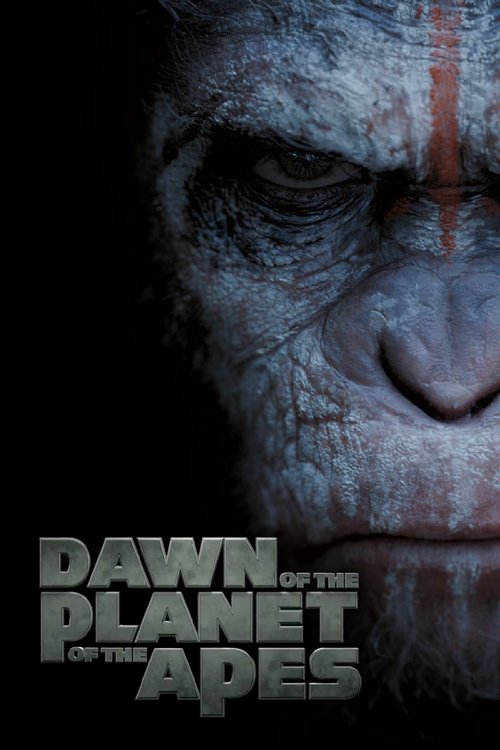
Dawn of the Planet of the Apes
2014 · Matt Reeves
When you want a blockbuster that takes itself seriously and leaves you something to chew on — heavy, gripping, closer to tragedy than popcorn. Not the pick for a light night.
What it's about
A decade after a plague gutted humanity, Caesar leads a thriving society of intelligent apes in the forests above a ruined San Francisco — until human survivors arrive needing access to a dam in ape territory. Caesar and a decent human named Malcolm try to build a fragile peace while hardliners on both sides, nursing fear and old wounds, pull toward war. It follows two leaders discovering how little control they have over their own people's worst instincts.
The experience
Somber, tense, and surprisingly mournful for a summer blockbuster — less a thrill ride than a slow-burn political tragedy where you can see the catastrophe coming and can't look away. When the violence arrives, it lands with real weight.
Performances
Andy Serkis's motion-capture Caesar is a landmark — a fully realized dramatic lead performance delivered through a digital ape, matched by Toby Kebbell's frightening, wounded Koba.
The craft
The performance-capture effects remain some of the best ever put on screen; rain-soaked fur, flickering eyes, apes on horseback — it all simply looks real. Matt Reeves directs with patience and long takes rare in franchise filmmaking, and the film's murky forest light and thunderous set pieces reward a big screen and good sound.
Why it matters
It raised the bar for what motion-capture acting and effects could carry emotionally, fueled the ongoing debate about awards recognition for digital performances, and established Matt Reeves as a premier blockbuster director.
Snapshot
Dawn of the Planet of the Apes is the second installment of 20th Century Fox's rebooted Apes franchise, following Rupert Wyatt's Rise of the Planet of the Apes (2011) and preceding Matt Reeves's own War for the Planet of the Apes (2017). Set roughly a decade after the events of Rise, it unfolds in a Northern California depopulated by the "Simian Flu," where Caesar's community of intelligent apes has built a forest society in the hills above San Francisco and a band of human survivors seeks access to a hydroelectric dam in ape territory. The film is notable less as spectacle than as a sober political tragedy in blockbuster form: a study of two leaders, Caesar and the human Malcolm, straining to hold fragile peace against the fear and grievance of their own factions. It stands as one of the more critically respected studio tentpoles of its era and as the film that established Reeves as the franchise's guiding voice.
Industry & production
The film was produced by Chernin Entertainment (Peter Chernin and Dylan Clark) for 20th Century Fox, capitalizing on the unexpected critical and commercial strength of Rise, which had rehabilitated a property dormant since Tim Burton's disowned 2001 remake. Rupert Wyatt initially planned to return but departed over scheduling and the studio's release timetable; Matt Reeves, coming off Cloverfield (2008) and the American remake Let Me In (2010), was hired to direct. The screenplay is credited to Mark Bomback and to Rick Jaffa and Amanda Silver, the writing team behind Rise.
Production drew on Vancouver and New Orleans locations, with substantial forest and exterior shooting that was central to the film's technical ambitions (see Technology). As a major franchise entry it carried a large budget in the range typical of Fox tentpoles of the period, and it performed strongly at the box office — a substantial worldwide success that outgrossed its predecessor and secured the trilogy's completion. (I am avoiding precise grosses here to prevent misstatement; the broad outcome — a hit that greenlit War — is well established.) The film was released theatrically in 3D, with the stereoscopic presentation produced in post; it should be treated as a converted rather than natively-captured 3D image.
Technology
Dawn is a landmark in performance-capture visual effects, executed by Weta Digital under senior visual effects supervisor Joe Letteri. Its defining technical achievement was taking performance capture out of the controlled studio "volume" and onto real exterior locations — capturing actors in forests, in rain, and in low light rather than on a blank stage. This required advances in capturing marker data outdoors amid uncontrolled lighting and environmental interference, and it allowed the ape performers to interact directly with practical environments and with live-action human actors on set rather than being composited in afterward. The result is a marked gain in physical and emotional continuity between the two casts.
Weta's work also advanced the rendering of fur, skin, musculature, and — most consequentially — the eyes and micro-expressions that carry the apes' largely non-verbal performances. Because much of the film's drama is legible only in faces, the fidelity of facial capture and its translation onto anatomically distinct ape physiognomy was the load-bearing technology of the production. The picture's craft reputation rests heavily on the near-invisibility of this pipeline: the apes read as characters, not effects.
Technique
Cinematography
Cinematography is by Michael Seresin, a veteran whose credits include Midnight Express, Birdy, Angel Heart, and Harry Potter and the Prisoner of Azkaban, and whose signature is low-key, naturalistic, source-motivated lighting. Seresin's approach gives Dawn an unusually muted, weathered palette for a summer blockbuster: overcast forests, firelit ape encampments, rain, and the grimy interiors of a decaying city. The imagery favors available-feeling light and desaturated greens and grays over the burnished gloss typical of the form. This naturalism is doing thematic work — it grounds the fantastical apes in a tactile, degraded world and lends the film the texture of a survival drama rather than an effects showcase. The camera is frequently mobile and handheld among the apes, adopting their vantage; one widely-noted sequence mounts the camera on a rotating tank turret in the climactic assault, holding a continuous 360-degree pan through the chaos.
Editing
The film was edited by William Hoy and Stan Salfas. The cutting is comparatively patient for the genre, granting long stretches to near-wordless ape scenes and to the slow accretion of mistrust between the two communities. Action is staged for legibility rather than fragmentation; the editing tends to preserve spatial geography — who is where, and which faction holds what ground — which is essential to a plot driven by territory, sightlines, and betrayal.
Mise-en-scène / staging
Reeves and his designers build two contrasting societies as physical spaces: the vertical, organic, timber-and-firelight world of the ape settlement in the redwoods, and the horizontal, ruined-industrial human enclave in the city. The film opens with an extended, dialogue-free ape hunt that establishes the community's cohesion and hierarchy entirely through staging and gesture. Staging repeatedly rhymes the two camps — meetings, councils, domestic scenes — so that the audience reads them as mirror images heading toward the same failure.
Sound
The score is by Michael Giacchino (not by Rise composer Patrick Doyle). Giacchino builds an identity around percussive, tribal textures and a recurring Caesar theme, deploying the orchestra sparingly against long passages carried by ambience — rain, forest, the breathing and vocalizations of the apes. Sound design is crucial to the film's central conceit: the apes' gradual acquisition of spoken language is dramatized acoustically, from grunts and signed exchanges to Caesar's halting, hard-won speech, so that a spoken word lands as an event.
Performance
The performances are the film's foundation. Andy Serkis returns as Caesar in a role that anchors the trilogy and became a touchstone in the long argument over whether performance capture constitutes acting; his Caesar is a leader aging into gravity, weariness, and moral compromise. Toby Kebbell plays Koba, the scarred, human-tortured bonobo whose grievance curdles into insurrection — a genuine tragic antagonist rather than a villain. Karin Konoval (Maurice, the orangutan) and Nick Thurston (Blue Eyes, Caesar's son) round out the ape ensemble. The human cast — Jason Clarke as Malcolm, Keri Russell as Ellie, Kodi Smit-McPhee as Alexander, and Gary Oldman as the fearful, grief-driven leader Dreyfus — is deliberately kept in a supporting register; the film's emotional center of gravity is with the apes.
Narrative & dramatic mode
The film's dramatic mode is political tragedy structured around parallel leadership. Its architecture is essentially that of a peace that cannot hold: two reasonable men, Caesar and Malcolm, establish trust, while the extremists in each camp — Koba among the apes, Dreyfus's militia among the humans — drive events toward war through fear and a single act of provocation. The tragedy is engineered so that catastrophe flows not from a scheming villain alone but from the internal logic of frightened communities; Koba's betrayal is motivated, comprehensible, and rooted in real trauma. The narrative withholds easy moral asymmetry: the humans are not monsters and the apes are not saints, and Caesar's hardest lesson — "ape not kill ape" proven false — is the film's thesis about the universality of violence. This is a rare blockbuster whose climax is also a moral defeat, ending not in triumph but in the inevitability of the coming war.
Genre & cycle
Dawn sits at the intersection of science fiction, the post-apocalyptic survival drama, and the war film, with a strong undertow of the Western — the frontier standoff over land and water, the fragile treaty, the fort under siege. Within the Apes franchise it belongs to the rebooted continuity begun in 2011, a self-consciously serious reboot cycle distinct from the 1968–1973 original series and Burton's remake. It also participates in the 2010s wave of ambitious, effects-forward but tonally somber studio science fiction, and in the broader post-apocalyptic cycle that ran through the era's film and prestige television.
Authorship & method
Dawn is the film in which Matt Reeves found the register — restrained, character-first, tonally grave — that would define his subsequent work through War for the Planet of the Apes and The Batman (2022). Reeves's method here is to subordinate spectacle to performance and to treat the apes as full dramatic subjects, shooting their scenes with the patience of a chamber drama. His key collaborators shape that method concretely: cinematographer Michael Seresin, whose naturalistic lighting refuses blockbuster gloss; composer Michael Giacchino, whose percussive, motif-driven score gives the apes a sonic identity; editors William Hoy and Stan Salfas, whose legible, unhurried cutting preserves the film's moral and spatial clarity; and writers Mark Bomback, Rick Jaffa, and Amanda Silver, who built the two-leader tragic structure. Behind all of it is the Weta Digital team led by Joe Letteri and the performances of Andy Serkis and Toby Kebbell, without whom the authorial project — a drama in which the protagonists are digital apes — would not be legible.
Movement / national cinema
The film is a product of the American studio system, made for a Hollywood major, and does not belong to a national art-cinema movement. Its most meaningful "movement" affiliation is industrial and technological: it is a flagship of the New Zealand–centered Weta Digital effects tradition that ran from The Lord of the Rings through King Kong and Avatar, and of the performance-capture lineage most associated with Serkis. In that sense it is transnationally made — American authorship and financing, New Zealand visual-effects craft — in the manner typical of the era's globalized blockbuster production.
Era / period
Dawn is characteristic of mid-2010s Hollywood: a period defined by franchise consolidation, the maturation of digital performance capture, and a market in which even effects-driven tentpoles competed on the perceived seriousness lately associated with prestige television. Its comparatively adult tone, its willingness to end on defeat, and its investment in non-human interiority reflect a moment when studios briefly courted critical legitimacy for their largest properties. It also reflects the period's anxieties — pandemic, societal collapse, tribal breakdown — refracted through genre.
Themes
The film's governing theme is the cyclicality and universality of violence: the discovery, devastating to Caesar, that apes are no more immune to fear, vengeance, and slaughter than humans. Around this cluster several others. Leadership and its burdens: both Caesar and Malcolm are studies in the cost of trying to govern frightened people against their instincts. Fear as the engine of atrocity, embodied by Koba and Dreyfus, each acting from real wounds. Family and inheritance: Caesar's relationships with his sons and the question of what he passes on. The mirror between the two societies, which the film's staging insists are the same story. And, running beneath, trauma — Koba's scarred body as the literal inscription of human cruelty that returns as ape-on-ape war. The film treats "civilization" not as a fixed human achievement but as a fragile discipline against a shared nature.
Reception, canon & influence
Critically, Dawn was among the best-received studio blockbusters of its year, widely praised for its emotional seriousness, its visual effects, and above all the performances of Serkis and Kebbell — with Serkis's Caesar frequently cited in the recurring debate over recognition for performance-capture acting, which the film's advocates argued should be eligible for major acting awards. Its craft reputation rests on the seamlessness of Weta's outdoor performance capture.
Looking backward, the film draws on multiple lineages. Most directly it inherits the original Planet of the Apes series, especially the early-1970s Conquest and Battle installments that first dramatized an ape uprising and the founding of ape society and the Caesar figure. Its tragic architecture of doomed peace and the leader betrayed from within carries a Shakespearean charge — the political tragedy of leadership, loyalty, and usurpation — and its frontier standoff over territory and water is deeply indebted to the Western. Its patient, naturalistic post-apocalyptic texture aligns it with a broader tradition of somber survival cinema. Specific director-cited touchstones should be treated cautiously; where the interview record is thin, I have not attributed influences Reeves may not have named.
Looking forward, Dawn shaped its own franchise most of all: it cemented Reeves's authorship, set the trilogy's grave tone, and led directly to War for the Planet of the Apes and the later Kingdom of the Planet of the Apes (2024). More broadly it strengthened the industry's confidence that fully digital, motion-captured characters could headline a drama and carry its emotional weight — an argument advanced by Avatar and by Serkis's earlier work and consolidated here. Its central case — that a summer tentpole could be a morally serious tragedy told largely from a non-human point of view — remains one of the more persuasive proofs of that possibility in modern studio filmmaking.
A Deleuzian reading
The film opens on a hunt, and for a long time nobody speaks.
The full Deleuzian reading of Dawn of the Planet of the Apes →
Reception
Acclaimed on arrival in 2014 as that rarest thing — a sequel better than the original — and it's only climbed since, now routinely cited as proof that a mega-budget franchise film can be genuinely great, with the Caesar trilogy canonized as one of the century's best blockbuster runs.
How Dawn of the Planet of the Apes was received, from release to now →
How to watch Dawn of the Planet of the Apes: what to notice on a first viewing
- Watch the apes hunt without speaking for several minutes. Reeves establishes the whole ape society through posture, signs, and formation, never dialogue. You read hierarchy and discipline off how bodies stand and move together. The film proves you can build a whole society on screen through bodies alone, before a single word is spoken.
- Notice the muted grays and greens, firelight instead of gloss. Seresin lights the forest with overcast, source-motivated light and the human ruins with grimy, desaturated color, never the burnished sheen typical of blockbusters. The unglamorous light makes the apes feel like they belong in a real, weathered world rather than an effects showcase.
- Listen for how the apes' speech arrives: grunts, signs, then words. Giacchino's sound design tracks the apes' acquisition of language across the film, so that Caesar's halting spoken words land as rare, hard-won events. Language here is not given; it is earned onscreen, which is why one word can carry the weight of a whole scene.
- Notice how ape councils and human meetings are staged the same way. Reeves repeatedly rhymes the two camps' gatherings, arguments, and domestic scenes, so the same failure plays out twice without either side seeing it in the other. You are given a vantage neither community has: the sight of two peoples making the identical mistake.
- Track how often the camera moves and crouches among the apes. Reeves keeps the camera handheld and mobile in ape scenes, at their height and pace, rather than shooting them like effects on display. The camera adopts the apes' vantage, asking you to see the world at their scale, not ours.
The whole guide to watching Dawn of the Planet of the Apes, with the keys for a rewatch →
Influences: the films it descends from and the films it influenced
- Planet of the Apes (1968) — John Chambers's foam-latex ape makeup and the mime-trained physical ape performance it demanded establish the actor-embodies-ape convention that Weta's performance capture digitally supersedes.
- Conquest of the Planet of the Apes (1972) — Originates the ape-uprising plot and the Caesar figure who leads it, giving Dawn its founding-of-ape-society narrative spine.
- Battle for the Planet of the Apes (1973) — Dramatizes a fragile ape-human peace shattered by an internal coup (Aldo), the leader-betrayed-from-within two-society tragic structure Dawn rebuilds around Caesar and Koba.
- The Lord of the Rings: The Two Towers (2002) — Serkis and Letteri's Weta team establish the emotive, fully-CG performance-captured character (Gollum) as acted rather than animated — the method Caesar directly extends.
- King Kong (2005) — Serkis performance-captures a sympathetic great ape while Weta refines primate facial musculature and locomotion simulation, the technical rehearsal for Caesar.
- Avatar (2009) — Pioneers head-rig facial capture and mounts the feature-length argument that motion-captured digital non-humans can headline a film and carry its dramatic emotion.
- Rise of the Planet of the Apes (2011) — Immediate predecessor that establishes Caesar as a mocap protagonist and moves capture partway onto location; Dawn completes the leap to full outdoor performance capture.
- Children of Men (2006) — Naturalistic source lighting and handheld, geography-preserving long-take camerawork that keeps spatial relations legible through chaos — the visual grammar Seresin and Reeves adopt.
- Cloverfield (2008) — Reeves's own experiment in mobile, ground-level handheld immersion and creature-adjacent POV feeds Dawn's roving camera and the 360-degree tank-turret pan.
- Let Me In (2010) — The restrained, character-first chamber-drama register — spectacle subordinated to performance — that Reeves carries directly into Dawn.
- The Searchers (1956) — The Western frontier standoff between two societies over contested land and the moral geography of the border-crossing incursion, transposed onto Dawn's ape-human territorial conflict.
- War for the Planet of the Apes (2017) — Direct sequel that pushes outdoor performance capture into snow and extends the mocap tragedy to a near-silent, ape-POV hero's journey.
- The Jungle Book (2016) — Builds a live-action drama around photoreal, fully-digital talking animals, banking on Dawn's proof that CG creatures can sustain emotional and dramatic weight.
- Alita: Battle Angel (2019) — Weta pushes facial-mocap fidelity — eyes, skin subsurface, micro-expression — further to carry a digital human lead, extending the facial-capture standard Dawn set.
- Avengers: Infinity War (2018) — Josh Brolin's facial-captured Thanos anchors the film as a dramatically legible antagonist-protagonist, the mocap-character-as-lead argument Dawn consolidated.
- Kingdom of the Planet of the Apes (2024) — Continues the trilogy's outdoor performance capture and ape-point-of-view storytelling several generations on, inheriting Dawn's craft template wholesale.
- Hope (2026) — Moved performance capture onto muddy daylight exteriors for a species with its own signed and spoken system, so the creature reads as a language-user with a culture — the technical and ethical precondition for Hope's reversal into the non-human perspective.
- The Batman (2022) — Reeves extends the grave tonal register and naturalistic, gloss-refusing source lighting he found on Dawn into a live-action tentpole.
Similar films
- War for the Planet of the Apes (2017) — influence & lineage · same viewing thread
- Kingdom of the Planet of the Apes (2024) — influence & lineage · same viewing thread
- Planet of the Apes (1968) — influence & lineage · same viewing thread
- Rise of the Planet of the Apes (2011) — influence & lineage
- King Kong (2005) — influence & lineage
- Cloverfield (2008) — influence & lineage
- Star Wars: The Force Awakens (2015) — same viewing thread
- Dune: Part Two (2024) — same viewing thread
All the films related to Dawn of the Planet of the Apes →
Watch it with: curated runs of related films
- The Blockbuster Sci-Fi Canon — A run of the effects-driven epics that taught modern audiences what a movie could feel like — from the desert planets of Star Wars to the rain of Blade Runner and the sands of Arrakis.