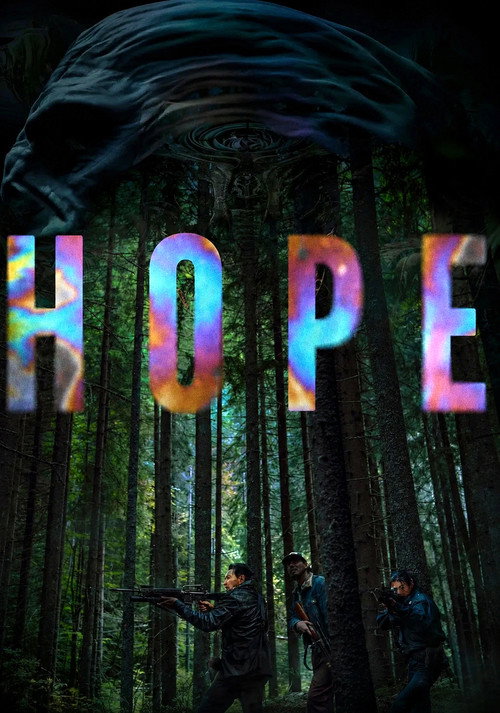
Hope
2026 · Na Hong-jin
When you want to be swallowed by a big, strange, ambitious epic — a challenge, not a comfort watch, for viewers who like their genre films to spiral out of control on purpose.
What it's about
In Hope Harbor, a remote fishing village at the southern tip of Korea, police chief Bum-seok and rookie officer Sung-ae are called out to investigate a creature attacking the community, while a local hunting party heads into the hills after it. Nothing about the situation is what it first appears, and every human misreading makes things worse — small-town ignorance and fear escalating step by step toward something of cosmic scale.
The experience
Starts as a tense village procedural and keeps enlarging until it's overwhelming — dread, dark absurdity, and spectacle stacked on each other. It's a long, engulfing watch that leaves you shaken and arguing about what it meant.
Performances
Hwang Jung-min brings his bruising, lived-in intensity to the village police chief, with Jung Ho-yeon as the rookie beside him; Michael Fassbender and Alicia Vikander perform the creatures in motion capture — an extraordinary piece of casting.
The craft
Na Hong-jin builds dread through escalation — investigation, hunt, wildfire cutting the village off — and mounts it at genuine blockbuster scale, with motion-capture creatures that are characters rather than monsters. It's made for the biggest screen and loudest sound system you can find.
Why it matters
Na Hong-jin's first film in the decade since The Wailing, one of the most anticipated returns in Korean cinema — a director known for genre puzzle boxes going for cosmic scale.
Snapshot
A creature arrives in a fishing village at the southern edge of the Korean peninsula, and the men with guns go to look at it. Hope — Na Hong-jin's fourth feature and his first in ten years — takes the structure that made The Wailing (2016) a puzzle box and enlarges it until it will not fit inside a human frame of reference. Ko Bum-seok (Hwang Jung-min), who runs the one-room police substation at Hope Harbor, and Im Sung-ae (Jung Ho-yeon), the rookie posted to him, investigate an attack; a hunting party led by the villager Sung-ki (Zo In-sung) goes into the hills; wildfire severs communication with the outside; and what the film eventually discloses is that the thing being hunted is a parent looking for its young. The creatures are extraterrestrial, organised, grieving, and played in motion capture by Michael Fassbender, Alicia Vikander, Taylor Russell and Cameron Britton. The synopsis's own formulation — ignorance plants the seed of disaster, escalating "into a tragedy of cosmic proportions" — is close to a précis of Na's whole career, transposed from the village to the galaxy.
It premiered in Competition at Cannes on 17 May 2026 at 160 minutes, opened in Korea on 15 July at 156 minutes after a re-edit, and reached the United States through Neon on 9 September. It was made for a reported $46m, the most expensive Korean production to that point, and it did not recoup domestically. It is the rare film that is simultaneously a national industrial event, a divisive object, and a genuinely strange piece of authorship.
Industry & production
Hope is a Forged Films production presented by Plus M Entertainment, with the Korean visual-effects house Westworld — founded in 2018 — attached as a co-producing entity rather than a straightforward vendor; Na produced alongside Kim Sae-mi and Kim Sae-rom. That configuration matters. A mid-scale industry cannot buy a full-length creature film at Hollywood rates, and folding the effects supplier into the production's own risk is one of the few ways to afford the shot count. The exact terms of that arrangement are not on the public record.
Reported budget figures vary between roughly ₩50bn and ₩60bn in the Korean trade press, converging on about $46m — modest by American tentpole standards, unprecedented in Korea. The financing was de-risked by international pre-sales after Cannes: Neon for the United States, Mubi across several European territories, Focus Features in France, Benelux and South Africa, and Sony Pictures Worldwide Acquisitions in Portugal, Scandinavia, the Middle East and Israel. Break-even in the domestic market was estimated at six to six-and-a-half million admissions, lowered somewhat by those foreign sales.
Domestically the film opened enormously and then cooled. It took roughly 330,000 admissions on its first day — the best opening of the Korean year — and about 1.5 million over its first weekend for a market share near 66%. It crossed four million admissions but stalled short of five, finishing with about $31m in Korea and $41.6m worldwide against the $46m negative cost. Korean coverage attributed the fade to an unusually polarised word of mouth: viewers who had bought a ticket to a monster movie found a film with an unaccommodating narrative, a dense invented cosmology, and an ending that withholds resolution. The release was further complicated in its third week by a private-life controversy involving Hwang Jung-min, which his side characterised as stalking and which entered legal proceedings; the actor continued with scheduled theatre appearances. Whether and how much that affected the run is not measurable from the available record.
Principal photography took place in 2023, in Haenam County at the peninsula's southwestern tip — Bukpyeong-myeon and Namchang — and in Romania's Retezat Mountains and national park. Vikander's and Russell's performance-capture block ran later, completing by July 2024, which gives a sense of how long the creature work remained live. One widely repeated production claim should be set aside: that Alfonso Cuarón was an early collaborator on the project. Na has publicly called this false and complained that it persists in reference sources. The verifiable origin is his own: an image that came to him in 2017 or 2018 while he was eating in a restaurant, developed across most of a decade before the money arrived.
Technology
The technical proposition of Hope is stated in a single production decision: the aliens appear in daylight. "In deciding whether these aliens appear during the day or at night," Na has said, "I decided that, even if it makes it more difficult, I should maximize the locations we're shooting in." Full-body digital creatures in direct sun, staged in real landscape, deny an effects team every traditional concealment — darkness, rain, smoke, rapid cutting, shallow focus. Na compounded the difficulty by shooting wide, so that creature and human occupy the same frame at the same time rather than trading closeups. That is the hardest version of the assignment, and the reviews that complained about the effects were, in effect, complaining about a choice made in the director's favour of legibility.
The performance pipeline began with the actors' faces: Fassbender, Vikander, Russell and Britton were scanned, their features forming the substrate of creatures who are deliberately not recognisable as them. Na's stated design principle is anti-iconic — "the intention behind the look of the alien is to not look too obviously alien" — with the designs evolving as the plot discloses the creatures' hierarchy and motive, and shaped to be viable in action choreography.
The most linguistically ambitious element is also the least visible. Na had an extraterrestrial language built with scholars at Seoul National University, drawn from prehistoric models; he has described it as resembling Old Mongolian and as "extremely poetic." The language was written first and the casting followed it — the Western performers were chosen partly because their native pronunciation suited its phonology. This is a rarer order of operations than it sounds, and it inverts the usual relation between star and role.
Two further technological facts belong to the film's release rather than its making. Korea released it in IMAX format, an unusual scale of exhibition commitment for a Korean-language original. And the Cannes print carried incomplete effects: Na has confirmed that version was "a halfway mark until the final release version," and the creature animation around the 50-to-60-minute mark was among the things finished afterwards. The capture format itself — cameras, lenses, aspect ratio — is not something I can confirm.
Technique
Cinematography
Hong Kyung-pyo shot The Wailing for Na, and before and after it Mother, Snowpiercer, Burning and Parasite; he is the connective tissue of three decades of ambitious Korean cinema. The work here has been the most consistently praised element of the film across otherwise divided notices. The signature is a gliding, unbroken camera moving through chaos with a composure that several critics read as ironic — Roger Ebert's notice described tracking shots whose execution is hard to reconstruct, and Brian Eggert at Deep Focus Review compared the vehicular sequences to The French Connection and To Live and Die in L.A. The wide-angle scheme that keeps humans and creatures co-present also produces the film's most discussed image: a digital closeup of an alien in distress, weeping, held long enough that Bum-seok — and the audience — must decide what they are looking at.
Editing
Kim Sun-min cut the film, and Hope is one of the clearer recent cases of editing as public process. Between the 160-minute Cannes version and the 156-minute release, two sequences were reorganised and trimmed, the transport of a creature's corpse before the notorious chainsaw autopsy was abbreviated, and the balance among concurrent threads was redistributed — Yang-bae, the village taxidermist, gained screen time and Sung-ae lost some. Na has said the heaviest revision was not in picture at all but in sound. Four minutes is a trivial cut; that it measurably improved the film's flow suggests the problem was never length but the ordering of information.
Mise-en-scène / staging
Na's staging grammar is the provincial procedural: a substation with one desk, a village hall, a hillside, a road. Into that he introduces the resources of the Western — a hunting party, horseback riding through forest, a rifle as the instrument of both competence and catastrophe. The Rotten Tomatoes critical consensus singled out "awe-inspiring production design," and the geography does real dramatic work: fire cutting the village off converts a national emergency into a local one, which is the same manoeuvre The Wailing performed with a rural parish. Na has also been explicit that dark humour is load-bearing rather than decorative — a way of conveying "humanity's primitive nature" without solemnity. The autopsy-with-a-chainsaw sequence is the limit case: slapstick, horror, and an anatomy lesson in the same scene.
Sound
Given that Na identified sound as where he did the most post-Cannes work, it is the film's least-reviewed major achievement. Michael Abels composed the score — the American composer of Jordan Peele's Get Out, Us and Nope, which is a pointed hire: Peele's films are precisely the recent body of work in which genre spectacle carries a thesis about who is permitted to be misunderstood. The invented language functions as sound design as much as dialogue, since for most of the film it is heard as noise before it is understood as speech; the film's central reversal is in part an acoustic one.
Performance
Hwang Jung-min plays Bum-seok as a small-authority man whose devotion to his village is, in Eggert's phrase, "shaky, almost comical" — a register Hwang has commanded for two decades, from New World to Veteran. Zo In-sung's hunter and Eum Moon-suk's Yang-bae supply the film's local knowledge and much of its comedy; Lee Sang-hee appears as a retired colonel and Im Hyun-sik as a village elder. Jung Ho-yeon, cast largely on the global visibility of Squid Game, drew the most divided response in Korea, where her profane, hard-charging rookie was read by some as tonally adrift from the ensemble and by others as the film's deliberate outsider. On the other side of the ledger, the four Western actors deliver performances no viewer can identify as theirs — Vikander as the empress J'aur, Fassbender as the warrior Ma'veyyo, Russell as Ai'dovor, Britton as the first creature to reach the town. Vikander has said she sought Na out after encountering The Chaser, The Yellow Sea and The Wailing at Busan; Fassbender has praised the unpredictability of Na's genre logic against Western convention.
Narrative & dramatic mode
The architecture is three movements and two betrayals of expectation. The first hour withholds the creature in the manner of Jaws, and plays as a rural procedural with Western and 1950s B-picture inflections — the comparison to Tremors recurs in the reviews. The middle stretch is sustained action: shootouts, a celebrated car chase, physical comedy. The last movement turns the film inside out by granting the creatures interiority, language, politics and grief — at which point the audience is asked to recognise that it has spent two hours watching a family be exterminated by frightened men.
That the third act divided critics is not incidental; it is the design working as intended and paying the price. Na's dramatic mode has always been retrospective revelation: The Wailing is a film whose meaning exists only after its final ten minutes, and Hope extends the method past the point where a mystery can be re-read into one where a moral position must be. The cost, fairly identified by several critics, is that the film's late exposition explains the cosmology while leaving the human story unfinished — a choice Na has since framed as deliberate, telling interviewers that the sequel begins where "the human part of [the story] ends."
Genre & cycle
Three cycles converge. The first is the Korean creature film, whose modern charter is Bong Joon-ho's The Host (2006) — a monster produced by foreign contamination, a family of incompetents, and a state that arrives to make everything worse. The lineage runs through Sector 7 (2011), Monstrum (2018) and Choi Dong-hoon's Alienoid duology (2022–24), the last of which is the closest domestic precedent for big-budget Korean science fiction and, like Hope, met an audience that had not been prepared for its structural difficulty.
The second is the first-contact-as-mistranslation film: Close Encounters of the Third Kind inverted, District 9 (2009) for the dehumanising apparatus, Arrival (2016) for language as the whole of the drama. Hope sits with these in treating communication as the film's real subject and violence as what fills the vacuum where communication fails.
The third is native: the Korean rural procedural of official incompetence, of which Memories of Murder (2003) is the founding text. Bum-seok's substation is directly descended from that film's provincial police, and from Na's own Jong-gu in The Wailing. What Na adds is scale — the arena is no longer a county but, as the synopsis has it, the cosmos.
Authorship & method
Na Hong-jin has made four features in eighteen years: The Chaser (2008), The Yellow Sea (2010), The Wailing (2016) and Hope. All four have screened at Cannes; Hope is the first in the main Competition, where it competed for the Palme d'Or. The through-line is not genre but epistemology. His protagonists act on incomplete information and their action is the catastrophe: a pimp chasing a killer, a taxi driver crossing a border, a policeman choosing which of two supernatural agents to believe. His method is to withhold the frame of reference until the damage is done.
He has described the continuity himself, and it is the most useful single statement about the film: "After The Wailing, I wanted to try viewing this phenomena from a perspective I haven't been used to before. I decided on a cosmic perspective." He has also named the political weather in which he wrote — a period when, as he put it, Korea felt as if it could be on the brink of war, with the war in Ukraine and domestic immigration disputes shaping the material's relevance.
The collaborators are the argument's instruments. Hong Kyung-pyo supplies the compositional principle — everything in one frame, in daylight, no hiding. Kim Sun-min's cut sequences the disclosures. Abels's score imports the idiom of American social-allegory horror. The Seoul National University linguists supply the film's ethical premise as a technical artefact: a language exists, therefore a culture exists, therefore what the villagers did was not pest control. Na wrote the screenplay alone.
Movement / national cinema
Hope belongs to the mature phase of the Korean genre renaissance that began with the industry's late-1990s liberalisation and reached global authority with Parasite. Na is of that cohort's second rank by output and first by intensity, adjacent to Bong Joon-ho, Park Chan-wook, Kim Jee-woon and Yeon Sang-ho — filmmakers who treat genre as a serious vehicle and tonal instability as a legitimate register rather than a defect.
What makes Hope nationally specific beyond its setting is its politics of scale. Korean cinema returns obsessively to the small unit abandoned by the large one: the village, the family, the precinct, cut off while institutions fail elsewhere. Na literalises it with a wildfire that severs the harbour's communications, then supplies the ultimate large institution — an interstellar polity with an empress — which is no more capable of understanding what happened than the fishermen were. His remark about the language's resemblance to Old Mongolian points at something else in the film's imagination: a deep-historical, continental sense of peoples looking at the same sky, which is a more Northeast Asian frame for first contact than the Anglo-American tradition of invasion.
Era / period
The film arrives at a precarious moment for Korean exhibition. Post-pandemic admissions have not recovered to their 2019 peak, streaming has absorbed the mid-budget middle, and investors have grown reluctant to fund expensive originals without established IP. Into that market Na delivered a $46m non-franchise science-fiction film in a national language, given an IMAX rollout — the most exposed possible bet. That it opened to the year's best numbers and then failed to reach break-even domestically is the period's characteristic outcome: Korean audiences will show up for an event, and will not stay for one that refuses to behave. Internationally, the picture belongs to the small class of original spectacle films sustained by specialist distributors — Neon, Mubi, Focus — whose business is now partly to import the risk that studios no longer take.
Themes
The governing theme is the moral cost of ignorance, which Na has pursued since The Chaser and here raises to a species-level charge. The villagers are not villains; they are frightened, armed, and deprived of information, and the film's structure ensures the audience shares their error before being made to account for it.
From that follow three readings, of which the film licenses all and confirms none. The first is xenophobia and the machinery of dehumanisation — critics including Eggert have asked whether the creatures stand for migrants, and noted pointedly that the humans never attempt peaceful contact even after recognising the aliens' intelligence. The second is the asymmetry of power between a small community and an incomprehensible external force, a durable Korean subject with obvious historical referents; Eggert also raised American influence on Korea as a possible frame. The third, and the one Na's own statements support most directly, is the cosmic-indifference reading: seen from far enough away, human moral self-regard is a local error, and what looks like heroism is a hunting accident. The Ebert review's formulation — that the film destroys the hero narrative — is the cleanest summary of what the last act does.
Running beneath all three is grief. The creatures are searching for their offspring. The film's title is the name of a harbour.
Reception, canon & influence
Cannes received it loudly and divisively: a long standing ovation, specific enthusiasm for the car chase, and a Korean press framing that captured the split exactly — "insane movie" against "worst CG." The aggregate settled favourable but qualified: 80% at Rotten Tomatoes across 127 critics with a 6.9 average, the consensus praising "awe-inspiring production design" while calling the effects "amusingly quaint"; 66 at Metacritic from 36 critics. Nicholas Barber at the BBC gave four stars and called it the year's must-see monster movie; Variety's notice found it overlong; Eggert's 2.5-star review is the most useful dissent, arguing that two superb hours are undone by thirty minutes of exposition and by creature animation that could not carry the weight the staging placed on it. Awards recognition so far has favoured its craft where it is least contested: the Palme d'Or nomination, the Daniel A. Craft Award for Excellence in Action Cinema at the 25th New York Asian Film Festival, and Best Film and Best Director nominations at the 35th Buil Film Awards.
Backward, the influences are legible and unembarrassed: Jaws for concealment, the 1950s creature picture and Tremors for tone, the Western for the hunting party and the horses, The Host and Memories of Murder for the Korean provincial catastrophe, District 9 and Arrival for contact as a failure of translation, and Na's own The Wailing for the structure of belated understanding.
Forward, it is too early for a real assessment, and any claim otherwise would be invention. Three things can be said. It demonstrated that a Korean production can execute sustained daylight creature work and Hollywood-grade vehicular action at roughly a fifth of an American blockbuster's cost, with a domestic vendor sharing the risk — a template other Korean producers will study. It also demonstrated the limit: a $46m original that divides its home audience does not recoup at home, and the next such film will be financed with that in mind. And Na has confirmed that a sequel script exists and that he would like to shoot it, beginning where the human story ends. Whether Hope is finally read as an overreaching spectacle or as the most ambitious statement of a career-long argument about ignorance will depend on whether that second film arrives to complete it.
A Deleuzian reading
There is a shot in *Hope* where a creature cries and Na Hong-jin refuses to cut away.
The full Deleuzian reading of Hope →
Reception
Premiered in competition at Cannes in May 2026 to famously split reviews — a few even reached for Michael Bay comparisons — then landed in Korea that July as a debate-fueled event hit, blowing past 2 million admissions in five days. In months it's gone from 'Cannes misfire?' to the film everyone has to have an opinion on.
How Hope was received, from release to now →
Influences: the films it descends from and the films it influenced
- Jaws (1975) — The withheld-monster schedule — an hour of displaced water, severed evidence and reaction shots standing in for the animal — is the structural template Hope adopts before inverting it, paying off the concealment in flat daylight rather than in night-and-ocean cover.
- Them! (1954) — Establishes the procedural-before-creature build in which the monster arrives first as forensic artefact (a cast footprint, a recorded sound) parsed by unqualified local officers, and turns on the discovery that the species has a communicative social order — the exact move Hope's linguists make load-bearing.
- Tremors (1990) — The daylight creature-hunt staged as amateur community problem-solving, with dread and rube comedy held inside the same wide desert frame rather than alternated between scenes — the tonal-mixing licence Na's provincial hunting party runs on.
- The Searchers (1956) — The posse ride: horses and men strung across a horizontal composition against open landscape, the group's geography legible in one unbroken wide, which is how Hope blocks its villagers' mounted pursuit instead of cutting for speed.
- The Host (2006) — Reveals its creature whole, early, in a sunlit master that keeps monster and fleeing civilians in a single continuous frame — the no-hiding compositional dare Hong Kyung-pyo restates in Hope's wide-angle coexistence, alongside Bong's grammar of bureaucratic farce inside a Korean provincial catastrophe.
- Memories of Murder (2003) — The rural procedural whose engine is investigative incompetence rather than deduction, pivoting from pratfall to atrocity within one held take on a paddy-field wide — the provincial-procedural register and tonal turn Hope's police and villagers inherit.
- The Wailing (2016) — Na's own prototype for belated understanding — Hong Kyung-pyo's rain-heavy wides, Hwang Jung-min as the charismatic interpreter whose reading of the phenomenon is the decisive error, and a withholding of the frame of reference until the protagonist's choice has already caused the ruin.
- The Yellow Sea (2010) — Na's vehicular grammar — chases built from blunt weighted collision and real traffic geography, cut long enough to register mass — is the direct precedent for the Cannes-singled-out car sequence in Hope.
- Arrival (2016) — Commissioned a genuine constructed language from academic linguists and made its decipherment the dramatic action, then reordered its own timeline so the first act is revealed to have been misread — both the technical artefact and the retrospective-revelation device Hope borrows via its Seoul National University linguists.
- District 9 (2009) — Proved a non-Hollywood mid-budget vendor could integrate photoreal creatures into handheld documentary-grade daylight plates, and framed first contact as a bureaucratic mistranslation in which the paperwork, not the alien, is the violence.
- Dawn of the Planet of the Apes (2014) — Moved performance capture onto muddy daylight exteriors for a species with its own signed and spoken system, so the creature reads as a language-user with a culture — the technical and ethical precondition for Hope's reversal into the non-human perspective.
- Get Out (2017) — Michael Abels's method — non-English choral voice used as a diegetic-adjacent warning signal over sparse strings — is the scoring idiom he imports into Hope, where invented-language vocalisation crosses the line between score and sound design.
- Godzilla Minus One (2023) — Delivered sustained blockbuster-grade creature work through a small in-house domestic VFX team at a fraction of an American budget, establishing the cost-and-vendor template Hope tests at $46m with a Korean vendor sharing the risk.
- Alienoid (2022) — Ran feature-length creature and vehicle effects through a domestic Korean vendor carrying the shot count in-house, the industrial experiment in local VFX capacity that Hope scales up into sustained daylight work.
Similar films
- The Host (2006) — influence & lineage · same viewing thread
- Okja (2017) — influence & lineage · same viewing thread
- The Wailing (2016) — influence & lineage
- Godzilla Minus One (2023) — influence & lineage
- Nope (2022) — influence & lineage
- The Yellow Sea (2010) — influence & lineage
- Memories of Murder (2003) — influence & lineage · same viewing thread
- Train to Busan (2016) — same viewing thread
All the films related to Hope →
Watch it with: curated runs of related films
- New Korean Cinema — Watch these in a run and you feel one national cinema flip between monster movie, revenge thriller, gothic horror, and slow-burn procedural without ever loosening its grip on class, history, and family.