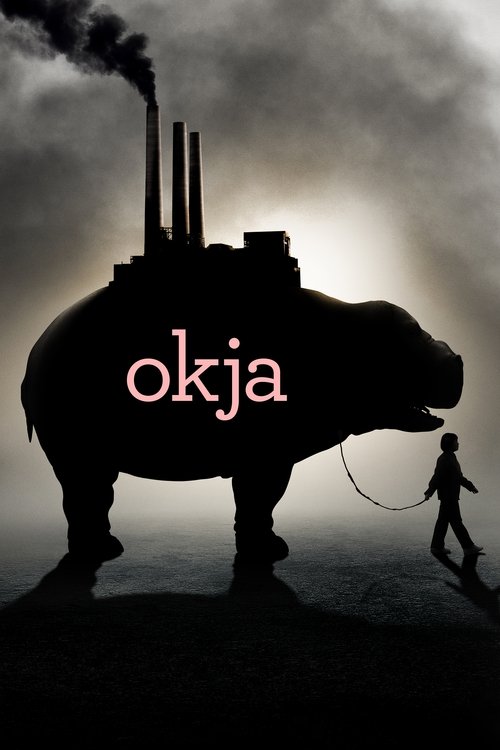
Okja
2017 · Bong Joon Ho
For when you want an adventure with teeth: big-hearted enough to watch with older kids, pointed enough to leave adults chewing on it for days. Not a comfort watch, despite the adorable creature.
What it's about
Mija is a girl in the Korean mountains whose best friend is Okja — an enormous, gentle, genetically engineered super-pig raised on her grandfather's farm. When the multinational corporation that created Okja comes to collect its property for a marketing spectacle in New York, Mija chases her friend across the world, colliding with corporate PR machinery and a band of animal-liberation activists along the way.
The experience
It swings wildly on purpose — from sun-dappled childhood idyll to slapstick chase comedy to scenes of real darkness about where meat comes from — and the whiplash is the point. You'll laugh, then feel guilty for laughing, then maybe skip the burger.
Performances
Ahn Seo-hyun anchors the whole film with fierce, wordless determination, while Tilda Swinton has a ball as a brittle corporate CEO and Jake Gyllenhaal goes gloriously unhinged as a washed-up TV zoologist.
The craft
Bong Joon Ho stages action with total clarity — a chase through an underground shopping mall is a small masterpiece of choreography — and the creature effects make Okja feel heavy, warm, and alive rather than digital. The tonal gear-shifts are handled with a confidence few directors would attempt.
Why it matters
Its Netflix release ignited the 2017 fight over streaming versus theaters at Cannes, and it's credited with turning a real number of viewers vegetarian — a rare film with a measurable effect on dinner plates. It also paved Bong's road to his later global breakthrough.
Snapshot
Okja is Bong Joon Ho's second English-language production and his first film financed and distributed by a streaming platform — a Korean-American hybrid in which a girl from the mountains of Gangwon Province crosses an ocean to retrieve a genetically engineered animal from the agribusiness conglomerate that made her. It is simultaneously a children's animal picture, a corporate satire, a heist thriller, and an abattoir film, and Bong makes no attempt to reconcile those registers. That refusal is the point: the film's tonal shear enacts the gap between how industrial meat is marketed and what it actually is.
Made for a reported budget in the $50 million range, with Netflix granting Bong final cut, Okja became the flashpoint of the 2017 theatrical-window wars — booed at Cannes, boycotted by Korea's three multiplex chains, and directly responsible for a change in Cannes competition rules. It is also, in retrospect, the workshop in which Bong assembled the Korean crew — composer Jung Jae-il, editor Yang Jin-mo, production designer Lee Ha-jun — who would take Parasite to the Palme d'Or two years later.
Industry & production
The production history is inseparable from Bong's previous film. Snowpiercer (2013) had been the subject of a protracted fight with Harvey Weinstein, whose company held North American rights and pushed for substantial cuts; the film eventually received a limited US release in a version closer to Bong's. When Netflix offered roughly $50 million and complete creative control with no notes, the appeal was structural rather than merely financial. Bong has spoken plainly about that trade: he surrendered a guaranteed theatrical rollout in exchange for an unmolested cut.
The film was produced by Plan B Entertainment (Brad Pitt, Dede Gardner, Jeremy Kleiner) alongside Lewis Pictures and Kate Street Picture Company, shooting across South Korea (the Gangwon mountains and a Seoul underground shopping arcade), New York, and Vancouver, which supplied much of the laboratory and slaughterhouse interior work. The crew was genuinely bilingual, and the screenplay — by Bong with the British journalist Jon Ronson, author of Them and So You've Been Publicly Shamed — is roughly half Korean and half English, with translation itself dramatized inside the story.
The distribution consequences arrived fast. Okja premiered in competition at the 70th Cannes Film Festival in May 2017, one of two Netflix titles in the lineup alongside Noah Baumbach's The Meyerowitz Stories. French exhibitors objected on the grounds of the chronologie des médias, the statutory window then requiring a long delay between theatrical release and streaming availability. At the premiere the Netflix logo drew audible booing, and a projection error — the film ran incorrectly masked for the opening minutes — forced a restart, an accident that acquired an unearned symbolic weight in the coverage. Jury president Pedro Almodóvar publicly questioned whether the Palme d'Or should go to a film not committed to cinemas; juror Will Smith argued the opposite. The festival announced shortly afterward that from 2018 all competition titles would require French theatrical distribution, a rule that pushed Netflix's prestige premieres toward Venice, where Roma debuted the following year.
In South Korea the reaction was sharper still. Okja opened day-and-date theatrically and on Netflix on 29 June 2017. Korea's exhibition sector is vertically integrated — CJ CGV, Lotte Cinema, and Megabox each sit alongside distribution arms within larger conglomerates — and all three chains declined to screen a film that collapsed the customary three-week window. It played instead on roughly a hundred independent and art-house screens. Reliable admission figures for that release are harder to cite with confidence than the boycott itself, and Netflix has never published viewership data for the title, so any claim about how many people actually watched Okja is speculation.
Technology
Three technological arguments run through the film, and they are braided.
The first is the creature. Okja is a fully computer-generated animal carried by visual effects supervisor Erik-Jan De Boer, whose work on Life of Pi had established the current benchmark for photoreal CG quadrupeds sharing frames with a young performer. The design — a compaction of hippo, pig, and manatee, roughly elephant-scaled, with small sad eyes and a heavy, shy carriage — deliberately refuses cuteness. Bong has described wanting an introverted animal, one whose personality reads as timid rather than charming, so that affection for her has to be earned rather than solicited. Method Studios handled the bulk of the shot work. The lineage runs back to The Host (2006), where Bong had already demonstrated that a creature's credibility depends less on rendering than on staging and weight.
The second is capture. By most accounts the production shot on ARRI's large-format Alexa 65 — a choice consistent with Netflix's origination requirements for originals at the time, which mandated 4K capture and effectively excluded several then-standard digital packages. That specification, an ordinary line in a delivery contract, is a good example of how platform infrastructure quietly determines the look of platform cinema.
The third is distribution: near-simultaneous availability in every Netflix territory, in 4K with high-dynamic-range and object-based audio, on the same day. Okja is a film whose subject is industrial scale and whose release mechanism was itself an assertion of industrial scale.
Technique
Cinematography
Darius Khondji shot the film, his first collaboration with Bong and a marked departure from the director's regular Korean cinematographers Hong Kyung-pyo and Kim Hyung-koo. Khondji — of Delicatessen, Se7en, Amour, and later Uncut Gems — divides the film chromatically. The Gangwon mountain passages are green, humid, and diffuse, lit as pastoral, with wide lenses that let Okja's mass fill the frame without ever quite fitting in it. The Mirando material is colder, harder, more evenly and artificially lit, its corporate whites and pastels drained of atmosphere. New York arrives as noise and glare.
The signature passage is the early forest descent, where Mija and Okja tumble down a slope in a sustained, camera-with-them movement that establishes the animal's physics before the plot ever asks us to care about her fate. The other is the Seoul underground mall chase — a long, geographically legible action sequence threading a truck, an activist van, a stampeding animal, and civilian crowds through a confined commercial arcade, staged so that the comedy and the danger occupy the same shots.
Editing
Yang Jin-mo cut the film (with Han Mi-yeon), two years before his Oscar-nominated work on Parasite. The editing's chief problem is tonal transit: Okja must move from slapstick to atrocity without a tonal airlock, and the cuts do this abruptly rather than by modulation. The chase is assembled for spatial clarity — you always know where the truck is relative to the van — while the final-act abattoir sequences slow markedly, holding on process and duration where the earlier film had been all velocity. The film's rhythm reverses itself at exactly the moment its subject stops being an adventure.
Mise-en-scène / staging
Production designer Lee Ha-jun — who would go on to build the house in Parasite — draws the film's argument in objects. The grandfather's mountain homestead is a landscape of improvised contraptions, ropes, and pulleys, an agrarian intimacy engineered by hand. Mirando's spaces are branded environments: a pastel identity system, a rebranded factory, a laboratory whose cruelty is administered under good lighting. The corporation's name is one letter and a vowel away from Monsanto, and the design treats greenwashing as a visual grammar rather than a plot point.
The slaughterhouse is staged as infrastructure: corrals, gates, throughput. Several critics noted how directly the imagery of massed animals awaiting processing evokes genocidal iconography; whatever the intent, the film does not soften the resemblance, and it withholds the reassurance that a children's-film framing would normally guarantee.
Sound
Jung Jae-il's score — his first for Bong, and the beginning of a partnership continuing through Parasite, Squid Game, and Mickey 17 — works in a bright, brassy, marching-band register, jaunty to the edge of sardonic, so that the music keeps promising a parade the film keeps failing to deliver. Licensed music is deployed against the grain, John Denver's "Annie's Song" among the more pointed of these choices.
Okja's vocalizations were performed by the actor Lee Jung-eun — later the housekeeper Moon-gwang in Parasite — layered with animal recordings. That a human performer supplies the grunts and cries of a manufactured animal is the film's thesis in miniature.
Performance
Ahn Seo-hyun, a child actor at the time of shooting, anchors the film opposite a creature that did not exist on set beyond eyelines and physical proxies; her Mija is stubborn, unsentimental, and largely unsmiling, a performance built on refusal rather than charm. Tilda Swinton, in her second Bong collaboration after Snowpiercer, plays both Mirando twins — Lucy, the anxious PR-fluent rebrander with her prosthetic teeth and platinum bob, and Nancy, the unembarrassed operator who ends the film — a doubling that presents corporate benevolence and corporate candor as the same organism in different costume.
Paul Dano's Jay leads an Animal Liberation Front rendered with unusual sympathy and unusual scrutiny: doctrinally nonviolent, scrupulous about consent, and then, in the film's most uncomfortable scene, violently punitive when Steven Yeun's K deliberately mistranslates Mija. Jake Gyllenhaal's Dr. Johnny Wilcox — a collapsed television zoologist, pitched at a shriek — was the film's most divided critical question, read by some as a misjudged register and by others as an accurate portrait of a man who has monetized his own nervous breakdown. Byun Hee-bong, a Bong regular since Memories of Murder, plays the compromised grandfather; Choi Woo-shik appears briefly, two years before Parasite.
Narrative & dramatic mode
The structure is a rescue quest that keeps discovering it is a supply-chain document. Bong builds it in four movements: a corporate prologue in New York; an idyll in the mountains; a chase across Seoul and then across the Pacific; and a descent into the processing plant. Each movement changes genre.
The dramatic mode is fundamentally ironic rather than tragic. Mija has no politics — she is not an activist, and Bong has been explicit that the film is not a vegetarian tract. She wants one animal back. The ending honors that literalism with brutal precision: Mija buys Okja's life with the solid-gold pig her grandfather gave her as a consolation, and Nancy Mirando accepts, because a transaction is the only language the system speaks. Mija walks out with her animal past thousands who stay. The coda smuggles a single piglet through a fence. This is the anti-Free Willy ending: rescue is possible, at retail, one unit at a time, and the plant does not stop.
Genre & cycle
Okja sits at the confluence of several traditions. From the child-and-animal picture it takes E.T., Babe, Free Willy, Charlotte's Web, and above all Miyazaki — the forest, the scale contrast, and the creature's dignified silence read directly out of My Neighbor Totoro. From the creature feature it takes King Kong, whose structure it borrows almost formally: a wonder captured in a peripheral landscape, shipped to Manhattan, and paraded before a paying crowd. From the muckraking tradition it takes Upton Sinclair, and from documentary the unblinking process-cinema of Franju's Le Sang des bêtes and Wiseman's Meat.
Within Bong's own filmography the cycle is clear. The Host supplied the template — a CGI creature, a family, a negligent institution, comedy and grief in the same shot. Snowpiercer supplied the English-language allegorical-industrial mode and the Swinton grotesque. Okja fuses them and adds the corporation as protagonist-antagonist, a thread Bong extends through Mickey 17 (2025).
Authorship & method
Bong storyboards his films himself, in near-complete comic form — a habit from his early cartooning — and on a creature picture that discipline becomes a production technology, since the boards function as de facto previsualization for effects work planned long before the shoot. His method also includes physical research: Bong and collaborators visited a working slaughterhouse in Colorado during preparation, and he has said the experience stopped him eating meat for a period afterward. The abattoir sequence's specificity comes from that visit rather than from genre memory.
The collaborator list is the more consequential authorship story. Khondji is the outlier — a one-film partnership that gave Bong a European art-cinema surface for a Netflix blockbuster. But Jung Jae-il, Yang Jin-mo, Lee Ha-jun, and Lee Jung-eun all met Bong on Okja and all carried through to Parasite. Jon Ronson's contribution is visible in the film's satirical ear — the corporate euphemism, the activist self-seriousness, the media-trained sincerity — which is recognizably his journalistic territory.
Movement / national cinema
Okja belongs to the transnational phase of New Korean Cinema. The generation that came up after the 1990s liberalization — Bong, Park Chan-wook, Kim Jee-woon — spent the 2010s testing English-language production, with Park's Stoker and Kim's The Last Stand arriving the same year as Snowpiercer. What distinguishes Okja is that it does not assimilate: it stays half in Korean, keeps its Korean crew, and makes mistranslation a plot mechanism. K's tattooed creed, "translations are sacred," and his parting jab about learning English are jokes that Bong would later reframe seriously as the "one-inch-tall barrier of subtitles" during the Parasite campaign.
The film's collision with Korean exhibition is also nationally specific. Because Korean multiplex chains are corporately entangled with distributors, a streaming release that bypasses the window is not a scheduling inconvenience but a threat to a vertically integrated system. The boycott was structural self-defense.
Era / period
The film arrives at the crest of the streaming wars: Netflix aggressively buying auteur prestige, MoviePass distorting the exhibition economy, and the theatrical window under pressure everywhere — three years before the pandemic dissolved it outright. Politically, the film reaches Korean screens months after the impeachment of Park Geun-hye, whose administration had maintained a cultural blacklist of thousands of artists; Bong was reported among the names on it. A Korean director taking foreign money and full creative control, then premiering at Cannes over the objections of French exhibitors and Korean chains alike, is a very 2017 configuration.
Themes
The central theme is abstraction: the industrial conversion of a creature into a product, and the marketing apparatus that manages the gap. Mirando's crime is not simply cruelty but narrative — the ten-year superpig competition, the folksy branding, the insistence that the animals are "non-GMO," a lie the film treats as more corrosive than the killing.
Around that sit several others. Translation as ethics: every act of mediation in the film — K's lies, Dr. Johnny's television persona, Lucy's rebrand — is a betrayal performed in the space between languages. Activist purity and its failure: the ALF is admirable and insufficient, and Jay's beating of K exposes the gap between a creed and a temperament. Complicity across generations: the grandfather sells Okja, then buys silence with gold. And food as class and character, a Bong constant running from The Host's beer and instant noodles through Snowpiercer's protein blocks to Parasite's ram-don.
The gold pig is the film's sharpest idea. It converts the market's own instrument into the tool of rescue, which is both a victory and a confession — you can negotiate with the system, but you cannot step outside it.
Reception, canon & influence
Critical reception was broadly positive, with the strongest praise for Ahn Seo-hyun, for Swinton's double performance, and for the Seoul chase; the most common reservations concerned tonal management and the pitch of Gyllenhaal's performance. The Cannes reception generated a lengthy ovation and a great deal of coverage that conflated hostility toward Netflix with hostility toward the film. It won no prize; the Palme d'Or that year went to Ruben Östlund's The Square. Because Netflix released no viewership figures, the film's actual audience remains unquantified — a genuinely thin part of the record.
Looking backward, the film's inheritance is legible: Miyazaki's creature-and-child grammar, King Kong's capture-and-parade architecture, the muckraking abattoir tradition, and Bong's own The Host.
Looking forward, its consequences are unusually traceable. Cannes rewrote its competition eligibility rules in direct response, redirecting Netflix's festival strategy to Venice and altering the geography of awards-season prestige for years. Within Bong's career, Okja built the crew that made Parasite and demonstrated that a Korean director could take platform money without surrendering authorship — leverage that shaped what followed. For Steven Yeun it marked the pivot from television toward the auteur cinema of Burning, Minari, and Nope. And it became a durable reference point in animal-ethics discourse, cited in advocacy and classroom contexts far more often than most studio-scale science fiction, precisely because it refuses to let its rescue stand in for a solution.
A Deleuzian reading
A girl and an animal the size of an elephant fall down a mountainside.
The full Deleuzian reading of Okja →
Reception
In 2017 Okja was almost swallowed by the noise around it — booed at Cannes for its Netflix logo and treated as a proxy war over streaming. Post-Parasite, it's been happily reappraised as vintage Bong: the tonal whiplash people once called messy now reads as the point.
How Okja was received, from release to now →
How to watch Okja: what to notice on a first viewing
- Watch the camera roll down the mountain with the girl and animal. Khondji puts the camera in the tumble instead of watching it from safety. By the time the two of them stop rolling you know what Okja weighs, how she dents the ground, how a child can treat that body as terrain. Bong establishes the animal's physics before the plot asks you to care about her, so the feeling rests on weight rather than on cute eyes.
- Watch how Okja carries her head and when she flinches. She is built from hippo, pig and manatee, with small eyes and a shy, heavy walk. Bong wanted a timid animal rather than a charming one. Lee Jung-eun performed her grunts and cries, layered into animal recordings. The timidity is not temperament. She was engineered docile, and she carries her manufacture in the way she moves.
- Look at the color change when the film leaves the mountains. Gangwon is green, humid and diffuse, lit like pasture. Mirando is cold, hard and evenly lit in corporate whites and pastels with no weather in it. New York arrives as glare and noise. Khondji sorts the film into zones by color, so you can feel which system you are inside before anyone explains it.
- Listen for brass band music under scenes that are not celebrations. Jung Jae-il scores the film in a bright, jaunty marching register pitched just to the edge of sardonic. It keeps promising a parade. Licensed songs land against the grain too, John Denver most pointedly. The music is selling you something the images will not deliver, which is the same gap the whole film is about.
- Track where the truck and the activist van are during the chase. Bong stages the Seoul underground arcade so every element stays locatable. Truck, van, running animal, shoppers, all in relation to each other at every moment, with the comedy and the danger sharing the same shots. The clarity is what lets slapstick and real threat sit together without one canceling the other.
The whole guide to watching Okja, with the keys for a rewatch →
Influences: the films it descends from and the films it influenced
- King Kong (1933) — Supplies the three-movement capture-and-parade architecture Okja reuses wholesale — creature seized in its highland habitat, shipped in restraints, then unveiled to a ticketed metropolitan crowd on a proscenium stage before breaking loose into the street.
- Nausicaä of the Valley of the Wind (1984) — The Ohmu establish the grammar Okja's creature design follows: a massive herbivore whose emotional state is legible through eye color and low-frequency vocalization rather than facial expression, staged with a girl running alongside the stampeding body at ground level.
- My Neighbor Totoro (1988) — Bong's scale-contrast staging is Miyazaki's — the child treating the creature's body as terrain (sleeping on its belly, riding its back down a slope), so that size difference reads as intimacy and comic physics instead of threat.
- E.T. the Extra-Terrestrial (1982) — The template for Ahn Seo-hyun's performance opposite nothing — eyeline and weight-bearing contact acted against a stand-in — plus the hazmat-suited institutional siege of the domestic space, and Ben Burtt's method of blending real animal recordings into a non-verbal creature voice.
- The Host (2006) — Bong's own proof that a fully digital creature can be staged in flat daylight, in long unbroken takes, moving through real Korean public infrastructure alongside a running family — the exact shooting logic scaled up for the Seoul chase.
- Memories of Murder (2003) — Source of the rhythmic reversal Yang Jin-mo cuts in Okja: a pratfall or slapstick beat dropped inside a scene of real dread, with the edit refusing the tonal cushion that would tell the audience which register wins.
- Snowpiercer (2013) — Swinton's Mason — prosthetic teeth, provincial vowels, corporate scripture delivered as pep talk — is the direct prototype for the Mirando sisters, along with the multinational English-language cast-and-crew production model Bong reran with Netflix money.
- Delicatessen (1991) — Khondji's calling card for the assignment: jaundiced amber-and-bile interior zoning and butchery photographed as comic grotesque, the same chromatic separation he uses to make Mirando's labs and the Manhattan showroom read as different worlds from the Korean mountainside.
- Our Daily Bread (2005) — The wordless industrial-abattoir grammar — locked-off symmetrical wides, machine rhythm as the only score, no editorial commentary — that Bong adopts for the slaughterhouse act after his Colorado research visit, so the horror arrives through composition rather than emphasis.
- The Revenant (2015) — Established the Alexa 65 workflow Khondji inherits — large-format capture in available and low natural light — which is what lets Okja's CG body hold skin detail and atmospheric depth in the same frame as an actor without a lighting cheat.
- Babe (1995) — The precedent for a hybrid animatronic/digital livestock animal built to sustain audience personhood attribution, and for making the processing plant the unspoken stake the whole film is running away from.
- Hail, Caesar! (2016) — Swinton's immediately prior twin-sister turn as the rival Thacker columnists — differentiated by vocal pitch, posture and costume silhouette rather than effects work — is the rehearsal for the Lucy/Nancy dual role a year later.
- Parasite (2019) — Built by the crew Okja assembled — Jung Jae-il, editor Yang Jin-mo, production designer Lee Ha-jun and Lee Jung-eun all met Bong here — and carries forward the specific device of a stately classical-register cue playing under a genre pivot so the score refuses to flag the tonal change.
- Sorry to Bother You (2018) — Extends the corporate-satire-to-body-horror pivot: a media-trained executive presents an engineered human-animal hybrid as a productivity product in a launch-event setting, with the late genre rupture staged as a marketing reveal exactly as Mirando stages the superpig.
- Roma (2018) — The direct consequence of Okja's Cannes fight — after the rule change on theatrical eligibility, Netflix redirected its prestige campaign to Venice, where this won the Golden Lion, rerouting the auteur-on-a-platform release model Okja had tested.
- Nope (2022) — Designs its creature from animal behavior rather than monster convention — territorial feeding, threat display, a body that must be read to be survived — and gives Steven Yeun a showman who monetizes a captive animal as a ticketed spectacle, the Mirando parade restaged as a Western attraction.
- Mickey 17 (2025) — Bong's own follow-through: a lead actor differentiating two versions of one body across the same frame (Pattinson extending Swinton's dual-role device) and a creature species whose vocalizations are mediated by a comically unreliable translation device, the mistranslation gag from Okja made structural.
- Hope (2026) — Puts a fully animated creature with legible interiority into sunlit Korean rural locations sharing wide frames and physical contact with actors, sustaining comedy and horror around the same body — the daylight-creature-with-inner-life problem Hope's vendor takes on at feature length.
- White God (2014) — Runs the same choreographic problem in the opposite medium: a mass animal body moving at speed through real urban streets, blocked so that traffic architecture and pedestrian sightlines do the framing work — the practical staging logic behind the underground mall chase.
Similar films
- The Host (2006) — influence & lineage · same viewing thread
- Parasite (2019) — influence & lineage · same viewing thread
- Snowpiercer (2013) — influence & lineage
- Mickey 17 (2025) — influence & lineage
- Memories of Murder (2003) — influence & lineage · same viewing thread
- Train to Busan (2016) — same viewing thread
- Oldboy (2003) — same viewing thread
- Hope (2026) — same viewing thread
All the films related to Okja →
Watch it with: curated runs of related films
- New Korean Cinema — Watch these in a run and you feel one national cinema flip between monster movie, revenge thriller, gothic horror, and slow-burn procedural without ever loosening its grip on class, history, and family.