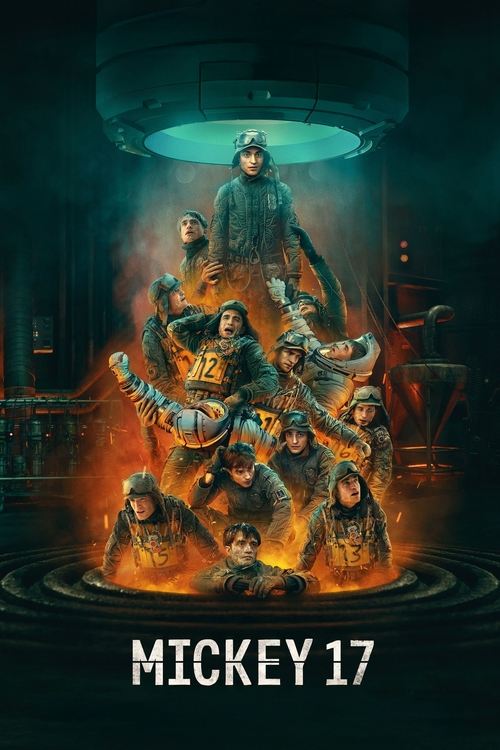
Mickey 17
2025 · Bong Joon Ho
For when you want a blockbuster with a brain and a mean streak of humor — something weird enough to talk about after, but still a ride. Choose it when straight sci-fi feels too solemn and straight comedy too light.
What it's about
On a colonial expedition to a frozen planet, Mickey Barnes has the worst job on the ship: he's an 'expendable,' contracted to die on lethal assignments and be reprinted as a new copy of himself, memories intact. He's on death number seventeen when a mission goes sideways and the system that recycles him hits a snag — leaving Mickey to deal with the fallout, hostile alien creatures, and an employer with grand ambitions for the colony.
The experience
A dark comedy wrapped in a big-budget space adventure — funny, macabre, and unexpectedly tender about a man the universe treats as disposable. It swings between slapstick, satire, and genuine creature-movie thrills, and it keeps you off balance in a way that's part of the fun.
Performances
Robert Pattinson is the whole show and knows it, giving Mickey a hangdog voice and physicality that makes seventeen deaths land as both punchline and tragedy — it's a genuinely strange, committed comic performance.
The craft
Bong Joon Ho's first film since Parasite, adapted from Edward Ashton's novel Mickey7, made with full Hollywood resources but his signature tonal whiplash intact — comedy and horror sharing the same frame. The frozen-planet world-building and creature design give it real big-screen scale.
Why it matters
Watched worldwide as the follow-up to an Oscar-sweeping phenomenon, it's a rare case of a major studio handing blockbuster money to a director's genuinely eccentric vision.
Snapshot
Mickey 17 is Bong Joon Ho's first feature after the global phenomenon of Parasite (2019) and his most fully Hollywood production — financed and distributed by Warner Bros., shot largely in England, performed in English by an international cast. The film adapts Edward Ashton's 2022 novel Mickey7 (St. Martin's Press), adjusting the protagonist's iteration count upward in its title, a quiet editorial signal that the film may press even harder against the premise's logic of disposability than its source. Set aboard a colonial mission to a frozen planet called Niflheim, it follows Mickey Barnes (Robert Pattinson), who holds the ship's most abject position: "expendable," a worker contracted to die on dangerous assignments and be re-printed as a functionally identical clone. When Mickey 17 survives a mission that has already triggered the printing of Mickey 18, two versions of the same consciousness find themselves coexisting — an event the colony's rules classify as an emergency requiring elimination of the surplus copy. A dark comedy about identity, labor, and the machinery of colonial megalomania, the film arrives as Bong's most overtly satirical work since The Host (2006).
Industry & production
Mickey 17 was produced for Warner Bros. Pictures, which distributed it theatrically worldwide. The project had an extended gestation: Bong acquired the rights to Ashton's novel before its publication, and the film's release was delayed from an originally targeted 2024 window — owing in part to the Hollywood strikes of 2023 and the significant post-production demands of its visual-effects workload. Principal photography took place largely at Warner Bros. Studios Leavesden in Hertfordshire, England, with studio-built sets constituting the primary environment for the ship's interior and the alien surface sequences.
The production represents a continuation of Bong's relationship with Hollywood infrastructure that began, turbulently, with Snowpiercer (2013) — a film whose U.S. distribution became a celebrated battle of wills when Harvey Weinstein sought substantial cuts and Bong refused, ultimately reaching a limited-release compromise. The global triumph of Parasite, which won the Palme d'Or and four Academy Awards including Best Picture, gave Bong a leverage in the studio system that few non-American directors have achieved. Warner Bros. reportedly granted him substantial creative autonomy on a film whose ensemble cast, elaborate world-building, and creature-effects scope placed it solidly in tentpole territory.
Technology
The alien creatures of Niflheim — indigenous beings whose relationship to the human colonists becomes a moral crux — were developed using a hybrid methodology consistent with Bong's practice since The Host: practical animatronic and suit-based construction on set, augmented and extended digitally in post-production. Bong has been explicit across his career about his preference for physical reference during filming; the performers' and crew's actual behavioral response to a tangible creature, he has argued, produces something unavailable when reacting to a tennis ball on a stick. The film's extensive digital environment work — building out the alien planet's surface beyond what sets could contain — follows the now-standard matte-extension and LED-volume toolkit of contemporary large-scale production.
The more technically unusual challenge was the dual-Mickey sequences. Robert Pattinson appears as two simultaneously present, physically distinct characters who must share scenes. The production approach favored practical solutions where possible — Pattinson performing against a stand-in, with scenes structured so that editorial cutting could separate the performances — reserving digital face-replacement and compositing for situations where both Mickeys genuinely needed to occupy the same frame. This restraint reflects a consistent Bong instinct: technology deployed to support performance rather than substitute for it.
Technique
Cinematography
Darius Khondji, the French-Iranian cinematographer whose career spans the expressionistic shadow-work of Se7en (Fincher, 1995), the warm nostalgia of Midnight in Paris (Allen, 2011), and the kinetic grain of Uncut Gems (Safdie Brothers, 2019), served as director of photography — a notable departure from Bong's long collaboration with Hong Kyung-pyo, who shot Snowpiercer, Okja, and Parasite. Hong's visual language and Bong's compositional grammar developed in tandem over years: a preference for wide lenses that hold entire spatial situations simultaneously in frame, so that power relations can be read architecturally rather than communicated through shot/reverse-shot cutting. Khondji's instincts are differently calibrated — more attuned to tonal atmosphere, to the expressive weight of cold or saturated light, to selective focus as a means of isolating psychological states. On Mickey 17, the collaboration reportedly channels Bong's spatial geometry through Khondji's atmospheric palette: the ship's interior rendered in the flat, institutional light of administrative banality, the alien surface in a blue-white cold that refuses the sublime grandeur typically granted to science-fiction frontier landscapes.
Editing
[The specific editing credit for Mickey 17 is not confirmed in sources available to this writing with sufficient certainty to state definitively. Yang Jin-mo, who edited Parasite, The Host, and Memories of Murder for Bong, developed with the director an editorial rhythm central to his tonal signature: the slow accretion of domestic or procedural detail punctuated by sudden violence or tonal collapse, with comedy and horror alternating so rapidly in their final states that they cease to be separable.] Whatever the editorial collaborator, the film's structural conceit — two Mickeys simultaneously present in the narrative — demands unusual precision in managing the tonal register of each version without allowing the doubling to collapse into confusion.
Mise-en-scène / staging
Bong's staging practice encodes social hierarchy as spatial geography. He has described, in various interviews, a process of designing sequences so that the physical relationship between characters in the frame communicates power structure before dialogue or plot has made it explicit: who stands above, who is diminished by low-angle perspective, who commands full-face access from the camera and who is withheld. In Mickey 17, this practice maps onto the colonial ship's architecture, where compartment proximity physically embeds class stratification. Mark Ruffalo's commander — a demagogue whose charismatic populism papers over authoritarian violence — is reportedly staged with insistence on physical scale, his frames calibrated to reduce Pattinson's Mickey to peripheral smallness or upward-angled submission. The alien-planet sequences invert this geometry: on Niflheim, Mickey operates in terrain the human hierarchy cannot administer, and the staging reflects that spatial escape from institutional legibility.
Sound
Bong's films have consistently weaponized the indifference of ambient sound — the ordinary domestic noises that continue through catastrophe in Parasite, the creature sounds of The Host that slide from grotesque toward something almost pitiable. Mickey 17 reportedly uses the acoustic logic of the enclosed ship to similar effect, making the bureaucratic soundscape of the colony — procedural announcements, administrative processing tones, the matter-of-fact audio protocols surrounding Mickey's repeated deaths — carry a menacing normality. The institutionalization of violence is rendered audible as routine before it is visible as policy. [Specific sound design credits are not confirmed in available sources.]
Performance
Robert Pattinson's career since Twilight has been a sustained project of auteur self-reconstruction: collaborations with David Cronenberg (Cosmopolis, 2012), David Michôd (The Rover, 2014), Claire Denis (High Life, 2018), Robert Eggers (The Lighthouse, 2019), and Matt Reeves (The Batman, 2022) developed a performance mode built on controlled dissociation — the body present in the frame while something interior remains withheld or displaced. Bong's casting exploits precisely this quality. Mickey 17 is meek, his self worn down by accumulated death and re-printing; Mickey 18, activated without that history, is stranger, more assertive, differently broken. The distinction Pattinson draws between them relies primarily on adjustment of posture, vocal register, and behavioral rhythm — prosthetics are minimal — and the result has invited comparison to Jeremy Irons' dual performance in Cronenberg's Dead Ringers (1988), another anatomization of identity's fragility under institutional pressure, with the critical difference that Bong plays the doubling for comedy as much as horror.
Mark Ruffalo's performance as the colonial commander courts deliberate over-scale — a satirical rendering of a specific strain of contemporary political pathology, the charismatic authoritarian who deploys folksy affect as a weapon. Critical reception of this choice divided along lines of whether the caricature constitutes pointed satire or tonal miscalibration; the same tension attended Bong's deployment of Tilda Swinton in Snowpiercer and Okja, where performances were similarly heightened beyond naturalism. Toni Collette, as the commander's wife, operates in a comparably heightened comic register. Steven Yeun and Naomi Ackie anchor the film's more intimate, grounded emotional frequency.
Narrative & dramatic mode
The film's operative mode is the one Bong has refined since Memories of Murder (2003): genre exercise as social X-ray. The science-fiction premise — repeated death and resurrection as an employment contract — is accepted at strict face value and then permitted to generate its satirical logic through narrative consequence rather than authorial commentary. Mickey's situation is precarious labor taken to its terminal reduction: the worker's body not merely sold for time but contractually destroyed and reconstituted as a renewable input to the production process. The emergence of two simultaneous Mickeys introduces a philosophical problem — which constitutes the legitimate self when two identical-but-not-identical persons claim the same history — that the film handles as dark comedy rather than existential tragedy. Bong has consistently refused to let his films settle into a single genre contract with the audience; Mickey 17 shifts between survival thriller, workplace comedy, creature feature, and political satire without signaling its gear changes, placing the tonal burden on the viewer to keep up.
Genre & cycle
Mickey 17 participates in a distinct post-2000 cycle of identity-and-consciousness science fiction: Moon (Jones, 2009), in which a lone lunar worker discovers he is one in a long cycle of re-printed clones completing the same assignment; the television series Orphan Black (2013–2017), which built an entire dramatic architecture around identity multiplication; Alex Garland's Annihilation (2018), in which biological duplication becomes an epistemological crisis. The deeper lineage runs through Philip K. Dick's fiction — Do Androids Dream of Electric Sheep? (1968), "We Can Remember It for You Wholesale" (1966) — in which institutional reproduction of persons exposes the self as a contingent construction rather than a metaphysical given. Moon is the most formally proximate predecessor: both films place a working-class man inside a system that regards his replaceable body as an operational asset, and both use that situation to generate something closer to character study than action.
As satire of imperial and corporate ideology, the film belongs with Paul Verhoeven's Starship Troopers (1997) and RoboCop (1987) in using genre-coded science fiction to anatomize the legitimating rhetoric of Western power with straight-faced deadpan. The colonial mission's vocabulary — frontier settlement, sacrifice for civilization, the expendable vanguard — is permitted to speak itself at full volume until its horror becomes audible without editorializing.
Authorship & method
Bong adapted Ashton's novel himself, writing the screenplay and working through translation into the English-language shooting script — a process consistent with his approach on Snowpiercer, where he co-wrote in Korean before translation. His pre-production process is famously visual: Bong is a meticulous storyboard artist who enters production with sequences fully diagrammed and shot-listed, while remaining alert to what he has called the "found moments" of actual filming that exceed the planned geometry.
Khondji's involvement represents a departure from established pattern. Hong Kyung-pyo's extended absence from the director's roster — whether permanent or circumstantial — opens questions about how much of Bong's visual language was co-developed in that collaboration versus how much belongs entirely to his own directorial instinct. The early evidence of Mickey 17 suggests the spatial and hierarchical logic persists; the atmospheric quality has shifted register.
[The composer for Mickey 17 is not established with certainty in available sources. Jung Jae-il, who scored Parasite with a range moving from spare piano miniatures to full orchestral irony, worked closely with Bong on Korean-language productions; whether that collaboration extended to this film cannot be confirmed here without risking fabrication.]
Movement / national cinema
Mickey 17 is the most thoroughly Anglophone and Hollywood-embedded of Bong's features, yet it remains unmistakably the work of a Korean director. The class consciousness, the refusal to sentimentalize its protagonist's suffering, the oscillation between comedy and dread, and the spatial politics of hierarchical enclosed systems all carry markers that scholars trace to a national cinema formed under conditions of rapid industrialization, military authoritarianism, and extreme class stratification. Bong belongs to the generation — alongside Park Chan-wook, Lee Chang-dong, Hong Sang-soo — who internationalized a distinctively Korean cinematic sensibility from the late 1990s onward. Parasite's Academy Awards victory made Bong the most globally visible Korean director in the history of the medium, and Mickey 17 was received in part as a test of whether that sensibility could assert itself inside Hollywood's largest production machinery or whether it would be absorbed and neutralized by it. The evidence suggests the former: the film's concerns, staging instincts, and tonal signature are recognizably continuous with Bong's Korean work, even when its setting, language, and financing are not.
Era / period
The film arrives in the mid-2020s, a moment of structural volatility in studio filmmaking: theatrical distribution under sustained pressure from streaming, post-strike renegotiation of creative labor, the ongoing debate over generative AI's role in screenwriting and visual-effects production, and a prestige science-fiction revival (the Dune films, Poor Things, Everything Everywhere All at Once) that has reclaimed serious critical terrain for the genre. Mickey 17 occupies a category that has contracted severely since the 1970s: the studio-financed auteur film, produced at scale, with a major star, and with enough creative latitude to sustain a genuinely idiosyncratic vision. The conditions that produced it are not guaranteed to persist.
Themes
Expendability as system is the film's central preoccupation: the institutionalization of sacrifice as a renewable resource, the normalization of a worker's death as an operational cost to be absorbed and recovered from through technological re-printing. The "expendable" contract is capitalism's fantasy of the fully fungible laborer made literal; the colonial mission is the historical project of civilization-building rendered dependent on a class of persons whose lives are the price of the frontier. Bong does not make this argument editorially — he constructs a situation in which the argument becomes visible through its own internal logic.
Identity and continuity run as the film's philosophical counterpoint. The question of what survives bodily death and re-printing — whether Mickey 17 is, in any meaningful sense, continuous with Mickey 1 — is left productively unresolved. The film treats this as comedy as much as tragedy: the accumulated deaths have made Mickey 17 a particular kind of self, different from Mickey 18's fresh-printed consciousness, and the difference is simultaneously absolute and absurd. Political satire constitutes the third register, with the colonial commander functioning as a figure of a recognizable contemporary political type — the charismatic authoritarian whose populist performance conceals and enables institutional brutality.
Reception, canon & influence
Critical reception was broadly positive, with particular emphasis on Pattinson's dual performance as the film's primary achievement and Bong's genre orchestration as evidence of a director still willing to take formal risks inside a studio system that generally punishes them. Dissenting criticism focused on the satirical register's occasional bluntness — Ruffalo's performance cited as caricature that tips into self-parody — and on the film's structural fullness relative to Parasite's more economical social geometry. [Specific box-office figures are not reproduced here; the film performed modestly relative to its production scale, a result consistent with the commercial realities of R-rated auteur science fiction in the theatrical market of 2025.]
The influences running backward through the film are extensive: Ashton's source novel, the Philip K. Dick tradition, Verhoeven's satirical genre work, Cronenberg's body-horror investigations of selfhood and institutional power, and Bong's own Snowpiercer and Okja — both of which placed living bodies inside systems designed to consume them and asked what moral categories apply when consumption is the system's legitimate purpose. Moon is the most formally proximate precursor.
As for Mickey 17's own forward influence — what it will be understood to have shaped — the proximity of this writing to the film's release makes confident assessment impossible. What can be said is that it consolidates, and makes newly explicit, a particular strand of Bong's project: the deployment of genre not as a vehicle for narrative but as a vocabulary for social argument, and the insistence that comedy and horror are not alternating moods but a single compound register in which neither cancels the other. Whether it will be seen, in retrospect, as a major statement or a transitional work will depend in part on what Bong makes next, and in part on what the political and cinematic moment of the late 2020s decides it needs from the films made in its approach.
A Deleuzian reading
The printer hums and a body slides out wet, blinking, already briefed on the manner of its last death — burned, frozen, dissolved by whatever Niflheim threw at the previous edition.
The full Deleuzian reading of Mickey 17 →
Reception
Landed in March 2025 as the most anticipated follow-up in years — Bong's first film after Parasite swept the Oscars — then underwhelmed at the box office and drew a shrugging 'good, not great' consensus; the 'actually, this one's underrated' defense took hold online almost immediately.
How Mickey 17 was received, from release to now →
Influences: the films it descends from and the films it influenced
- Moon (2009) — Jones built Sam Rockwell's dual clone performance entirely through motion-control compositing and physical differentiation between instances — the technical and conceptual direct precedent for Mickey 17's dual-Pattinson architecture and its treatment of clone disposability as corporate labor logic.
- RoboCop (1987) — Verhoeven punctuates the action with fake TV commercials and ED-209 boardroom farce that normalize institutional violence without ironic distance — establishing the bureaucratic-ambient-normalization mode and satirical-over-scale performance register Bong inherits directly.
- Starship Troopers (1997) — Verhoeven embeds colonial-ideology critique so fully into the genre's own propaganda aesthetics — recruitment ads, 'Would you like to know more?' cutaways — that satire operates without tonal separation from its object, the exact unmarked-tonal-shifting strategy Mickey 17 inherits at the register of species expansion.
- Total Recall (1990) — Verhoeven's PKD adaptation centers identity instability in a disposable laborer protagonist and builds its social argument out of genre mechanics rather than around them — the formal strategy Mickey 17 extends to the Expendable-clone narrative and its question of which self owns the moral claim.
- Brazil (1985) — Gilliam systematizes bureaucratic-ambient-normalization as architecture and sound design — pneumatic tubes, hold music, Form 27B/6 — making institutional dread a spatial and acoustic texture that refuses to break for critique; Bong inherits this formal refusal to editorialize the system.
- Se7en (1995) — Khondji's collaboration with Fincher established his signature desaturated, green-shifted cold-atmospheric palette — underexposed shadows, clinical highlights, visible grain from bleach-bypass processing — that Khondji carries directly into Mickey 17 as a visual grammar for institutional dread.
- Delicatessen (1991) — Jeunet and Caro's debut deploys Khondji's cold atmospheric palette within dark satirical genre — cannibalism literalizing disposable-labor economics — and stages hierarchical building-strata through low-angle spatial geometry, delivering both the visual instrument and its social application that Bong recruits for Mickey 17.
- Videodrome (1983) — Cronenberg uses the body's physical instability — Renn's pulsing abdominal slot — as the horror register for ideological inscription on flesh; Mickey 17's Expendable body, endlessly consumed and reproduced by colonial mission logic, extends this body-horror encoding of institutional power into social satire.
- The Host (2006) — Bong's foundational creature feature establishes his practical-digital hybrid methodology — the Han River monster built to move with physical weight in real water — and proves genre-as-social-x-ray against Korean institutional incompetence, the direct methodological prototype for Mickey 17's creature design and satirical genre structure.
- Snowpiercer (2013) — Bong's hierarchy-as-spatial-geography grammar — train cars encoding class strata through low-angle staging and axial blocking — is the direct architectural precedent for the colony ship's power geography in Mickey 17, produced through the same storyboard-driven preproduction method.
- Okja (2017) — Bong's practical-digital hybrid creature design — a CGI animal whose physical weight and tactile presence are built through compositing with real environmental interactions — establishes the hybrid-creature methodology Mickey 17 extends, alongside the satirical-over-scale dual performance (Tilda Swinton's two sisters) as political register.
- Parasite (2019) — Parasite's spatial encoding of class hierarchy — the Parks' architecturally elevated sightlines versus the Kims' semi-basement — is the most immediate formal precedent for Mickey 17's vertical colony-ship power geography, using the same low-angle/high-angle shot grammar to map social position without dialogue.
- Sorry to Bother You (2018) — Riley's unmarked pivot from satirical labor comedy to literal horse-man body horror — with no generic warning or tonal preparation — is the closest contemporary parallel to Mickey 17's compound horror-comedy register; both films refuse to resolve genre into a single mode because their argument depends on the compound holding.
- Never Let Me Go (2010) — Romanek's adaptation uses bureaucratic-ambient-normalization — the calm institutional vocabulary of Hailsham, the donation schedules spoken as administrative fact — to make clone disposability morally invisible within the narrative world, the same strategy by which Mickey 17's Expendable program is normalized for audience and diegetic community alike.
Similar films
- Snowpiercer (2013) — influence & lineage
- Okja (2017) — influence & lineage
- Parasite (2019) — influence & lineage
- The Host (2006) — influence & lineage
- RoboCop (1987) — influence & lineage
- Starship Troopers (1997) — influence & lineage · same viewing thread
- Star Wars: The Last Jedi (2017) — same viewing thread
- No Other Choice (2025) — shared sensibility
All the films related to Mickey 17 →
Watch it with: curated runs of related films
- Galaxies to Get Lost In — Watch these when you want to disappear into an entire built world — hostile planets, star empires, colonial expeditions gone wrong — at full blockbuster scale.