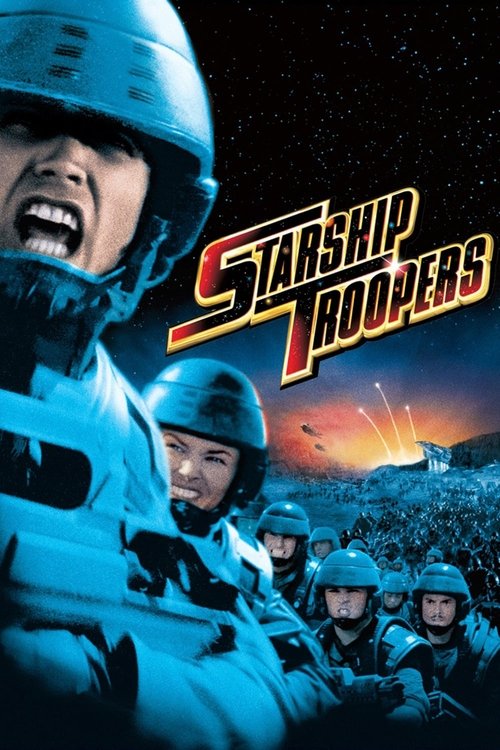
Starship Troopers
1997 · Paul Verhoeven
When you want big, loud, rewatchable spectacle that turns out to be much smarter than it looks — great with a crowd, better with one friend who'll argue about it afterward. Comfort food with a razor blade inside.
What it's about
In a spit-shined future where citizenship must be earned through military service, a handsome high-school graduate named Johnny Rico enlists in the Mobile Infantry just as humanity goes to war with an insectoid alien species. After an asteroid strike devastates Buenos Aires, Rico and his equally gorgeous classmates ship out to fight giant bugs on distant planets, rising through the ranks as the war grinds on.
The experience
It plays on two channels at once: up top, a loud, gory, genuinely thrilling war spectacle; underneath, a deadpan satire that keeps a straight face while the society on screen cheers itself into fascism. It's funny in a way that curdles — the mock recruitment ads interrupting the action are a running dare to notice what you're applauding.
Performances
The chiseled young cast plays everything perfectly straight — the soap-opera blankness is the joke — while Michael Ironside cuts through it as a war-scarred teacher whose true-believer conviction is genuinely unnerving.
The craft
Verhoeven frames the whole film as a state newsreel, complete with propaganda bulletins, and stages bug battles whose creature effects still hold up remarkably well — swarming, tactile, and brutal. The rousing military score is used with a straight face that becomes its own punchline. It absolutely rewards a big screen and loud speakers.
Why it matters
Widely misread on release as the dumb militaristic movie it was mocking, it has since been rehabilitated as one of the sharpest satires ever smuggled through a Hollywood studio — a rare film whose reputation flipped completely once audiences caught the joke.
Snapshot
Starship Troopers is Paul Verhoeven's gleefully poisonous adaptation of Robert A. Heinlein's 1959 novel, a $100-million-plus studio spectacle that smuggles a satire of militarism and fascist aesthetics inside the casing of a star-bug action movie. Marketed by TriStar as a straightforward effects extravaganza for teenagers, it bewildered many 1997 critics, who took its square-jawed earnestness at face value and judged it juvenile or, worse, an endorsement of the very martial values it was lampooning. Verhoeven — a Dutch director who spent his childhood in the German-occupied Hague and watched Allied bombs fall on his own city — intended exactly the opposite: a Brechtian fable in which beautiful, blond recruits march cheerfully toward a war whose "facts" are propaganda and whose enemy is a screen onto which a society projects its appetite for violence. The film's reputation has inverted over the decades; it is now widely read as one of the sharpest political satires Hollywood ever bankrolled almost by accident, and as a landmark in CG creature effects. It remains a definitive case study in the gap between authorial intent, marketing, and reception.
Industry & production
The film emerged from Columbia/TriStar (Sony) and Touchstone, produced by Jon Davison and Alan Marshall, with Verhoeven and screenwriter Edward Neumeier reuniting the creative core of RoboCop (1987). The project's development history is frequently cited: Neumeier's script began life as an original property titled Bug Hunt at Outpost Nine, and Heinlein's novel was attached relatively late, lending the production its title and its conceit of a future militarist society. This origin matters because it clarifies the adaptation's freedom — the film keeps Heinlein's premise (a citizenship-through-service polity at war with an arachnoid enemy) while inverting the novel's admiring tone into critique. Verhoeven has said in interviews that he found the novel's politics repellent and could not finish it, and read only a portion before proceeding; treat the precise extent as the kind of oft-repeated anecdote that resists firm verification.
The budget was large by 1997 standards — widely reported in the $100–105 million range — much of it absorbed by Phil Tippett's effects house and the sustained desert and combat photography. The picture opened in November 1997 to soft domestic returns and mixed-to-hostile reviews; it was not a clear theatrical hit in the U.S., though international and especially home-video markets sustained it into profitability and franchise life (several direct-to-video and animated sequels followed, none with Verhoeven). Exact grosses should be checked against a reliable database rather than asserted here.
Technology
Starship Troopers sits at a hinge moment in effects history. Phil Tippett, the stop-motion and creature veteran whose go-motion dinosaurs had just been superseded by ILM's computer-generated ones on Jurassic Park (1993), led the bug work here largely in CG, combining digital arachnids with practical full-scale animatronics and rod puppets for close contact. The result is one of the most ambitious organic-creature CG showcases of the 1990s: swarms of insectoid Bugs rendered in numbers and with a skittering, weighty physicality that earned the film an Academy Award nomination for Visual Effects. Tippett's methodology retained an animator's sensibility — staging, timing, and "performance" planning rooted in his stop-motion discipline — applied to digital models, a transitional craft that distinguishes the film's creatures from purely simulation-driven later work. Alongside the bugs, the production deployed large physical sets, pyrotechnics, and the now-celebrated Federal Network propaganda interstitials, shot as faux-broadcast inserts.
Technique
Cinematography
Jost Vacano, Verhoeven's longtime collaborator (Das Boot, RoboCop, Total Recall, Showgirls), shot the film, and his contribution is central to its double game. The human world is photographed with a glossy, recruitment-poster cleanliness — bright high-key light, saturated colors, handsome faces framed like advertising — that reads as sincere yet is pitched a half-step too perfect, the visual register of propaganda. The combat sequences then break into chaotic, kinetic coverage: long lenses compressing onrushing Bug swarms, dust and bodies, a deliberate sensory overload. Vacano's command of large-scale action staging (honed on Das Boot's claustrophobic interiors and Total Recall's set pieces) gives the battle scenes legibility within their pandemonium. The contrast between the antiseptic civilian/recruitment imagery and the meat-grinder front is the film's core visual argument.
Editing
Cut by Mark Goldblatt (a Terminator and Terminator 2 editor) with Caroline Ross, the film's rhythm alternates between the smooth, almost sitcom-like pacing of the Buenos Aires youth scenes and the percussive acceleration of combat. The most distinctive editorial device is structural: the recurring Federal Network news bulletins ("Would you like to know more?") that punctuate the narrative, interrupting the drama with mock-broadcast montage. These inserts function as both connective tissue and ironic counterpoint, editorializing against the story they appear to advance, and they give the film its essayistic, Brechtian spine.
Mise-en-scène / staging
The production design (Allan Cameron) and costuming build a retro-futurist fascism: silhouettes that quote 1930s–40s totalitarian iconography — the now-famous black leather greatcoat and peaked cap worn by Neil Patrick Harris's Carl Jenkins, consciously echoing SS uniform design — set against shiny, optimistic civilian spaces. The staging repeatedly arranges human bodies as ornament: synchronized recruits, cheering crowds, classroom rows, the architecture of mass consent. Against this, the Bug planets are staged as raw, granular wastelands. The deliberate dissonance — gorgeous people in beautiful uniforms doing monstrous things while smiling — is the mise-en-scène's thesis.
Sound
Basil Poledouris, who had scored RoboCop and Conan the Barbarian for Verhoeven and Milius respectively, composed a brassy, martial, deliberately rousing score whose triumphalism is itself part of the satire — it swells exactly where a war film "should," coaxing the audience toward the very enthusiasm the film is interrogating. Sound design foregrounds the dry chitter and shriek of the Bugs and the percussive overload of the firefights; the film's sound earned Academy Award recognition in the sound categories (verify the exact nomination roster against a reliable source). The interplay of stirring music and horrific image is the auditory equivalent of the film's irony.
Performance
Verhoeven cast deliberately telegenic, television-bred young actors — Casper Van Dien (Johnny Rico), Denise Richards (Carmen Ico), Dina Meyer (Dizzy Flores), Neil Patrick Harris (Carl), Jake Busey (Ace), Patrick Muldoon — and directed them toward a bright, flattened, almost daytime-soap affect. This is a much-misread choice: the "wooden" or "plastic" acting many reviewers panned is a calculated register, the blank wholesomeness of advertising and propaganda. The performances are sincere within a frame that is not, producing characters who are beautiful instruments of a system rather than rounded psychological subjects. Michael Ironside, as the teacher-turned-officer Rasczak, supplies the one weathered, ironic adult voice. Reading the ensemble as bad acting misses that the artifice is the point.
Narrative & dramatic mode
The film adopts the shape of a war-movie Bildungsroman — high-school graduates enlist, train, suffer, and rise through the ranks against an existential enemy — and executes its beats with total genre fluency: the romantic triangle, the brutal drill instructor, the baptism of fire, the costly victory. But it wraps this earnest melodrama in a frame of mock-propaganda that continually undercuts it. The dramatic mode is thus doubled: a straight-faced heroic narrative and an ironic meta-commentary on that narrative's machinery. The "Would you like to know more?" bulletins, the recruitment ads, the news of atrocities reframed as patriotic spectacle — these construct an unreliable diegesis in which the audience is positioned to enjoy the war movie while being shown the apparatus that manufactures such enjoyment. It is satire conducted not by exaggeration alone but by faithful, seductive execution of the thing being satirized.
Genre & cycle
Starship Troopers belongs to the 1990s cycle of large-scale science-fiction action spectacles enabled by maturing CG (Jurassic Park, Independence Day, Men in Black), and to the lineage of bug-war and alien-invasion cinema reaching back to 1950s creature features and forward to Aliens (1986). Within Verhoeven's own American output it forms a loose trilogy of subversive genre work with RoboCop and Total Recall: studio entertainments that weaponize spectacle to critique American media, corporatism, and violence. It also participates in the military-SF subgenre Heinlein helped codify — power-armored infantry against insectoid hordes, a template that influenced everything from Aliens to anime to videogames — even as the film strips out the novel's power armor and turns the subgenre's enthusiasm against itself.
Authorship & method
This is foremost a Verhoeven film, legible within his career-long preoccupations: the seductions of violence, the manufacture of consent, the body as spectacle, and an outsider European's appalled fascination with American mass culture. His method — irony delivered through total commitment to genre surface — is the film's organizing principle, and it depends on a trusted ensemble of collaborators: screenwriter Edward Neumeier, his RoboCop partner, who supplies the satirical structure and the propaganda conceit; cinematographer Jost Vacano, whose glossy-then-chaotic imagery enacts the irony; composer Basil Poledouris, whose triumphal score is complicit by design; editor Mark Goldblatt, who threads the mock-broadcasts through the drama; and effects supervisor Phil Tippett, whose creatures give the satire its monstrous, persuasive antagonist. Verhoeven has spoken often about reading the rise of European fascism into the material, drawing on his wartime childhood; the film is, in his account, an attempt to make an audience feel the pull of fascist aesthetics from the inside and then recognize what they are cheering.
Movement / national cinema
The film is a Hollywood studio product, but its sensibility is unmistakably that of a European émigré director. Verhoeven's formation in Dutch cinema (Soldier of Orange, Spetters, The Fourth Man) and his lived memory of occupation give the film an authorial distance from American patriotism that a native director would be unlikely to achieve. It thus sits at the intersection of two traditions: the spectacle economy of late-1990s Hollywood and the ironic, politically charged European art-cinema lineage. The satire's coldness — its refusal to console — reflects that continental remove more than any American genre convention.
Era / period
Released in November 1997, the film arrived in a post–Cold War, pre-9/11 American moment when the country lacked a defining existential enemy and the "war on terror" rhetoric of mobilization had not yet returned to the foreground. This timing partly explains its initial misreading: audiences and critics had less recent cultural grammar for reading wartime propaganda critically. The film's reputation rose sharply in the 2000s, as the post-9/11 climate of embedded media, "support the troops" iconography, and televised war made its satire of newsreel jingoism look prophetic. It is also a period artifact of CG's coming-of-age, capturing the brief window when digital creatures were new enough to astonish and crafted by animators trained in physical effects.
Themes
The governing themes are militarism and the manufacture of consent: a society in which full citizenship is earned through military service, where schoolchildren are taught that "violence is the supreme authority," and where war is sold as civic virtue and entertainment. Closely bound to this is the seduction of fascist aesthetics — the film deliberately makes fascism look good, beautiful and clean and exciting, in order to expose how such imagery works on a viewer. Other threads include media as propaganda (the Federal Network as a satire of broadcast news and recruitment advertising), the dehumanization of the enemy (the Bugs as a pure, faceless Other onto which the society projects its violence — and, the film hints, whom the society may have provoked), and youth as cannon fodder, its telegenic recruits processed cheerfully into casualties. The film's irony insists that the audience examine its own pleasure in watching.
Reception, canon & influence
Initial reception in 1997 was mixed-to-negative; a notable strand of criticism took the film's fascist imagery literally and accused it of glorifying militarism or being morally incoherent — a reading Verhoeven and Neumeier have spent years rebutting, and one now widely regarded as a misreading of an intentional satire. Some critics did recognize the irony at the time, but the dominant early framing was of an expensive, juvenile bug movie. Its Academy recognition was concentrated in the technical categories (a Visual Effects nomination for the Tippett-led bug work), reflecting how the film was received as spectacle first.
Influences on the film (backward): Heinlein's 1959 novel supplies the premise and title, while the film inverts its politics; Neumeier's original Bug Hunt script supplies the satirical DNA. The visual vocabulary draws on 1930s–40s totalitarian propaganda (Riefenstahl-style mass ornament, fascist uniform design) and on the recruitment-advertising and newsreel idioms of mid-century war cinema. The bug-war scenario inherits from 1950s creature features and from James Cameron's Aliens. Verhoeven's own RoboCop is the immediate template for the mock-media interludes.
Legacy (forward): Over time the film has been substantially canonized as a major political satire, routinely revisited in criticism on propaganda, fascism, and media after 9/11, and frequently named among the most misunderstood studio films of its era. Its "Would you like to know more?" propaganda format and its strategy of satire-by-faithful-execution have been widely cited and imitated, and its retro-fascist visual design and bug-war spectacle left a durable imprint on military science fiction across film, animation, and videogames. The Tippett creature work stands as a benchmark in the transition from practical to digital effects. The film spawned a franchise of sequels and animated spin-offs (without Verhoeven), evidence that its surface as a bug-war action property has had a commercial afterlife quite separate from the critical reappraisal of its satire. Its trajectory — from dismissed to celebrated — is itself a frequently taught lesson in how reception lags authorial intent.
A Deleuzian reading
A bright ad opens the recruiting reel later in the film: schoolkids in a sandbox, a smiling soldier letting them fondle live rounds, everyone delighted.
The full Deleuzian reading of Starship Troopers →
Reception
In 1997 critics largely took it at face value — a loud, expensive bug-shoot that some even accused of peddling the fascism it was mocking — and it underwhelmed at the US box office. Today it's routinely cited as one of the great misunderstood satires, with think-pieces arriving every few years to announce it was right all along.
How Starship Troopers was received, from release to now →
Influences: the films it descends from and the films it influenced
- RoboCop (1987) — Verhoeven and Neumeier's prior collaboration establishes the exact template of satire-by-faithful-execution, with mock-TV/advertising interludes ('I'd buy that for a dollar!') threaded into the drama as the propaganda-deflating device reused here.
- Triumph of the Will (1935) — Supplies the literal visual grammar — mass ornament of uniformed bodies, low-angle heroic framing, and rally architecture — that Verhoeven quotes wholesale in the Federal Network recruitment and assembly imagery to make fascist aesthetics feel seductive from the inside.
- Aliens (1986) — Cameron's colonial-marines-versus-insectoid-swarm combat — squad tactics, dropships, overrun firebases — is the direct action blueprint for the bug-war set pieces and the doomed-grunt ensemble structure.
- Them! (1954) — The 1950s giant-insect creature feature gives the film its inherited premise of massed arthropod menace and the militarized-response procedural that the bug war faithfully escalates.
- The Green Berets (1968) — Embodies the sincere recruitment-poster war film whose newsreel earnestness and pro-enlistment address Verhoeven mimics and inverts via the 'Would you like to know more?' broadcast idiom.
- Soldier of Orange (1977) — Verhoeven's WWII resistance epic, drawn from his wartime childhood, is where he develops the appalled-insider's reading of fascist allure that becomes the organizing intent of Starship Troopers.
- Dr. Strangelove (1964) — Pioneers the strategy of playing militarist apocalypse with total deadpan commitment so the satire emerges from straight-faced genre execution rather than overt parody — the same tonal contract Verhoeven signs.
- Star Wars (1977) — Inverts the fascist ceremony staging Lucas used earnestly: the Federation's parade formations, banner iconography, and recruitment-film inserts quote Riefenstahl's grammar (which Lucas applied to the Empire) and apply it to the ostensible heroes, exposing the visual language Star Wars naturalized for its 'good' side.
- Das Boot (1981) — Carries Vacano's mobile-camera-in-tight-quarters technique and his anti-war irony forward, framing ensemble soldiers as propaganda-driven expendable materiel — the same theme/propaganda-versus-reality lens.
- Zulu (1964) — Stages an explicit outnumbered-outpost siege — troopers firing in ranks from parapets as an insect horde swarms the walls — a direct Rorke's-Drift-style volley-fire-vs-horde last stand.
- Hollow Man (2000) — Continues Verhoeven's body-as-spectacle CG showcase with Jost Vacano's camera, extending the glossy-surface/visceral-payload technique into invisibility effects.
- District 9 (2009) — Builds its whole structure on the mock-broadcast insert — faux-documentary news segments, corporate PSAs, and interview cutaways frame the action exactly as the Federal Network does.
- Team America: World Police (2004) — Adopts the satire-by-over-committed-jingoism method and a triumphal, complicit-by-design anthem score, mocking militarist spectacle by executing its propaganda surface unironically.
- Edge of Tomorrow (2014) — Inherits the powered-armor-versus-alien-swarm combat staging and the slick military-recruitment media wrapper around mass infantry slaughter that Starship Troopers codified.
- Iron Sky (2012) — Extends the retro-futurist-fascism production design — space-age hardware fused with 1930s totalitarian uniform and propaganda iconography — as a load-bearing satirical device.
- Halo (Bungie) (2001) — The franchise's UNSC marines, dropship insertions, and recruitment-styled fiction translate the film's bug-war infantry spectacle and propaganda framing into the dominant military-SF videogame template.
- Robocop (mock-media via) — Black Mirror: 'Men Against Fire' (2016) — Directly reworks the conceit of media/sensory propaganda dehumanizing an insectoid-coded enemy to engineer consent for slaughter — Starship Troopers' 'make the audience cheer, then recognize it' mechanism made the episode's thesis.
- Mickey 17 (2025) — Verhoeven embeds colonial-ideology critique so fully into the genre's own propaganda aesthetics — recruitment ads, 'Would you like to know more?' cutaways — that satire operates without tonal separation from its object, the exact unmarked-tonal-shifting strategy Mickey 17 inherits at the register of species expansion.
- Transformers (2007) — ILM/Tippett's massed CG-creature-versus-military integration proved photoreal armies could share the frame with live soldiers, a precursor to Transformers' robot-vs-army battles.
- Divergent (2014) — Processes militarized youth through a propaganda-saturated training academy with fascist recruitment iconography — the aesthetic behind Dauntless's cult-of-fearlessness pageantry.
- Jurassic Park (1993) — Phil Tippett's go-motion-to-digital pivot on Jurassic Park is the direct technical precursor to his benchmark Tippett Studio bug work, marking the same practical-to-CG creature transition.
- Showgirls (1995) — Verhoeven and Vacano's immediately prior film deploys the same high-key glossy surface and flattened, heightened performance register that critics misread literally — the exact reception trap Starship Troopers sprang.
- Total Recall (1990) — Shares the Verhoeven–Vacano interrogation of mediated reality and embedded advertising/broadcast inserts, plus the body-horror creature spectacle that prefigures the bug grotesques.
Similar films
- RoboCop (1987) — influence & lineage
- District 9 (2009) — influence & lineage
- Total Recall (1990) — influence & lineage
- Aliens (1986) — influence & lineage
- Mickey 17 (2025) — same viewing thread
- Star Wars: The Last Jedi (2017) — same viewing thread
- Full Metal Jacket (1987) — shared sensibility
- Planet of the Apes (1968) — shared sensibility
All the films related to Starship Troopers →
Watch it with: curated runs of related films
- Galaxies to Get Lost In — Watch these when you want to disappear into an entire built world — hostile planets, star empires, colonial expeditions gone wrong — at full blockbuster scale.