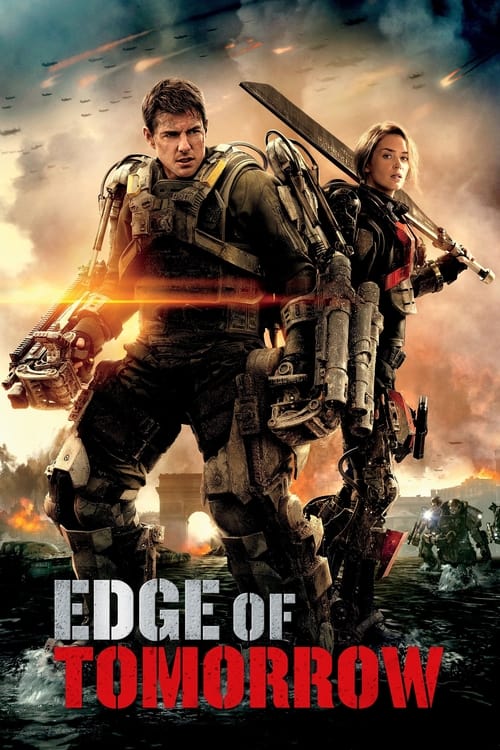
Edge of Tomorrow
2014 · Doug Liman
The perfect crowd-pleaser for when you want smart fun with zero homework — great with friends, pizza, and people who like yelling at the screen. Comfort viewing with real craft under the hood.
What it's about
Major Bill Cage is a smooth military PR man who has never seen combat — until he's demoted, dropped onto a beach assault against an alien invasion, and killed within minutes. Except he wakes up at the start of the same day, again and again, and his only way forward is to train with the army's most feared warrior and get a little further with every death.
The experience
Fast, punchy, and much funnier than the premise suggests — dying becomes a running gag before it becomes moving. It's the rare blockbuster that gets more entertaining as it goes, because every repetition pays something off.
Performances
Tom Cruise gleefully plays against type as a coward who has to earn his competence one death at a time, and Emily Blunt is magnetic as the hardened soldier training him — a genuinely star-making action turn.
The craft
The editing is the secret weapon: it turns repetition into rhythm and comedy, trusting you to fill in loops it skips. The beach assault — armored exo-suits, chaos, and dread played at video-game speed — is thrilling, brutal spectacle that holds up on any screen.
Why it matters
Undersold in theaters and then rediscovered as a modern action classic, it became the template for smart 'respawn logic' storytelling in Hollywood and cemented Emily Blunt as an action lead.
Snapshot
A high-concept military science-fiction action film starring Tom Cruise and Emily Blunt, Edge of Tomorrow adapts Hiroshi Sakurazaka's 2004 Japanese light novel All You Need Is Kill into a studio blockbuster that applies video-game respawn logic to the iconography of D-Day. An incompetent military spokesman is press-ganged into a beachhead assault against an invading alien force, dies within minutes, and wakes to repeat the same day indefinitely — each iteration accumulating tactical knowledge until the loop itself can be broken. The film fuses the temporal mechanics of Groundhog Day with the kinetic violence of Saving Private Ryan's opening act, producing a work that is simultaneously bleak war satire and crowd-pleasing action spectacle. Despite a marketing campaign widely regarded as inadequate to its premise, the film has steadily accumulated a devoted audience and a reputation as among the most formally inventive blockbusters of the 2010s.
Industry & production
Warner Bros. and Village Roadshow Pictures produced Edge of Tomorrow at an estimated budget in the range of high-tentpole productions of its era. Principal photography was conducted largely in the United Kingdom, including studio work at Leavesden (the facility that had become the Warner Bros. UK hub through the Harry Potter productions) and location work in and around London. A substantial beach assault sequence — the film's recurring set piece — was shot on location on a stretch of British coastline standing in for a fictional future Normandy.
The source novel, All You Need Is Kill, had already generated a manga adaptation by Ryosuke Takeuchi and Yoshitoshi ABe before the film rights were acquired. Early development carried the novel's title; the decision to rename the property Edge of Tomorrow for its theatrical release was widely criticized at the time as generic and incommunicative, stripping the hook that the source title had made explicit. The studio's belated acknowledgement that the title had harmed the film's commercial performance came in the form of an unusual rebranding: for home video and streaming release, the film was retitled Live. Die. Repeat: Edge of Tomorrow, foregrounding the loop mechanic that theatrical marketing had downplayed. The film's theatrical run was considered a domestic underperformance relative to its budget, though international receipts — particularly in Europe and Asia — were considerably stronger, and home video performance exceeded theatrical returns substantially.
The screenplay is credited to Christopher McQuarrie and Jez Butterworth & John-Henry Butterworth. The development history involved multiple drafts and a significant late-stage McQuarrie rewrite that tightened the comedic and emotional registers of the material; McQuarrie had recently collaborated with Cruise on Jack Reacher (2012) and would continue as the central creative partner on the Mission: Impossible franchise. Jez Butterworth's involvement is notable: best known as a playwright — his Jerusalem (2009) is among the most celebrated British stage works of the century's first decade — he brought a structural discipline and a darkly comic sensibility that distinguishes the screenplay from conventional action fare. Whether his specific contributions are separable from McQuarrie's is not reliably documented in the public record.
Technology
The film's most consequential technological choice was to build the UDF (United Defense Force) exo-suits as fully practical, wearable pieces rather than relying on digital augmentation. Constructed by Legacy Effects (the company formed from the remnants of Stan Winston Studio), the suits were substantial physical objects requiring significant effort to don and creating genuine fatigue in the performers who wore them through repeated takes. Cruise and Blunt have both discussed the physical toll of working in the armor across an extended shoot, and the visible strain is legible on screen in a way that digital compositing would likely have flattened. The suits communicated institutional exhaustion — battered, oil-stained, jury-rigged — rather than the gleaming futurism common to the genre.
The alien antagonists, the Mimics, were rendered entirely in digital visual effects: organic-mechanical hybrid entities resembling animate masses of metallic filaments capable of explosive, multi-directional attack. Their design resists easy comprehension, which is both an aesthetic choice and a tactical one — the loop narrative depends on the Mimics remaining threatening through repetition, and creatures that could be decoded visually in a single pass would lose their menace. The film's VFX pipeline was substantial and conventional for its era, relying on photorealistic integration of CG creatures into largely practical environments.
Principal photography employed digital capture rather than film. The 3D release was a theatrical supplement rather than a core creative decision; the cinematography was designed for the 2D image, and the 3D conversion is not considered a defining element of the film's visual argument.
Technique
Cinematography
Dion Beebe — an Australian cinematographer who won the Academy Award for Memoirs of a Geisha (2005) — shot the film with a restless, embedded aesthetic that owes something to both the handheld kinetics of the Bourne cycle and the chaos-cinema tradition of post-Saving Private Ryan war filmmaking. The beach sequences are deliberately disorienting on first pass: cuts are rapid, spatial geography is withheld, and Cage's death arrives before the viewer has established bearings. This is narratively purposeful — the audience experiences the same overwhelming confusion as the protagonist — but the film's formal intelligence emerges in subsequent iterations, where Beebe and Liman gradually allow the camera to stabilize, to anticipate, to survey the same terrain with growing clarity. The visual language tracks the protagonist's accruing competence.
Interior and briefing-room scenes are lit with a flat institutional cold, reinforcing the dehumanizing bureaucracy into which Cage is conscripted. The Omega sequences late in the film — set in flooded Paris beneath the Louvre — introduce a saturated, almost bioluminescent palette against the cold blue-gray that has dominated most of the runtime, signaling the narrative's approach to resolution.
Editing
Editing is by James Herbert, working with a structure that is radically dependent on rhythm and ellipsis. The film must repeat its scenario many times without becoming tedious, which requires a surgical calibration of how much each iteration shows and where each cut falls. Early loops are played at relatively full length; as iterations accumulate, Herbert and Liman compress them aggressively, sometimes cutting to Cage's death within seconds of a scene's establishment — a technique that extracts dark comedy from what would otherwise be exhausting repetition. The editing participates in the film's argument about mastery: the cuts get faster because the protagonist (and the audience) no longer needs the connective tissue.
The third act, after Cage loses the loop mechanic, has been the subject of some critical discussion as a zone where the film's formal control loosens slightly — the conventional action-film grammar reasserts itself when the time-loop structure is no longer available to organize the material. Some viewers find this a structural disappointment; others read it as the point at which Cage's story finally becomes conventional, which is thematically legible even if it strains the film's formal intelligence.
Mise-en-scène / staging
Liman stages the beach assault as a deliberate invocation of Omaha Beach — the date of the film's release (June 6, 2014) was chosen to coincide with the 70th anniversary of D-Day, and the imagery is not coded or subtle. Cage arrives among troops in the wave of landing craft; the scale of slaughter, the arbitrary quality of survival, and the logistical incoherence of the operation all reference the footage and mythology of 1944. The film treats this intertextual weight seriously: by literalizing the fantasy of "if only I could replay that battle with what I know now," it reframes the D-Day mythology through the specific logic of trauma repetition and learned endurance.
The staging of the loop's reset point — Cage waking on the tarmac at Heathrow, surrounded by the same soldiers performing the same routines — is rendered with an almost theatrical precision. Liman holds on small details of behavior in the background: a drill sergeant's timing, a soldier's personal tic. These accumulate as orientation points, allowing the audience to measure how early or late in the day's established choreography a given iteration begins.
Sound
Christophe Beck's score synthesizes orchestral forces with processed electronic texture, operating within the grammar of early-2010s blockbuster composition without distinguishing itself strongly from that context. The score's most effective work is in the loop sequences, where musical motifs are truncated and reset in parallel with the visual editing — the audio equivalent of the cut to death. Sound design for the Mimics emphasizes metallic, organic, layered qualities: a distinctive high-frequency whirring that signals proximity before the creatures are visible, building an audio cue system that pays off as Cage's competence increases and he begins to hear threats before encountering them.
Performance
Emily Blunt's performance as Sergeant Rita Vrataski — "the Full Metal Bitch," the decorated veteran who once held the same time-loop ability as Cage and has been fighting on its residual advantages — is the film's anchor. Blunt conducted extensive weapons and physical training for the role, and her embodiment of a soldier who has died and reset enough times to have burned through conventional affect is the film's most precisely calibrated characterization. Vrataski is neither love interest nor exposition vehicle in the conventional sense; she functions as mentor, tactical partner, and mirror — a model of what Cage can become if he survives enough iterations to stop being afraid.
Cruise's arc is more structurally dependent: his value is as a legible coward-to-hero trajectory. His instinct for self-deprecating comedy, relatively uncommon in his blockbuster persona, serves the film well in the early iterations where Cage is genuinely useless and his deaths are played for increasingly bleak laughs. The film is unusual in the Cruise filmography for the extended time it allows its protagonist to be contemptible.
Narrative & dramatic mode
Edge of Tomorrow operates in a mode that might be called comic tragedy with redemptive resolution: the loop is Sisyphean, the deaths are genuinely violent, and the emotional register of Cage's growing attachment to Vrataski — knowing that each reset will erase whatever they have built together — approaches genuine pathos. The narrative communicates that experience and competence are accumulated at the cost of memory and relationship; Cage becomes capable precisely as he becomes isolated from conventional human continuity.
The video-game metaphor is inescapable and the film accepts it. "Respawn" and "checkpoint" were in critical vocabulary before reviews were published; Liman and the screenwriters did not resist this framing, recognizing that the source novel's logic was already derived from game mechanics. What the film adds is the question of what that iterative experience costs emotionally — a question games rarely pause to pose.
The screenplay's structure is unusually rigorous for a studio action film: the rules of the loop are established, stressed, and finally violated in ways that follow internal logic rather than convenience. When Cage receives a blood transfusion that strips him of the loop ability, the loss is felt as genuine dramatic diminishment rather than plot manipulation.
Genre & cycle
The film belongs to several overlapping cycles. It is a military science-fiction film in the lineage of Starship Troopers (1997) — powered infantry, alien invasion, institutional satire of the military-media complex — though it declines Verhoeven's full satirical commitment in favor of mainstream action resolution. It participates in the time-loop cycle whose definitive American instance remains Groundhog Day (1993); its ambition is to apply that structure to a genre (war action) that typically cannot sustain the comedy that structure generates, and to find dramatic rather than comic stakes in the repetition.
It also belongs to the mid-2010s cycle of intelligent blockbusters — films that attempt to supply genuine formal or structural complexity within the commercial action framework — alongside works like Inception (2010), Looper (2012), and Interstellar (2014). Within this cycle, Edge of Tomorrow is notable for how fully it integrates its concept into every level of craft, rather than using the concept as a premise that the conventional action film then runs on top of.
Authorship & method
Doug Liman arrived at Edge of Tomorrow following a career built on kinetic, often improvisationally inflected filmmaking: Swingers (1996), Go (1999), The Bourne Identity (2002), Mr. & Mrs. Smith (2005). His reputation within the industry involves a certain creative volatility — productions marked by significant on-set revision, conflicts with studio expectations, and an improvisational approach to script and camera that produces films with strong energy and occasional structural irregularity. Edge of Tomorrow is probably his most formally disciplined work precisely because the loop structure imposed a rigidity that rewarded rather than resisted his instinct to revisit and revise.
Dion Beebe (cinematography) contributed the embedded, kineticism of the combat photography and a tonal control across the film's extreme shifts of register.
James Herbert (editing) solved the central formal problem of the film: how to repeat a scenario many times without losing an audience. His solution — calibrating compression to the audience's growing familiarity — is the film's most underappreciated structural achievement.
Christophe Beck (composer) provided functional blockbuster scoring; his contribution is competent without being a significant authorial element.
Christopher McQuarrie and Jez & John-Henry Butterworth (screenplay) produced a script distinguished by tonal control, structural clarity, and an unusually disciplined adherence to its own rules. McQuarrie's subsequent career as the architect of the later Mission: Impossible entries suggests his hand in the action architecture; the Butterworths' theatrical background is legible in the dialogue's comic economy.
Movement / national cinema
Edge of Tomorrow is formally an American studio production but was made almost entirely in the United Kingdom, with a largely British supporting cast and crew. It does not constitute a meaningful entry in any national cinema framework, though its U.K. production context is legible in the texture of the institutional scenes and the casting. The source material is Japanese, and the adaptation process — stripping the novel's Japanese military setting and transplanting the scenario to a generic near-future Europe defending against a Normandy-analogue invasion — is a fairly conventional Americanization of source material. The film does not engage meaningfully with the cultural specificity of its source beyond the premise.
Era / period
The film sits at the center of the mid-2010s studio blockbuster moment: post-Avengers (2012) in its acceptance of genre-mixing, post-Avatar (2009) in its use of 3D as an afterthought, and within the specific context of an attempt to rehabilitate Tom Cruise as a reliable box-office anchor following a period of career turbulence in the mid-2000s. The Cruise-McQuarrie collaboration, which began with Jack Reacher (2012) and expanded with the Mission: Impossible sequels beginning in 2015, finds Edge of Tomorrow as a significant moment of consolidation: a film that demonstrated both Cruise's willingness to play inadequacy for extended periods and his collaborative instincts with a writer-director team.
The film also participates in a period of visible recalibration in how female action roles were written and cast. Blunt's Vrataski — competent, affectless, indifferent to Cage's conventionally romantic overtures until they have been earned, and never subordinated to the male protagonist's arc — was noted at the time as a departure from the genre's norms and has been cited in subsequent discussions of the evolution of female action performance.
Themes
Repetition and mastery is the film's primary thematic architecture: the claim that skill is accumulated through failure, that expertise is an artifact of survived catastrophe. The loop strips Cage of the cowardly opportunism that defined his pre-invasion life and forces him through an accelerated version of what soldiers who survive combat actually undergo — the accumulation of traumatic memory in service of improved performance.
Memory, identity, and continuity run below the action surface. Cage remembers every iteration; Vrataski does not. Each reset destroys whatever intimacy has been constructed and requires its rebuilding from scratch. The film treats this as genuinely tragic rather than as a convenient plot convenience, and the emotional weight of the climax — Cage making a choice that will erase Vrataski's memory of everything they have shared — is the film's deepest dramatic gambit.
Institutional cowardice and its limits colors the satire: Cage's pre-loop role as a media handler for a military that employs publicity management as a primary weapon against its own soldiers is the film's sharpest social observation. His punishment for refusing to participate in a media opportunity that would likely kill him is to be sent to die anonymously, stripped of rank — a commentary on the relationship between the military as spectacle and the military as slaughter.
The ethics of the loop are never fully unpacked but are gestured toward: Cage develops the ability to treat people as subroutines, knowing their next moves, manipulating their behavior across iterations they will not remember. The film registers this as a kind of power corruption without fully dramatizing its costs, which may be a limitation of the thriller-action frame.
Reception, canon & influence
Critical reception on release was strongly favorable, with reviewers consistently noting the formal intelligence with which the loop structure was deployed and the unusually effective chemistry between Cruise and Blunt. The gap between critical enthusiasm and box-office performance was unusual and widely remarked upon in industry press; the marketing failure became a case study in studio title and campaign strategy. The subsequent rebranding for home video — leading with the tagline "Live. Die. Repeat" — was a belated acknowledgment that the theatrical campaign had failed to communicate the film's central appeal.
Influences on the film are traceable along several distinct lines. Groundhog Day is the most direct structural antecedent, acknowledged by Liman and the screenwriters; its contribution is the loop mechanic applied to personal growth, the comedic potential of repetition, and the emotional stakes of a relationship that cannot persist across resets. Saving Private Ryan (1998) provides the visual and tonal register for the beach sequences — the chaos-cinema of the Omaha Beach sequence is the primary reference for what the film's combat language aspires to. Starship Troopers supplies the powered-infantry genre framework and the satirical overlay on military institution. All You Need Is Kill as a source is itself in dialogue with Japanese manga and game culture of the early 2000s, a lineage the film inherits without particularly engaging.
Legacy and forward influence is substantial relative to the film's theatrical performance. The time-loop action film became a recognizable minor genre in its wake: Happy Death Day (2017) and its sequel applied the structure to slasher horror; Boss Level (2020) is a near-direct genre descendant; Palm Springs (2020) returned the loop to romantic comedy with a darker philosophical register. Whether these films cite Edge of Tomorrow as a direct influence or participate in a broader cultural resurgence of loop narrative enabled by streaming and video-game culture is difficult to establish cleanly. The film is regularly invoked in critical discussions of underrated blockbusters and in analyses of gender in the action genre. Blunt's performance in particular has become a touchstone in arguments about the waste of the genre's conventional female roles, and has been cited — without verifiable direct attribution — as a contributing factor to the broadening appetite for female-led action properties that accelerated through the latter 2010s.
The film's canonical standing has risen steadily on home video and streaming, where its central conceit is easier to communicate to new audiences and where its tonal complexity — neither straight action film nor straight comedy nor straight tragedy — finds a more patient reception than theatrical marketing infrastructure typically rewards.
A Deleuzian reading
He dies on the beach with sand in his mouth, and then his eyes open on a tarmac at Heathrow — a boot nudging him, a drill sergeant barking the same line he barked a death ago.
The full Deleuzian reading of Edge of Tomorrow →
Reception
In 2014 it was the great movie nobody saw — rave reviews, but a muddled title and marketing left it underperforming in US theaters. A decade on it's routinely called one of the best sci-fi action films of the 2010s, the textbook case of a flop-in-name-only becoming a modern classic.
How Edge of Tomorrow was received, from release to now →
Influences: the films it descends from and the films it influenced
- Groundhog Day (1993) — Provided the foundational loop-reset narrative structure that Liman and his screenwriters acknowledged as the direct model: the comedic iteration that modulates into genuine tragedy, the relationship stakes that cannot persist across resets, and the formal premise that repetition can substitute for linear development without losing audience investment.
- Saving Private Ryan (1998) — The Omaha Beach sequence is the direct visual antecedent for EoT's beach assault staging: embedded handheld cameras operating at ground level in the surf, diegetic audio chaos used as the primary spatial cue, and the grammar of D-Day as a site of overwhelmingly lethal confusion are transposed wholesale into the film's opening combat.
- Starship Troopers (1997) — Established the powered-infantry military sci-fi genre template that EoT inhabits: the join-up/suit-up/die arc, the satirical framing of military institution as spectacle and recruitment apparatus, and the tonal permission to treat soldiers as expendable units for comedic-ironic effect without abandoning investment in individual survival.
- The Bourne Identity (2002) — Liman developed his camera-tracks-competence method here — handheld coverage that registers a protagonist's growing mastery through increasingly fluid, legible action staging — and carried it directly into EoT; the technique of calibrating camera behavior to the character's current skill level is a continuity of Liman's authorship across both films.
- Run Lola Run (1998) — Pioneered the ellipsis-rhythm editing strategy for repeated scenarios: each subsequent run compresses the prior-knowledge beats, accelerating through familiar territory by cutting earlier in established sequences; editor James Herbert's solution to EoT's loop problem — calibrating how much of a reset to show based on audience accumulated knowledge — works in this direct tradition.
- Black Hawk Down (2001) — Established the contemporary grammar of embedded-handheld chaos-cinema in sustained ground combat, with diegetic audio cueing — radio chatter, directional weapon-fire, proximity-based sound texture — as the primary means of spatial orientation inside fragmented battlefield sequences; EoT's combat photography and sound design operate from this template.
- Aliens (1986) — Defined the colonial-marine-infantry-in-exo-gear staging template and the practical approach to selling powered armor through weight, hydraulic sound, and physical performance; Cameron's mentor-mirror structure — the lone competent combatant dragging a squad of over-confident soldiers through a hostile environment — is the direct prototype for Vrataski's function as teacher to Cage.
- Full Metal Jacket (1987) — The performance register of extended contemptibility through military institution — protagonist as object of systematic degradation before emergence as competent soldier — and the mentor-mirror dynamic (Hartman's contempt toward Joker) directly precede EoT's sustained exploitation of Cage's incompetence and Vrataski's withering instruction as the film's central performance engine.
- Source Code (2011) — The closest structural sibling: identical video-game-respawn narrative logic (protagonist reset to a fixed point, gaining information each iteration toward a solution), the same compressed-iteration editing strategy for managing audience orientation across repeated scenario versions, and the same action-genre framing of the loop as a problem to be solved rather than endured.
- Looper (2012) — Uses a time mechanic as a character-forging engine rather than a puzzle box, the same subordination of spectacle to an idea-driven studio sci-fi premise Looper modeled.
- Go (1999) — Liman returns to Go's hard-rewind logic as premise — the narrative literally resets and replays a loop, the same scenes re-run with variation — making the editorial conceit of Go the film's diegetic engine.
- Happy Death Day (2017) — Directly transposes EoT's theatrical-loop-reset staging conventions — protagonist wakes in the same location, same ambient sound, same line of dialogue — and the loop-compression editing strategy into the slasher genre; the comic-tragic oscillation between deaths played for absurdity and deaths played for emotional weight is lifted from EoT's tonal playbook.
- Boss Level (2020) — Near-direct genre descendant: military protagonist in a time-loop respawn cycle, loop-compression editing that accelerates through repeated failure points by cutting earlier on each reset, and the same comic-tragic tonal movement between deaths as farce and deaths as genuine grief that EoT established as the genre's affective grammar.
- Palm Springs (2020) — Returns the loop structure to romantic comedy while sustaining the darker philosophical register that EoT's comic-tragic tone had authorized for the format; the ellipsis-rhythm editing of repeated days — compressing what both characters now know into increasingly abbreviated scene fragments — descends from the compression strategies EoT refined from Groundhog Day.
- Free Guy (2021) — Extends EoT's video-game-respawn-logic into explicit video-game diegesis and inherits the camera-tracks-competence approach: coverage of the protagonist's action becomes progressively more fluid and legible as his mastery develops, using the physical grammar of competence accumulation that Liman and Beebe developed for Cage's arc.
- Inception (2010) — Co-crystallizes the intelligent-blockbuster mode that EoT inhabits: narratively dense mainstream action cinema built around complex structural rules the audience must track; both films use compression editing to manage layered temporal logic within a studio format, establishing that high-concept structural formalism could survive the blockbuster release apparatus.
- Alita: Battle Angel (2019) — The only other Hollywood production of this era to adapt a Japanese source property by using combat-sequence repetition as the primary narrative delivery mechanism — compressing character development into action grammar rather than dialogue — the same structural economy driving Alita's origin-story compression.
- Before I Fall (2017) — Solved loop-tedium with die-and-reset supercuts that compress dozens of repeats into montage, a repetition-management device Before I Fall echoes in the accelerated, elliptical editing of its later loops.
- Good Luck, Have Fun, Don't Die (2026) — The immediate genre rival: it renders loop-acquired competence as an explicit death-and-reset drill montage with practical exo-suit rigs, making it the visible negative image of this film's withheld-iteration structure, which asserts the same expertise without ever showing the training.
Similar films
- Source Code (2011) — influence & lineage
- Aliens (1986) — influence & lineage
- Mission: Impossible - The Final Reckoning (2025) — same viewing thread · often watched together
- Alita: Battle Angel (2019) — same viewing thread
- TRON: Legacy (2010) — same viewing thread
- Oblivion (2013) — often watched together
- Top Gun: Maverick (2022) — often watched together
- Jack Reacher (2012) — often watched together
All the films related to Edge of Tomorrow →
Watch it with: curated runs of related films
- Rogue Heroes, Rigged Systems — A run of slick, propulsive 21st-century spectacle — spies, super-soldiers, sci-fi survivors, and dystopian rebels all squaring off against some vast machine or shadowy apparatus — best watched back-to-back when you want momentum, style, and a lone figure taking on the whole board.