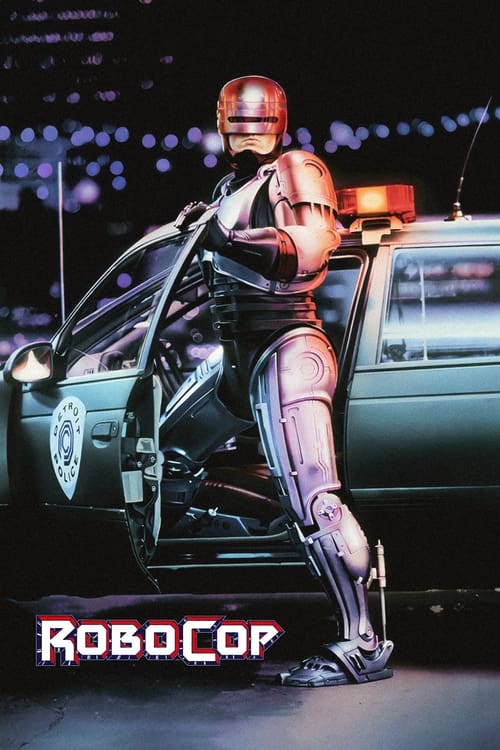
RoboCop
1987 · Paul Verhoeven
For when you want a big, loud action night that's also smarter than it has any right to be — perfect with friends, beer, and a willingness to be surprised that the 'dumb' movie is the sharpest thing you've seen all month.
What it's about
In a near-future Detroit rotting from crime and corporate greed, the megacorporation Omni Consumer Products takes over the police force and needs a body for its new law-enforcement product. Street cop Alex Murphy, gunned down by a vicious gang on his first day in a new precinct, is rebuilt as RoboCop — a part-human, part-machine officer who cleans up the streets with terrifying efficiency while fragments of the man he was start surfacing. It's a shoot-out movie about crime lords and boardrooms, and underneath, a story about a stolen identity clawing its way back.
The experience
A wild double experience: ferociously violent action beats sitting right next to laugh-out-loud satirical TV ads and newscasts, with an unexpected vein of real sadness running through the middle. It's fast, mean, funny, and weirdly moving all at once.
Performances
Peter Weller does remarkable work from inside a full-body suit, conveying Murphy's buried humanity through nothing but his jaw, his voice, and the way he moves, while Kurtwood Smith makes crime boss Clarence Boddicker one of the era's most gleefully hateful villains.
The craft
Paul Verhoeven fuses practical-effects bravado — the iconic RoboCop suit, the stop-motion menace of the ED-209 enforcement robot — with razor-edged satirical writing about privatization and media rot. Basil Poledouris's score gives the machine a genuinely heroic, mournful theme, and the whole thing still looks and sounds fantastic cranked up loud.
Why it matters
It launched Verhoeven's American career, spawned a franchise, and became the benchmark for smuggling savage social satire inside a blockbuster — endlessly quoted, endlessly imitated, rarely matched.
Snapshot
RoboCop is the film in which a European art-cinema émigré took a piece of pulp science fiction about a cyborg policeman and turned it into one of the sharpest satires of Reagan-era America ever produced inside the studio system. On its surface it is a hyper-violent action picture: street cop Alex Murphy is murdered by a gang of thugs, resurrected by the megacorporation Omni Consumer Products as a part-human, part-machine law-enforcement product, and gradually reclaims the memory of the man he was. Beneath that surface runs a corrosive comedy about privatization, media saturation, corporate amorality, and the commodification of the body. Directed by Paul Verhoeven in his first American assignment, written by Edward Neumeier and Michael Miner, and built from an unusually coherent fusion of practical effects, stop-motion animation, and operatic scoring, the film became both a commercial success and a durable cultural touchstone — the rare blockbuster whose ironies have only sharpened with age.
Industry & production
RoboCop was a product of Orion Pictures, the independent-minded studio that during the 1980s cultivated directors with distinctive voices. The screenplay by Edward Neumeier and Michael Miner circulated as a high-concept genre piece, and by Verhoeven's own much-repeated account he initially dismissed it — reportedly throwing the script away before his wife encouraged him to look past the lurid title to the satirical structure underneath. Verhoeven, an established figure in Dutch cinema (Soldier of Orange, The Fourth Man), had no English-language feature to his name; the project became his Hollywood debut, with producer Jon Davison, a veteran of Roger Corman's orbit and of Airplane!, shepherding it.
Production relocated the explicitly Detroit-set story largely to Dallas, Texas, whose then-rising corporate skyline and available architecture supplied the imagery of a near-future American city hollowed out by capital. The shoot was physically demanding, particularly for star Peter Weller, who endured long hours inside Rob Bottin's heavy, heat-trapping suit.
The film's most documented industrial episode is its battle with the MPAA. Verhoeven's unsparing depiction of violence — above all Murphy's drawn-out execution and the climactic dissolution of a henchman in toxic waste — drew repeated X ratings, forcing several rounds of trims before an R was secured for theatrical release. The episode became a frequently cited example of the period's friction between directorial intent and the ratings board, and later home-video editions restored some excised footage.
Technology
RoboCop is a landmark of late practical-effects filmmaking, made just before computer-generated imagery began to displace such craft. Two technologies define it. The first is the RoboCop suit itself, designed and executed by Rob Bottin's effects shop — a sculpted, articulated costume that had to read as armored machinery while permitting an actor to perform inside it. The second is ED-209, the corporation's rival enforcement droid, animated by Phil Tippett using stop-motion and "go-motion" techniques refined in his earlier work on Star Wars and Dragonslayer; the droid's lumbering menace and its notorious boardroom malfunction depend on the slightly uncanny weight that hand-animation lends. Full-scale ED-209 mock-ups were used for interactive shots.
The film also deploys point-of-view technology as a storytelling device: RoboCop's heads-up display, targeting reticles, and data readouts visualize his machine perception, while the recurring "media break" interludes — satirical newscasts and commercials — function as a diegetic technology of saturation, presenting the world through screens.
Technique
Cinematography
The film was photographed by Jost Vacano, the German cinematographer best known for the claustrophobic mobility of Das Boot. Vacano gives RoboCop a hard, metallic clarity appropriate to its corporate-industrial world, and he varies register sharply: the human Murphy material is shot with relative warmth, while the RoboCop sequences favor low angles, reflective surfaces, and a steely palette that monumentalizes the figure. Vacano is also associated with kinetic, body-mounted camerawork, and the picture's action has a propulsive physicality. The cinematography consistently frames OCP's interiors as gleaming, vertiginous spaces of power, contrasted with the grimy, low-lit precincts and ruined steel mills where the street action unfolds.
Editing
Frank J. Urioste cut the film, and its rhythmic control is central to both its violence and its comedy. The editing modulates between sustained, almost unbearable duration — the prolonged cruelty of Murphy's death — and rapid, percussive assembly in the gunfights. Crucially, the media breaks are edited as abrupt tonal interruptions, puncturing the narrative with bursts of satire before snapping back; this interleaving structure, more than any single joke, is what gives the film its distinctive double consciousness.
Mise-en-scène / staging
Verhoeven stages RoboCop as a series of escalating spectacles built around a vertical social architecture: the higher one rises in OCP's glass tower, the more abstract and lethal the cruelty becomes, while the violence on the street is squalid and immediate. The boardroom demonstration of ED-209 — in which the machine guns down a junior executive over a procedural error while his superiors react with bureaucratic embarrassment — is the film's defining set piece of staging, locating horror inside the polished decorum of corporate ritual. The production design fills the frame with logos, brand names, and consumer detritus, making commodification a constant visual texture rather than a stated theme.
Sound
Basil Poledouris's score is one of the film's signal achievements. Against the satirical, electronic-inflected world, Poledouris supplies a genuinely heroic, brass-driven orchestral theme for RoboCop that takes the character's plight seriously even as the film mocks everything around him — a tonal counterweight that lets the audience feel Murphy's tragedy as well as laugh at the dystopia. The sound design renders RoboCop's movements with mechanical servos and weighted footfalls, and the modulated, processed quality of Weller's RoboCop voice is itself a sonic marker of his hybrid state.
Performance
Peter Weller's performance is built from restraint and physical precision. Reportedly working with mime and movement coach Moni Yakim, Weller developed a deliberate, machine-like economy of motion — a stillness and ratcheting precision that survived even after the bulky suit altered his original choreography. The pathos of the film depends on the small human flickers Weller permits through the visor: the half-remembered gesture, the twitch of grief. Around him, Kurtwood Smith makes the gang leader Clarence Boddicker a memorably reptilian villain, Ronny Cox plays OCP's Dick Jones as smooth corporate menace, Miguel Ferrer's Bob Morton embodies yuppie ambition, Nancy Allen grounds the film as Murphy's partner Lewis, and Dan O'Herlihy presides as the genteel, oblivious "Old Man."
Narrative & dramatic mode
The film operates in two simultaneous modes that rarely cancel each other out. The primary arc is a tragedy of identity and resurrection: a man is destroyed, rebuilt as property, and must recover his selfhood against the corporation that owns him — a structure Verhoeven has repeatedly framed in mythic terms, describing RoboCop as a kind of American Christ figure who dies, is reborn, and walks again. Around that earnest spine the film wraps a savage satirical mode, delivered chiefly through the media breaks and the corporate scenes, which treat the dystopian society as absurdist farce. The dramatic engine is Murphy's gradual reclamation of memory — keyed to fragments of his former family life and culminating in his insistence, late in the film, on his own name. The narrative resolves as both revenge thriller and restoration of personhood.
Genre & cycle
RoboCop sits at the intersection of several genres: science fiction, the action film, and — beneath both — the western and the police procedural. Murphy is a lawman gunned down and resurrected to clean up a lawless frontier town, a structure with deep roots in the western. It belongs to the 1980s cycle of dystopian, corporately-dominated science fiction that includes Blade Runner, The Terminator, and Escape from New York, and to the decade's hard-R action cinema. More specifically, it inaugurates what is now commonly described as Verhoeven's loose trilogy of American satirical science fiction, completed by Total Recall (1990) and Starship Troopers (1997), all of which smuggle social critique inside the conventions of the spectacular blockbuster.
Authorship & method
The film is most strongly stamped by Verhoeven, whose method is to take genre material at full, lurid face value while loading it with irony — refusing the safe distance of camp by making the violence and the sentiment equally extreme. His authorship here is inseparable from a tight constellation of collaborators: screenwriters Edward Neumeier and Michael Miner, whose script supplied the satirical architecture and the media-break device; cinematographer Jost Vacano, who carried over from Verhoeven's European work; composer Basil Poledouris, whose score insists on the human stakes; editor Frank J. Urioste; effects designers Rob Bottin (the suit) and Phil Tippett (ED-209); and producer Jon Davison. The result is unusually unified for a studio genre film — the satire of the writing, the gravity of the music, and the craft of the effects pulling in the same direction.
Movement / national cinema
RoboCop is an American studio production, but it is decisively shaped by the European sensibility of a Dutch director and a German cinematographer arriving in Hollywood. Verhoeven brought from the Dutch cinema a willingness toward explicit sex and violence and a satirical relationship to authority that domestic filmmakers of the period rarely matched; the outsider's eye is part of what lets the film see Reagan-era America as a strange, brutal spectacle. It thus belongs less to any organized movement than to the productive friction of European art-film directors working within American genre commerce — a lineage that includes figures from Lang to Leone.
Era / period
The film is a quintessential document of the late Reagan 1980s. Its targets are the era's specific anxieties: the privatization of public functions, the deregulated ascendancy of the corporation, urban decay and deindustrialization (literalized in the ruined Detroit steel mills), media-driven consumerism, and a culture of slick, amoral ambition. OCP's plan to demolish "Old Detroit" and replace it with the gleaming speculative development "Delta City" reads as a direct satire of 1980s urban-renewal-by-capital. The media breaks — with their cheerful newscasters narrating geopolitical catastrophe between commercials — capture the period's televisual saturation with uncanny precision.
Themes
Several themes interlock. The most central is dehumanization and the recovery of the self: the question of what remains of a person once his body is corporate property. Closely tied is the critique of unchecked capitalism — the film's villains are less the street criminals than the executives who manufacture and profit from disorder, with OCP shown to be entangled with the very crime it claims to fight. A third strand is media and spectacle, the way violence and consumption are packaged for the screen. A fourth, foregrounded by Verhoeven himself, is resurrection and identity in a religious key — Murphy as a figure who dies and rises. Underneath runs a meditation on technology and the body, and on the western myth of the lawman restoring order to a frontier.
Reception, canon & influence
RoboCop was both a commercial success and, after some initial reactions to its violence, a critically respected one; over time its standing has risen markedly, and it is now widely regarded as one of the strongest American science-fiction films of its decade and a model of satire embedded in spectacle. (Precise box-office and budget figures vary across sources, so they are best treated with caution; what is not in dispute is that the film performed strongly enough to launch a franchise.)
The influences on the film are several and often acknowledged in the critical literature: the dystopian corporate futures of Metropolis and Blade Runner; the killer-android premise of Westworld; the cybernetic-rebuilt-hero conceit of The Six Million Dollar Man; the ultraviolent satirical law-enforcer of the British comic Judge Dredd in 2000 AD, frequently cited as a kinship even where direct influence is debated; and the deep structure of the western and film noir. Verhoeven's own European satirical instincts complete the mix.
Its legacy forward is broad. It spawned a franchise — RoboCop 2 (1990), with a screenplay involving Frank Miller, RoboCop 3 (1993), television and animated series, comics, and video games — and a 2014 remake directed by José Padilha. More diffusely, its fusion of hard action, biting corporate satire, and genuine pathos became a template, and its imagery and lines entered popular culture. Within Verhoeven's own career it set the pattern completed by Total Recall and Starship Troopers. Perhaps its most telling legacy is interpretive: a film once received in some quarters as mere violence is now routinely taught and written about as prescient social critique, its satire of privatized policing, corporate governance, and media spectacle having proved durable enough to keep finding new audiences.
A Deleuzian reading
Start with the visor.
The full Deleuzian reading of RoboCop →
Reception
A surprise hit in the summer of '87 that critics liked more than anyone expected from a movie called RoboCop — and it's only climbed since, now canonized as one of the sharpest satires of the Reagan era wearing an action-movie disguise.
How RoboCop was received, from release to now →
Influences: the films it descends from and the films it influenced
- Metropolis (1927) — Establishes the low-angle monumentalizing of the corporate tower and the machine-man as labor-capital allegory that Verhoeven reprises in OCP's mirror-glass skyscraper and the rebuilt worker-cop.
- Blade Runner (1982) — Provides the noir-lit, ad-saturated dystopian-corporate cityscape — privatized future as production design — from which the decaying Old Detroit and OCP's master plan descend.
- Westworld (1973) — Pioneers the pixelated machine-vision POV of the killer android, the direct ancestor of RoboCop's targeting-reticle HUD that renders the protagonist's perception as readout.
- Dirty Harry (1971) — Codifies the urban-western lone enforcer dispensing summary justice with an outsized sidearm, the police-procedural-as-western armature RoboCop satirizes by literalizing the cop into hardware.
- Network (1976) — Models satire delivered through diegetic broadcast — the media-as-corporate-spectacle device that Neumeier and Miner extend into RoboCop's tonal-interruption news and ad breaks.
- Dragonslayer (1981) — Phil Tippett's go-motion breakthrough on the dragon Vermithrax is the exact animation technique he carried to ED-209, blurring stop-motion's strobe into fluid mechanical menace.
- The Empire Strikes Back (1980) — Tippett's stop-motion tauntaun and AT-AT walkers establish the armatured-machine puppetry vocabulary that ED-209's stiff, servo-driven movement directly inherits.
- Flesh+Blood (1985) — Verhoeven's first English-language film with cinematographer Jost Vacano, where the method of playing extreme violence and extreme sentiment at equal, un-camped pitch is rehearsed before RoboCop.
- Conan the Barbarian (1982) — Basil Poledouris's mythic-heroic orchestral idiom — insisting on human gravity beneath genre spectacle — is the scoring approach he reprises to keep Murphy's pathos audible under the satire.
- The Terminator (1984) — Shares the relentless cyborg rendered through red-tinted machine-vision HUD overlays and a stop-motion endoskeleton, the contemporaneous practical-effects cyborg-POV craft RoboCop refines.
- Das Boot (1981) — Directly extends Jost Vacano's self-built gyro-stabilized handheld rig — the same fluid, body-mounted mobility he engineered for Das Boot's corridor runs — into Hollywood action staging.
- Total Recall (1990) — Reunites Verhoeven, Vacano, and Tippett on the same resurrection/identity premise, extending RoboCop's practical-gore satire and full-face-value irony into Mars.
- Starship Troopers (1997) — Completes Verhoeven's satirical trilogy by evolving RoboCop's media-break interludes into the 'Would you like to know more?' propaganda net that structures the whole film.
- RoboCop 2 (1990) — Frank Miller's screenplay pushes the corporate-satire architecture further while Tippett's stop-motion Cain cyborg scales up the ED-209 puppetry craft into a full-body antagonist.
- Demolition Man (1993) — Transplants RoboCop's privatized-policing-as-near-future-satire premise into a sanitized corporate utopia, keeping the embedded-satire-in-action-spectacle template.
- District 9 (2009) — Inherits the faux-documentary corporate-military media breaks and practical body-horror of mechanized augmentation, fusing biting satire with hard action exactly as RoboCop did.
- Elysium (2013) — Extends RoboCop's man-bolted-to-machine imagery and corporate-dehumanization satire through a surgically grafted exoskeleton, pairing practical hardware effects with class allegory.
- Terminator 2: Judgment Day (1991) — The corporate engineer whose research enables autonomous law-enforcement violence without his complicity being visible to him (Dick Jones / Bob Morton) is the direct structural model for Miles Dyson; Phil Tippett's go-motion ED-209 also established the convention of staging the machine body through a combination of puppet, optical, and sound design rather than as a human performance.
- Alita: Battle Angel (2019) — Murphy and Alita share the structural device of a cyborg body-as-corporate-property whose suppressed pre-corporate memory reasserts itself through combat competence, framing the question of who legally owns the enhanced body.
- Mickey 17 (2025) — Verhoeven punctuates the action with fake TV commercials and ED-209 boardroom farce that normalize institutional violence without ironic distance — establishing the bureaucratic-ambient-normalization mode and satirical-over-scale performance register Bong inherits directly.
- Iron Man (2008) — Established the practical man-in-a-suit armored hero as a vehicle for satirizing a corporate weapons-maker, with iterative-suit reveals and a critique of the military-industrial complex that Stark's arc inverts.
- Iron Man 2 (2010) — Template for the man-fused-to-photoreal-armored-machine, including the mechanical servo/motor sound-design motifs that score every suit movement.
- Chappie (2015) — The privatized-policing corporate dystopia and the stomping, malfunctioning bipedal ED-209 are directly reworked as Tetravaal/OCP and the MOOSE, down to the boardroom arms-dealer framing.
- Dredd (2012) — Realizes the Judge Dredd ultraviolent-lawman kinship RoboCop shared in 1987 — the armored, faceless summary-justice enforcer as deadpan critique of authoritarian policing.
- Sorry to Bother You (2018) — Ancestor of the satirical-SF mode that splices mock-corporate advertisements and a body-modified worker into a violent dystopia to indict capital, tonally rupturing comedy and horror.
- Basic Instinct (1992) — Same authorial method of playing genre material at full sincerity and full satiric excess simultaneously, so the lurid surface can be consumed straight or read as critique.
Similar films
- Total Recall (1990) — influence & lineage
- Blade Runner (1982) — influence & lineage
- The Terminator (1984) — influence & lineage
- Starship Troopers (1997) — influence & lineage
- Metropolis (1927) — influence & lineage
- District 9 (2009) — influence & lineage
- Upgrade (2018) — same viewing thread
- The Running Man (2025) — same viewing thread
All the films related to RoboCop →
Watch it with: curated runs of related films
- Rogue Heroes, Rigged Systems — A run of slick, propulsive 21st-century spectacle — spies, super-soldiers, sci-fi survivors, and dystopian rebels all squaring off against some vast machine or shadowy apparatus — best watched back-to-back when you want momentum, style, and a lone figure taking on the whole board.