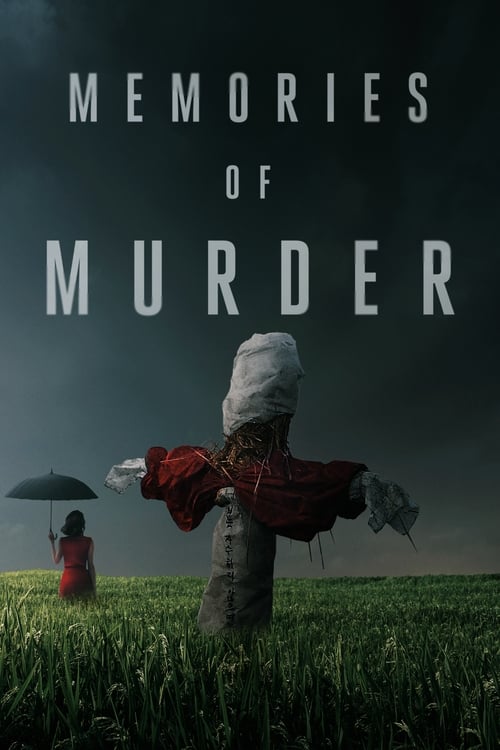
Memories of Murder
2003 · Bong Joon Ho
For when you want a masterpiece you can sink into — a crime film that's about far more than the crime. This is challenge-viewing that rewards total attention, ideal for a night you want to be moved as much as gripped.
What it's about
In a rural South Korean province in the 1980s, young women are being murdered by a serial killer, and the case falls to detectives who are catastrophically unequipped for it: a local cop who trusts his gut and his fists, and a methodical investigator down from Seoul. As the bodies accumulate and the leads dissolve, their conflicting methods — and the authoritarian machinery around them — bend under the weight of a killer they cannot find.
The experience
It starts almost as a dark comedy of small-town incompetence and slowly tightens into something devastating — rain-soaked, mournful, and haunted. Few thrillers leave this kind of ache; it stays with you for days.
Performances
Song Kang-ho gives one of the great screen performances as the local detective — blustering, funny, and finally heartbreaking — and Kim Sang-kyung charts the Seoul rationalist's unraveling with terrible precision.
The craft
Bong Joon Ho orchestrates tone like nobody else, sliding from farce to horror within a single scene, and stages the countryside — rice fields, tunnels, rain — as both gorgeous and menacing. The widescreen compositions and famous long takes reward the biggest screen you can find.
Why it matters
It established Bong Joon Ho internationally, became a cornerstone of the Korean cinema renaissance, and is routinely cited among the greatest crime films ever made — its influence visible in a generation of procedurals that followed.
Snapshot
Bong Joon Ho's second feature is a police procedural built around an irresolvable absence. Set in rural South Korea in the mid-to-late 1980s, the film follows two detectives—the provincial, intuition-driven Park Du-man (Song Kang-ho) and the rationalist Seoul transplant Seo Tae-yoon (Kim Sang-kyung)—as they pursue the perpetrator of a series of murders of young women in Hwaseong, Gyeonggi Province. The investigation yields no arrest. The film's final image—Park staring out of the frame and, in effect, at the audience—transforms the procedural into an open wound in national memory. Memories of Murder is simultaneously a critique of authoritarian policing, an elegy for victims lost to institutional failure, and a meticulously crafted genre work that refuses the satisfactions genre ordinarily provides. It became one of the definitive South Korean films of the 2000s and a landmark in world cinema.
Industry & production
Memories of Murder was produced by Sidus Corporation, one of the major commercial production and distribution companies driving the South Korean cinema boom of the late 1990s and early 2000s. It was Bong's second feature after Barking Dogs Never Bite (2000), which had performed modestly; Memories of Murder was the project that elevated him to the top tier of Korean new wave filmmaking.
The film is based on a stage play by Kim Gwang-rim, written in the mid-1990s and drawn directly from the unsolved Hwaseong serial murders of 1986–1991—South Korea's first identified serial murder case. Ten women were killed in the province; the case was never solved during the active investigation, which involved hundreds of thousands of police man-hours and multiple false arrests. The play dramatized these failures and their social texture. Bong co-wrote the screenplay with Shim Sung-bo, substantially fictionalizing the material—particularly the relationship between the two lead detectives and the film's political undertow—while remaining faithful to the investigative vacuum at the center of the historical record.
The film was a significant commercial success upon its South Korean release in April 2003, drawing millions of admissions and generating substantial critical attention domestically and at international festivals; readers should consult KOFIC records for authoritative figures. Its release coincided with South Korean cinema's ongoing consolidation as a global force.
Technology
The film was shot on 35mm in anamorphic widescreen (2.35:1), giving it a lateral sprawl suited to the wide agricultural landscapes of the Hwaseong countryside. The 35mm grain structure contributes to the image's material weight and period authenticity; Bong and cinematographer Kim Hyung-goo calibrated a slightly desaturated, muddy palette—greens and browns predominant—that registers the rural setting as a specific physical world rather than a backdrop. The photochemical character of the image is meaningful rather than incidental: it situates the film in a documentary-adjacent register without ever fully abandoning cinematic control.
Production design was substantial, recreating late-1980s South Korea meticulously—police station interiors, irrigation ditches, period-correct civilian dress—at a moment when Korean commercial films were investing heavily in production value as a competitive differentiator against Hollywood imports.
Technique
Cinematography
Kim Hyung-goo's work is the film's invisible spine. His signature choice is to deploy wide, often static or slowly drifting shots that grant the landscape the same visual weight as the human figures within it—a technique that implicitly refuses the typical procedural grammar of close-up intensity, where faces drive the revelation of truth. The early shot of the first victim's body in an irrigation ditch, revealed in slow lateral camera movement, establishes that this film's world will absorb violence into its physical texture rather than isolate it for spectacle. Deep focus is used throughout to hold foreground action and background environment in simultaneous resolution, denying the viewer easy prioritization of figure over ground.
Night sequences have a quality of available-light ambiguity: darkness is not stylized noir shadow but the actual low visibility of inadequately lit rural locations. This refusal of atmospheric enhancement gives the film a documentary adjacency that the narrative content—with its horror and its absurdity—continually complicates.
Editing
Edited by Kim Sun-min, the film's cutting rhythm is deliberately measured by genre standards. Scenes are permitted to breathe, and tonal incongruities—a slapstick foot chase followed by the discovery of a body—are placed in direct juxtaposition without editorial cushioning. The editing never signals how to feel; it presents tonal dissonance without resolution, forcing the audience to absorb incompatible emotional registers simultaneously. The film's final sequence, with its time-jump to 2003 and prolonged near-wordless close-up of Song Kang-ho, relies on the editing allowing sheer duration to function as pressure—the cut back to his face arrives not as revelation but as accumulation.
Mise-en-scène / staging
Bong's staging is consistently attentive to the relationship between authority and physical space. Police stations are cramped and bureaucratically provisional; interrogation scenes lit from above emphasize the physical coercion of bodies rather than the exchange of information. One of the film's most formally discussed scenes involves a suspect in an open field being questioned by both detectives simultaneously, the staging embodying competing methodological temperaments in pure spatial terms. Open agricultural fields frequently dwarf human figures—suggesting not pastoral openness but exposure and vulnerability.
Darkness and partial visibility are used as staging resources rather than technical problems to be solved. The sequences around the drainage canal at night, navigated by torchlight, establish the limits of what can be known as a visual condition before making it a thematic claim.
Sound
The score by Japanese composer Taro Iwashiro works consistently against genre convention. The music is largely restrained and melancholic rather than suspenseful, underscoring the film's elegiac rather than thriller-driven register. The conventional procedural underscore—which typically cues the viewer that progress is being made or that danger is approaching—is largely absent from investigative scenes, denying the viewer the usual genre signal that knowledge is accumulating. Ambient rural sound (insects, wind across fields, distant machinery) is allowed to sit under scenes in ways that anchor the film in a specific physical environment and resist the abstraction of conventional genre atmosphere.
Performance
Song Kang-ho's performance as Detective Park Du-man is the film's emotional center and its most technically accomplished achievement. Song—already established as a significant presence through Park Chan-wook's JSA (2000)—plays Park as a man whose confidence in his own intuition is both his defining flaw and a kind of necessary fiction: the alternative to intuition, in a case where evidence yields nothing, is paralysis. Song's capacity to modulate between broad physical comedy (Park is often genuinely funny, and the film leans into this) and devastation (the final scene makes no emotional concessions) is exceptional, and Bong uses this range as the film's tonal engine.
Kim Sang-kyung as Seo brings a contrasting register—intellectually brittle, increasingly desperate as the rationalist method fails—that prevents the film from reading as a simple critique of Park's cowboy methods. Both men are inadequate to the task; the film's point is precisely that both are. Kim Roi-ha as the violent Detective Cho occupies a third position—pure institutional brutality—that makes the procedural genre's default hero figure look systemically implicated in the violence the investigation purports to oppose.
Narrative & dramatic mode
Memories of Murder operates as a subverted procedural: it adopts the genre's structural promise (investigation leads to resolution) and systematically defeats it. The film's first act deploys many genre conventions—body discovered, detectives assigned, suspects identified—before gradually revealing that the evidence is contaminated, the witnesses unreliable, and the institutional apparatus of justice too coercive and too epistemologically limited to function as it claims. The two detective methods converge in failure, not in synthesis.
Dark comedy functions throughout not as tonal relief but as epistemological commentary: the detectives' methods are often genuinely absurd, and the film refuses to let audiences maintain comfortable distance from this absurdity. The comedy is not external to the tragedy but imbricated within it—the farcical elements illuminate how a state apparatus can fail people while remaining entirely earnest about its own legitimacy. This tonal mode—where horror and comedy inhabit the same event—would become the most recognized signature of Bong's subsequent work.
The film's time-jump ending, moving from the late 1980s to the film's own present of 2003, is a structural argument: the past is not closed, the murders remain open, and the detective who failed is still living inside the memory of that failure.
Genre & cycle
Memories of Murder belongs to the serial-killer procedural subgenre that gained global visibility through films like David Fincher's Se7en (1995), which preceded it. The two films are in evident dialogue: where Se7en provides a killer, a rationale, and a perverse resolution, Memories of Murder provides none of these. The structuring absence—the killer who cannot be identified—is deployed to opposite ends: in Se7en a final revelation intensifies horror; in Memories of Murder the absence becomes a wound that cannot close. The film is also adjacent to the true-crime procedural tradition, where the authority of documented fact haunts fictionalized dramatization.
Within South Korean cinema, the film participates in a broader early-2000s genre revisionism—Park Chan-wook's Vengeance Trilogy, Kim Jee-woon's A Tale of Two Sisters (2003)—in which genre conventions are deployed with formal sophistication and turned toward political and psychological content not ordinarily accommodated by genre. Memories of Murder is perhaps the most politically legible of these films, anchoring its genre critique in the specific failure of an authoritarian state rather than in mythologized or stylized violence.
Authorship & method
Bong has described his filmmaking method as rooted in careful pre-visualization—extensive storyboarding and preparation—combined with a treatment of tonal complexity as a structuring principle rather than a feature of individual scenes. His collaboration with Kim Hyung-goo established a visual approach they would continue on The Host (2006): wide frames, environmental anchoring, skepticism toward close-up-driven emotional guidance.
The co-writing relationship with Shim Sung-bo shaped the screenplay's calibration of the political material. The film's commentary on authoritarian policing—torture as standard procedure, coerced confessions as investigative currency—is embedded in character and narrative rather than delivered as exposition, giving it a more durable critical edge than explicitly polemical drama. Shim went on to direct his own debut, Haemoo (Sea Fog, 2014), produced by Bong.
Song Kang-ho's centrality to Bong's method deserves note: the director has returned to him repeatedly—The Host, Snowpiercer (2013), Parasite (2019)—and the director-actor relationship is one of the more significant sustained collaborations in contemporary world cinema. Bong has spoken in general terms about the way Song's ability to inhabit moral ambiguity—to be simultaneously sympathetic and culpable—corresponds to the ethical complexity Bong seeks in his protagonists. Memories of Murder is where this dynamic was first fully realized.
Movement / national cinema
Memories of Murder is a product of the South Korean new wave that emerged in the late 1990s following the relaxation of strict government censorship and the consolidation of KOFIC (Korean Film Council) support structures. This new wave was also materially enabled by the screen quota (의무상영제), which required Korean theaters to program domestic films for a minimum number of days annually, protecting the local industry from full Hollywood dominance. The generation that emerged from this environment—Bong Joon Ho, Park Chan-wook, Kim Jee-woon, Lee Chang-dong, Hong Sang-soo—produced films marked by generic ambition, technical sophistication, and willingness to engage with the unprocessed political history of the authoritarian period.
Memories of Murder is specifically legible within this context: its subject matter implicates the Chun Doo-hwan military dictatorship (1980–1988) and the early Roh Tae-woo presidency (1988–1993), a period of systematic state violence that included the Gwangju Uprising of 1980 and pervasive institutional coercion. The detectives' torture of suspects is not sensationalized; it is presented as routine practice, a normalized feature of the political order. The film's critique of the investigative failure is inseparable from its critique of the state that conducted the investigation.
Era / period
The film appeared at the apex of the first phase of the Korean new wave's international visibility—the period between JSA (2000) and Oldboy (2003), when Korean cinema became a regular and significant presence at major international festivals and in arthouse distribution globally. It was made during a moment of substantial South Korean cinematic ambition and commercial vitality, and its success reinforced the argument that commercially serious genre filmmaking and political and formal ambition were not mutually exclusive. The screen quota debates of the mid-2000s, which would intensify after the US-Korea Free Trade Agreement negotiations began, cast a retrospective light on this as a moment of productive but precarious institutional protection.
Themes
The film's dominant thematic preoccupation is institutional failure and the limits of reason. The state's investigative apparatus—the police, the legal system, the bureaucratic infrastructure of evidence—is revealed as inadequate not merely through incompetence but through structural violence: a system that tortures suspects cannot produce reliable knowledge, and a system that cannot produce reliable knowledge cannot protect people. This is both a critique of specific authoritarian practices and a more general claim about the epistemological consequences of state brutality.
Memory—individual and collective—is implicated throughout, named in the title. The murders leave a residue that cannot be processed or resolved; Park Du-man's return to the original crime scene in 2003 is the film's statement that unresolved historical violence continues to inhabit the present. The Hwaseong case was a collective trauma in South Korean public consciousness precisely because it had no resolution, and Bong's film internalizes that irresolution as formal principle rather than thematic assertion.
Gender is present but largely treated by implication: the victims are young women, the investigators exclusively male, and the film's refusal to dwell on the physical details of the crimes reads as both formal restraint and ethical stance—the violence against women is the condition that structures everything without being rendered as spectacle for the audience's processing.
Reception, canon & influence
Memories of Murder was received as a major work upon its Korean release and traveled internationally with significant critical success, cementing Bong's reputation outside Korea and establishing him as a director whose genre facility coexisted with serious thematic ambition. Korean critics and awards bodies recognized it substantially; internationally, it became—alongside Oldboy and A Tale of Two Sisters, both also 2003—one of the films through which the Korean new wave entered global critical consciousness.
Influences on the film: The serial-killer procedural tradition, and specifically the existential strain represented by Se7en, provides the closest genre antecedent, though Memories of Murder diverges sharply in its tonal and epistemological choices. The staging of bureaucratic dysfunction has antecedents in the New Hollywood police films of the 1970s. Within Korean cinema, JSA's demonstration that genre could carry political complexity was likely generative context. Bong has cited Hitchcock as a general formative influence; the specific shape that influence takes in this film—procedural mechanism as vehicle for irresolvable suspense—is evident but transformed.
Legacy and forward influence: Memories of Murder is now frequently cited alongside Fincher's Zodiac (2007) as one of the definitive procedurals about the limits of investigation—though the two films arrived in different national contexts and their relationship is one of convergent formal concern rather than direct influence. Within South Korean cinema, the film contributed to normalizing the mode of commercially viable genre work with serious political content that would define the Korean industry's international prestige through the 2010s. Its influence on subsequent Korean crime cinema—the use of historical true crime as a vehicle for political critique—is widely acknowledged by critics.
The film's reception was decisively altered by a real-world development. In 2019, DNA evidence identified Lee Chun-jae as the Hwaseong killer. Lee, already serving a life sentence for a separate murder committed in 1994, confessed to the Hwaseong crimes. The identification transformed Memories of Murder from a film about unresolved collective trauma into something stranger: a historical document of a case that had since been resolved, but too late for legal consequence—the applicable statute of limitations had expired. Bong Joon Ho responded publicly to the news, noting that the revelation gave the film's ending a different and more specific weight: the face in the final shot had, after sixteen years, become in principle identifiable. This real-world recursion—a fiction about an unsolvable case becoming the document of a case eventually solved—has few precedents in cinema history, and ensures that Memories of Murder will be read with permanently layered temporalities.
A Deleuzian reading
A body in an irrigation ditch, and the camera doesn't rush to it.
The full Deleuzian reading of Memories of Murder →
Reception
A domestic smash and critical darling in Korea in 2003, it stayed a cinephile deep cut in the West for years — then Parasite's Oscar sweep sent everyone back, a 2020 re-release followed, and it rocketed up the Letterboxd canon, now routinely called Bong's true masterpiece.
How Memories of Murder was received, from release to now →
Influences: the films it descends from and the films it influenced
- Chinatown (1974) — Polanski's subverted procedural establishes the formal template Bong inherits directly: investigative failure as the film's structural conclusion rather than a plot complication, with a final image encoding irreversible loss that forecloses the genre's consolatory resolution.
- Blow-Up (1966) — Antonioni structures an entire investigation around unverifiable photographic evidence—an image that may or may not prove a murder—giving Bong the precedent for treating evidentiary ambiguity as a narrative principle, and for sustained wide observational shots that watch without yielding interpretive certainty.
- The Conversation (1974) — Coppola's procedural built on a piece of surveillance audio that shifts meaning depending on emphasis establishes the epistemologically unstable evidence model Bong extends: in both films, methodological obsession accumulates data that confirms nothing, and the case outlasts the investigator's institutional mandate.
- Picnic at Hanging Rock (1975) — Weir and cinematographer Russell Boyd develop the visual grammar—wide, slow landscape shots where terrain consumes rather than frames human figures, the environment absorbing the disappeared without yielding explanation—that Kim Hyung-goo transposes directly to the Hwaseong agricultural fields.
- Badlands (1973) — Malick deploys lyrical non-diegetic music (Carl Orff, Erik Satie) that observes criminal violence without moralizing or signaling horror—the tonal model for Bong's score-against-genre, where a wistful melodic theme persists through crime scenes the procedural form would conventionally underscore with dread.
- Seven (1995) — Fincher's serial killer procedural establishes the two-detective template of methodological opposition—Freeman's systematic rationalism versus Pitt's intuitive aggression—that Bong reworks as the Seoul/province dialectic, and its refusal to restore order in the ending granted formal permission to withhold not merely justice but identification.
- Peppermint Candy (1999) — Lee treats 1980s South Korean authoritarianism as the origin wound of a generation through temporal dislocation—reverse chronology encoding the same decade Bong interrogates through flash-forward—establishing the formal grammar for mapping the Hwaseong murders' era as national scar tissue rather than period backdrop.
- Se7en (1995) — Inverts Se7en's serial-killer procedural so that the detectives fail and the case goes cold, performing the same subversion of genre expectation that Se7en's ending executes but sustaining it across the entire investigative arc rather than concentrating the subversion in a single climactic delivery.
- L.A. Confidential (1997) — Bong extends the braided three-investigator procedural — two detectives with incompatible methods joined by a third specialist — using Kim Hyung-ku's anamorphic depth-plane compositions and the parallel crosscutting structure, culminating in an institutional-false-conviction moral architecture that mirrors Hanson's.
- The Vanishing (1988) — Bong extends Sluizer's anti-thriller grammar — investigation that fails, identity that resists disclosure — to a Korean provincial landscape: rice paddies and drainage ditches become non-places in the Augé sense, and the refusal of narrative resolution converts the procedural form into a study of institutional impotence.
- High and Low (1963) — Police procedural deployed as shakai-ha social critique of institutional inadequacy and class-inflected justice, with rapid procedural assembly editing that accumulates investigative details simultaneously as evidence and as social symptom — Bong's direct inheritance of Kurosawa's genre politicization.
- Cure (1997) — Bong, who discusses Cure as a touchstone, builds an unsolved-murder anti-procedural in which the investigation corrodes the investigators; the wide, depth-staged rural compositions and withheld culprit follow Cure's deconstruction of the serial-killer hunt.
- Mother (2009) — Bong extends his own Memories grammar—open-field interrogation staging, wide static shots of rural Korean landscape, subverted procedural structure—into a maternal thriller where a technically achieved conclusion is rendered morally vacuous, deepening the original film's equation of institutional justice with epistemological failure.
- Zodiac (2007) — Fincher adopts Bong's formal solution to the irresolvable case—elapsed calendar time as the measure of institutional failure, documentary-adjacent widescreen cinematography that refuses stylization, and the detective's obsession outlasting the official investigation—extending the procedural's temporal scope from a single ending scene to a 20-year structural principle.
- The Chaser (2008) — Na Hong-jin's debut directly inherits the tonal dissonance structure Bong codified—physically comic chase sequences cutting to brutal violence without editorial cushioning—establishing this as standard Korean crime-procedural grammar in the wake of Memories of Murder.
- I Saw the Devil (2010) — Kim radicalizes the competing-methodologies dialectic Bong established by collapsing both poles into a single investigator whose rationalist methodology disintegrates under pressure, carrying forward Memories' argument that institutional authority—whether provincial or rationalist—is a producer of violence rather than a constraint on it.
- The Wailing (2016) — Na Hong-jin escalates Bong's competing-methodologies structure to include supernatural epistemology—shamanism, rationalism, and Christianity as equally unavailing investigative frameworks—while inheriting the wide-static rural Korean landscape cinematography, the tonal whiplash between grotesque comedy and genuine horror, and the irresolution that ends in worse devastation than the crime it initiated.
- Burning (2018) — Lee Chang-dong inherits Bong's structuring-absence device and applies it to a Murakami adaptation: an investigation of a possibly murdered woman built around unverifiable evidence, with wide static shots of South Korean rural landscape holding foreground and background in deep focus, the suspect's guilt permanently unconfirmable—irresolution as epistemological statement rather than narrative failure.
- Parasite (2019) — Bong systematizes the tonal dissonance editing first deployed in Memories—sustained comedic sequences followed by abrupt violence without editorial transition or tonal preparation—making the cut-without-warning technique a formal signature rather than a local device, now extended as the organizing principle of the entire film's structure.
- The Host (2006) — The immediate precursor where Bong, DP Kim Hyung-koo, and Song Kang-ho first fused documentary-register photography, scene-long tonal instability, and the buffoon-as-pathos performance that The Host elevates to its central method.
- The Yellow Sea (2010) — Bong's method of reading Korean crime through ethnographic peripheral geography — provincial roads, marginal social spaces, locations that resist genre glamorization — establishes the staging approach Na relocates to the Yanbian–Busan diaspora corridor.
- Prisoners (2013) — Double-investigator procedural structure — two investigators with opposed methods working a case that yields no arrest — which Prisoners inherits as its central device (Keller's amateur search running parallel to Loki's police procedural).
- Confession of Murder (2012) — Provides the procedural architecture in which the statute of limitations functions as the specific mechanism of state complicity — the dramatic engine Confession of Murder reactivates, shifting the unsolved-case structure from investigator's failure to survivor's reckoning.
- New World (2013) — Established procedural-institutional withheld omniscience — the killer is never conclusively identified — as a viable conclusion for serious Korean genre cinema, licensing New World's own refusal to resolve its moral arithmetic and raising the stakes for what Korean crime film endings could withhold.
- Joint Security Area (2000) — Park's procedural systematically dismantles its own investigative conclusions—evidence producing a story that institutional authority cannot officially recognize—developing in parallel with Bong the Korean New Wave grammar of the investigation-as-critique, where procedural failure reveals political structure rather than individual guilt.
- Sympathy for Mr. Vengeance (2002) — Park places bodies within wide observational frames that refuse to isolate violence from landscape, and cuts without editorial transition between registers of deadpan comedy and graphic harm—the same tonal dissonance grammar Bong deploys, developed simultaneously within the Korean New Wave's commercial peak.
- Oldboy (2003) — Bong deploys the same anamorphic widescreen register to isolate figures against the institutional landscapes of Korea, and both films use the investigation structure to arrive at an unresolved revelation about systemic failure rather than individual guilt; released within months of each other, they constitute the matched peak of Korean New Wave genre filmmaking.
- Infernal Affairs (2002) — Bong's investigative procedural deploys the same slow surveillance rhythm and editing patience — information withheld from investigators rather than disclosed, institutional failure accumulating without cathartic resolution — that Infernal Affairs establishes for its parallel-mole structure, forming a contemporaneous Korean branch of the psychological crime cycle's formal departure from action-genre momentum.
- The Silence of the Lambs (1991) — A humane, procedurally grounded serial-killer investigation that foregrounds investigator subjectivity and unresolved dread over spectacle.
- To Catch a Killer (2023) — Shares the procedural that deliberately refuses resolution, grinding its investigators down without the satisfaction of capture, and stages the hunt across cold, unglamorous institutional and rural space.
- Once Upon a Time in Anatolia (2011) — Turns a rural murder investigation toward unresolved futility, the procedure defeated by landscape and human opacity rather than fulfilled — the genre subversion Ceylan radicalizes into stasis.
- The Secret in Their Eyes (2009) — An unsolved-murder procedural that fuses tonal whiplash (comedy to dread) with national political trauma, the identical genre-melodrama-history braid on a different nation's wound.
- Decision to Leave (2022) — A Korean New Cinema detective film whose atmospheric, fog-and-terrain-soaked procedural centers on an investigator defeated by an unresolvable case, sharing Park's melancholic failure-of-detection and landscape mood.
- Save the Green Planet! (2003) — Same-year twin in method: interrogation-basement brutality played for laughs one shot and horror the next, and an ending that withholds resolution and drops to silence rather than releasing the audience with a reveal.
Similar films
- The Chaser (2008) — influence & lineage · same viewing thread
- Mother (2009) — influence & lineage · same viewing thread
- Joint Security Area (2000) — influence & lineage · same viewing thread
- Parasite (2019) — influence & lineage · same viewing thread
- Burning (2018) — influence & lineage · often watched together
- I Saw the Devil (2010) — influence & lineage
- Sympathy for Mr. Vengeance (2002) — influence & lineage
- The Wailing (2016) — influence & lineage
All the films related to Memories of Murder →
Watch it with: curated runs of related films
- New Korean Cinema — Watch these in a run and you feel one national cinema flip between monster movie, revenge thriller, gothic horror, and slow-burn procedural without ever loosening its grip on class, history, and family.
Film essays and courses that include it
- Portrait of the Killer: Serial Murder from Lang to Fincher
- Draining the World: The Grammar of Gray
- Rage and Form: The Korean New Wave
- Portrait of a Killer: How Cinema Learned to Inhabit the Monster
- Premeditated: Cinema's Century of the Kill
- The Long Beat: How Cinema Invented the Police Film
- The Investigator's Eye: From Sam Spade to Zodiac
- The Master of the Tonal Swerve