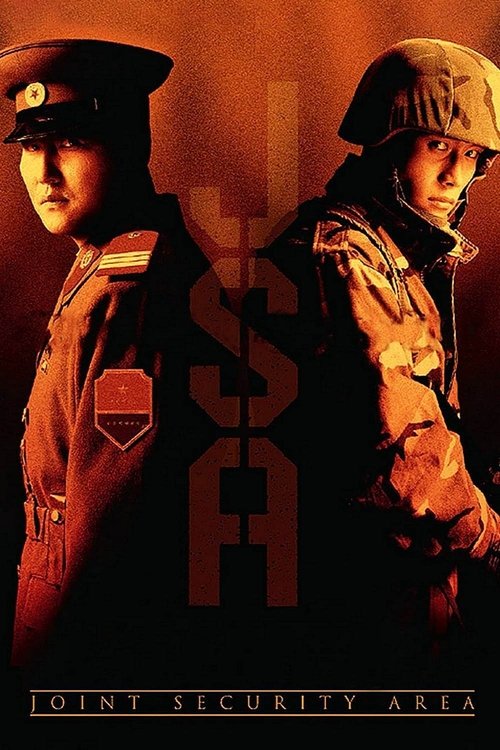
Joint Security Area
2000 · Park Chan-wook
Decision to Leave made him Letterboxd's romantic-obsession auteur; No Other Choice's Venice reception restarted the "greatest living Korean director" argument with Bong partisans. Elegance-plus-perversity is his brand in the discourse.
When you want a film that sneaks up on you emotionally — a mystery you watch for the puzzle and remember for the ache. One for a serious night in, and a conversation after.
What it's about
Two North Korean soldiers are shot dead in a border post at Panmunjom, the most heavily guarded strip of land on earth, and the South Korean sergeant who fired is in custody. A Swiss-Korean investigator from a neutral commission arrives to sort out why the two sides' accounts can't both be true — and what she uncovers is a hidden story of friendship across the line.
The experience
It starts as a cool procedural and slowly becomes something heartbreaking — warm, funny, and human in the middle, with a weight of sadness pressing in from the edges. By the end it plays less like a thriller than an elegy.
Performances
Song Kang-ho brings enormous warmth and gravity to a North Korean sergeant, and Lee Byung-hun carries the film's guilt and grief as his Southern counterpart — two performances that make the border feel like a wound between friends.
The craft
Park Chan-wook structures the investigation as competing testimonies, letting the true story surface piece by piece, and stages the divided border with precise, symmetrical images — men facing each other across a painted line. It's controlled, handsome filmmaking where every composition carries the theme.
Why it matters
A landmark of the Korean film renaissance, it arrived at a rare moment of thaw between the two Koreas, broke box-office records at home, and launched Park Chan-wook toward international fame.
Snapshot
A Swiss-Korean officer with the Neutral Nations Supervisory Commission is dispatched to investigate a double killing at the DMZ's Panmunjom, where a South Korean soldier is accused of crossing into North Korean territory and shooting two guards. As she takes testimony from the survivors on opposing sides, their irreconcilable accounts slowly fracture into a third story — one of secret nocturnal friendship across the most militarized border on earth. Joint Security Area is simultaneously a procedural thriller, an elegy for a divided nation, and a Rashomon-structured moral tragedy. It arrived at a precise historical hinge: the era of Kim Dae-jung's Sunshine Policy, when inter-Korean contact seemed briefly imaginable, and it shaped what Korean cinema could say about that contact for years afterward.
Industry & production
Park Chan-wook's first two features — The Moon Is the Sun's Dream (1992) and Trio (1997) — had performed negligibly at the domestic box office, leaving him a respected but commercially marginal figure in the Korean industry. Joint Security Area was produced by Myung Films, which had already staked out politically ambitious genre territory, and adapted from Park Sang-yeon's 1998 novel DMZ. The screenplay was co-written by Park Chan-wook, Lee Moo-young, and Kim Hyun-seok, substantially restructuring the source novel's narrative architecture to foreground the investigative frame and the Rashomon oscillation between testimonies.
Upon release in September 2000, the film broke South Korean box-office records, surpassing Shiri (1999, dir. Kang Je-gyu) — itself a landmark — to become the highest-grossing domestically produced Korean film at that time. Exact admissions figures were widely reported in the Korean press but should be verified against the Korean Film Council's archival data rather than cited from secondary sources. The commercial magnitude was unambiguous: it confirmed that large-scale, politically engaged Korean genre cinema had a mass audience, and it gave Park the leverage to pursue the far darker projects that followed.
The production navigated the considerable logistical sensitivity of depicting the Joint Security Area itself — the four-hundred-square-meter zone in Panmunjom where North and South Korean soldiers stand face-to-face around the clock. Shooting at the actual site was not feasible; the production constructed detailed replicas of the Bridge of No Return and the JSA guard posts, informed by documentary research and period photography. This necessity of reconstruction became, in retrospect, thematically apt: the film is about the impossibility of recovering the truth of an event, about reproductions that can never perfectly substitute for the original.
Technology
Joint Security Area was shot on 35mm, consistent with Korean mainstream production norms of the period. The film predates the digital intermediate workflows that would become standard within a few years, so color was managed through photochemical timing rather than DI grade. The cinematography makes deliberate use of contrast between the desaturated, institutional gray-green palette of the official investigation sequences — signaling bureaucratic neutrality — and the warmer, higher-contrast images of the flashback scenes depicting the soldiers' friendship. This tonal shift was achieved through lens selection, lighting design, and lab timing rather than post-digital manipulation, which gives the contrast a slightly softer, more organic quality than equivalent DI-era work would produce.
Production design constructed replicas of the JSA buildings and the Bridge of No Return with evident attention to documentary accuracy; behind-the-scenes materials confirm significant architectural research. The photograph that serves as the film's central piece of physical evidence — a picture of the four soldiers together, proof of their illegal fraternization — was designed as a narrative object required to be both intimate and credible as a military-period snapshot.
Technique
Cinematography
The cinematographer was Kim Sung-bok. His approach to the JSA compound spaces emphasizes the architectural geometry of confrontation: guard booths placed symmetrically on opposing sides of a demarcation line, the soldiers' bodies held at prescribed angles by regulation, the frame itself partitioned by the built environment. In the investigation sequences, camera movement is restrained and observational, reinforcing Sophie Jean's role as external witness. In the flashback scenes, the camera loosens — handheld passages intrude into sequences that are otherwise composed, marking the clandestine human warmth as something resistant to official framing. The night scenes at the North Korean guard post, where the four men eat together and tell jokes across ideological lines, are lit with a practical warmth — lamplight, low angles — that evokes intimacy rather than drama, and the cinematography trusts the actors' physical proximity to carry the scene rather than cutting for emphasis.
Editing
Kim Sang-beom edited the film; he would become one of Park Chan-wook's essential long-term collaborators, cutting each film in the subsequent Vengeance Trilogy. His cutting on JSA manages a complex temporal architecture: the official present of the investigation, the divergent testimonies that offer contradictory flashbacks, and the single unified truth that the film withholds until close to the end. The editing does not editorialize between conflicting accounts — the cuts between testimony and flashback are clean and direct, keeping the viewer in a suspended analytical state rather than prompting suspicion toward any single narrator. The climactic sequence, in which the actual events of the shooting are finally rendered, deploys rapid cutting and spatial disorientation to convey both the physical chaos of the moment and the emotional collapse of everything that preceded it.
Mise-en-scène / staging
The film's most celebrated staging achievement is the extended sequence in the North Korean guard post, where Sgt. Lee Soo-hyeok (Lee Byung-hun), Sgt. Oh Kyeong-pil (Song Kang-ho), and junior soldier Nam Il (Shin Ha-kyun) occupy a small interior space with the ease of people who have made a home there in secret. Park stages these scenes with careful attention to proxemics — the soldiers' bodies incline toward one another across the political gulf their uniforms represent, their gestures borrowing the vernacular of ordinary male friendship: sharing food, needling each other, falling asleep in the same room. The staging insists on their ordinariness, which is precisely the point. The political tragedy the film builds toward is premised on the audience having fully accepted these people as friends before the machinery of national division destroys what they built.
The JSA itself — the line, the booth, the prescribed standing positions — functions as a kind of physical grammar of confrontation that the film periodically returns to, juxtaposing its official rigidity with what the soldiers have quietly abolished in private.
Sound
Jo Yeong-wook composed the score, his first collaboration with Park Chan-wook; he would score the entirety of the Vengeance Trilogy as well. His work here is restrained by comparison with those later films — the score leans toward melancholic strings and spare piano, accompanying the investigation's grief-soaked revelations rather than driving tension. The decision is apt: the film's emotional freight comes from the human drama, and a more insistent score would compete with it. The JSA soundscape — wind over an open border zone, the ambient silence of a space where sound itself is loaded — is used to establish mood in the exterior scenes without resort to conventional genre signaling.
Performance
Song Kang-ho's performance as Oh Kyeong-pil is the film's anchor. Already recognized for The Foul King and his role in Shiri, Song here plays a North Korean noncommissioned officer with a quality of quiet, weary competence that refuses caricature in either direction — neither the Western-cinema stock villain nor a sentimental idealization of the Other. His Oh is pragmatic, funny in small ways, and finally devastated by events, and Song renders each of these registers without apparent seams. Lee Byung-hun, whose career would extend to major international productions in subsequent decades, brings a volatile interiority to Sgt. Lee — a man whose warmth and capacity for violence are genuinely coextensive, which the film requires. Lee Young-ae's Sophie Jean is written as an outsider, and Lee plays the character's dual exclusion — too Korean for Switzerland, too Swiss for Korea — with a controlled opacity that works structurally: she is the audience's surrogate, positioned to discover rather than know.
Narrative & dramatic mode
The Rashomon structure is not incidental but constitutive. The film explicitly invokes Kurosawa's model — conflicting testimonies about a violent event, the impossibility of adjudicating between them — while departing from it in one decisive way: JSA does provide an answer. The film ultimately shows us what happened, dissolving the epistemological suspense into something more purely tragic. Where Kurosawa's film ends in the irresolvability of human self-interest, Park ends in the irresolvability of human feeling — we know exactly what happened and we know it changed nothing. The investigation's outcome is predetermined by the political structure it serves; the truth, once revealed, has nowhere to go.
The dual temporal tracks — investigation present, friendship past — are handled with discipline. The past is not simply backstory but the emotional core; the procedural present is the means by which its contents are released.
Genre & cycle
Joint Security Area belongs to a cycle of inter-Korean thrillers that emerged in the late 1990s following the relaxation of South Korean censorship restrictions on direct dramatic treatment of the North. Shiri (1999) had demonstrated the commercial viability of the form; JSA deepened its thematic range. Subsequent films in the cycle — Silmido (2003), Welcome to Dongmakgol (2005), and The Front Line (2011) — all engage the question of what happens when Koreans on opposing sides of the division recognize each other as human, and JSA's influence on their narrative architecture is evident. The film is also legible as a legal thriller and a detective procedural, genres that bracket its political content in a framework accessible to audiences without prior investment in Korean history.
Authorship & method
Park Chan-wook's involvement in the screenplay means the film's thematic architecture — the interest in guilt, complicity, and the inadequacy of justice as a response to moral catastrophe — reflects concerns that would define his subsequent work. The Vengeance Trilogy that followed JSA pursues these themes into far more stylized and extreme territory, but JSA is their first full statement. Park has spoken in interviews about his interest in moral complexity that resists resolution, and the film's refusal to assign simple blame — the shooting is both understandable and catastrophic, the political structure both explicable and obscene — exemplifies this.
Kim Sang-beom's editing partnership with Park begins here and constitutes one of the more significant director-editor collaborations in New Korean Cinema. Jo Yeong-wook's scoring relationship with Park also originates here, establishing a musical vocabulary that would evolve across the trilogy. Kim Sung-bok's cinematographic contribution was more singular — Park would work with different cinematographers on subsequent films — but his work on JSA established the tonal range the material required.
Movement / national cinema
Joint Security Area is a central document of what came to be called the Korean New Wave or New Korean Cinema — the explosion of formally accomplished, commercially successful, internationally recognized filmmaking that emerged from South Korea between roughly 1997 and 2010. The conditions enabling this wave included structural reform of the film industry in the wake of the 1997 financial crisis, the growth of screen quota protections for domestic productions, and the abolition or relaxation of censorship provisions that had constrained political subject matter. The generation of directors who emerged in this period — Park Chan-wook, Bong Joon-ho, Lee Chang-dong, Kim Ki-duk — shared a willingness to engage historical and political trauma directly, within genre frameworks that ensured mass audiences, and JSA is among the first and most commercially vindicated expressions of that synthesis.
The film also participates in what might be called the cinema of national division — a distinctly Korean genre with no precise equivalent elsewhere, in which the DMZ and its human consequences serve as the site through which questions of identity, memory, and political legibility are worked out. This is a genre that Korean cinema can claim as fully its own.
Era / period
The film arrives in the specific historical window of the Kim Dae-jung administration (1998–2003) and its Sunshine Policy of engagement with North Korea, a policy whose diplomatic high point — the first inter-Korean summit, June 2000 — coincided almost exactly with the film's production and release. The Sunshine Policy created cultural permission for imagining North Koreans as something other than enemies; JSA pushed that permission as far as it would go, depicting not just diplomatic exchange but private friendship, affection, and shared laughter. The film registers the optimism of that moment while providing it no comfort: the machinery of division is shown to be impervious to the human connections it inadvertently produces.
Themes
The film's primary thematic investment is in the arbitrariness of the political categories that structure its characters' lives and deaths. The four soldiers — two South Korean, two North Korean — are shown to be mutually legible as people long before any ideology is relevant to their interactions; the ideology is externally applied, a bureaucratic fact of their bodies' locations on a map. The tragedy is not that they fail to understand each other but that their understanding is politically inadmissible.
Secondary themes include the inadequacy of official structures of truth-telling: the NNSC investigation is earnest and professionally conducted and arrives, in the end, at an account that serves political necessity rather than the actual events. Memory, testimony, and institutional record are shown to diverge systematically. The film also engages the gendered politics of the division narrative — Sophie Jean's status as a woman in a space defined by male military confrontation, and as a Korean diaspora figure in a conflict that erases the distinctions between the Korean diaspora and either side, gives the investigation scenes a quality of double exclusion.
Reception, canon & influence
Joint Security Area received widespread critical acclaim in South Korea and substantial international attention, contributing to the growing global recognition of Korean cinema in the early 2000s. It won multiple Grand Bell Awards (Daejong Film Awards), including significant craft categories, though precise award lists should be confirmed against official records. It was selected as South Korea's submission for the Academy Award for Best Foreign Language Film.
Backward influences: The Rashomon structure (Akira Kurosawa, 1950) is the acknowledged formal ancestor. The film's treatment of border-zone male friendship under political duress has affinities with earlier European films about divided nations — including works from the German cinema of partition — though Park has not, to this author's knowledge, cited specific precedents in this tradition. The political thriller conventions it employs are internationally derived but deployed with a specifically Korean historical consciousness.
Forward influence: JSA is the film from which Park Chan-wook's international career effectively began — the Vengeance Trilogy (Sympathy for Mr. Vengeance, 2002; Oldboy, 2003; Lady Vengeance, 2005) would extend his global reputation, but JSA established his name. Its influence on the inter-Korean thriller cycle that followed is structural and thematic. Welcome to Dongmakgol (2005) in particular can be read as a deliberate variation on its premise — inter-Korean male friendship interrupted by political violence — transposed to the Korean War period. The film's success also helped legitimate Song Kang-ho as the central performer of his generation in Korean cinema, a position he has consolidated across a career that includes Memories of Murder, The Host, Parasite, and Broker. Lee Byung-hun and Lee Young-ae both trace significant portions of their subsequent careers to the visibility JSA provided.
In the broader canons of political cinema and of films about national division, Joint Security Area holds a secure position: it is the film that most fully demonstrated what a popular South Korean cinema could do with the defining fact of Korean modern history, and it did so at a moment when that history seemed, briefly, to be changing.
A Deleuzian reading
A photograph of four men, taken in a small room they were never meant to share.
The full Deleuzian reading of Joint Security Area →
Reception
A record-breaking blockbuster in Korea on release — it briefly became the highest-grossing Korean film ever — but abroad it was quickly overshadowed by Oldboy; decades on, it's been reappraised as maybe Park Chan-wook's most humane and emotionally direct film.
How Joint Security Area was received, from release to now →
Influences: the films it descends from and the films it influenced
- Rashomon (1950) — The four-witness structure that renders each testimony in full conviction before collapsing into irresolvable contradiction — JSA copies this architecture directly, including the framing investigator who cannot adjudicate between versions and the understanding that each account is psychologically true for its speaker.
- Courage Under Fire (1996) — A military officer investigates conflicting soldier testimony about a lethal battlefield incident through successive flashback reconstructions that contradict each other; the procedural-Rashomon hybrid with military hierarchy as the investigative frame is JSA's most direct structural template.
- Hiroshima mon amour (1959) — The syntax of handheld or fragmented image irrupting into a composed present-tense scene as a formal marker of traumatic memory that resists institutional order — JSA's handheld flashback intrusions into the bureaucratically framed investigation sequences inherit this Resnais device.
- Shiri (1999) — Established the inter-Korean thriller as a viable mainstream Korean genre by granting North Korean characters full psychological interiority rather than propaganda abstraction; JSA inherits this generic vocabulary and deepens it, centering its North Korean soldiers as the moral and emotional fulcrum of the film.
- Peppermint Candy (1999) — Reverse-chronological editing architecture in which the temporal structure itself encodes political trauma — the cut is the argument; made in the same New Korean Cinema moment, both films use fragmented time as moral statement rather than mere stylization.
- The Spy Who Came in from the Cold (1965) — Institutional desaturation — a flat, gray-green photographic palette that renders Cold War bureaucracy as moral anesthetic — furnishes the visual language JSA deploys in its investigation sequences to signal that neutrality is itself a form of ideological erasure.
- Au revoir les enfants (1987) — Proxemic staging of cross-ideological forbidden friendship: the camera holds observational distance as bodies navigate socially enforced separation, trusting physical closeness between the boys to carry moral weight without editorial comment — exactly the method JSA uses in its nocturnal North Korean guard-post scenes.
- The Sweet Hereafter (1997) — A community trauma investigated by an outside professional who collects fractured testimony across non-linear time, where the retrospective reconstruction is exposed as incomplete and the investigator's own position is structurally compromised — JSA's Swiss officer Sophie Jean occupies an identical structural role.
- Sympathy for Mr. Vengeance (2002) — Kim Sang-beom's editing advances JSA's temporal-withholding architecture: causal sequence is now fragmented across the whole film so that moral consequence precedes comprehensible motive, pushing JSA's suspended-truth strategy into full structural disorientation as a sustained formal mode.
- Oldboy (2003) — Kim Sang-beom's editing manages the climactic truth-sequence with the same rapid cutting and spatial disorientation JSA deploys for the shooting; the protagonist who discovers he was the unwitting agent of his own destruction mirrors JSA's narrative logic of self-implication through withheld evidence.
- Welcome to Dongmakgol (2005) — Directly extends JSA's genre invention of the nocturnal cross-ideological soldier friendship — North and South Korean troops stranded together — including ensemble composition that grants soldiers on both sides equal psychological weight and scenes of clandestine warmth that JSA established as the genre's emotional register.
- The Front Line (2011) — Extends JSA's proxemic architecture of cross-ideological intimacy to the Korean War: the shifting trench line functions as JSA's demarcation line, with opposing soldiers developing clandestine contact staged using the same architectural geometry of confrontation — bodies at prescribed angles, the built divide partitioning the frame.
- The Berlin File (2013) — Extends the inter-Korean spy thriller into diasporic Korean communities abroad, deploying North and South Korean operatives as psychologically equivalent antagonists — a direct inheritance of JSA's genre premise that each side's soldiers are mirror figures rather than hero/villain opposites.
- The Handmaiden (2016) — Escalates JSA's two-testimony Rashomon structure into a three-chapter form where each part re-contextualizes the events of prior chapters; Kim Sang-beom edits the temporal reversals using the same clean-cut strategy he developed in JSA, now weaponized for narrative pleasure rather than moral elegy.
- Escape from Mogadishu (2021) — Establishes the Korean division film's emotional grammar: staging North and South Korean characters in enforced physical proximity to dramatize ideological division through personal affect rather than political argument, the direct template for EfM's diplomatic-compound sequences.
- Swing Kids (2018) — Builds soldiers from both sides of the division forging illicit fellowship through shared culture, doomed by the machinery of the state — the anti-cathartic division-tragedy template.
- Save the Green Planet! (2003) — The source of Shin Ha-kyun's tonal-whiplash technique — a performance that plays comedy and catastrophe with identical internal logic, so the register change comes from the film around him rather than from any visible gear-shift in the acting.
- Memories of Murder (2003) — New Korean Cinema procedural deploying ensemble proxemic realism and institutional investigation aesthetics to excavate political violence; Song Kang-ho performs in both films with the same body-language specificity, his physicality establishing a shared repertoire between the two directors' procedural registers.
- Tae Guk Gi: The Brotherhood of War (2004) — Contemporaneous division-trauma blockbuster that dramatizes the border through cross-line male fraternity and reconstructs its tragedy via an investigative flashback frame — the same memory-and-mourning framing device.
Similar films
- Memories of Murder (2003) — influence & lineage · same viewing thread
- Oldboy (2003) — influence & lineage · same viewing thread
- The Handmaiden (2016) — influence & lineage · same viewing thread
- Sympathy for Mr. Vengeance (2002) — influence & lineage
- The Berlin File (2013) — influence & lineage
- Decision to Leave (2022) — same viewing thread
- Tae Guk Gi: The Brotherhood of War (2004) — same viewing thread
- 12.12: The Day (2023) — same viewing thread
All the films related to Joint Security Area →
Watch it with: curated runs of related films
- New Korean Cinema — Watch these in a run and you feel one national cinema flip between monster movie, revenge thriller, gothic horror, and slow-burn procedural without ever loosening its grip on class, history, and family.