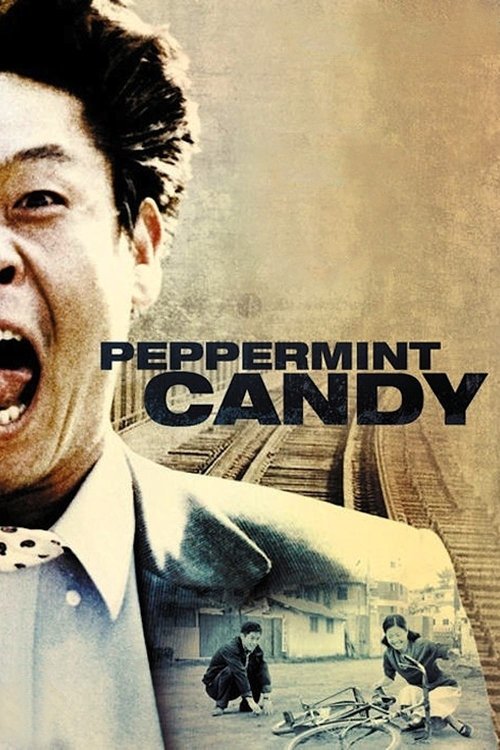
Peppermint Candy
2000 · Lee Chang-dong
For when you want a film to chew on for days and you're ready to be wrecked — a serious, demanding evening, not comfort viewing. Reach for it when you want cinema that treats one life as the story of a whole country.
What it's about
A broken, middle-aged man crashes the twentieth-anniversary reunion of his old factory friends at a riverside picnic, then climbs onto a railroad bridge and screams that he wants to go back. The film takes him at his word: it runs in reverse, moving through seven episodes across two decades of South Korean history — military service, police work, business, marriage, first love — peeling away the layers of how Yeong-ho became the man on the bridge.
The experience
Devastating in slow motion. Because you meet the wreckage first, every step backward lands with dread and tenderness at once — you keep hoping to find the moment things could have gone differently. It's heavy, deliberate, and it stays with you for days.
Performances
Sol Kyung-gu is astonishing as Yeong-ho, playing the same man at half a dozen ages and moral temperatures — from raw, hopeful boy to hollowed-out predator — and making every version recognizably the same person.
The craft
The reverse structure is the whole engine: each chapter quietly rhymes with the one before it, so ordinary objects and gestures accumulate unbearable meaning. Lee Chang-dong, a novelist before he was a director, builds it with a writer's precision — trains, rivers, and returning motifs stitch the episodes together — and the film rewards close, uninterrupted attention.
Why it matters
A foundational work of the Korean cinema renaissance around the turn of the millennium, and the film that established Lee Chang-dong as one of the country's essential directors. In Korea it became a touchstone for reckoning on screen with the dictatorship years and the cost of democratization.
Snapshot
Peppermint Candy (박하사탕, Bakha satang) is the second feature by the Korean novelist-turned-filmmaker Lee Chang-dong, and one of the foundational works of the Korean cinema renaissance that crested at the turn of the millennium. Its premise is deceptively simple: a broken middle-aged man, Yeong-ho, crashes a riverside reunion of old factory friends, climbs onto a railroad bridge as a train bears down, and screams "I want to go back!" before the screen cuts to black. What follows is the film's defining gambit — the story runs backward, through seven discrete episodes, peeling away two decades to recover the tender, hopeful young man Yeong-ho once was. The reverse structure converts a melodrama of personal ruin into something closer to an autopsy of a nation, tracing Yeong-ho's degradation against the spine of recent South Korean history: the 1997 financial crisis, the authoritarian 1980s, the 1980 Gwangju uprising, and the cusp of adulthood in 1979. It is at once a character study, a formal experiment, and a political reckoning, and it established Lee Chang-dong as a moral and stylistic force in world cinema while launching the careers of its leads, Sol Kyung-gu and Moon So-ri.
Industry & production
Peppermint Candy emerged from the specific conditions of late-1990s South Korean cinema, a period when relaxed censorship, the loosening of the old quota and conglomerate financing systems, and a wave of ambitious new directors converged to produce an unusually fertile commercial-arthouse cinema. Lee Chang-dong had come to film late and from literature — he was an established novelist and screenwriter before directing his debut, Green Fish (1997) — and he belonged to a cohort of filmmakers who treated cinema as a continuation of serious social fiction rather than as genre entertainment.
The film was mounted as a Korean production with Japanese co-financing; NHK's involvement situated it within the cross-border art-film financing networks that supported much ambitious Asian cinema of the era. (The precise corporate credits and budget figures are not something I can state with confidence, and I will not invent them; the broader pattern of modest-budget, festival-oriented production is, however, well documented for Lee's early work.) The project was logistically demanding for its scale: the backward structure required the production to stage and reconstruct distinct historical periods — the consumerist late 1990s, the riot-control violence of 1980, the rural innocence of 1979 — each with its own textures, props, and locations, and to choreograph the recurring train sequences that punctuate the episodes.
The film premiered domestically at the close of the 1990s and was positioned as a prestige festival title; it screened internationally, including in the Cannes parallel sections, and traveled widely on the festival circuit. It performed respectably at home and was recognized in the Korean awards season, helping cement both Lee's reputation and Sol Kyung-gu's arrival as a leading man.
Technology
Technologically, Peppermint Candy is a film of its moment: shot on 35mm photochemical film and edited in a largely traditional workflow, with no reliance on the digital intermediate grading that would soon become standard. Its formal ambition lies not in apparatus but in conception. The most technically distinctive element is the treatment of the train motif: the interludes between episodes are built from footage shot from the rear of a moving train and then played in reverse, so that the landscape appears to rush backward into the past. This is a low-tech, almost analog effect — the camera and the printer doing the work that the narrative demands — and its very plainness is the point. The reversed train is the film's thesis rendered as pure image: time running the wrong way, the impossibility of return made literal. The historical reconstructions likewise depend on production design and location work rather than effects, in keeping with Lee's resolutely realist sensibility.
Technique
Cinematography
The photography, by Kim Hyung-koo — the cinematographer who would go on to shoot several landmark Korean films of the decade — favors a sober, observational realism over expressive flourish. The camera tends to hold, to watch, to let scenes play in extended takes that refuse to cushion the viewer from discomfort, whether in the squalor of Yeong-ho's bankruptcy or the appalling banality of his work as a police torturer. Color and light are calibrated to period and mood: the 1979 idyll by the river carries a softer, more pastoral warmth, while the later/earlier-shown episodes of the brutal 1980s and the hollow 1990s are cooler and harder. The reversed train shots provide the connective visual grammar, and the recurring riverside-and-railway location functions as a fixed geographic anchor across the time-jumps — the same place to which the film, and Yeong-ho, keep returning.
Editing
Editing is the film's organizing intelligence, and the structure is its boldest stroke. The narrative is segmented into seven titled episodes arranged in reverse chronological order, each separated by the backward-running train. Within episodes the cutting is patient and unshowy; it is the macro-structure that performs the radical work, repeatedly handing the viewer an effect and then, in the next movement, its cause. This produces a peculiar and devastating mode of dramatic irony: we already know the ruined endpoint, so each step back into a less damaged Yeong-ho lands as elegy. By the time the film arrives at its final (earliest) episode, the accumulated knowledge of everything to come transforms a scene of ordinary youthful hope into something almost unbearable. (I have seen Kim Hyun credited as editor on Lee's early features; I am not fully certain of the credit here and flag it rather than assert it.)
Mise-en-scène / staging
Lee's staging is grounded and undramatized, drawn from his novelist's attention to the textures of ordinary Korean life — cramped apartments, factory floors, diners, riverbanks, police interrogation rooms. The peppermint candy of the title is the film's central recurring object and emblem: associated with Sun-im, the first love who works in a candy factory, it threads through the episodes as a token of sweetness and innocence that curdles into loss. The railway, the river, and the candy form a small, insistent system of motifs that the backward structure keeps re-presenting in altered emotional light. Violence — military, custodial, domestic — is staged with a flat, unsensational directness that implicates rather than excites.
Sound
The soundscape is naturalistic, prioritizing ambient detail and the rumble of the trains that both structure and haunt the film. Music is used sparingly rather than as emotional underscoring, in keeping with Lee's anti-sentimental method; I cannot confirm the composer credit with certainty and will not guess at it. The most charged sonic gesture is verbal: Yeong-ho's opening cry — the wish to "go back" — which the film's entire architecture then answers, granting him the return he begs for and exposing it as no salvation at all.
Performance
Performance is the film's beating heart. Sol Kyung-gu's portrayal of Yeong-ho is a tour de force of reverse character-building: he must play the same man at his most degraded first and his most innocent last, so that the audience watches cruelty and despair dissolve back into vulnerability. It is a performance defined by what it withholds and then restores — the hardness of the late Yeong-ho retroactively reading as scar tissue. The role made Sol a major star. Moon So-ri, as Sun-im, brings a luminous gentleness that the structure renders almost spectral; her presence, glimpsed across the years, becomes the measure of everything Yeong-ho loses. The supporting playing is uniformly grounded in the same realist register.
Narrative & dramatic mode
The film's mode is tragic realism organized by a formal conceit. Reverse chronology is not a gimmick here but the very engine of meaning: by inverting cause and effect, Lee strips the narrative of suspense in the conventional sense and replaces it with a mounting, retrospective sorrow. We are denied the consolation of not-knowing; instead we are made witnesses to the manufacture of a monster, and then asked to grieve the boy who was unmade. The structure also reframes questions of culpability. Is Yeong-ho a villain or a victim? The backward movement insists on both, locating his cruelty in a chain of historical and institutional violence — conscription, state terror, economic collapse — without ever excusing it. The dramatic arc is thus simultaneously individual and collective: one man's biography read as the curriculum vitae of a traumatized society.
Genre & cycle
Nominally a drama, Peppermint Candy sits at the intersection of the personal melodrama, the historical-political film, and the art-cinema character study. It belongs to a cycle of late-1990s/early-2000s Korean films that turned to recent national trauma — particularly the Gwangju massacre and the legacy of military dictatorship — as serious dramatic material, part of a broader cultural reckoning enabled by democratization. It also participates, almost by coincidence, in a brief international vogue for reverse and fractured chronologies around the year 2000; Peppermint Candy was conceived independently of those parallels and grounds its formal play in political substance rather than puzzle-making.
Authorship & method
Lee Chang-dong is the film's author in the fullest sense — writer and director — and his method is inseparable from his origins as a novelist. He builds from character, social observation, and moral inquiry rather than from genre or spectacle, and his films share a refusal of easy catharsis, a commitment to the textures of ordinary life, and a fascination with damaged people seeking grace or return. Peppermint Candy is the second panel of an early triptych — Green Fish (1997), Peppermint Candy (2000), Oasis (2002) — that announced one of the major directorial voices of contemporary world cinema and led, eventually, to Secret Sunshine (2007), Poetry (2010), and Burning (2018). His key collaborators here include cinematographer Kim Hyung-koo and his two lead actors, Sol Kyung-gu and Moon So-ri, the latter of whom Lee would direct again to acclaim in Oasis. Notably, Lee's engagement with national life extended beyond the screen: he later served as South Korea's Minister of Culture and Tourism, a fact that underlines how thoroughly his cinema is bound up with the question of the nation's conscience. (For the composer and editor credits I am not certain enough to attribute, and I leave them open rather than risk error.)
Movement / national cinema
The film is a cornerstone of the so-called Korean New Wave / Korean cinema renaissance, the surge of artistically ambitious and internationally visible filmmaking that emerged from South Korea in the late 1990s and 2000s alongside directors such as Park Chan-wook, Bong Joon-ho, Hong Sang-soo, and Kim Ki-duk. Within that movement Lee represents its most literary and socially grave wing. Peppermint Candy exemplifies the new cinema's willingness to confront the authoritarian past directly, to treat film as a vehicle for collective memory-work, and to win both domestic audiences and the global festival circuit on those terms.
Era / period
The film spans roughly 1979 to 1999, and its episodes are deliberately keyed to the landmarks of South Korea's modern trauma: the threshold of adulthood and military life at the end of the 1970s; the 1980 Gwangju uprising, where Yeong-ho, as a conscript soldier, is implicated in lethal violence against civilians — the film's primal wound; his years as a police interrogator and torturer during the repressive 1980s; the brittle prosperity and marital collapse of the 1990s; and finally the devastation of the 1997 IMF financial crisis, which finds him bankrupt and suicidal. The film thus uses one biography to narrate two decades of national history, making the era not a backdrop but the subject.
Themes
At its center is the theme of lost innocence and the impossibility of return — the wish to "go back" that the form both grants and refuses. Around this orbit the film's deeper concerns: the way historical violence is metabolized into private cruelty; the manufacture of complicity under authoritarianism; the corrosion of love and ideals by money, shame, and time; and the persistence of memory as both torment and the only available form of truth. The peppermint candy stands for a sweetness that survives only as relic. Crucially, the film resists redemption: it offers understanding without absolution, grief without consolation, insisting that to look honestly at how a person — or a country — is broken is itself a moral act.
Reception, canon & influence
Peppermint Candy was widely and seriously received as a major work, earning strong domestic recognition and traveling extensively on the international festival circuit, where it helped introduce global audiences to the seriousness of the new Korean cinema. It is consistently cited among the essential Korean films of its era and among the strongest achievements of reverse-chronology storytelling in any national cinema. Looking backward, the film draws on Lee's own literary realism, on the long tradition of socially engaged Korean and Asian cinema, and on the post-democratization impulse to reckon with Gwangju and the dictatorship years; formally, it converses with a broader twentieth-century lineage of backward-told narratives without being beholden to any single model. Looking forward, it confirmed reverse chronology as a vehicle for tragic rather than merely puzzle-driven storytelling, anchored the careers of Sol Kyung-gu and Moon So-ri, and helped establish Lee Chang-dong as a touchstone for a cinema of moral seriousness — an influence felt across the subsequent generation of Korean filmmakers who continued to mine national history for art of international stature. Where precise figures for its commercial performance or specific award tallies are concerned, I have refrained from stating numbers I cannot verify; the film's standing, however, rests securely on its artistic reputation and its place in the Korean canon.
A Deleuzian reading
The film's signature image isn't a face.
The full Deleuzian reading of Peppermint Candy →
Reception
A landmark at home from day one — it opened the 1999 Busan International Film Festival and hit Korean theaters on New Year's Day 2000 — but internationally it stayed a deep cut until Burning (2018) turned Lee Chang-dong into a cinephile obsession and sent everyone back through his filmography, where this one now regularly tops the 'actually his best' conversations.
How Peppermint Candy was received, from release to now →
Influences: the films it descends from and the films it influenced
- Green Fish (1997) — Lee's own debut established the template Peppermint Candy refines: a damaged everyman crushed by Korea's headlong modernization, built from novelistic character observation and unhurried, naturalistic scene-work rather than genre incident.
- Betrayal (1983) — Pinter's screenplay told a relationship strictly backward so every scene runs on dramatic irony — the audience already knows the ruin toward which the characters innocently move — the exact tragic (not puzzle) engine Lee adopts.
- Happy End (1967) — An early experiment in literally running a narrative in reverse, part of the twentieth-century lineage of backward-told stories the dossier names that Lee converses with formally without imitating.
- A City of Sadness (1989) — Hou's long-take, observational staging of a nation's suppressed historical trauma (the 2-28 massacre) models the long-take/observational-realism approach Lee and DP Kim Hyung-koo use to frame Gwangju and the dictatorship years.
- A Petal (1996) — Directly dramatized the Gwangju massacre's wounding of an innocent, the same era/trauma Peppermint Candy locates as the originating violence in its protagonist's reverse-chronology descent.
- Chilsu and Mansu (1988) — A founding Korean New Wave work of post-democratization social realism that bound ordinary lives to political history — the engaged tradition Lee inherits and deepens.
- Bicycle Thieves (1948) — Neorealism's method of building moral weight from the textures of ordinary economic life and a refusal of consoling resolution underpins Lee's observational, anti-cathartic realism.
- Two Friends (1986) — Told a friendship's dissolution in reverse so each earlier-but-later-shown scene gains pathos from foreknowledge — the same affective use of reverse chronology Lee scales to a life and a nation.
- A Brighter Summer Day (1991) — Continues the structuring of private violence as an index of authoritarian public conditions across a memory-driven historical timeline.
- Oasis (2002) — The third panel of Lee's triptych, sharing Sol Kyung-gu and Moon So-ri and the same refusal of easy grace — damaged people groping for redemption that the form withholds.
- Public Enemy (2002) — Built around the raw, eruptive Sol Kyung-gu screen presence Peppermint Candy first anchored, capitalizing on the actor's capacity to make moral collapse physically legible.
- 5x2 (2004) — Structures a marriage as five scenes told in reverse, each gaining its sting from the dissolution already shown — extending Lee's confirmation of reverse chronology as a vehicle for tragic rather than gimmicky storytelling.
- Secret Sunshine (2007) — Carries forward the method's signature refusal of redemption — grief and the impossibility of forgiveness rendered through patient observation and a performance (Jeon Do-yeon) of unmediated suffering.
- Poetry (2010) — Sustains the novelist-director's moral inquiry through quiet observational realism and naturalistic sound, prioritizing ethical reckoning over plot — the mature flowering of the Peppermint Candy method.
- Burning (2018) — Extends Lee's long-take, ambiguity-tolerant realism and his fixation on class wounds and characters seeking a grace the film denies, confirming the throughline of his authorship.
- Mother (2009) — Exemplifies the subsequent Korean generation Lee made possible — mining national anxieties for art of international stature while refusing the moral comfort of a clean resolution.
- Joint Security Area (2000) — Reverse-chronological editing architecture in which the temporal structure itself encodes political trauma — the cut is the argument; made in the same New Korean Cinema moment, both films use fragmented time as moral statement rather than mere stylization.
- Memories of Murder (2003) — Lee treats 1980s South Korean authoritarianism as the origin wound of a generation through temporal dislocation—reverse chronology encoding the same decade Bong interrogates through flash-forward—establishing the formal grammar for mapping the Hwaseong murders' era as national scar tissue rather than period backdrop.
- A Taxi Driver (2017) — Establishes the Gwangju uprising as the originating historical wound of the democratization generation in Korean arthouse cinema, using a single protagonist's trajectory to embody the period's damage; A Taxi Driver works within the tradition of Gwangju representation this film founded while translating its register from formal art cinema into mainstream genre, democratizing access to the same material.
- The Attorney (2013) — Renders Fifth Republic state torture and the era's moral wounding through a single man's trajectory, supplying the cinematic vocabulary for the Burim-incident brutality that ignites The Attorney's second half.
- House of Hummingbird (2019) — Pioneers the Korean counter-history mode that reads national trauma through one ordinary interior life, the tradition Kim's 1994-set film extends toward the domestic and female.
- Memento (2000) — Released the same year, it independently weaponized reverse-ordered storytelling for dramatic irony, marking the moment the device crystallized in world cinema — though Nolan bends it to noir puzzle where Lee bends it to tragedy.
- Irréversible (2002) — Runs strictly backward from atrocity to lost innocence so the closing (chronologically first) idyll is unbearable for what we know follows — the identical reverse-chronology-as-elegy-for-innocence structure.
- Sympathy for Mr. Vengeance (2002) — The Korean New Wave's formal commitment to sustained-duration tragedy without cathartic resolution; both films deploy temporal patience as argument — making the audience endure grief's full duration rather than eliding it — within a Greek structure of irreversible accumulation.
- Stuart: A Life Backwards (2007) — Traces a broken man's life in discrete reverse chapters to locate the precise moment of damage, making causation-in-a-life the object of an inverted quest — the same diagnostic backward structure Stuart uses on its subject.
- So Long, My Son (2019) — Uses reverse/non-chronological structure to trace national political history backward through one man's life — the East Asian parallel for scrambled chronology as a device for withheld trauma.
Similar films
- Burning (2018) — influence & lineage
- Oasis (2002) — influence & lineage
- Poetry (2010) — influence & lineage
- Oldboy (2003) — shared sensibility
- The Man Standing Next (2020) — shared sensibility
- Joint Security Area (2000) — shared sensibility
- House of Hummingbird (2019) — shared sensibility
- Sunny (2011) — shared sensibility
All the films related to Peppermint Candy →