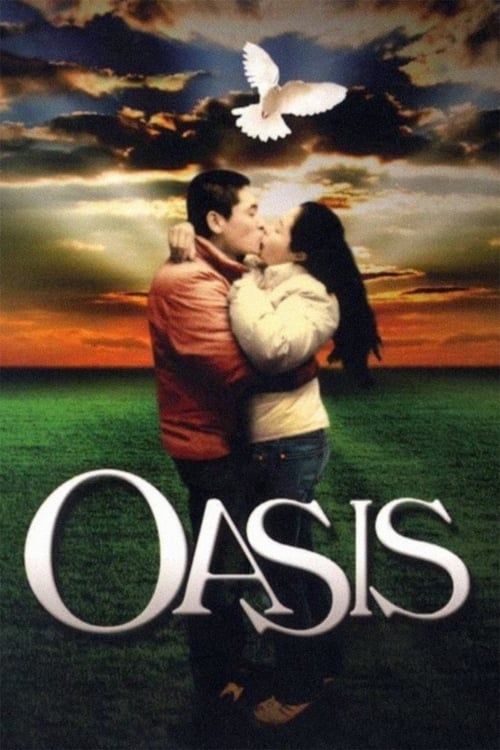
Oasis
2002 · Lee Chang-dong
When you want a film that tests you and rewards you — one to argue about and chew on for days, not a comfort watch. Save it for a night when you have emotional room to spare.
What it's about
A socially maladroit ex-convict, fresh out of prison, seeks out the family of the man he was convicted of killing in a drunk-driving accident — and becomes fixated on their daughter, a young woman with severe cerebral palsy whom her own family keeps hidden and quietly exploits. Against every expectation, including the audience's, a genuine relationship begins to form between two people their society has written off. It's a love story built on the most uncomfortable foundation imaginable.
The experience
Bruising and tender in the same breath — it makes you squirm, then catches you off guard with moments of pure imaginative flight. Lee refuses both pity and uplift, so you're never allowed to relax into an easy feeling; it stays with you for a long time.
Performances
Sol Kyung-gu and Moon So-ri give two of the great performances of Korean cinema — his ex-con all misfiring impulses and unguarded need, her physically transformative work as Gong-ju conveying a full inner life the world refuses to see. Moon won the Marcello Mastroianni Award at Venice for it.
The craft
Lee Chang-dong writes and directs with a moralist's precision, walking a line where one false note would tip the film into exploitation or sentimentality — and never falling. The film moves between hard realism and sudden flashes of fantasy that show you how its characters see themselves, a device that lands like a punch each time.
Why it matters
It won Lee the directing prize at Venice and cemented him as one of world cinema's essential moral storytellers, while forcing a broader conversation about how movies depict disability and desire.
Snapshot
Oasis is Lee Chang-dong's third feature, a love story between two people whom their society has decided are unlovable: Hong Jong-du (Sol Kyung-gu), a socially disordered ex-convict recently released from prison, and Han Gong-ju (Moon So-ri), a young woman with severe cerebral palsy who is kept largely hidden by a family that exploits her. Out of a premise that could curdle into either exploitation or uplift, Lee builds something harder and stranger — a film that insists on the erotic and emotional interiority of two characters the world treats as objects of pity, nuisance, or use. It premiered at the Venice Film Festival in 2002, where Lee took the festival's directing prize and Moon So-ri received the Marcello Mastroianni Award for a young or emerging performer; the film also drew the international critical prize (FIPRESCI). It arrived at the crest of South Korea's cinematic renaissance and confirmed Lee — a novelist who came to filmmaking late — as one of the most morally serious directors of that wave. Within months of the film's success, Lee would leave the set for government, serving as South Korea's Minister of Culture and Tourism.
Industry & production
Oasis was made inside the South Korean film industry's most confident decade. The dismantling of the old censorship regime after democratization, the rise of well-capitalized production and distribution companies, the multiplex boom, and the screen-quota politics of the late 1990s had produced both a robust domestic market and an export-minded art cinema. Lee Chang-dong belonged to the serious, socially engaged end of that renaissance rather than its blockbuster wing; where the era is often narrated through the genre virtuosity of Park Chan-wook or Bong Joon-ho, Lee represented a slower, more literary and humanist tendency.
He had established himself with Green Fish (1997) and, especially, Peppermint Candy (1999), a reverse-chronology account of a broken man that mapped one life onto three decades of Korean political trauma. Oasis reunited Lee with Sol Kyung-gu, the star of Peppermint Candy, and paired him with Moon So-ri, who had a supporting role in that film. The production was a mid-budget art film rather than a major commercial venture; the specific corporate producer and financing structure I can only describe in general terms here, as I cannot verify the exact company credits from memory without risking error. What is well documented is the film's festival trajectory: Venice launch, prizes, and subsequent international arthouse distribution that made Oasis a calling card for Korean auteur cinema abroad. The picture's afterlife is inseparable from Lee's own: his appointment as culture minister shortly after gave the film an unusual halo, that of a work by a director who then briefly held responsibility for the very national film policy that had helped make his career possible.
Technology
Oasis was produced on 35mm film, the standard professional format of Korean features at the turn of the millennium, several years before digital acquisition became normal for art cinema. Its aesthetic is defined by an almost anti-technological restraint: available and naturalistic lighting, location shooting in unglamorous apartments, restaurants, roadsides, and construction sites, and a refusal of the polish that the era's better-funded productions could command. The one place technology becomes conspicuous is in the handful of fantasy inserts, in which Gong-ju's body is briefly "released" from cerebral palsy; these required careful staging and, for the images involving the oasis tapestry on her wall coming to life, modest optical or digital effects. Lee uses such effects sparingly and without spectacle — the point is not the trick but the ache of the wish behind it. There is no evidence that Oasis was a technical showcase, and it would misrepresent the film to call it one; its innovations are dramaturgical and performative rather than technological.
Technique
Cinematography
The camerawork favors patient, often handheld or loosely mobile framing, long takes, and a documentary plainness that keeps the actors' bodies and faces at the center. Lee tends to hold on difficult behavior — awkwardness, spasm, humiliation — rather than cutting away to spare the viewer, and the photography serves that ethic of unblinking attention. Interiors are cramped and drably lit; the palette is muted, institutional, wintry. The camera neither prettifies Gong-ju's disability nor turns it into grotesque display; it simply stays present. (I am not able to confirm the director of photography's name with certainty here, and would rather flag that gap than risk a false attribution.) The visual scheme's most striking gesture is its contrast structure: the gray naturalism of the "real" world set against the warmer, freer imagery of Gong-ju's fantasies, so that the film's rare beauty registers precisely as escape from an ugly social reality.
Editing
The cutting is unhurried and observational, built to let scenes play at the tempo of lived embarrassment and slow-dawning tenderness rather than dramatic efficiency. Lee lets encounters run long enough that the audience must sit inside their discomfort — the early, genuinely disturbing scene in which Jong-du's approach to Gong-ju reads as attempted assault is not softened by quick cutting, and this refusal is central to the film's moral design. The fantasy sequences are integrated without heavy signposting, so that the shift from the real to the imagined can catch a viewer mid-scene; the effect is to blur the line between the world's cruelty and the interior life that resists it. The specific editor's credit I cannot reliably state from memory.
Mise-en-scène / staging
Space in Oasis is a map of social exclusion. Gong-ju is confined to a shabby apartment while her family lives elsewhere on the strength of a welfare allocation tied to her disability; the flat is at once her prison and, once Jong-du enters it, the "oasis" of the title. The tapestry of a desert oasis on her wall — the film's governing image — is a cheap decorative object that becomes the screen onto which her longing is projected, complete with the elephant and figures that animate in her mind. Lee stages the two leads in tight, obstructed compositions among furniture, doorways, and traffic, emphasizing constriction. Public settings — a family dinner, a restaurant, a police station — are staged to expose how the couple is seen from outside: as spectacle, embarrassment, or crime. The staging repeatedly sets private truth against public misreading.
Sound
The soundtrack is spare and largely diegetic, in keeping with Lee's realist instincts. Ambient noise — traffic, television, the awkward silences of family gatherings — carries much of the atmosphere, and Gong-ju's labored speech and breathing are foregrounded rather than smoothed over, forcing the audience to attend to a voice the film's other characters dismiss. Non-diegetic music is used with restraint, reserved for moments of interior release. I cannot confirm the composer's identity with certainty and will not guess at one; what is clear is that the film's sound design privileges the texture of a difficult, embodied reality over conventional emotional scoring.
Performance
The film's greatest achievement is its acting. Moon So-ri's portrayal of Gong-ju is a sustained physical performance — the contorted posture, the involuntary movements, the strained voice — that avoids both sentimentality and caricature, and it is punctuated by the fantasy scenes in which she plays the same character able-bodied, lucid, and radiant, so that the audience glimpses the person the world refuses to see. The performance was widely celebrated (the Venice young-performer award recognized it) and has also prompted legitimate discussion about an able-bodied actress representing disability, a debate the film itself seems to anticipate in its concern with who is permitted to be seen. Sol Kyung-gu matches her as Jong-du, a man whose social incompetence, impulsiveness, and childlike volatility make him genuinely hard to like; Sol refuses to soften him into a holy fool. The two performances together produce the film's central provocation: a tender love story carried by two characters the audience must work to accept.
Narrative & dramatic mode
Oasis operates in a register of social realism shadowed by lyric fantasy. Its dramatic mode is melodrama in the serious sense — a story of feeling and moral recognition among the powerless — but Lee systematically strips out melodrama's consolations. The narrative is essentially a two-hander tracing the halting formation of a bond, framed by the families and institutions that surround and betray the couple. The film courts and then complicates our sympathies: Jong-du is introduced as an irritant and near-criminal, and his first intimate approach to Gong-ju is staged as violation, so that the romance that follows must be earned against the audience's revulsion. The fantasy inserts function as the narrative's counter-voice, giving Gong-ju's inner life a reality the plot's realism denies her. The ending — with Jong-du criminalized once more and the couple's love legible to no one but themselves — withholds catharsis, leaving the viewer with the gap between what the audience has come to understand and what the world will ever acknowledge.
Genre & cycle
Nominally a drama-romance, Oasis belongs to a cycle of ambitious Korean art films of the late 1990s and 2000s that took the nation's marginalized and traumatized as their subject and treated genre expectations as raw material to be broken. It sits alongside Lee's own Peppermint Candy in a strain of socially conscious auteur cinema distinct from the revenge thrillers, crime films, and monster-movies that dominate popular accounts of the Korean wave. As a disability narrative and an "impossible love" story it inherits the shape of romantic melodrama, but its realism and its ethical unease align it more with international art cinema than with any commercial romance formula.
Authorship & method
Oasis is a directorial and authorial statement by Lee Chang-dong, who wrote as well as directed it. Lee came to film from literature — he was an established novelist before his screen career — and his method is recognizably a writer's: character-driven, morally exacting, suspicious of easy emotion, attentive to social specificity. His authorship is defined by a humanism that refuses flattery, placing damaged and difficult protagonists at the center and daring the audience to extend them dignity. Among collaborators, the most legible authorial partnership on screen is with his actors: Sol Kyung-gu, carried over from Peppermint Candy, and Moon So-ri, whom this film elevated to the front rank of Korean performers and who would remain associated with Lee's cinema. On the specific below-the-line collaborators — cinematographer, editor, composer — I have deliberately declined to name individuals I cannot verify, since a false credit would betray the scholarly purpose of this account. What can be stated firmly is that the film's vision is unmistakably Lee's, and that its power derives from the alignment of his script, his direction of actors, and his willingness to hold the camera on what other films would cut away from.
Movement / national cinema
The film is a landmark of the South Korean cinematic renaissance, the internationally celebrated wave that made Korean cinema a major festival and arthouse presence in the 2000s. Within that movement Lee represents its conscience — the strand most concerned with historical trauma, social justice, and the moral treatment of the marginalized, as against the movement's more genre-forward figures. Oasis also participates in a broader current of Asian art cinema of the period preoccupied with realism and interiority. Its national specificity is acute: the welfare bureaucracy, the family structures, the treatment of disability and of ex-convicts that the film indicts are rooted in a particular Korean social moment, even as its concerns translate universally.
Era / period
Made and released in 2002, Oasis belongs to the early-2000s high tide of Korean cinema, a period of expanding domestic audiences, aggressive international festival presence, and unusual creative freedom following democratization and the loosening of censorship. It predates the digital transition in art cinema and the global streaming era, sitting squarely in the celluloid, festival-driven model of arthouse distribution. Its historical footnote — Lee's near-immediate move into government as culture minister — marks it as a product of a moment when Korean film culture and the Korean state were unusually intertwined, and when a serious filmmaker could plausibly step from the festival podium into national cultural policy.
Themes
At its core Oasis is about the invisibility of the marginalized and the persistence of desire within it. It insists that people society writes off — the disabled, the criminal, the socially incompetent — possess full interior lives, including erotic and romantic longing, and it makes the audience's discomfort with that assertion part of its meaning. The family emerges as an oppressive institution: both protagonists are exploited by relatives who trade on their circumstances (Gong-ju's disability registration secures housing her family enjoys without her; Jong-du is scapegoated for a crime the film implies was not simply his own). The recurring image of the oasis and the fantasy sequences dramatize the gap between social perception and inner reality — the tension between how the two are seen and who they are. Love, in this film, is not redemptive in any easy sense; it is a fragile refuge that the surrounding world cannot recognize and will not permit. Running beneath all of this is a sharp critique of institutional pity — welfare, policing, family duty — that manages people's bodies while ignoring their humanity.
Reception, canon & influence
Oasis was received as a major arthouse work on its 2002 Venice premiere, where its directing and young-performer prizes and its critics' award established both Lee's international standing and Moon So-ri's. Critically it has been praised for its moral courage, its refusal of sentimentality, and above all its central performances; where it has drawn scrutiny, it is over the ethics and representation of disability and over the deliberately disturbing early scene of attempted assault — debates the film's own design seems to invite rather than evade. Backward, the film draws on Lee's literary sensibility and on a tradition of humanist social realism, refracted through the specific pressures of post-democratization Korean society; it also extends the moral project of Peppermint Candy, trading that film's historical sweep for an intimate two-hander. Forward, Oasis consolidated Lee Chang-dong's reputation as one of world cinema's foremost humanist directors, a standing he would deepen with Secret Sunshine (2007), Poetry (2010), and Burning (2018). It helped define the "serious" international face of the Korean wave and remains a touchstone for filmmakers pursuing unsentimental depictions of disability, marginalization, and forbidden love. For Moon So-ri it was a career-making showcase. Its precise commercial performance and the full apparatus of its production credits are details I have left unstated where I cannot verify them; its critical and canonical stature, by contrast, is secure — Oasis endures as one of the essential films of early-2000s Korean cinema.
A Deleuzian reading
There is a tapestry on the wall of the flat where Han Gong-ju is kept: a desert oasis, palms, water, an elephant, small figures.
The full Deleuzian reading of Oasis →
Reception
A Venice prize-winner in 2002 that cemented Lee Chang-dong as a major auteur, and its stock has only risen since Burning (2018) sent cinephiles back through his filmography — though today's viewers wrestle far more openly with its thornier choices than 2002 critics did.
How Oasis was received, from release to now →
Influences: the films it descends from and the films it influenced
- Peppermint Candy (1999) — Lee's immediately prior feature establishes the two-hander moral architecture and carries over Sol Kyung-gu as the damaged male lead whose dignity the film dares the audience to grant, trading historical sweep for Oasis's intimate scale.
- Green Fish (1997) — Lee's debut codifies his novelist's method — character-first scripting, socially specific milieu, suspicion of easy emotion — that structures Oasis's refusal of melodramatic release.
- Bicycle Thieves (1948) — Neorealist humanism that shadows society's discarded through real locations and unresolved endings, the tradition of unsentimental social realism Oasis inherits and turns onto the disabled and the ex-convict.
- Mouchette (1967) — Bresson's austere, consolation-refusing portrait of an abused outcast models Oasis's withheld catharsis — holding the camera on cruelty and desire without cueing the viewer how to feel.
- A Woman Under the Influence (1974) — Sustained, uncomfortable long scenes built entirely around a woman's socially illegible behavior — the actor-centered duration that Moon So-ri's full-body performance extends.
- My Left Foot (1989) — The template of an able-bodied actor's total physical portrayal of cerebral palsy as the film's centerpiece, the representational lineage (and ethical scrutiny) Moon So-ri's Han Gong-ju enters.
- A Petal (1996) — Korean New Wave precedent for fusing brutal social realism with a mentally damaged girl's interior fantasy imagery, the mode Oasis refines in Gong-ju's daydream escapes from her body.
- Breaking the Waves (1996) — Handheld camera trained on a 'simple,' marginalized woman whose transgressive love is socially punished — melodrama stripped of comfort, a formal cousin to Oasis's disability-impossible-love.
- Secret Sunshine (2007) — Deepens Oasis's withheld-catharsis method into a study of grief and grace, again anchoring the whole film on one actor's (Jeon Do-yeon) sustained emotional exposure.
- Treeless Mountain (2008) — Extends the patient, handheld observational long take onto abandoned children, inheriting Oasis's refusal to editorialize marginalization through cutting or score.
- Poetry (2010) — Carries forward the novelist-director's morally exacting, socially specific portraiture of an overlooked woman, resolving on quiet reckoning rather than release.
- Rust and Bone (2012) — Builds a physical romance around disability and an actor's bodily embodiment of impairment, continuing Oasis's fusion of tactile carnality with impossible-love melodrama.
- Margarita with a Straw (2014) — Centers a disabled woman's sexuality and desire through an able-bodied actor's committed physical portrayal, advancing the disability-impossible-love terrain Oasis opened for arthouse cinema.
- Burning (2018) — Consummates Lee's social-realism-with-latent-fantasy mode and class marginalization, sustaining Oasis's ambiguity and denied catharsis at feature length.
- Mother (2009) — Establishes within Korean social realism the performance and representational framework for cognitive difference that refuses both sentimentality and redemptive arc — the son's intellectual disability in Mother draws on this precedent for portraying limitation without condescension.
- Memoir of a Murderer (2017) — Established Sul Kyung-gu's performance register of surface behavioral legibility masking morally irresolvable interiority — the precise grammar he imports into Memoir, where Alzheimer's-induced erraticism must simultaneously register as dangerous and pitiable without resolving into either.
- Hope (2013) — Establishes the Korean realist ethic of treating a stigmatized victim with unsentimental tenderness and offscreen sexual violence from which Hope's handling of its child survivor descends.
- Peranbu (2019) — Its unsentimental staging of desire between a social outcast and a woman with cerebral palsy — granting the disabled character full erotic subjectivity while refusing pity — is the exact register Peranbu adopts for disabled sexuality.
- Rosetta (1999) — Contemporary handheld long-take realism that physically tails a single marginalized protagonist through cramped, obstructed space, the observational grammar Oasis deploys in Korean register.
- A Good Lawyer's Wife (2003) — Made in Oasis's immediate wake, it capitalizes on Moon So-ri's fearless, body-forward performance style within the same Korean New Wave push toward raw physical candor.
- Nobody Knows (2004) — Observational long-scene realism on socially invisible, abandoned children that withholds sentiment and lets duration expose marginalization — the same restraint Oasis practices.
- Sympathy for Mr. Vengeance (2002) — The disabled body deployed as formal instrument — Lee's protagonist with cerebral palsy redirects staging toward gesture and physical sign in exactly the year Park is solving the same formal problem with Ryu's deafness, both films insisting the body speak where speech is unavailable.
- Silenced (2011) — Korean social-realist observational restraint around a disabled protagonist, using impaired, non-verbal performance and refusing sentimental uplift — the anti-melodramatic disability portraiture Silenced practices.
- The Way Home (2002) — Same-year renaissance work that replaces expository dialogue with un-actorly, naturalistically directed performance to dramatize communication across a barrier.
Similar films
- Burning (2018) — influence & lineage
- Poetry (2010) — influence & lineage
- Breaking the Waves (1996) — influence & lineage · often watched together
- Amour (2012) — often watched together
- Peppermint Candy (2000) — shared sensibility
- EO (2022) — shared sensibility
- The Handmaiden (2016) — shared sensibility
- 3-Iron (2004) — shared sensibility
All the films related to Oasis →
Watch it with: curated runs of related films
- Desire on Uneven Ground — A run of tender, lopsided intimacies — an outsider fixed on someone just out of reach — that keep slipping from realism into dream, myth, or memory.