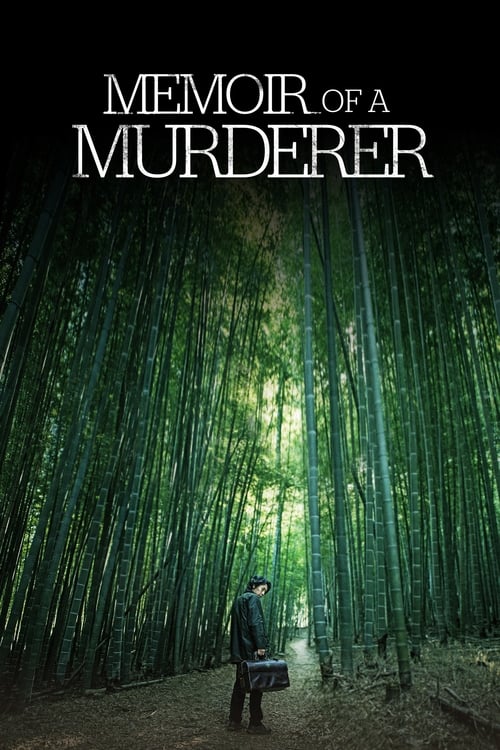
Memoir of a Murderer
2017 · Won Shin-yun
For when you're craving a proper mind-bender — a dark Korean thriller that keeps pulling the floor out from under you. Choose it on a night you want to be gripped and unsettled, not soothed.
What it's about
A retired serial killer in rural South Korea is losing his memory to Alzheimer's when he becomes convinced that his daughter's new boyfriend is also a murderer. But with his mind erasing and rewriting itself daily, he can't be sure whether he's detecting a predator or inventing one — and his daughter's life may hinge on which it is.
The experience
Twisty and increasingly claustrophobic — a thriller where the unreliable narrator isn't a trick but the whole engine, so your certainty erodes right alongside his. It's tense, dark, and disorienting in a way that makes you second-guess every scene.
Performances
Sol Kyung-gu is the reason it works: he plays a fading, dangerous mind with such conviction that you believe both possibilities at once — the vigilant father and the deluded killer.
The craft
Adapted from Kim Young-ha's novel, the film builds its structure out of the disease itself — flashbacks, notes, and recordings that may or may not be trustworthy — while delivering the muscular staging and bursts of violence Korean thrillers are known for. The editing does the psychological work, splicing memory and present until you share the protagonist's vertigo.
Why it matters
It stands as a strong entry in the 2010s wave of high-concept Korean thrillers, proof of the industry's knack for fusing pulp premises with genuine psychological weight.
Snapshot
A former serial killer in rural South Korea, now in the grip of advancing Alzheimer's, becomes convinced that his daughter's new boyfriend is himself a murderer — and can no longer trust whether that conviction is detection or delusion. Directed by Won Shin-yun from Kim Young-ha's 2013 novel, Memoir of a Murderer builds its thriller machinery entirely out of epistemological instability: when the protagonist's mind is actively destroying its own archive, every flashback, every identification, every moment of certainty is placed under forensic suspicion. The film belongs to the long tradition of Korean genre cinema that uses crime as a lens for moral philosophy, and it functions simultaneously as a psychological puzzle film, a study in the phenomenology of forgetting, and a genre exercise of considerable formal sophistication. Sul Kyung-gu's performance as the killer-turned-father is among the most demanding in his career and the film's most consistent critical touchstone.
Industry & production
Memoir of a Murderer was produced by Yong Film and released through CJ Entertainment, by 2017 one of the dominant vertically integrated forces in Korean theatrical distribution, combining production financing, theatrical release, and home entertainment within a single corporate structure. That infrastructure had become the standard pipeline for mid-to-large Korean genre productions, and the film benefited from its promotional resources and institutional prestige. The source novel carried its own cultural weight: Kim Young-ha is among South Korea's most internationally recognized literary novelists, known for genre-adjacent fiction with serious philosophical ambitions, and adaptation of his work arrived pre-loaded with critical legitimacy. Won Shin-yun adapted the screenplay himself — a consolidation of interpretive authority that kept the novel's epistemological core under directorial control rather than delegating it to a separate writer.
The film was released theatrically in South Korea on September 7, 2017. Reliable box-office admissions figures require verification against Korean Film Council (KOFIC) data and are not reproduced here. International distribution was substantially extended by Netflix's acquisition of streaming rights across multiple territories, giving Memoir considerably wider circulation in East Asian and Western markets than a theatrical release alone would have achieved — part of Netflix's accelerating investment in Korean content in the years immediately preceding Parasite's global watershed.
Technology
The film was shot digitally, in keeping with near-universal adoption of digital acquisition in South Korean mainstream production by the mid-2010s. The choice of digital workflow is not incidental to the film's formal concerns: digital capture's flexibility in color grading provided the primary technical instrument for marking the graduated unreliability of the protagonist's perceptual states. Desaturation, contrast manipulation, and color temperature shifts are deployed to suggest epistemological instability without hardening into a simple reliable/unreliable code — the ambiguity is preserved formally as well as narratively, so no single visual register can be claimed as ground truth. Principal photography took place largely on location in the Changnyeong County area of South Gyeongsang Province, using the rural landscape as both geographic setting and psychological correlative. The production makes no significant investment in special effects or digital spectacle; its technological resources are concentrated in post-production color and in the editing suite.
Technique
Cinematography
The film's visual strategy is organized around its governing epistemological problem. Close-up work dominates the rendering of Byung-soo's (Sul Kyung-gu) perceptual field, pressing the viewer into alignment with a consciousness that cannot be trusted as witness. The cinematography declines the stabilizing wide-angle establishing shots that in conventional thriller grammar would anchor the viewer's perspective independently of the protagonist's; instead, the camera largely shares his confusion, occupying the subjective field of a mind whose reliability is in progressive dissolution.
Rack focus and shallow depth of field are deployed with particular deliberateness during confrontations between Byung-soo and Tae-joo (Kim Nam-gil), the suspected killer-detective. By keeping background environments soft and spatially unstable, the cinematography withholds the environmental anchors that would permit the viewer to reason independently of Byung-soo's compromised sightline. Warmer tones dominate the domestic memory sequences; cooler blue-gray registers the present-tense investigation — an affective grammar that provides orientation without resolving ambiguity. The rural South Gyeongsang landscape is rendered with a muted naturalism that resists both picturesque prettification and Expressionist distortion, maintaining the visual register of ordinary provincial life from which violence and psychosis have not yet cleanly separated themselves. (Specific director of photography credits are difficult to verify with confidence in the English-language scholarly record; this account defers to primary Korean industry credits rather than risk misattribution.)
Editing
The editing is the film's most consequential formal decision and the primary technical instrument of its epistemological project. Temporal structure is deliberately disordered: flash-fragments, involuntary memory intrusions, and prospective hallucinations interrupt the present-tense narrative without consistent formal announcement. Unlike the hyperactive cutting that characterizes much commercial thriller editing, Memoir of a Murderer achieves disorientation through duration as much as frequency — holding shots of Byung-soo's stilled, confused face long enough to make the viewer register the phenomenological texture of the gap between recognition and meaning. The editing grammar is calibrated so that viewers cannot be certain, on first pass, whether a given cut moves forward in time, backward into memory, or into subjective fabrication.
The third act in particular employs an intercutting strategy between apparent objective narrative fact and subjective distortion that requires retroactive rereading of earlier sequences — a structure with precedents in Korean unreliable-perception cinema (A Tale of Two Sisters, Kim Jee-woon, 2003) and in the international tradition of twist-architecture thrillers, but deployed here with more phenomenological seriousness than simple plot mechanics would require.
Mise-en-scène / staging
The family home that Byung-soo shares with his daughter Eun-hee (Kim Seol-hyun) is staged with careful symbolic economy. Objects of domestic familiarity — photographs, the notebooks in which Byung-soo records everything he fears losing — carry visual emphasis sufficient to register as potential evidence without being fetishized as clues. The notebooks are among the film's governing props: they recur across the staging as both character shorthand and thematic declaration, an analog externalization of the cognitive archive that is ceasing to function — and, at a meta-level, a paper-and-ink version of the film's own enterprise, the memoir of the title.
Spatial staging between Byung-soo and Tae-joo returns persistently to frames of obstructed or uncertain sightline — surveillance across distances too great to read, watching that might be vigilance or paranoia in equal measure. Doors and thresholds are used with Expressionist deliberateness: figures who should be admitted versus excluded become increasingly difficult to categorize as the interior/exterior distinction that defines domestic safety erodes in parallel with Byung-soo's cognition. The geography of the house — what is visible from where, who controls access — functions as a spatial argument about the permeable boundary between protector and threat.
Sound
The sound design works against any expectation of scored psychological-thriller excess. Ambient sound of the rural Gyeongsang environment — insects, wind, the low texture of agricultural landscape — is maintained at a level that keeps the setting stubbornly present against the interior drift of the narrative, refusing the sealed, de-naturalized soundscapes of urban-set Korean thrillers. Musical scoring (composer credits require verification against primary Korean-industry sources and are not specified here) tends toward sustained tonal clusters rather than melodic signposting, providing atmospheric unease without cuing the viewer's emotional response too directly.
Memory intrusions are sometimes — but not always — sonically marked, with partial audio textures from an earlier time bleeding into the present-tense scene. The inconsistency is purposeful: it refuses the viewer a reliable auditory code for distinguishing levels of reality. Silence, or sustained near-silence, is used strategically in scenes of revelation and confrontation, placing interpretive weight entirely on performance rather than delegating it to the score.
Performance
Sul Kyung-gu's work is the axis on which everything else rotates. Sul had established himself as one of South Korea's most rigorous screen actors through his work in Lee Chang-dong's Peppermint Candy (1999) and Oasis (2002), and had extended that reputation across a career notable for physical and psychological specificity. The role of Byung-soo is among the most technically demanding he has undertaken: the performance must simultaneously inhabit the predatory cool of the former killer — rendered as professional detachment rather than sadism, a competency rather than a pathology — and chart the gathering cognitive disorder, which is played not as pantomime diminution but as moments of frightening lucid precision interrupted by void. Sul is required to make legible a character who is simultaneously the investigator, the suspect, the unreliable narrator, and the viewer's only guide through the film's reality, without allowing any of these performances to cancel the others.
Kim Nam-gil as Tae-joo plays with exemplary restraint. His character must sustain genuine ambiguity across the entire running time — any performance choice that tips him clearly toward menace or innocence would destroy the film's central mechanism — and Kim keeps the surface opaque while suggesting interior depths that are never fully disclosed. Kim Seol-hyun as the daughter operates within the constraints of a role that is primarily the site of threatened harm, and she works against the passive-victim reduction wherever the staging allows.
Narrative & dramatic mode
The film's narrative premise inverts a genre convention with surgical precision: instead of a detective investigating a crime, the investigator is the criminal; instead of memory being the instrument of detection, memory is the antagonist. This double inversion generates a dramatic mode that is closer to phenomenological thriller than procedural. The question at stake is not whodunit but what-is-true: dramatic tension derives not from physical pursuit but from epistemological contest between the protagonist's interpretation and the viewer's capacity to evaluate it independently. The film places the viewer in exactly Byung-soo's predicament — surrounded by evidence that might constitute a picture or might constitute a symptom.
The first-person voice, rooted in Kim Young-ha's novel's diary-memoir structure, gives the film a literary interiority uncommon in mainstream Korean thriller production. The novel's central conceit — a murderer writing his memoir as a preemptive act against his own forgetting — translates into the film's use of voiceover that announces its own unreliability while serving as the primary vehicle of narrative transmission. The film thus sustains a double bind: the narrator is the only access to the story, and the narrator cannot be trusted.
Genre & cycle
Memoir of a Murderer belongs to the mature cycle of Korean psychological crime thrillers that consolidated following the international recognition of Memories of Murder (Bong Joon-ho, 2003), Oldboy (Park Chan-wook, 2003), and I Saw the Devil (Kim Jee-woon, 2010). By 2017 that cycle had established a recognizable set of generic competencies — tonal darkness, moral ambiguity, formal sophistication, a disposition toward locating horror in the ordinary — that Memoir inherits and extends. Within the cycle it is most closely positioned with productions that foreground subjective distortion as their primary thriller engine: A Tale of Two Sisters (Kim Jee-woon, 2003) and The Wailing (Na Hong-jin, 2016) are the nearest generic neighbors.
The Alzheimer's-killer premise also situates the film within a smaller international cycle of cognitive-deterioration narratives, though its thriller mode distinguishes it sharply from the drama-oriented dementia films — Still Alice (2014), Away from Her (2006) — that are more typically cited in that category. The sympathetic serial killer draws on a tradition extending through Thomas Harris's Hannibal Lecter series and its cinematic adaptations, but the film reconfigures this figure by making his violence strictly past-tense and his present orientation protective — a moral displacement sustained, in a literally physiological sense, by the Alzheimer's that is erasing the predatory self along with everything else.
Authorship & method
Won Shin-yun functions here as both adaptor and director, with interpretive authority over the source material consolidated in a single figure — an arrangement more common in Korean literary-prestige production than in purely commercial genre work. His adaptation strategy appears to have been structural fidelity to Kim's core conceit combined with a translation of the novel's first-person prose interiority into cinematic subjectivity: voiceover is retained, the diary-memoir structure preserved, but the temporal fragmentation is rendered through editing rather than through Kim's prose typography.
Won Shin-yun's wider directorial career and standing as an auteur within Korean cinema is a topic on which English-language film scholarship is currently thin; the Korean industry press would provide a more complete account of his development and method than the international scholarly record presently sustains, and this dossier does not overextend beyond what can be verified.
Kim Young-ha's contribution as source author is significant beyond the provision of plot. His novel is a work of literary genre fiction with a serious philosophical dimension — the question of what constitutes self-evidence when the self cannot be trusted as witness — and the film's formal ambition exceeds the conventions of commercial thriller adaptation precisely because the source carried that ambition in. Kim's body of work, including I Have the Right to Destroy Myself (1996) and Your Republic Is Calling You (2010), has been translated internationally and forms part of a contemporary Korean literary new wave that attracted substantial critical attention in translation from the mid-2000s onward.
Movement / national cinema
The film is a product of the post-Oldboy, post-Memories of Murder phase in which the Korean genre thriller had become the dominant prestige export form of South Korean cinema, capable of sustaining commercial ambition and formal experimentation simultaneously and recognized internationally as such. The CJ Entertainment ecosystem and the KOFIC institutional infrastructure supporting it were by 2017 components of a mature national cinema that had successfully cultivated the international art-house and genre-festival audience at the same time.
The choice of a South Gyeongsang rural setting connects the film to a persistent strand in Korean thriller cinema that locates crime and psychological disorder in provincial landscapes — Memories of Murder being the defining precedent, and The Wailing a closer contemporary parallel. This spatial orientation carries social freight beyond aesthetic preference: the Korean provincial is coded in the genre tradition as the site of the unresolved, the hidden crime, the inadequately modernized psyche not yet absorbed into the managed rationality of the Seoul metropolitan order.
Era / period
2017 falls in the mature phase of Korean cinema's global expansion, a process building since the early 2000s that would reach its institutional apex with Parasite's Palme d'Or (2019) and Academy Awards (2020). The genre conventions Memoir employs were, by 2017, sufficiently established to operate legibly for an international festival and streaming audience without cultural translation. The year also falls in the period of Netflix's accelerating investment in Korean content — the streaming infrastructure that would eventually make Korean film and television globally dominant was being built around precisely this category of formally accomplished, internationally accessible genre production, and Memoir's Netflix acquisition placed it within that developing ecosystem at an early and significant moment.
Themes
Memory, identity, and the unreliable archive. The film's governing philosophical concern is whether identity can survive the destruction of its mnemonic substrate. Byung-soo's sense of himself — as killer, as father, as investigator — depends entirely on a memory that is ceasing to function as reliable storage. The Alzheimer's is not decorative but structural: the film argues, through form as much as content, that selfhood and trustworthiness are memory-dependent, and that a subject who cannot trust his own archives cannot be trusted by others or by himself. The notebooks he fills are an act of desperate self-constitution — the attempt to externalize what the interior can no longer hold.
The serial killer as domestic subject. Byung-soo's past violence is rendered as a closed chapter: he has stopped killing, raised a daughter to adulthood, achieved provincial normalcy. The thriller reactivates his professional competencies — his ability to recognize killing patterns, his forensic reading of other people's behavior — while placing them in the service of protection rather than predation. This reactivation without relapse is one of the film's more disturbing structural moves, requiring the viewer to actively root for the effective functioning of a murderer's perceptual apparatus.
Protective surveillance and its shadow. The father-daughter relationship is triangulated through questions of protection and exposure that map onto broader anxieties about women's vulnerability to male violence in Korean social life. The film handles this with greater complexity than the genre template requires, since the protective father is himself a source of historical harm, and the threat he identifies may be a projection of his own criminality onto an innocent man. The act of watching over — the father who will not let his daughter out of his surveillance range — is rendered as both love and danger simultaneously.
Doubt as phenomenological condition. The film's deepest formal achievement is to make epistemological doubt a lived phenomenological state rather than a narrative suspense device. By refusing to finally resolve the ambiguity — the third act's apparent revelation is itself available to rereading — Memoir insists on an uncomfortable position: that the question of what is real, and what a compromised consciousness has fabricated, may not be answerable from inside that consciousness.
Reception, canon & influence
Critical reception. Memoir of a Murderer received generally positive notices in South Korea and in the international genre-film press on release, with Sul Kyung-gu's performance drawing consistent and sometimes lavish praise as the film's primary distinction. Some critics questioned whether the film fully sustains its epistemological rigor through its third act — a reasonable objection to a resolution strategy that risks settling the ambiguity it has cultivated — but the formal ambition of the central conceit was broadly recognized. The film is not yet the subject of substantial English-language scholarly monographs, and its canonical standing within Korean cinema studies is not yet consolidated; it remains more present in cinephile and genre-film criticism than in academic film studies.
Influences on the film. Within Korean thriller cinema, the primary predecessors are: Memories of Murder (Bong Joon-ho, 2003) for the rural-Korea investigation and the phenomenology of failed or unreliable detection; I Saw the Devil (Kim Jee-woon, 2010) for the structure of the criminal as investigator; A Tale of Two Sisters (Kim Jee-woon, 2003) for the unreliable-perception thriller grammar; and The Wailing (Na Hong-jin, 2016) for the use of unresolved ambiguity as narrative terminus. The literary source draws on a Korean tradition of autofictional and confessional first-person narration, and on the conventions of the crime memoir. Internationally, the unreliable-narrator thriller has a canonical lineage running from Rashomon (Kurosawa, 1950) through The Usual Suspects (Singer, 1995) and their many successors; the sympathetic serial killer figure acknowledges, at a distance, the Hannibal Lecter franchise and its normalization of the murderer as protagonist-guide.
Legacy and forward influence. Memoir of a Murderer's specific influence on subsequent Korean thriller production is difficult to isolate with precision, since it arrived within a cycle already in full productive maturity rather than founding a new one. Its most particular contribution — the Alzheimer's-inflected epistemological thriller — has not immediately generated a recognizable subgenre. The film's broader significance may be best understood not as a founding text but as a refinement: a demonstration of the extent to which, by 2017, Korean genre tradition could sustain formally ambitious variations on its established themes without sacrificing commercial viability. Netflix distribution gave it a substantial international afterlife, and it remains one of the more accessible entry points for international viewers approaching Korean psychological thriller cinema after the Parasite watershed — a film whose formal seriousness is evident without requiring deep prior knowledge of the national genre tradition in which it participates.
A Deleuzian reading
Start with the notebooks.
The full Deleuzian reading of Memoir of a Murderer →
Reception
A solid box-office hit in Korea in 2017, it later found a second, wider life on streaming, where it became a fixture of 'best Korean thrillers' lists for international audiences discovering K-cinema post-Parasite.
How Memoir of a Murderer was received, from release to now →
Influences: the films it descends from and the films it influenced
- Rashomon (1950) — Establishes the foundational grammar of testimony-as-unreliable-construction: competing first-person accounts of the same event cannot be resolved into singular truth, making epistemological uncertainty the film's terminal condition rather than a plot obstacle to be cleared.
- The Usual Suspects (1995) — Pioneers retrospective unreliable first-person narration in which the entire film functions as fabricated testimony, demanding complete retroactive rereading once the narrator's identity is disclosed — the structural grammar Memoir's voiceover-as-confessional directly inherits.
- Memento (2000) — Formalizes memory disorder (anterograde amnesia) as narrative structure through reverse chronology, making the viewer share the protagonist's incapacity to retain sequential knowledge — the founding text for the principle of cognitive-disorder-as-form that Memoir translates into Alzheimer's-inflected voiceover unreliability.
- Oasis (2002) — Established Sul Kyung-gu's performance register of surface behavioral legibility masking morally irresolvable interiority — the precise grammar he imports into Memoir, where Alzheimer's-induced erraticism must simultaneously register as dangerous and pitiable without resolving into either.
- Memories of Murder (2003) — Establishes the rural Korean investigative landscape as epistemically hostile and portrays detection itself as phenomenologically unreliable — investigators who cannot distinguish evidence from noise; Memoir inherits this geography of failed cognition and relocates it inside the detective's own disintegrating mind.
- Oldboy (2003) — Deploys amnesia and suppressed memory as structural devices that demand complete retroactive rereading on revelation — pioneering within Korean cinema the grammar of a protagonist whose deepest knowledge about himself is inaccessible, which Memoir translates from voluntary repression to organic Alzheimer's dissolution.
- A Tale of Two Sisters (2003) — Develops Korean thriller's grammar of unreliable perception by staging events whose ontological status — real occurrence or hallucinatory episode — remains undecidable, training the viewer to distrust scene-level evidence; Memoir inherits this staging of perceptual irresolution and routes it through voiceover rather than image.
- I Saw the Devil (2010) — Establishes the structural template of detective-criminal role inversion within Korean genre: the investigator adopts his quarry's methods until pursuer and pursued become morally interchangeable; Memoir extends this structure to the limiting case where protagonist and antagonist may be the same person.
- The Wailing (2016) — Demonstrates that Korean genre cinema can sustain radical epistemological ambiguity through its final frame — the identity and nature of the malevolent force is never disclosed, and withholding resolution is itself the formal statement; Memoir's third-act irresolution strategy inherits this license.
- Burning (2018) — Extends epistemological ambiguity to complete and deliberate irresolution — the central crime may or may not have occurred, the suspect may or may not be a killer, and the film refuses confirmatory closure; it develops the genre's tolerance for withheld resolution that Memoir demonstrated was commercially viable within Korean genre production.
- The Father (2020) — Translates Alzheimer's disease into cinematic formal structure through spatial disorientation — rooms, faces, and identities shift between cuts without narrative acknowledgment, making the viewer inhabit the protagonist's collapsing epistemology rather than observe it from outside; extends Memoir's Alzheimer's-as-form principle to full subjective immersion.
- Vortex (2021) — Renders Alzheimer's disease as a formal bifurcation of the film itself — persistent split-screen separates the cognitively intact husband from the deteriorating wife, making the film's material structure enact the disease's fragmentation of shared reality; the most formally extreme extension of the Alzheimer's-as-form principle Memoir introduced.
- Decision to Leave (2022) — Extends the detective-inversion structure by making the investigator epistemically compromised by desire for his suspect — mirroring Memoir's protagonist whose self-investigation is compromised by his own memory dissolution — and deploys warm-cool digital color grading to distinguish registers of reliability, elaborating the Korean thriller cinematographic grammar Memoir employs.
- Gone Girl (2014) — Develops the confessional diary-as-narration as unreliable testimony and the written personal record as object-of-evidence that simultaneously constitutes and deceives the investigation — the same grammar Memoir's serial-killer memoir and voiceover employ; parallel evolution from literary source material rather than direct influence.
- The Handmaiden (2016) — Employs retroactive rereading as structural principle across three movements, each of which rewrites the viewer's understanding of all prior scenes — the same grammar Memoir applies to voiceover narration here applied to plot architecture; both films contemporaneously domesticate the unreliable-narrator tradition through Korean genre conventions.
Similar films
- Memories of Murder (2003) — influence & lineage · same viewing thread
- A Tale of Two Sisters (2003) — influence & lineage · same viewing thread
- The Handmaiden (2016) — influence & lineage · same viewing thread
- Decision to Leave (2022) — influence & lineage · same viewing thread
- I Saw the Devil (2010) — influence & lineage
- The Wailing (2016) — influence & lineage
- Burning (2018) — influence & lineage
- Memento (2000) — influence & lineage
All the films related to Memoir of a Murderer →
Watch it with: curated runs of related films
- New Korean Cinema — Watch these in a run and you feel one national cinema flip between monster movie, revenge thriller, gothic horror, and slow-burn procedural without ever loosening its grip on class, history, and family.