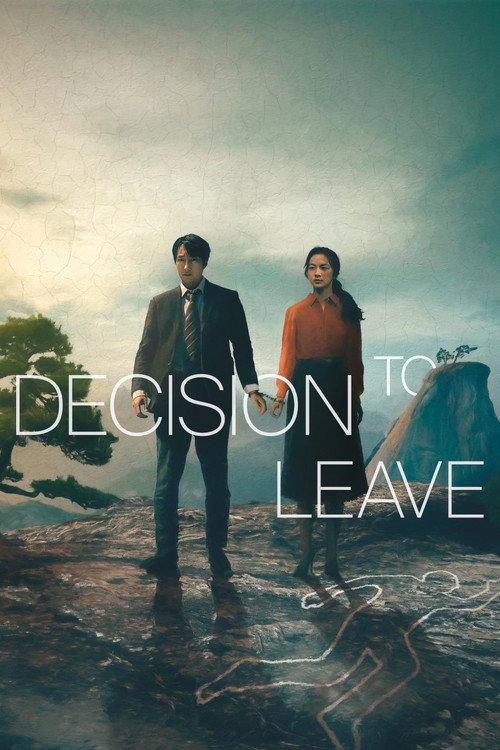
Decision to Leave
2022 · Park Chan-wook
Decision to Leave made him Letterboxd's romantic-obsession auteur; No Other Choice's Venice reception restarted the "greatest living Korean director" argument with Bong partisans. Elegance-plus-perversity is his brand in the discourse.
For when you want to be seduced by a movie — a grown-up romance wrapped in a detective story, ideal for a night you're willing to lean in rather than half-watch. It's the kind of film you immediately want to see twice.
What it's about
A man falls to his death from a Korean mountain peak — jump, accident, or push? The detective assigned to the case, a meticulous insomniac, begins studying the dead man's elegant Chinese-born widow, and finds that she is studying him right back. What starts as an investigation becomes a slow, dangerous entanglement of suspicion and longing, conducted across a language barrier through phones, recordings, and stakeout binoculars.
The experience
Elegant, teasing, and quietly swooning — a mystery that works like a seduction, precise on the surface and aching underneath. It demands attention (the editing is quick and playful) and repays it with one of the most romantic slow burns in recent memory.
Performances
Tang Wei and Park Hae-il play the widow and the detective with a formality that keeps threatening to crack — every glance and half-finished sentence carries weight, and Tang Wei in particular makes unknowability magnetic.
The craft
Park Chan-wook turns the tools of surveillance — phone screens, voice memos, translation apps, binoculars — into instruments of longing, and his editing collapses distance until the detective seems to stand inside scenes he can only be imagining. Fog-bound mountains and sea, a melancholy 1967 Korean pop song, and immaculate sound design make this one to watch big and loud.
Why it matters
It won Park Best Director at Cannes and marked a turn for Korean cinema's great maximalist of vengeance: his most restrained film, and for many his most romantic, embraced worldwide as an instant classic of the form.
A man falls from a mountain peak; the detective assigned to the case finds himself studying the widow the way one studies a painting — and she, unnervingly, studies him back. After decades as Korean cinema's great maximalist of vengeance, Park Chan-wook made his most restrained film and won Best Director at Cannes for it: a romance conducted almost entirely through the instruments of surveillance — phone screens, voice memos, translation apps, stakeout binoculars — each one turned into a vessel for longing. Tang Wei and Park Hae-il play the pair with a formality that keeps threatening to crack, and Park's editing collapses the distance between them, placing the detective inside scenes he can only be imagining. The ghost of Vertigo drifts through it, as does 'Mist,' the melancholy 1967 Korean pop song that scores the film's fog-bound second movement. Nothing here is explicit — no violence dwelt upon, barely a kiss — yet it plays as one of the most erotic films of its decade, desire displaced entirely into procedure, weather, and the act of paying attention.
A Deleuzian reading
Night, a parked car, a pair of binoculars.
The full Deleuzian reading of Decision to Leave →
Reception
It arrived already crowned — Best Director at Cannes 2022 and the top of Sight and Sound's year-end poll — but plenty of first-watchers found it cooler and more elusive than The Handmaiden. Rewatch culture did the rest: it's since hardened into many fans' pick for Park's best film.
How Decision to Leave was received, from release to now →
Influences: the films it descends from and the films it influenced
- Vertigo (1958) — Supplies the master template Park openly rebuilds: an investigator whose surveillance of a woman curdles into obsessive love, structured as two movements where the woman 'dies' and returns, with the detective's gaze literally constructing her.
- Rear Window (1954) — Establishes the immobilized watcher whose desire and detection flow through an optical device, so that voyeuristic looking becomes the film's engine of both romance and investigation.
- Laura (1944) — Originates the detective who falls for the very woman whose apparent murder he investigates, fetishizing her image until the case dissolves into erotic fixation.
- Blow-Up (1966) — Models investigation-as-image-forensics — obsessively enlarging and re-scanning mediated evidence — which Park updates to zoom-photos, phones and translation apps that never quite yield the truth.
- The Conversation (1974) — Builds an entire study of a surveillance professional undone by the recorded traces he replays, foregrounding sound and playback as the medium through which a watcher becomes emotionally entangled with his subject.
- Peeping Tom (1960) — Fuses the apparatus of looking with lethal desire, staging the reciprocal circuit of looking-and-being-looked-at that Park's mutual-surveillance romance depends on.
- In the Mood for Love (2000) — Perfects eroticism-without-explicitness through formal restraint, held glances and a recurring pop refrain, giving Park his model of unconsummated longing carried by décor, framing and a signature song ('Mist').
- Chungking Express (1994) — Pioneers romance conducted through mediated devices and surveilled domestic space — an infatuated cop intruding on an absent object's apartment — the template for love routed through phones and watching.
- Stoker (2013) — Park's own Hitchcockian exercise built on collapsed-distance editing — graphic match cuts (hairbrush to grass, present to memory) that fuse separated bodies and times exactly as 'Decision to Leave' inserts the detective into scenes he imagines.
- Memoir of a Murderer (2017) — Extends the detective-inversion structure by making the investigator epistemically compromised by desire for his suspect — mirroring Memoir's protagonist whose self-investigation is compromised by his own memory dissolution — and deploys warm-cool digital color grading to distinguish registers of reliability, elaborating the Korean thriller cinematographic grammar Memoir employs.
- Lust, Caution (2007) — Built directly on Tang Wei's Lust, Caution persona, it stages romance-as-surveillance in which interrogation and desire, performance and truth blur — the honeytrap logic turned inside out onto the watcher.
- Burning (2018) — Contemporary Korean New Cinema of surveillance-tinged obsession — a man fixated on a woman he watches and cannot read — that carries forward displaced desire and epistemic ambiguity into the same 2020s register.
- No Other Choice (2025) — Develops the surveillance deep-focus cinematography and Kim Sang-bum's elliptical editing of watching and being-watched that structure the new film's voyeuristic frames.
- Obsession (1976) — A declared Vertigo variation that isolates the returning-double structure and the man remaking a lost woman, running the same lineage Park mines but toward operatic excess rather than restraint.
- Body Double (1984) — Extends the voyeur-detective into a surveillance thriller where telescopic watching becomes erotic complicity and the watched woman is a constructed lure.
- Caché (2005) — Turns anonymous surveillance footage into the film's destabilizing device, making the watcher's guilt and the ambiguity of who-watches-whom the formal problem, as Park does with his suspect's counter-gaze.
- The Handmaiden (2016) — Deploys interlocking, replayed POV structure and meticulous eyeline/framing so that watching and being deceived by a desired woman drive the plot, with eroticism staged through withholding and reveal.
- Thirst (2009) — Earlier Park study of illicit desire and formally restrained performance escalating to transgression, developing his method of eroticism conveyed through composure and suppressed gesture rather than display.
- Memories of Murder (2003) — A Korean New Cinema detective film whose atmospheric, fog-and-terrain-soaked procedural centers on an investigator defeated by an unresolvable case, sharing Park's melancholic failure-of-detection and landscape mood.
Similar films
- The Handmaiden (2016) — influence & lineage · same viewing thread
- Burning (2018) — influence & lineage · same viewing thread
- Memories of Murder (2003) — influence & lineage · same viewing thread
- In the Mood for Love (2000) — influence & lineage
- Stoker (2013) — influence & lineage
- Joint Security Area (2000) — same viewing thread
- No Other Choice (2025) — same viewing thread
- 3-Iron (2004) — same viewing thread
All the films related to Decision to Leave →
Watch it with: curated runs of related films
- The Ache of Almost — Watch these together for the way each circles a love that time, distance, or duty keeps just out of reach — long looks, feelings left unsent, and the life that gets lived instead.
- New Korean Cinema — Watch these in a run and you feel one national cinema flip between monster movie, revenge thriller, gothic horror, and slow-burn procedural without ever loosening its grip on class, history, and family.