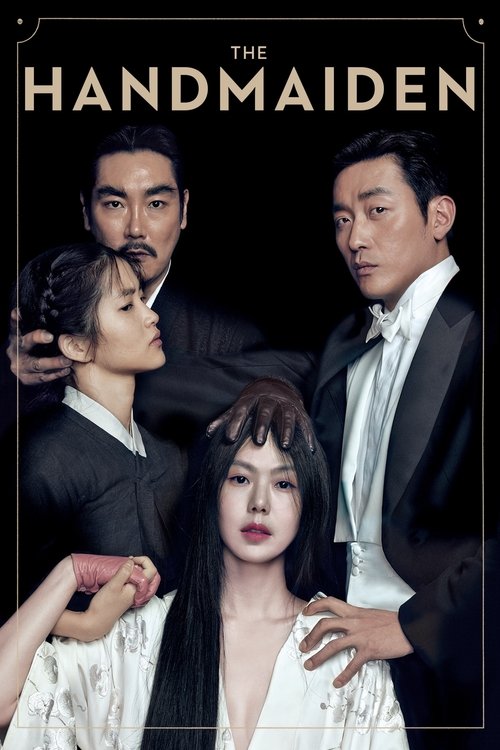
The Handmaiden
2016 · Park Chan-wook
Decision to Leave made him Letterboxd's romantic-obsession auteur; No Other Choice's Venice reception restarted the "greatest living Korean director" argument with Bong partisans. Elegance-plus-perversity is his brand in the discourse.
For when you want to be seduced and outsmarted in the same evening — a lavish, adult entertainment that rewards your full attention. A challenge that goes down like a pleasure.
What it's about
In 1930s Korea under Japanese occupation, a young pickpocket named Sook-hee is planted as handmaiden to Hideko, a secluded Japanese heiress kept on a vast estate by her domineering uncle. Sook-hee is working for a conman posing as a count, whose plan is to seduce the lady, marry her, and steal her fortune — but the closer maid and mistress get, the less the con goes to plan. It's a heist, a Gothic romance, and a game of nested deceptions all at once.
The experience
Sumptuous, wickedly funny, and genuinely erotic, with a story that keeps pulling the rug and re-dealing the cards — each new vantage point makes you rethink everything you just watched. It's twisty without being cold: by the end it's unexpectedly romantic and punch-the-air satisfying.
Performances
Kim Min-hee and Kim Tae-ri are electric together, each playing several layers of pretense at once, and Ha Jung-woo makes the fake count a delicious cad.
The craft
Park Chan-wook directs with ornate precision — gliding camera moves, interiors that blend Japanese and Victorian design into something dreamlike, and a three-part structure that re-narrates events from shifting points of view. Every frame is composed like a jewel box; it absolutely rewards the biggest screen you can find.
Why it matters
A festival sensation that became one of the most internationally beloved Korean films of its decade and pushed queer romance to the center of prestige world cinema. It broadened Park's reputation from cult provocateur to master craftsman.
Snapshot
The Handmaiden (Korean title Agassi, "The Lady") is Park Chan-wook's tenth feature, a lavish erotic thriller that transplants Sarah Waters' 2002 Victorian novel Fingersmith from Dickensian London to Korea under Japanese colonial rule in the 1930s. A pickpocket named Sook-hee is installed as handmaiden to the sequestered heiress Hideko as part of a con devised by a swindler posing as "Count Fujiwara"; the plan to seduce, marry, and institutionalize the lady for her fortune unravels as the two women's mutual deception curdles into genuine desire and, finally, alliance. Told in three movements that re-narrate the same events from shifting vantage points, the film is at once a heist picture, a Gothic romance, a colonial fable, and a polemic against the patriarchal consumption of women's bodies and stories. It premiered in competition at the 2016 Cannes Film Festival and became one of the most internationally visible Korean films of the decade, consolidating Park's reputation as a stylist of baroque control. Its reputation now rests on the marriage of sumptuous craft to a genuinely subversive narrative architecture, in which the apparatus of seduction is repeatedly turned back on the men who built it.
Industry & production
The film was produced through Park's company Moho Film together with Yong Film, with CJ Entertainment — the dominant force in the post-1999 Korean industry — handling backing and domestic distribution. It belongs to the mature, well-capitalized phase of New Korean Cinema, in which a marquee auteur could command a substantial budget, an extended production schedule, and elaborate period construction. The most consequential production fact is the adaptation rights: Park and his co-writer Chung Seo-kyung licensed Waters' Fingersmith and then performed a wholesale cultural transposition, relocating the action to the Japanese occupation, a move that let the source novel's class anxieties be re-coded as colonial and national ones.
Internationally the film traveled widely on the festival and specialty circuit; Amazon Studios and Magnolia Pictures handled the United States release, and the picture circulated in multiple territories on the strength of its Cannes competition slot. Park later assembled a longer "extended"/director's cut running roughly twenty minutes beyond the theatrical version, a not-uncommon practice for him. The film performed strongly in Korea as a prestige commercial release and over-performed for a subtitled, sexually explicit arthouse title abroad; precise admissions and gross figures I won't assert here, but its commercial standing was robust by the measure of a foreign-language auteur film. One industry footnote frequently noted: South Korea did not select The Handmaiden as its submission to the Academy's international category, choosing Kim Jee-woon's The Age of Shadows instead — a decision that drew comment given the film's global profile.
Technology
The film's most discussed technical innovation is paratextual rather than photochemical: its handling of language. The screenplay shuttles between Korean and Japanese, the latter the language of colonial power and of Hideko's coerced refinement, and the original Korean release color-coded its subtitles — Japanese dialogue rendered in one color, Korean in another — so that audiences could track who is speaking the master's tongue and who the servant's at any moment. Language is thus made visible as a technology of domination, a formal device woven directly into the viewing apparatus.
Beyond this, the production's technological signature is one of high-gloss, large-scale period fabrication: a purpose-built estate fusing Japanese and Western architecture, extensive interior sets dressed to the level of the heiress's vast pornographic library, and fluid camera movement — cranes, dollies, and Steadicam — that glides through the house's nested rooms and corridors. The cinematography belongs unmistakably to the polished digital-era image culture of 2010s prestige cinema; I won't claim a specific capture format or camera package as fact, but the look is one of meticulous lighting control, deep saturated color, and seamless movement rather than rough naturalism.
Technique
Cinematography
Chung Chung-hoon, Park's longtime director of photography (he shot Oldboy, Lady Vengeance, Thirst, and Park's English-language Stoker), gives the film a controlled, symmetrical, often frontal compositional language that recalls the architecture it photographs. The camera is mobile but never agitated: long lateral tracks follow servants through the house, slow pushes isolate a face mid-deception, and the recurring motif of thresholds, sliding doors, and framing-within-framing keeps reminding the viewer that everyone is being watched and staged. The palette shifts with the estate's two architectures — cool, woody Japanese interiors against the heavier European wing — and the exteriors (the garden, the famous tree) open the claustrophobic plot onto sudden depth. The erotic sequences are shot with the same lacquered precision as everything else, a choice that became central to debates about whether the film critiques or indulges the gaze it depicts.
Editing
Cut by Kim Sang-bum and Kim Jae-bum, Park's habitual editing team, the film's defining structural gambit is its tripartite, perspective-shifting design. Part One presents the con from Sook-hee's point of view; Part Two doubles back to reveal Hideko's history and the manipulations Sook-hee never saw; Part Three resolves the double-cross in present time. The editing must therefore replay scenes from new angles and withhold or restore information across the seam between parts, so that revelations land as retroactive re-readings. Within scenes the cutting is classical and legible, prizing clarity of eyeline and reaction; the bravura lies in the macro-architecture, where the film's pleasures of suspense come from learning how much of what we first watched was itself a performance.
Mise-en-scène / staging
Production designer Ryu Seong-hie — whose work on the film was honored at Cannes with the Vulcan Award for the festival's artistic/technical contributor — is arguably the film's second author. The Kouzuki estate is a thesis in built form: a Japanese country house grafted onto an English manor, the physical emblem of Uncle Kouzuki's grotesque aspiration to become his Japanese-Anglophile ideal while despising his Korean origins. The basement, the library, the garden, and the reading room are staged as distinct moral chambers. Objects carry the argument: the rare erotic books, the white gloves, the bell, the snake-pit threat in the cellar, the visual quotation of Hokusai's tentacled erotica. Park stages the men's voyeurism literally — a gentlemen's audience assembled to hear a woman read aloud — so that the room itself becomes an indictment of the consuming male spectator.
Sound
Jo Yeong-wook (also credited as Cho Young-wuk), Park's regular composer across much of his filmography, supplies a lush orchestral score that leans toward Western late-Romantic and chamber idioms, lending the colonial pastiche an aptly borrowed European grandeur. The sound design exploits the textures of the house — sliding screens, rain, the creak of the cellar, the small intimate sounds of dressing and undressing — and the bilingual dialogue track is itself a sonic dramatization of power. Music swells most pointedly around the women's emerging bond, the score taking the side of romance against the schemers' machinations.
Performance
Kim Min-hee plays Hideko with a brittle, watchful poise that gradually admits warmth and cunning, calibrating a character who is both victim and active deceiver. Opposite her, Kim Tae-ri — in a breakout debut — gives Sook-hee an earthy, quick directness that grounds the film's more rarefied registers. Ha Jung-woo's "Count Fujiwara" is all oily charm shading into desperation, and Cho Jin-woong makes Uncle Kouzuki a fastidious monster, his perversion expressed through bibliophilia and exacting cruelty rather than overt violence. The two leads' performances are essential to the film's central claim: that the women's intimacy is the one genuine thing in a house of forgeries.
Narrative & dramatic mode
The dominant mode is the unreliable, recursive thriller — a con narrative that repeatedly re-frames its own events. Park builds suspense less from "what will happen" than from "what was really happening," exploiting the gap between the heist's intended choreography and the participants' concealed feelings. The three-part structure converts the source novel's serialized revelations into a cinematic architecture of doubling and reversal. Tonally the film is promiscuous by design, sliding from Gothic dread to caper comedy to erotic melodrama, often within a single sequence, and ending in a register of liberation and even vengeance against the patriarchs. The dramatic engine is the conspirators' shifting alliances: every character is running a scheme, and the plot's resolution is the moment the two women stop performing for the men and start conspiring for each other.
Genre & cycle
The Handmaiden sits at the intersection of several genres — the heist/con film, the Gothic romance, the period costume drama, and the erotic thriller — and consciously refuses to settle into any one. It also participates in the broader cycle of literary transposition and in Korean cinema's recurring fascination with the colonial period, a setting that several mid-2010s Korean prestige films revisited. Within Park's own oeuvre it extends the strain of perverse romance and stylized cruelty running from Oldboy through Thirst. As a same-sex love story rendered with mainstream production resources and explicit content, it also belongs to a small, prominent international cycle of lesbian period dramas in the 2010s.
Authorship & method
The film is a near-ideal showcase of Park Chan-wook's authorship as a system of trusted collaborators. He co-wrote with Chung Seo-kyung, his sustained screenwriting partner, whose contribution to the women-centered re-conception of the material has been widely credited. He shot with Chung Chung-hoon, scored with Jo Yeong-wook, cut with the Kim brothers (Kim Sang-bum and Kim Jae-bum), and built the world with Ryu Seong-hie — essentially the repertory company behind his major works. Park's method here is one of total design: every element, from subtitle color to the architecture of the house to the ordering of the three parts, is bent toward a single thesis about looking, telling, and ownership. His signature is the fusion of immaculate formal beauty with transgressive content, such that elegance and cruelty become indistinguishable — and, in this case, such that the apparatus of male voyeurism is meticulously constructed in order to be dismantled.
Movement / national cinema
The film is a flagship of New Korean Cinema (sometimes "Korean New Wave"), the post-1999 wave of commercially robust, formally ambitious filmmaking that produced Park alongside contemporaries such as Bong Joon-ho and Kim Jee-woon. It embodies that movement's defining capacities: genre fluency, technical polish equal to any global industry, tonal volatility, and a willingness to fold national history — here the trauma and ambivalence of the Japanese occupation — into popular forms. The colonial setting is not mere backdrop but the film's deep structure, with Korean/Japanese power asymmetries mapped onto class, gender, and the very languages spoken on screen.
Era / period
The Handmaiden arrives in the streaming-globalized mid-2010s, when Korean cinema's international standing was rising toward the broader "Korean wave" recognition that Parasite would crystallize at decade's end. It reflects the era's appetite for cross-border prestige titles distributed by both legacy specialty labels and new platform players, and its bilingual, transnational construction suits a moment of expanding global circulation. Set in the 1930s, the film also reflects a contemporary Korean reckoning with the colonial past, treating that period with a mixture of opulent fascination and pointed critique rather than straightforward historical solemnity.
Themes
The film's governing theme is the patriarchal consumption of women — their bodies, their voices, their fortunes, and their stories — and the women's reclamation of all of these. Kouzuki's library literalizes the idea: female sexuality is cataloged, performed for, and trafficked among men, and the climactic gesture of the women is, fittingly, an assault on that archive. Allied themes include deception and performance (everyone wears a role; sincerity becomes the rarest commodity); language, translation, and colonial identity (Japanese as the tongue of mastery, the estate's hybrid architecture as a fantasy of assimilation); class and servitude reimagined through colonial hierarchy; and liberation through solidarity rather than rescue. Crucially, the film stages female desire as the one authentic force capable of breaking the men's interlocking cons — the love is not a subplot but the mechanism of escape.
Reception, canon & influence
Critical reception was strongly favorable, with particular praise for the cinematography, production design, structural ingenuity, and the two lead performances; the most substantial critical debate concerned the explicit sex scenes and whether their lavish staging implicated the film in the very male gaze it sets out to critique — a productive disagreement that has kept the film central to discussions of eroticism and authorship. Its festival and awards life was prominent: the Cannes competition berth, the Vulcan Award for Ryu Seong-hie's design, and, in 2018, the BAFTA for Best Film Not in the English Language. (I'd flag the broader awards tally as something to verify rather than enumerate from memory.)
Looking backward, the film's influences are legible and acknowledged: Sarah Waters' Fingersmith as direct source (with its prior BBC television adaptation as an intervening reference point); the Gothic and sensation-novel traditions; the sensual, transgressive literary world associated with Japanese writers of the period; and Park's own body of work, whose appetite for revenge, perversity, and ornamental cruelty the film extends. Looking forward, The Handmaiden became a touchstone for the international prestige of Korean cinema in the years just before Parasite's global breakthrough, a high-water mark for the lavish-yet-subversive period erotic thriller, and a frequent reference in discussions of how to adapt and culturally relocate literary source material. It also marked the arrival of Kim Tae-ri as a major performer. Within the still-consolidating canon of 21st-century world cinema, it stands as one of Park Chan-wook's most fully realized films and a defining example of craft mobilized in the service of a feminist reversal.
A Deleuzian reading
Picture the reading room.
The full Deleuzian reading of The Handmaiden →
Reception
Acclaimed from its Cannes 2016 premiere onward, it never needed a reappraisal — but its stature has only grown, and Korea's decision to submit The Age of Shadows for the Oscar instead now looks like one of the great snubs of the decade.
How The Handmaiden was received, from release to now →
Influences: the films it descends from and the films it influenced
- Oldboy (2003) — Park's own ancestor: the ornamental-cruelty revenge architecture and the third-act recursive reveal that re-narrates everything seen, here re-tooled as the tripartite perspective shift.
- Lady Vengeance (2005) — Establishes Park's chapter-structured female-vengeance machine and the immaculate-frame-housing-transgressive-content method that The Handmaiden refines into a feminist reversal.
- Thirst (2009) — Direct collaborator lineage — Chung Chung-hoon's fluid sensual camera and Park/Chung Seo-kyung's writing of carnal desire as moral upheaval, prototyped before being perfected here.
- The Servant (1963) — Master-class ancestor in class/servant role-reversal staged through an estate's architecture, where the house itself and framing-within-framing chart shifting power.
- Stoker (2013) — Park's English-language sibling sharpening the symmetrical-frontal compositions, match-cut object transitions, and a young woman's erotic awakening into menace.
- Joint Security Area (2000) — Escalates JSA's two-testimony Rashomon structure into a three-chapter form where each part re-contextualizes the events of prior chapters; Kim Sang-beom edits the temporal reversals using the same clean-cut strategy he developed in JSA, now weaponized for narrative pleasure rather than moral elegy.
- Memoirs of a Geisha (2005) — Refines the lush constructed-period Asian melodrama — painterly low-key interiors, kimono/costume as character, and transgressive deferred desire — that Memoirs popularized as a prestige image-craft showcase.
- Raise the Red Lantern (1991) — Ravishingly colored, rigorously composed interiors of an estate stage women under patriarchal surveillance-and-performance, extending the architectural-confinement-as-theater device into erotic thriller form.
- The Skin I Live In (2011) — Restructures a literary source (as Almodóvar reworks Jonquet's novel) around captivity, eros and a withheld reveal that inverts victim and master.
- Lust, Caution (2007) — Extends the erotic-espionage form under Japanese colonial occupation, using performance-as-deception, nested frames-within-frames, and explicit sex as the actual narrative engine of a con rather than decoration.
- No Other Choice (2025) — Ryu Seong-hie's production design turns a single house into a plot machine of rooms, sightlines, and traps — the spatial method carried directly into this film's staging.
- Fingersmith (BBC) (2005) — The intervening adaptation of Waters' novel whose con-within-con plot and mid-story betrayal reveal supplies the exact narrative skeleton Park relocates to colonial Korea.
- Belle de Jour (1967) — Ancestor in surfacing bourgeois female fantasy and fetish as elegant, deadpan tableau — the lacquered eroticism Park adopts to interrogate the gaze.
- In the Mood for Love (2000) — Sibling in pan-Asian period sensuousness: opulent production design and repetition-with-variation editing that aestheticizes restrained then released desire.
- Rebecca (1940) — Gothic ancestor of the sinister-estate sensation narrative — a naive young woman, a controlling household, and dread built from interiors and withheld information.
- The Piano Teacher (2001) — Sibling in clinical staging of patriarchal sexual repression and a woman's transgressive desire, treating perversion with rigorous formal control rather than titillation.
- Blue Is the Warmest Color (2013) — Sibling in the explicit, extended lesbian sex scene as central dramatic event — and the live critical debate over whether such staging serves or betrays the female gaze.
- Carol (2015) — Sibling in period lesbian romance built from glances and reflective surfaces — the voyeurism-and-the-gaze grammar of looking-through-glass that The Handmaiden weaponizes.
- Parasite (2019) — Descendant in New Korean Cinema's con-on-the-rich within a single charged house, using estate architecture and tonal whiplash to stage class predation.
- Decision to Leave (2022) — Descendant extending the unreliable-recursive structure and color-coded textual interface (here phone subtitles/translation) into a surveillance-romance built on watching.
- The Favourite (2018) — Descendant/sibling in the lavish period costume-drama recast as a triangulated female power game of manipulation, servitude, and desire among women.
- Portrait of a Lady on Fire (2019) — Descendant articulating the reciprocal female gaze as explicit thesis — looking as authorship and equality, the corrective ideal The Handmaiden dramatizes through its maids and masters.
- Phoenix (2014) — Sibling in immaculate period melodrama hinging on disguise, mistaken/withheld identity, and a woman reclaiming agency through a slow reveal of who truly knows what.
Similar films
- Decision to Leave (2022) — influence & lineage · same viewing thread
- Parasite (2019) — influence & lineage · same viewing thread
- Oldboy (2003) — influence & lineage · same viewing thread
- No Other Choice (2025) — influence & lineage · same viewing thread
- Lady Vengeance (2005) — influence & lineage · often watched together
- In the Mood for Love (2000) — influence & lineage · often watched together
- Stoker (2013) — influence & lineage
- Portrait of a Lady on Fire (2019) — influence & lineage
All the films related to The Handmaiden →
Watch it with: curated runs of related films
- New Korean Cinema — Watch these in a run and you feel one national cinema flip between monster movie, revenge thriller, gothic horror, and slow-burn procedural without ever loosening its grip on class, history, and family.