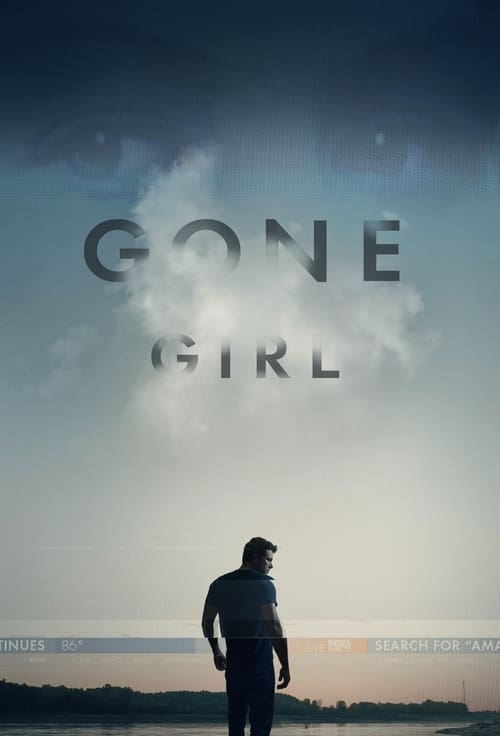
Gone Girl
2014 · David Fincher
The Killer and his Netflix marriage keep the "master craftsman in a streaming cage" discourse alive; every rumored project (the Chinatown prequel series, a Squid Game English remake rumor cycle) trends instantly.
For when you want a smart, nasty thriller that plays with your head — date night if you dare, because you'll argue about it in the car home. More of a delicious challenge than a comfort watch.
What it's about
On the morning of his fifth wedding anniversary, Nick Dunne comes home to a Missouri house showing signs of a struggle and a wife, Amy, who has vanished. As a national media circus descends and the police start circling, the question shifts from where Amy went to who Nick really is — and whether anyone in this marriage was ever telling the truth. It's a missing-person mystery wrapped around an autopsy of a marriage.
The experience
Cold, controlled, and quietly vicious — it tightens like a slow-turning screw, then keeps finding new ways to unsettle you. There's a streak of pitch-black comedy running under the dread, and you'll spend half the runtime changing your mind about who to root for.
Performances
Rosamund Pike is the reason to watch: a career-redefining performance of surgical precision, charm, and menace. Ben Affleck is perfectly cast as a man whose every smile reads wrong on camera.
The craft
David Fincher directs with icy exactness — immaculate compositions, a needling electronic score by Trent Reznor and Atticus Ross, and editing that doles out information like a dealer stacking a deck. Gillian Flynn adapted her own novel, and the screenplay's structure is the star: it withholds, misdirects, and detonates on schedule. Rewards close attention and good speakers more than a big screen.
Why it matters
A defining thriller of the 2010s that sparked endless dinner-table debate about marriage, media, and manipulation, and minted the modern wave of twisty domestic thrillers. It made 'cool girl' a cultural shorthand.
Snapshot
Gone Girl is David Fincher's adaptation of Gillian Flynn's 2012 bestselling novel, a marital thriller that doubles as a corrosive satire of media spectacle and the performances that sustain a marriage. On the morning of his fifth wedding anniversary, Nick Dunne (Ben Affleck) returns to his Missouri home to find signs of a struggle and his wife Amy (Rosamund Pike) missing. As a national media circus descends and the police investigation tightens around him, the film withholds and then detonates the truth: Amy has staged her own disappearance to frame an unfaithful, complacent husband, narrating the scheme in a voice of triumphant, ice-cold control. Structured around a midpoint reversal that converts a missing-wife mystery into a study of two people locked in mutually assured deception, Gone Girl became one of the defining mainstream films of the 2010s — a glossy, exacting, deeply cynical work that married Fincher's procedural precision to Flynn's poison-pen take on coupledom, gender narratives, and the appetite of the news cycle. It confirmed Pike as a major actor and gave the decade one of its most quoted set pieces, the "Cool Girl" monologue.
Industry & production
Gone Girl was produced by Regency Enterprises, Pacific Standard (the production company of Reese Witherspoon and Bruna Papandrea), and Fincher's own banner, and distributed by 20th Century Fox. The project moved unusually fast for a Fincher film: Flynn's novel was a publishing phenomenon, and the screen rights were acquired with Witherspoon attached as producer before the book had fully crested. Fincher came aboard as director and, crucially, the studio engaged Flynn herself to write the screenplay — her first produced script — preserving the authorial voice that made the novel distinctive while reshaping its structure for the screen.
Casting drew on Fincher's taste for working against type. Ben Affleck, whose own career had been entangled with tabloid scrutiny, was cast as the affable, evasive Nick, his public persona an asset to the role. The pivotal part of Amy went to Rosamund Pike, a British actor then known chiefly for supporting work; Fincher reportedly pursued a relative unknown to American audiences precisely so that the character's duplicity would not be pre-read. The supporting ensemble was assembled with similar against-grain instincts: Neil Patrick Harris as Amy's controlling former suitor Desi Collings, Tyler Perry as the telegenic defense attorney Tanner Bolt, Kim Dickens as Detective Rhonda Boney, and Carrie Coon, in her film debut after a stage career, as Nick's twin sister Margo. The film was shot largely on location in Cape Girardeau, Missouri, standing in for the fictional North Carthage, grounding the recession-scarred Midwestern setting that is central to the book's class texture. Gone Girl opened the 2014 New York Film Festival — an unusual berth for a studio genre picture — and went on to substantial commercial success; precise grosses should be checked against a reliable source, but it was among the most profitable adult-oriented releases of its year.
Technology
Gone Girl was shot digitally on the RED Epic Dragon, the high-resolution sensor that Fincher adopted as part of his long-standing commitment to digital acquisition. Fincher had been among the most prominent Hollywood advocates of digital capture since Zodiac (2007), valuing its latitude in low light, the freedom to run extended takes without reloading, and the control it afforded in post over color, grain, and frame. Cinematographer Jeff Cronenweth exploited the Dragon's resolution and dynamic range to build the film's cool, lacquered surfaces and to shoot comfortably in the dim, amber-and-shadow interiors that recur throughout. The workflow was characteristically exacting: Fincher's preference for many takes, digital intermediate grading, and meticulous, often invisible visual-effects clean-up (set extensions, removals, the seamless management of blood and continuity) is integral to the picture's machined finish. The technological signature here is less a single novel device than a total digital pipeline used in service of absolute precision.
Technique
Cinematography
Cronenweth, a frequent Fincher collaborator (Fight Club, The Social Network, The Girl with the Dragon Tattoo), gives Gone Girl a sickly, beautiful gloss — a palette of desaturated greens, sodium ambers, and cold institutional whites that makes the suburban Midwest feel both ordinary and faintly toxic. The camera is typically locked, smooth, and deliberate, gliding on dollies or held in still, composed frames; Fincher's aversion to handheld jitter produces an unsettling calm, the image as controlled as Amy's scheme. Compositions are frequently symmetrical and centered, and the lighting tends to carve faces out of surrounding gloom. The famous turn at Desi's lake house escalates this controlled surface into something operatic and bloody, the clinical visual language making the violence more shocking for its tidiness.
Editing
Kirk Baxter, who cut The Social Network and The Girl with the Dragon Tattoo for Fincher (winning Academy Awards for both, the former shared with Angus Wall), edits Gone Girl around its central structural gambit. The first half braids two timelines — Nick's present-tense ordeal and Amy's diary, read in voiceover as flashback — and the cutting carefully sustains the diary's false reality until the midpoint reveal pulls the rug out, retroactively recoding everything the audience has seen. The film's rhythm is patient and procedural, accumulating detail with the calm of an investigation, then accelerating into the thriller mechanics of the back half. The editing's discipline — its refusal to oversell the twist, its willingness to let scenes breathe — is essential to the film's grip.
Mise-en-scène / staging
The production design renders the Dunnes' world as a catalog of recession-era surfaces: the cavernous, under-furnished McMansion the couple can no longer afford, the failing strip-mall bar Nick runs with Margo, the sterile police station and the media-staged vigil. Staging repeatedly emphasizes performance and surveillance — Nick rehearsed before cameras, Amy constructing her crime scene like a set, the couple's flashback courtship glowing with a too-perfect romantic-comedy sheen that the film later exposes as another fabrication. Fincher blocks for control and watchfulness; characters are often framed as if observed, complicit in their own image management.
Sound
The score by Trent Reznor and Atticus Ross — their third feature collaboration with Fincher after The Social Network and The Girl with the Dragon Tattoo — is one of the film's defining elements. Reznor and Ross have described drawing on the deceptively soothing register of music heard in spas, massage rooms, and medical waiting areas: a placid, synthetic calm that the film twists into dread, the aural equivalent of a pleasant suburban surface concealing something rotten. The result is ambient, droning, and quietly menacing, swelling into discord as the narrative curdles. Sound design throughout favors a hushed, controlled field punctuated by the intrusions of television noise — the cable-news chatter and talk-show outrage that form the film's media chorus.
Performance
The performances pivot on doubleness. Rosamund Pike's Amy is the film's engine: she modulates between the warm "Amazing Amy" of the diary, the steely architect of the frame-up, and the wounded, weaponized survivor of the final act, the "Cool Girl" monologue serving as the hinge where the mask drops. The role earned Pike an Academy Award nomination for Best Actress and remade her career. Affleck calibrates Nick as a man whose every expression invites suspicion — his smirk at a press conference becomes evidence — exploiting the slipperiness of a charming man who may or may not be guilty. The supporting work is sharp throughout: Carrie Coon's Margo supplies the film's grounded moral center and announced a significant new screen presence, while Neil Patrick Harris and Tyler Perry lean into the satirical register, and Kim Dickens anchors the procedure with watchful intelligence.
Narrative & dramatic mode
Gone Girl is built on an unreliable, bifurcated narration that the film stages as a structural trap. The first hour invites the audience to read Amy's diary as truth and to suspect Nick of murder; the midpoint reveal — Amy alive, narrating her own engineering of the plot — converts the film from whodunit to a game of dueling manipulators, and forces a retrospective re-evaluation of everything prior. From there the dramatic mode shifts again, into a grim domestic horror in which the "happy ending" is the most disturbing outcome of all: a marriage reconstituted as mutual hostage-taking, performed for the cameras and sustained by blackmail. The film's refusal of catharsis — Nick trapped, Amy victorious, the couple bound together by a pregnancy engineered as leverage — is its boldest dramatic gesture, denying the genre's expected justice in favor of a bleak equilibrium.
Genre & cycle
The film operates across several genres at once: the missing-person mystery, the courtroom-adjacent media thriller, the erotic-thriller tradition of the lethal partner, and the marital melodrama turned to horror. It self-consciously revives and inverts the "psycho spouse" cycle of the late-1980s and 1990s domestic thrillers — Fatal Attraction, Basic Instinct, The Hand That Rocks the Cradle — while complicating their gender politics rather than simply reproducing them. It also belongs to a strain of prestige adult drama-thrillers, increasingly rare in the 2010s studio landscape, that treated genre material with auteurist seriousness and aimed squarely at grown-up audiences. Within Fincher's own filmography it extends the lineage of his crime and obsession pictures, from Seven and Zodiac to The Girl with the Dragon Tattoo.
Authorship & method
Gone Girl is a characteristic Fincher work executed through an unusually close authorial partnership with its source novelist. Fincher's method — exhaustive preparation, large numbers of takes in pursuit of a precise, unforced naturalism, total command of the digital image, and a fascination with procedure, control, and the unknowability of other people — is fully present. Yet the film's voice is inseparable from Gillian Flynn, who adapted her own novel and reportedly reworked elements of its back half for the screen while preserving its acid view of marriage and media. The collaboration was genuinely co-authorial: Flynn's psychology and dialogue, Fincher's surfaces and rhythm.
His key collaborators form the now-familiar Fincher repertory. Cinematographer Jeff Cronenweth supplied the cold, glossy look; editor Kirk Baxter shaped the structure and tempo; composers Trent Reznor and Atticus Ross provided the queasy ambient score. This recurring team — extending across multiple films — gives Fincher's recent work a consistent sensory signature: controlled, digital, desaturated, scored to unease. The unity of craft serves a single vision of a world in which everyone is managing an image and no surface can be trusted.
Movement / national cinema
Gone Girl is a Hollywood studio film, but one that exemplifies a particular strand of 2010s American cinema: the auteur-driven, genre-grounded prestige picture made for adults at a moment when the studios were increasingly ceding such films to television and the specialty market. It reflects a specifically American set of anxieties — the post-2008 recession's hollowing of middle-class aspiration, the cable-news and true-crime media ecosystem, the suburban Midwest as a site of economic and moral decay. Its preoccupation with public performance and the manufacture of innocence is bound up with American media culture and its appetite for the wronged-husband and perfect-victim narratives that the film both depicts and dissects.
Era / period
The film is firmly of its early-2010s moment. Its economic backdrop — the foreclosed subdivisions, the laid-off magazine writers decamping from New York to a dying river town, the shuttered mall — is pure post-recession texture, and the plot's class resentments depend on it. Its media satire belongs to the era of 24-hour cable outrage and the ascendant true-crime industry, with talk-show pundits and viral public sentiment functioning as a kind of parallel jury. The film also captures a transitional media world in which television spectacle still dominates even as the dynamics it depicts — performance for an audience, the policing of a public image — anticipate the fully networked, social-media-saturated culture that followed.
Themes
The governing theme is marriage as performance — the idea that intimacy is a sustained act, and that to be known by a spouse is to be most dangerously exposed. Amy's "Cool Girl" monologue crystallizes the film's argument about gendered self-fashioning: the way women contort themselves into men's fantasies, and the rage that can fester beneath that accommodation. The film is preoccupied with narrative itself — who controls the story, whose version is believed, how victimhood and guilt are authored and consumed — and with the media apparatus that adjudicates these stories for a watching public. Surface and depth, the unknowability of the person beside you, class precarity and its humiliations, and the violence latent in domestic life run throughout. Critics have debated the film's gender politics extensively: whether Amy is a misogynist caricature of the lying woman or a deliberately monstrous figure deployed to interrogate the very narratives — the wronged wife, the false accuser — that culture circulates. The film holds this ambiguity rather than resolving it, and the debate is a substantive part of its meaning.
Reception, canon & influence
Gone Girl was widely acclaimed on release, praised for its control, its tonal balance of dread and black comedy, and especially for Pike's performance, which earned an Academy Award nomination for Best Actress (the film's principal awards recognition). It was a major commercial success for an R-rated adult drama, a result frequently cited in debates about whether such films could still find a mass theatrical audience. The chief critical fault lines concerned its gender politics — the charge, contested by other critics, that Amy embodies a regressive fantasy of female deceit — and these arguments became part of the cultural conversation around the film well beyond the usual review cycle.
Looking backward, the film draws on the domestic and erotic thrillers of the 1980s and 1990s and their lethal-partner archetypes; on the unreliable-narrator tradition in fiction and film; on the media-spectacle satire of films like To Die For and Network; and on Fincher's own body of procedural crime cinema. Flynn's novel, with its dual-diary structure and its furious feminist-noir voice, is the proximate and decisive source.
Looking forward, Gone Girl helped catalyze a wave of "domestic noir" and unreliable-narrator thrillers across publishing, film, and television in the later 2010s — the Girl on the Train-style cycle of twist-driven stories about untrustworthy women and rotten marriages owes much to its commercial template. It elevated Rosamund Pike to leading status and launched Carrie Coon's screen career. The "Cool Girl" monologue entered the broader culture as a touchstone for discussions of gendered performance. And the film stands as a key example, frequently invoked, of the prestige adult thriller's persistence — and precarity — in the 2010s studio system, a model that Fincher would carry forward into his subsequent work in film and television.
A Deleuzian reading
Watch the smirk.
The full Deleuzian reading of Gone Girl →
Reception
A big hit and awards-season talking point in 2014 (Rosamund Pike's Oscar nod, endless think-pieces), it's since climbed from 'zeitgeist thriller' to consensus modern classic — one of the defining films of the Letterboxd era, its stock only rising as the discourse it predicted kept coming true.
How Gone Girl was received, from release to now →
Influences: the films it descends from and the films it influenced
- Zodiac (2007) — Fincher's own procedural template — obsessive accumulation of detail, locked digital framing, and the unknowability of guilt — that Gone Girl repurposes from cold-case investigation into the forensic dissection of a marriage.
- The Girl with the Dragon Tattoo (2011) — The immediate predecessor for the Cronenweth/Baxter/Reznor-Ross repertory method: desaturated digital sheen, dual-investigation cutting, and an ambient dread score, all applied to a literary thriller about a weaponized woman.
- Vertigo (1958) — The originating grammar of the woman-as-constructed-performance reveal, where a mid-film disclosure retroactively reframes everything the protagonist (and viewer) believed about her identity.
- Les Diaboliques (1955) — The faked-death conspiracy and the plot built around a corpse that isn't where it should be, structuring suspense around a staged disappearance the audience misreads.
- Double Indemnity (1944) — The film-noir architecture of the lethal partner and voiceover confession, supplying the duplicitous-narration scaffolding that Flynn's dual-diary structure modernizes.
- Rosemary's Baby (1968) — Domestic paranoia rendered through a wife's distrust of her ambitious husband, weaponizing the marital home and the spouse's performed normalcy as the site of dread.
- Network (1976) — The satirical model of television news as a self-feeding spectacle machine, the cable-news intrusion that Gone Girl uses to stage Nick's trial-by-media.
- To Die For (1995) — The mock-documentary indictment of a woman who curates her media image for advancement, prefiguring Amy's instrumental command of cameras and public sympathy.
- Fatal Attraction (1987) — The 1980s erotic-thriller archetype of the relationship that curdles into lethal obsession, the genre template of the psycho-spouse threat Gone Girl both inherits and inverts.
- Presumed Innocent (1990) — The prestige legal thriller in which a husband becomes the prime suspect in a death engineered around him, the framed-spouse procedural Gone Girl elaborates.
- Basic Instinct (1992) — The blonde femme fatale who authors the narrative around her — manipulating investigators through performed innocence and an alibi she has scripted in advance.
- Fight Club (1999) — Fincher extends Fight Club's unreliable first-person voiceover into dual competing narratives, applying systematic viewer deception through gendered diary entries, while the Reznor-Ross score and cold digital-intermediate palette maintain the direct formal inheritance from Fight Club's aesthetic grammar.
- Sharp Objects (2018) — The other major Gillian Flynn adaptation, extending her acid feminist-noir voice and fractured-memory narration into prestige television with the same distrust of the maternal home.
- The Girl on the Train (2016) — The most direct beneficiary of the domestic-noir commercial template — an unreliable woman, a rotten marriage, and a twist-driven structure of withheld and retroactively revealed truth.
- A Simple Favor (2018) — Extends the duplicitous-doubleness and staged-disappearance plotting of Gone Girl, weaponizing a missing woman and a performed friendship into twisty domestic thriller.
- Gone Girl-era Big Little Lies (2017) — Carries forward the marriage-as-performance and surveillance themes through dual-timeline, withheld-event structure built around a death the narrative circles and finally reveals.
- Promising Young Woman (2020) — Extends the avenging-woman-as-performer device — a protagonist who scripts and stages elaborate deceptions, weaponizing performed feminine vulnerability for retribution.
- After the Hunt (2025) — Fuses a Reznor-Ross score with an opaque female lead and a he-said/she-said withheld-truth structure, the model of performed opacity Julia Roberts is directed toward.
- Fresh (2022) — Provides the tonally cool, ironic bait-and-switch that recasts courtship/marriage as mutual predation, plus against-type casting to conceal a monster behind a trusted screen persona.
- The Housemaid (2025) — Supplies the post-first-person midpoint twist that reassigns victim and villain, the cinematic-misdirection model for translating a page-turner's revelation to screen.
- Diabolique (1996) — A direct American remake of the staged-death marital conspiracy, sharing the genre DNA of the spouse who fakes mortality to entrap a partner.
- The Killing of a Sacred Deer (2017) — Shares the locked, symmetrical composition and clinical ambient dread deployed against a bourgeois family, treating marriage and domesticity with the same affectless surveillance gaze.
- Prisoners (2013) — Suburban American uncanny prestige thriller demonstrating that wide audiences would attend a film whose domestic order conceals irreparable moral damage; the digital intermediate palette and refusal of catharsis as a viable market proposition.
- Memoir of a Murderer (2017) — Develops the confessional diary-as-narration as unreliable testimony and the written personal record as object-of-evidence that simultaneously constitutes and deceives the investigation — the same grammar Memoir's serial-killer memoir and voiceover employ; parallel evolution from literary source material rather than direct influence.
- Forgotten (2017) — Structures dual temporal logic in the domestic thriller by running two irreconcilable first-person accounts of the same marriage, engineering systematic allegiance transfer in the audience through controlled information release rather than revelatory shock.
- The Last Duel (2021) — Flynn's screenplay constructs a first-person voice-over that builds false credibility for a self-serving account of victimhood, with Fincher's clinical shot selection maintaining the audience's epistemic alignment with the narrator until the structure forces correction — a formal cognate of the Le Gris chapter's self-exonerating logic and the film's argument that whose account is believed is a function of institutional power.
- Strange Darling (2024) — Stages a controlled two-faced reversal in which a woman's calibrated performance retroactively rewrites who is hunter and who is hunted — the same inverted dramatic irony driven by a deceiving lead.
- The Invisible Guest (2017) — Sibling in architectural plotting where a meticulously staged frame-up is narrated as truth before the construction is exposed, matching Paulo's blueprint-precision deception.
- Where the Crawdads Sing (2022) — Parallel construction of a female-driven literary adaptation as a dual-timeline mystery whose withheld final twist retroactively reframes a possibly-justified killing and the question of who the law can touch.
- Companion (2025) — Delivers a mid-narrative reveal that retroactively recodes a marriage as performance and control, in a cool controlled tone with a constructed-persona voiceover — Companion's POV-recoding logic.
- Send Help (2026) — The mid-narrative villain-turn of a woman who seizes control of her own mythology through media 'spin' and dramatic irony — the ironic anti-heroine ascent McAdams's performance echoes.
- Leave Her to Heaven (1945) — Inherits the image of composed evil behind an immaculate surface — the impassive, controlled wife whose sociopathy hides in perfect wifely presentation, Tierney's sunglasses updated to Amy's cool gaze.
Similar films
- The Girl with the Dragon Tattoo (2011) — influence & lineage
- Zodiac (2007) — influence & lineage
- Promising Young Woman (2020) — influence & lineage
- Fatal Attraction (1987) — influence & lineage
- Black Bag (2025) — same viewing thread
- Blink Twice (2024) — same viewing thread
- The Housemaid (2025) — same viewing thread
- Closer (2004) — often watched together
All the films related to Gone Girl →
Watch it with: curated runs of related films
- Elegant Betrayals — Watch these back-to-back for couples and beautiful people whose polished surfaces — a London flat, a Riviera villa, a spies' dinner party — hide a betrayal, a surveillance, and a body, each turning intimacy into a crime scene.