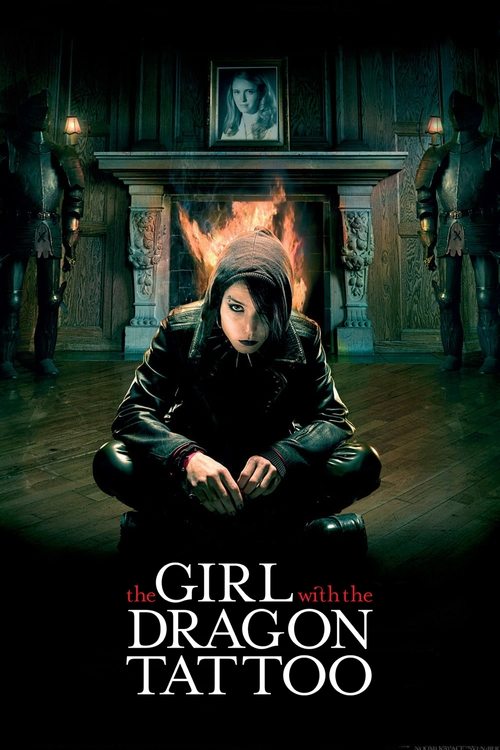
The Girl with the Dragon Tattoo
2009 · Niels Arden Oplev
When you're craving a serious, twisty mystery to sink into on a dark night — and you're ready for something confrontational, not cozy. This is a challenge watch, not comfort food.
What it's about
A disgraced financial journalist, fresh off losing a libel case, is hired by an aging industrialist to solve a cold case: the disappearance of his niece from an isolated family island forty years ago. His unlikely ally is Lisbeth Salander — a tattooed, fiercely private young hacker with her own history of surviving abuse — and together they start pulling at a wealthy family's darkest secrets.
The experience
A slow-burn procedural with a hard, wintry edge — methodical detective work punctuated by genuinely brutal passages involving sexual violence. It's gripping, grim, and anchored by a heroine you can't look away from.
Performances
Noomi Rapace is ferocious as Lisbeth Salander — guarded, damaged, and quietly lethal — a star-making turn that defined the character for a generation. Michael Nyqvist grounds her with a rumpled, believable decency.
The craft
Adapted from Stieg Larsson's novel — originally titled 'Men Who Hate Women,' which tells you exactly what it's angry about — the film braids two investigations into one tightening knot. Its cold Swedish light and unflinching directness became the visual grammar of a whole wave of Scandinavian crime stories.
Why it matters
The breakout international hit of the Nordic noir boom, it turned Larsson's trilogy into a global phenomenon, launched Rapace's career, and prompted a high-profile Hollywood remake.
Snapshot
The Girl with the Dragon Tattoo — released in Sweden as Män som hatar kvinnor ("Men Who Hate Women"), Stieg Larsson's original and far more accusatory title — is the 2009 screen adaptation of the first volume of Larsson's posthumously published Millennium trilogy. Directed by the Danish filmmaker Niels Arden Oplev, it braids two investigations: disgraced financial journalist Mikael Blomkvist (Michael Nyqvist), hired by aging industrialist Henrik Vanger to solve the four-decade-old disappearance of his niece Harriet, and Lisbeth Salander (Noomi Rapace), a tattooed, motorcycle-riding forensic researcher and hacker who is herself a ward of the state and a survivor of institutional and sexual violence. The film became the breakout international success of the Nordic noir wave, made Rapace a star, and — within two years — prompted a Hollywood remake by David Fincher. It is at once a well-machined procedural thriller and a bleak, morally furious study of misogyny woven into the respectable Swedish establishment.
Industry & production
The film was produced by Yellow Bird, the Scandinavian outfit that had already built a franchise machinery around Henning Mankell's Wallander novels and was thus ideally positioned to industrialize Larsson's estate after his sudden death in 2004, before the books' publication. It was a multi-territory co-production — principally Swedish and Danish, with German and Norwegian financing partners typical of the region's pooled public-broadcaster and film-fund model — with Søren Stærmose among the lead producers.
The most consequential production fact is structural: the three Millennium films were conceived as a single continuous enterprise, but only the first was built primarily as a theatrical feature. The two sequels, The Girl Who Played with Fire and The Girl Who Kicked the Hornets' Nest (both 2009, directed by Daniel Alfredson), were made largely for Swedish television and then released and re-cut for cinemas, and all three eventually circulated in longer broadcast versions. Dragon Tattoo itself exists in a theatrical cut of roughly two and a half hours and a substantially longer extended version aired as a two-part miniseries. This hybrid theatrical/television lineage is central to understanding the film's slightly novelistic density and its willingness to keep a large ensemble of Vanger relatives in play.
Distribution amplified everything. The film was a major commercial success across Scandinavia and continental Europe, and its rollout into the United Kingdom and United States (handled in America by the specialty distributor Music Box Films) turned a regional hit into a global phenomenon — an unusually large crossover for a subtitled thriller. Precise grosses vary by source and I won't assign a figure, but the qualitative record is unambiguous: it was one of the most widely seen non-English-language films of its moment.
Technology
Two distinct "technologies" bear on the film. The first is diegetic: the plot runs on digital forensics, surveillance, and hacking. Salander's power is informational — she penetrates hard drives and financial records, reconstructs a 1960s crime from scanned photographs by digitally enlarging and cross-referencing archival images, and ultimately dismantles the antagonist Wennerström through data theft. The film treats computation as the contemporary detective's magnifying glass, and its most bravura investigative sequence is essentially an act of image processing — old parade photographs re-examined frame by frame until a hidden witness resolves.
The second is the production technology itself, and here the public record is thinner. The film carries the polished, cold-graded look characteristic of late-2000s European features finished through a digital intermediate, but I won't assert a specific capture format or camera without confirmation. What can be said with confidence is that the film belongs to the moment when high-resolution digital scanning and grading made the desaturated, blue-steel Nordic palette a controllable, repeatable aesthetic rather than a photochemical accident — and it exploits that control thoroughly.
Technique
Cinematography
Shot by the Danish cinematographer Eric Kress, the film is a study in cold light. Its dominant register is wintry and low-saturation — snow, slate water, the gray stone and dark wood of the Vanger island estate — with interiors that feel underlit and institutional. The camera favors clarity and coverage over flamboyance; this is a thriller that wants you to follow evidence, and the photography serves legibility. Where it turns expressive is in the handling of Salander: she is often framed in isolating compositions, shot against darkness or through glass and screens, the light modeling her as a figure apart. Flashbacks to 1966 are keyed differently, giving the Harriet mystery a distinct temporal texture. The overall effect is austere rather than beautiful — a deliberate refusal of tourist-brochure Sweden.
Editing
The cutting has to solve a difficult structural problem: two parallel protagonists who do not meet until well into the film, plus a decades-old cold case unfolding in flashback. The editing sustains cross-cutting between Blomkvist's document-driven inquiry and Salander's digital and physical investigations, gradually converging the two timelines and the two characters. The rhythm is patient in its procedural stretches and abruptly kinetic in its violence, and the film trusts the audience to hold a large cast of suspects across long runtimes — a pacing strategy that reflects its part-television origins. I won't attach a single editor's name with certainty here, as the credit is worth verifying, but the assembly is notably disciplined given the material's sprawl.
Mise-en-scène / staging
Production design leans on the Vanger family compound as a closed world — an island reachable by a single bridge, a geography that literalizes the locked-room premise: on the day Harriet vanished, no one could have left. The staging repeatedly contrasts institutional respectability (boardrooms, the family's industrial wealth, tidy homes) with the concealed rot beneath it, and the film's most notorious set-pieces — Salander's assault by her state-appointed guardian Bjurman and her calculated revenge — are staged with a confrontational, unglamorized directness that refuses to aestheticize the violence into thriller spectacle. Salander's own spaces and body — her clothing, piercings, the dragon tattoo itself — are costumed as armor and as legible signs of an outsider who has weaponized her marginality.
Sound
Jacob Groth's score works mostly in shadow: cold electronic and orchestral textures that raise tension without over-scoring the procedural stretches. The sound design leans into the environmental — wind, water, the mechanical hum of computers and cameras — reinforcing the film's chilly materiality. Language is itself part of the sound world; the film is emphatically Swedish, and its international reception was, for many viewers, an encounter with subtitled Scandinavian speech as a texture of authenticity.
Performance
The film is now inseparable from Noomi Rapace's Salander, a performance of controlled ferocity built largely out of withholding. Rapace plays her as watchful, near-silent, and physically coiled, letting rage and damage surface in bursts rather than displays; it is a star-making turn that redefined the character for a global audience and, arguably, set the template every subsequent Salander has had to answer. Michael Nyqvist's Blomkvist is her essential counterweight — rumpled, decent, methodical, a fundamentally ordinary man whose steadiness makes Salander's extremity legible. The supporting ensemble of Vanger relatives supplies the film's atmosphere of buried, respectable menace.
Narrative & dramatic mode
Structurally the film is a double-stranded detective story that folds a classical form inside a contemporary one. The Harriet Vanger case is a locked-room, cold-case mystery of almost Golden-Age construction — a sealed island, a fixed cast of suspects, a decades-old photograph as the key clue. Around it, Larsson wraps a modern investigative-thriller mode driven by journalism, finance, and digital forensics, plus a survivor's revenge narrative in the Salander subplot. The dramatic engine is the slow convergence of Blomkvist and Salander from separate investigations into a partnership, and the film's satisfactions are procedural: accumulation, cross-reference, and revelation. Tonally it runs colder and more explicitly brutal than a conventional whodunit, using genre mechanics as a delivery system for social indictment.
Genre & cycle
The film sits at the center of the "Nordic noir" cycle — the wave of Scandinavian crime fiction and screen adaptation that carried a distinctive set of conventions: bleak northern landscapes, socially critical plotting, morally compromised institutions, and detectives who are damaged outsiders. That lineage runs backward through Henning Mankell's Wallander and, further, to Maj Sjöwall and Per Wahlöö's Martin Beck novels of the 1960s–70s, which fused police procedure with critique of the Swedish welfare state. Dragon Tattoo is the cycle's international apex on film, and it is also a genre hybrid — procedural thriller, cold-case mystery, conspiracy narrative, and rape-revenge drama braided together. The rape-revenge strand in particular links it to a much older and more contentious exploitation tradition, which the film both invokes and reframes as social critique rather than titillation — a tension critics have debated since its release.
Authorship & method
The controlling authorial force is arguably the absent one: Stieg Larsson, the journalist and anti-fascist activist whose source novel supplies the film's politics, its outrage at violence against women, and its investigative-reporter worldview. Larsson died in 2004 without seeing the books published, and the films are inevitably read through that biography — the crusading journalist Blomkvist as a partial authorial surrogate.
Director Niels Arden Oplev brought a Danish sensibility to Swedish material, and his method here is one of restraint and legibility: he subordinates directorial flourish to storytelling clarity and to his actors, most decisively to Rapace, whose casting and shaping are his most durable contribution. The screenplay by Nikolaj Arcel and Rasmus Heisterberg — Danish writers who would later collaborate on A Royal Affair — performed the difficult compression of a long, subplot-heavy novel into a followable feature, choosing which strands to foreground and how to stage the convergence of the two leads. Cinematographer Eric Kress supplied the cold visual grammar, and composer Jacob Groth the shadowed score. The editing credit is one I'd flag for verification rather than assert. The overall method is collaborative and craft-forward rather than auteurist: a well-built adaptation machine serving a pre-sold property, elevated decisively by performance and by the seriousness with which it takes the source's social argument.
Movement / national cinema
The film is a flagship of contemporary Scandinavian cinema's export success and, specifically, of the Swedish–Danish creative cross-pollination that has defined the region's screen culture (a Danish director and writers working on Swedish material within a pan-Nordic financing structure). It belongs to a national tradition with a strong social-realist and socially critical spine — Sweden's welfare-state self-examination — even as it operates in a commercial genre register far from the art-cinema legacy of Bergman. Its success helped consolidate "Nordic" as a global brand for quality crime storytelling, paving the way for the international travel of Danish and Swedish television (The Killing, The Bridge) in the years immediately after.
Era / period
Produced and released in 2009, the film is a document of its late-2000s moment in two ways. Diegetically, it is set in a contemporary Sweden of laptops, digital archives, and networked surveillance, with its central cold case reaching back to 1966 — a temporal split that lets the film indict both the sins of the postwar industrial generation and their persistence into the present. Historically, it arrived at the hinge point when subtitled European genre film could achieve genuine global reach through DVD, festival, and specialty-distribution channels, and just before streaming would reshape that pipeline entirely. It is also very much a post-financial-crisis text in its contempt for corrupt industrial and financial power.
Themes
The Swedish title states the central theme plainly: Men Who Hate Women. The film is, at its core, an anatomy of misogyny — not as individual pathology but as something structural, running through respectable families, state institutions (the guardianship system that delivers Salander to her abuser), and the historical continuities of the Vanger dynasty, whose buried Nazi sympathies link private violence to fascist ideology. Against that runs the theme of the outsider-avenger: Salander as a survivor who takes justice into her own hands because institutions have failed her, raising the film's most debated question — whether its graphic depiction of sexual violence indicts or exploits. Other throughlines include journalism as a moral vocation and a bulwark against powerful corruption; information and surveillance as instruments of both control and liberation; and the weight of concealed family history. It is a film about excavation — of photographs, hard drives, and the crimes a prosperous society prefers to keep sealed on a private island.
Reception, canon & influence
Critically, the film was widely praised — above all for Rapace, whose Salander became one of the most discussed screen characters of the era — while some critics raised sustained objections to the intensity and framing of its sexual violence. It performed strongly on the awards circuit; among its recognitions, Rapace's performance was honored in Sweden's Guldbagge Awards, and the film won the BAFTA for Best Film Not in the English Language, a significant marker of its crossover standing. (Specific award tallies are worth confirming against the official records rather than trusting to memory.)
Its influences run backward to the Sjöwall–Wahlöö and Mankell tradition of socially critical Scandinavian crime, to the locked-room detective form, and to the rape-revenge lineage it reworks. Its forward legacy is unusually large for a subtitled film. Most conspicuously, it triggered David Fincher's 2011 English-language remake with Rooney Mara and Daniel Craig — a rare case of a hit foreign film being remade in Hollywood within two years — which invites direct comparison and has kept both versions in critical circulation. More broadly, the film (and its two sequels) helped ignite the international appetite for Nordic noir that carried Scandinavian television to global audiences in the 2010s, and it established a benchmark performance against which every subsequent interpretation of Lisbeth Salander is measured. For a regional genre production, its imprint on the global crime landscape has been outsized and durable.
Reception
A massive European hit in 2009 that turned Noomi Rapace into an overnight international star — then, barely two years later, David Fincher's remake arrived and the original was recast as 'the Swedish one', the version purists defend rather than the default everyone sees.
How The Girl with the Dragon Tattoo was received, from release to now →
Influences: the films it descends from and the films it influenced
- The Virgin Spring (1960) — Establishes the Swedish rape-revenge template the film secularizes — a methodical vengeance mounted after a young woman's rape, staged with grave stillness rather than exploitation-genre kineticism.
- Se7en (1995) — Its rain-soaked green-gray desaturated palette and structure of ritual murders keyed to a scriptural/coded schema is the serial-killer-procedural grammar Kress echoes and that Fincher would literally inherit by remaking this film.
- The Silence of the Lambs (1991) — Pairs a marginalized young woman against systemic sexual predation and uses tight over-the-shoulder / near-POV framing to lock the viewer to her wary gaze — the investigator-subjectivity Rapace's Salander extends.
- Insomnia (1997) — The founding Nordic-noir look — cold overexposed northern light and a guilt-corroded investigator — supplies the desaturated visual atmosphere and morally compromised protagonist this film adopts.
- The Man on the Roof (1976) — A Sjöwall–Wahlöö adaptation that codified the socially critical Swedish procedural indicting institutions and power, the explicit tradition Larsson's journalist-hero worldview extends.
- Murder on the Orient Express (1974) — The closed-circle whodunit worked methodically through a fixed roster of suspects sealed off from the world — the exact locked-room logic applied to the isolated Vanger family island.
- The Social Network (2010) — Immediate continuation of the same Cronenweth digital cinematography and Reznor/Ross electronic underscore, deploying the cold-palette tech-thriller grammar developed here.
- The Girl Who Played with Fire (2009) — The immediate sequel continues Rapace's Salander and the investigative-vengeance arc, inheriting the same double-protagonist convergence and cold procedural staging.
- The Girl with the Dragon Tattoo (2011) — A direct English-language remake that preserves the double-protagonist structure while pushing the cold digital palette and swapping Groth's shadowed score for Reznor/Ross's electronic-orchestral dread.
- Bron/Broen (The Bridge) (2011) — Centers a socially atypical, trauma-marked female investigator inside a cross-border institutional critique — a bankable protagonist type that Salander's breakout helped legitimize for the Nordic-TV wave.
- Headhunters (2011) — A Jo Nesbø adaptation riding the post-Larsson Nordic-noir export appetite, delivering sleek desaturated brutality and a pursued-protagonist thriller engine to international audiences.
- Prisoners (2013) — Extends the wintry desaturated abduction procedural — Deakins' leached gray palette and isolating framing around a morally compromised searcher tracking violence done to the young.
- Gone Girl (2014) — Threads media/journalism scrutiny and gendered violence through a cold clinical procedural scored by Reznor/Ross — Fincher extending the exact Dragon Tattoo grammar he'd built on the remake.
- Wind River (2017) — A cold-landscape crime film that frames the investigation of sexual violence against women as an indictment of institutional neglect — the structural-misogyny-as-subject procedural Larsson pioneered for the genre.
- The Snowman (2017) — A Nesbø serial-killer adaptation trading directly on the frozen Nordic-noir palette and mutilation iconography this film helped make an exportable brand.
- Zodiac (2007) — Builds an obsessive investigation from archival documents, records, and a research-montage of clue collation in cold naturalistic light — the same journalist-plus-forensics procedural method the Blomkvist strand runs on.
- Forbrydelsen (The Killing) (2007) — Co-defines the Nordic-noir export mode — a cold-palette, serialized murder investigation braided with social and institutional critique — that this film's success amplified into a global appetite.
- A Royal Affair (2012) — Reunites screenwriters Nikolaj Arcel and Rasmus Heisterberg, reapplying the same dense-source compression craft — foregrounding strands and staging convergence — they used to make Larsson's sprawling novel filmable.
Similar films
- The Girl with the Dragon Tattoo (2011) — influence & lineage · same viewing thread
- Insomnia (1997) — influence & lineage
- Gone Girl (2014) — influence & lineage
- Headhunters (2011) — influence & lineage
- The Girl with the Needle (2024) — shared sensibility
- Revanche (2008) — shared sensibility
- Nosferatu (2024) — shared sensibility
- Black Book (2006) — shared sensibility
All the films related to The Girl with the Dragon Tattoo →
Watch it with: curated runs of related films
- No One Coming to Save Her — Watch these in a run for the same unblinking gaze on girls left to fend for themselves — abandoned by their mothers, circled by predatory men, and armed with nothing but their own nerve.