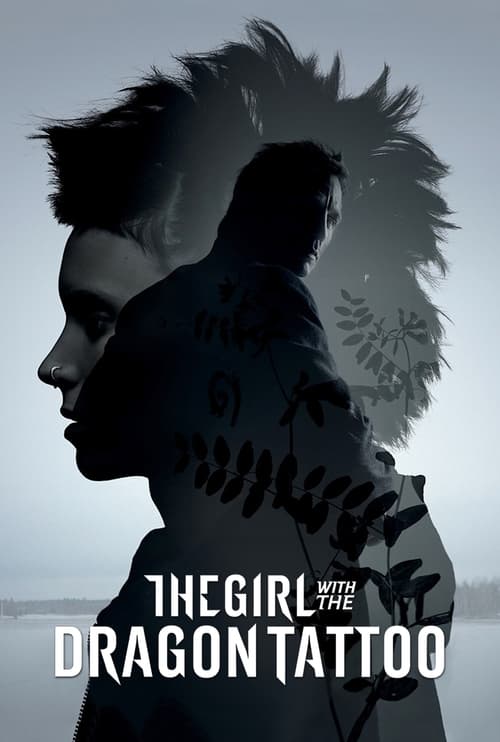
The Girl with the Dragon Tattoo
2011 · David Fincher
The Killer and his Netflix marriage keep the "master craftsman in a streaming cage" discourse alive; every rumored project (the Chinatown prequel series, a Squid Game English remake rumor cycle) trends instantly.
For when you want to disappear into a long, absorbing mystery on a dark night — a challenge, not comfort, and one to skip if depictions of assault are a hard line for you.
What it's about
A disgraced Stockholm journalist is hired by an aging industrialist to solve a cold case: the disappearance of his grand-niece from an isolated family island forty years earlier, with the extended clan — Nazis and abusers among them — as the suspect pool. He's eventually joined by Lisbeth Salander, a pierced, antisocial hacker with her own history of violence, and their archival digging opens onto something far worse than one missing girl.
The experience
Cold, precise and gripping — nearly three hours of research, interviews and old photographs that somehow plays like a vise slowly closing. It's genuinely dark, with scenes of sexual violence that are hard to watch, and it holds its wintry tone to the last frame.
Performances
Rooney Mara's Oscar-nominated Salander is the reason to watch: guarded, feral and unexpectedly moving, a full transformation. Daniel Craig plays smartly against type as a rumpled journalist who's usually the least dangerous person in the room.
The craft
Fincher's control is total — immaculate compositions in Swedish gloom, razor editing that makes reading documents suspenseful, and a droning, icy electronic score from Trent Reznor and Atticus Ross that gets under your skin. It sounds as designed as it looks; good speakers pay off.
Why it matters
The high-water mark of Hollywood's Nordic-noir moment, it made Rooney Mara a star and stands as a rare case of a major studio spending blockbuster money on an adults-only procedural.
Snapshot
David Fincher's The Girl with the Dragon Tattoo is a $90-million American studio adaptation of a Swedish bestseller, shot largely on location in Sweden with a mostly European supporting cast, delivered by a director then coming off the Oscar-nominated The Social Network (2010). It is an anomaly in Fincher's filmography and in the studio system of its moment: a hard-R, three-hour procedural about sexual violence, financial fraud, and archival research, released at Christmas as a would-be franchise starter.
The film adapts Stieg Larsson's Män som hatar kvinnor (2005) — literally "Men Who Hate Women," retitled in English translation — the first volume of the posthumously published Millennium trilogy. Larsson, a journalist and anti-fascist activist who edited the magazine Expo, died in 2004 before the books were published; their global sales made them one of the publishing phenomena of the 2000s. A Swedish film version directed by Niels Arden Oplev, starring Noomi Rapace, had already appeared in 2009 and traveled widely in subtitled release, which meant Fincher's version arrived as a remake of a film many art-house audiences had recently seen, as well as an adaptation of a book they had read.
Fincher's response was not to soften the material but to formalize it. Working from a script by Steven Zaillian, with cinematography by Jeff Cronenweth, editing by Kirk Baxter and Angus Wall, and a score by Trent Reznor and Atticus Ross, he produced something closer to a cold, exact machine than a thriller in the conventional sense: long stretches of two people reading documents, cross-cut across separate cities, rendered with the same density of craft Fincher had brought to Zodiac (2007). Rooney Mara, cast against expectation after a small role in The Social Network, plays Lisbeth Salander; Daniel Craig, then mid-tenure as James Bond, plays Blomkvist as a notably passive, put-upon figure.
The film received strong reviews and an Academy Award for Best Film Editing (Baxter and Wall), with nominations including Best Actress for Mara. Commercially it underperformed relative to its cost, and the planned sequels adapting The Girl Who Played with Fire and The Girl Who Kicked the Hornet's Nest were never made with this cast and director. Its most durable legacies are its title sequence, its Reznor/Ross score, and Mara's Salander — and, more diffusely, its role in the digital-cinema and streaming-era grammar of the prestige procedural.
Industry & production
The rights situation was unusual. Sony's Columbia Pictures acquired English-language rights to Larsson's novel while the Swedish film trilogy — produced by Yellow Bird, with the second and third installments made for television and released theatrically in edited form — was already in circulation. The English-language version was thus in the awkward position of remaking a recent success rather than discovering an untouched property, a common enough studio maneuver (compare the American Let Me In, 2010, or The Departed, 2006) but one that invites immediate comparison.
Fincher came to the project directly from The Social Network, which had won three Academy Awards, and he brought essentially that film's entire above-the-line craft team with him: Zaillian replaced Aaron Sorkin as writer, but Cronenweth, Baxter, Wall, Reznor and Ross, and production designer Donald Graham Burt all returned. Producer Scott Rudin, another Social Network holdover, produced with Søren Stærmose (a producer on the Swedish films) and others. This continuity of personnel matters: the film is legible as the second entry in a two-picture experiment in shooting long, dialogue-and-information-heavy narratives digitally at high shooting ratios.
Production was substantially located in Sweden — Stockholm and locations standing in for the fictional Hedeby Island, with additional work in Norway and Zurich, and interiors at Sony's facilities in Los Angeles. Shooting in Swedish winter, with very short daylight hours at northern latitudes, was a deliberate constraint that shaped the film's look; Fincher and Cronenweth have discussed working with the limited available light rather than fighting it. The production reportedly benefited from Swedish film incentives, and the mixed Anglo-Swedish cast — Stellan Skarsgård as Martin Vanger, Yorick van Wageningen as Bjurman, along with Christopher Plummer, Robin Wright, Joely Richardson, Steven Berkoff — reflects both the location and a house style of casting for texture rather than marquee value.
The film's marketing was itself a minor cultural event: a leaked red-band teaser cut to Reznor and Ross's cover of Led Zeppelin's "Immigrant Song," with Karen O on vocals, circulated widely online in advance of the trailer's official release, and the campaign's tagline positioned the film as "the feel-bad movie of Christmas." That positioning was accurate but commercially double-edged. Released 20–21 December 2011 in the U.S. with an R rating, the film performed respectably rather than spectacularly; against a production budget widely reported at around $90 million plus a substantial marketing spend, its worldwide gross was insufficient to make sequels an easy decision. Sony developed follow-ups intermittently over the following years, and eventually produced The Girl in the Spider's Web (2018), directed by Fede Álvarez with Claire Foy as Salander — a soft reboot rather than a continuation, and not a success. The unmade Fincher/Mara sequels remain one of the notable might-have-beens of 2010s studio filmmaking.
Technology
Dragon Tattoo was shot digitally on the RED Epic, following The Social Network's use of the RED One MX. Fincher had been among the most prominent early adopters of digital capture at the high end — Zodiac was shot largely on the Thomson Viper — and by 2011 he was using digital not as an economy measure but as a working method: enormous coverage, very high take counts, and the freedom to run long without magazine changes.
The practical consequences are visible. The Epic's sensitivity permitted shooting in the low, flat light of a Swedish winter and in genuinely dark interiors without the heavy supplementary lighting that film stock would have demanded, which is why so much of the film reads as underlit in a naturalistic rather than expressionistic way. The camera's small form factor allowed placements — tight car interiors, cramped apartments, the confined space of Martin Vanger's basement — that would have been harder with a film magazine attached.
Post-production was equally computational. Fincher's workflow by this point ran on a digital intermediate as a matter of course, with extensive use of invisible visual effects: stitched plates, replaced backgrounds, digital weather, cleanups, and composited faces or performance elements across takes. The film's most-discussed effects work is in a sequence involving a cat, and in the tunnel/road crash beat; more pervasively, effects are used to erase production traces and unify the palette. This is the Fincher signature of the period — VFX deployed not for spectacle but for control.
The title sequence, produced by Blur Studio under creative direction from Tim Miller, is the film's most conspicuous piece of digital craft: an entirely CG assemblage of black liquid, wires, hands, keyboards, and flowering violence set to the "Immigrant Song" cover. It reads as an abstract, oil-slicked compression of the whole trilogy's imagery and, in its indebtedness to the Bond main-title tradition, as a wry acknowledgment of Craig's presence.
Technique
Cinematography
Jeff Cronenweth — son of Blade Runner's Jordan Cronenweth, and Fincher's DP on Fight Club, The Social Network, and later Gone Girl — shoots the film in a desaturated, blue-green-leaning register with deep, retentive blacks. The palette is not the digital-teal cliché of the era so much as an attempt to render Nordic winter light: overcast, directionless, low-contrast outdoors; small, warm, insufficient practical sources indoors.
The camera is characteristically Fincherian in its discipline. Movement is motorized and precise, often a slow push or a lateral glide that reframes without calling attention to itself; handheld is used sparingly and pointedly. Fincher's aversion to the "found" camera — his preference for locked, composed frames that place information exactly where it needs to be — makes the film's rare violent kinetics land harder. Compositions frequently isolate figures in wide, cold spaces (the Hedeby exteriors, Vanger's house) and then, in interrogation and research scenes, close down to tight, symmetrical two-shots.
There is a strong architecture of screens and paper: monitors, scanned photographs, Salander's laptop, the grid of 1966 parade images that Blomkvist assembles. Cronenweth lights these so that the emitted light of a display becomes the dominant source on a face, a motif Fincher had refined across Zodiac and The Social Network and which here does double duty as characterization — these are people lit by the information they are consuming.
Editing
Kirk Baxter and Angus Wall won the Academy Award for Best Film Editing, their second consecutive win after The Social Network. The achievement is structural: the film runs roughly 158 minutes and spends much of its first hour on parallel tracks that do not intersect — Blomkvist's disgrace and exile, Salander's surveillance work and her catastrophic relationship with her guardian — and the editing has to sustain momentum without the crutch of shared scenes.
The cutting is fast at the level of the shot but patient at the level of the scene: Fincher's coverage permits many small, invisible cuts within a conversation that keep the frame changing while the information accumulates. Transitions are frequently elliptical and sound-led, with music or ambience bridging across a hard cut in space and time. The research montages — Blomkvist working through Vanger family files, Salander running searches — are edited as rhythmic sequences where the image of reading is made kinetic, an approach with a direct antecedent in Zodiac's handling of documentary tedium.
The film's most notorious formal decision comes after the mystery is solved: rather than ending on the resolution of the Harriet plot, it continues for a substantial coda dealing with the Wennerström fraud and Salander's private disappointment. Many critics found this structurally ungainly; it is faithful to Larsson, and it is also where the film's real subject — Salander, not the mystery — is finally allowed to occupy the frame alone.
Mise-en-scène / staging
Donald Graham Burt's production design draws a hard line between two worlds. The Vanger compound is old money made physical: dark wood, heavy furniture, family portraits, a private island reached by a single bridge — an emblem of a closed, self-policing dynasty. Blomkvist's rented cottage is spare and cold. Against this, Salander's Stockholm is a jumble of hardware, cables, black clothing, and takeaway containers, a habitat organized around equipment rather than comfort.
Staging repeatedly emphasizes thresholds and surveillance: doorways, one-way glances, the bridge, the CCTV-like framings of Salander watching and being watched. Costume (Trish Summerville) became genuinely influential — Salander's leather, piercings, bleached brows, and asymmetric hair were widely imitated, and a tie-in fashion collection followed. Crucially, the design refuses to glamorize: the outfits read as armor assembled from cheap materials, not as styling.
The film's two hardest scenes — Bjurman's assault on Salander and her retaliation — are staged with a flat, unblinking clarity that refuses both titillation and discretion. Fincher shoots them in extended takes with minimal scoring, and the retaliation is deliberately clinical, procedural rather than cathartic. Whether the film's rendering of sexual violence is critique or reproduction of the thing it depicts was the central point of contention in its reception, and the staging is what the argument is actually about.
Sound
Trent Reznor and Atticus Ross's score, released as a three-disc album, is longer and more ambient than a conventional thriller score: analog synth drones, corroded textures, arpeggiated pulses, and passages of near-silence. Its function is atmospheric rather than dramatic — it establishes cold and dread as a constant condition rather than punctuating events. The "Immigrant Song" cover with Karen O bookends this with something closer to an assault, and it is the exception that proves the rule: the rest of the score almost never asserts itself in that register. Reznor and Ross had won the Academy Award for The Social Network the previous year; this score deepened the collaboration into an ongoing house sound for Fincher.
Sound design (with Ren Klyce, Fincher's long-standing collaborator) is built on environmental specificity: wind, ice, snow underfoot, the mechanical noises of scanners, hard drives, engines, and the peculiar acoustic deadness of the Vanger interiors. Klyce and Fincher's practice of treating score and effects as a single continuous sonic field — where a drone may be a synth, a generator, or both — is fully realized here.
Performance
Rooney Mara's Salander was the film's principal gamble. She plays the character with an affectless, minimal-signal exterior: flat vocal delivery, minimal facial movement, an economy of gesture that makes small deviations enormous. The performance is legible as autistic-coded and trauma-shaped without the film ever diagnosing her, and it declines the audience's invitation to find her charming. Mara underwent well-documented physical alterations for the role, including piercings and bleached eyebrows. Her Academy Award nomination for Best Actress was, in context, a significant validation for a performance built on withholding.
Daniel Craig plays Blomkvist against his Bond persona: reactive, professionally humiliated, physically unimpressive in a fight, dependent on others' competence. That inversion is the film's structural joke and its point — the ostensible protagonist is the assistant. Stellan Skarsgård's Martin Vanger is the film's most conventional pleasure, a study in genial hospitality curdling into something worse; Yorick van Wageningen's Bjurman is played without a shred of charisma, which is the correct and harder choice. Christopher Plummer's Henrik Vanger supplies the film's only real warmth, and Robin Wright, Joely Richardson, and Goran Višnjić fill out a supporting field notable for how little any performance reaches for effect.
Narrative & dramatic mode
The film's dominant mode is the procedural: work depicted as work. Its through-line is not chase or confrontation but the accumulation and cross-referencing of records — photographs, ledgers, Bible verses, police files, corporate filings. Fincher had made this mode his own in Zodiac, where the failure of investigation was the subject; here investigation succeeds, but the pleasure remains the same, located in the click of one document against another.
Structurally, the film is a double-strand narrative that withholds convergence. Blomkvist's plot is a locked-room historical mystery: a disappearance from a closed island on a day when the bridge was blocked. Salander's plot is a contemporary account of institutional captivity — a woman declared incompetent, assigned a guardian, and made prey by the state's own machinery. The two run in parallel for roughly the first act and a half. When they join, the film reveals its argument: the private crime and the systemic one are the same crime at different scales.
Larsson's title, Men Who Hate Women, states the thesis the English title obscures. The film retains the novel's chaptered, quasi-documentary insistence on specifics — dates, place names, sums of money, the mechanics of a corporate fraud — and its intertitles and on-screen text function as a paratextual apparatus. The Wennerström coda, so often faulted as anticlimax, is generically consistent: this is a story about journalism as a mode of justice, and the fraud exposé is the plot Blomkvist actually set out to complete.
Fincher's tonal register is cold irony throughout. Violence is neither aestheticized nor elided; the film's most disturbing sequence, in Martin's basement, plays a monologue about the banality of predation over an entirely conventional thriller setup, and the rescue that follows arrives with a deflating lack of ceremony.
Genre & cycle
The film belongs to the Nordic noir cycle — the Scandinavian crime wave that ran from Maj Sjöwall and Per Wahlöö's Martin Beck novels of the 1960s–70s through Henning Mankell's Wallander to Larsson, and on into television (Forbrydelsen, 2007; Bron/Broen, 2011). The cycle's defining move is to use genre crime to indict the social-democratic welfare state's self-image: beneath the ordered surface, misogyny, racism, and unpunished wealth. Larsson, an anti-fascist journalist, wrote that critique explicitly into a trilogy in which the villains include industrialists with Nazi pasts and a state guardianship system that hands vulnerable women to their abusers.
Grafted onto this is the American serial-killer procedural, a genre Fincher himself had decisively shaped with Se7en (1995) and complicated with Zodiac. The Vanger case supplies the biblically-coded murders, the tour of atrocity photographs, the killer's basement — furniture inherited from Se7en and The Silence of the Lambs (1991). What Fincher does with it is characteristically deflationary: the killer's speech is banal, the trap is escaped through ordinary desperation, and the death is undignified.
The third strand is the hacker film, or more precisely the film of information competence: Salander belongs with the lineage of protagonists whose power is access. Her scenes of infiltration are shot with a plausibility that most films of the type do not attempt.
The film also participates in the rape-revenge tradition, a fraught inheritance running from I Spit on Your Grave (1978) through Ms. 45 (1981) and later Revenge (2017). It is the film's most contested affiliation. Fincher's treatment — clinical, unaroused, denying the retaliation any triumphal charge — is a deliberate revision of the form's exploitation origins, but the sequence's length and explicitness ensure the debate is unresolvable on the film's own terms.
Authorship & method
By 2011 Fincher's method was among the most documented in contemporary studio filmmaking: exhaustive pre-visualization and storyboarding, digital capture enabling very high take counts, a preference for exact, motorized camera movement, and post-production control extending to invisible digital manipulation of performance and environment. The often-repeated accounts of dozens of takes per setup describe an approach that treats performance as material to be refined past self-consciousness — and, in the digital era, as material to be recombined in post.
Fincher's authorship here is inseparable from a stable repertory of collaborators. Jeff Cronenweth had shot Fight Club and The Social Network; his work with Fincher is defined by low-key lighting, source-motivated practicals, and a willingness to let faces fall into shadow. Kirk Baxter and Angus Wall, editing together, had won for The Social Network and won again here; Wall's separate career in title design (his company Rock Paper Scissors, and his work on Fincher's earlier main titles) is part of the same sensibility. Trent Reznor and Atticus Ross, brought in for The Social Network, were now a fixture, and their approach — sound design as score, texture over theme — matched Fincher's. Ren Klyce, sound designer since Se7en, integrated the two. Donald Graham Burt, production designer from Zodiac onward, and costume designer Trish Summerville, whose work here became independently influential, complete the unit.
Steven Zaillian is the significant new voice. His screenwriting credits — Schindler's List (1993), Awakenings (1990), Searching for Bobby Fischer (1993, which he also directed), American Gangster (2007), later HBO's The Night Of (2016) — cluster around adaptations of dense, institutionally-detailed source material into procedurally patient screen narratives. Zaillian's script preserves far more of Larsson's structural bulk than a conventional adaptation would, including the Wennerström resolution, while making a small but consequential change to the ending's emotional logic. Compared with Sorkin's verbal pyrotechnics on The Social Network, Zaillian gives Fincher something closer to the opposite: sparse dialogue, long silences, information conveyed by action and image.
The clearest statement of Fincher's method here is negative. He does not make Salander sympathetic, does not make Blomkvist heroic, does not make the violence bearable, and does not end on the mystery's solution. What he does supply is an unbroken surface of technical control — a film in which every element is deliberate, and the deliberateness is itself the moral position: this material will be looked at squarely, without the softening that style usually provides.
Movement / national cinema
The film sits at an odd intersection of national cinemas. It is an American studio production, financed and released by Sony/Columbia, in English, with an American director and an English star. It is also a Swedish film in setting, source, supporting cast, crew, and much of its production base — shot in Swedish locations, with Swedish actors speaking English in lightly accented registers, a compromise the film adopts openly rather than concealing.
That compromise places it in a specific 2000s–2010s tendency: the English-language remake of a recent non-Anglophone success, aimed at audiences resistant to subtitles. The Ring (2002), The Departed (2006), Let Me In (2010), and Funny Games U.S. (2007) are variously its neighbors. What distinguishes Fincher's film from most is that it does not relocate the story to America; the Swedishness is retained as content and as texture, even as the language is not. The result is a kind of deracinated Scandinavia — legible to international audiences, geographically specific, linguistically fictional.
More broadly, the film belongs to the globalized prestige thriller of the 2010s, in which capital, cast, and locations cross borders freely while the finished object remains an American product. Its Nordic noir substrate had by 2011 become a genuinely transnational export category, with Scandinavian crime television and fiction reaching worldwide audiences and shaping the visual language of "serious" crime drama for a decade afterward.
Era / period
Dragon Tattoo is a document of the early 2010s in three respects. First, technologically: it arrives at the moment when digital capture became the default at the high end of American filmmaking, and when its consequences — long takes, huge coverage, aggressive post-production grading and manipulation — had settled into a house style rather than an experiment. Second, industrially: it is a late example of a mid-budget-adjacent, adult-oriented studio film released as a tentpole, made in the last years before the theatrical middle collapsed decisively toward franchises at one end and streaming at the other. That its failure to launch a franchise ended the project is precisely the era's logic.
Third, thematically: the film's preoccupations — surveillance, hacking, financial fraud, journalism's collapse and its residual authority — belong to the aftermath of the 2008 financial crisis and the beginning of the Assange/WikiLeaks decade. Blomkvist is destroyed by a libel judgment for reporting on a financier; the film's resolution is an act of financial hacking that redistributes stolen money. Salander's fluency with information systems is presented as the era's real power, and the film is unsentimental about who holds it.
The 1966 disappearance at the film's center supplies a second temporal layer. The Vanger family's Nazi sympathies, the postwar industrial dynasty, and the four-decade-old crime tie the present-day corruption to a specific twentieth-century inheritance — the argument being that the fascism was never a historical aberration but a family business.
Themes
Misogyny as system. Larsson's original title names the subject. The film is organized around a taxonomy of men who harm women: a serial murderer, a guardian who rapes his ward, a father, an institution that assigns the guardian, and a financial elite that protects itself. Statistical intertitles in the novel made the case explicitly; the film makes it structurally, by showing that Salander's private catastrophe and the Vanger murders are versions of the same arrangement.
Institutional guardianship and legal personhood. Salander is a legal minor in her thirties — declared incompetent, financially controlled by a state-appointed man. This is the film's sharpest political idea and its most Swedish: the welfare state's protective apparatus turned into a mechanism of predation.
Information as power and as violence. Every character's leverage is informational: Blomkvist's journalism, Wennerström's concealment, Salander's hacking, Martin's photographs, and the Vanger archive itself. Salander's most decisive acts are acts of recording and disclosure — most explicitly in how she resolves the Bjurman situation, which converts documentation into permanent control. The film treats surveillance as morally neutral technology weaponized according to who wields it.
Family as concealment. The Vanger compound literalizes the closed family: an island with one bridge, a dynasty policing its own crimes, an inheritance that includes fascism. The mystery's solution is not that an outsider intruded but that nobody ever left.
Damage and the refusal of redemption. Salander is not healed by the narrative. The ending — her wordless reversal upon seeing Blomkvist with Erika Berger — declines the romance the structure has been building. It is a small gesture that retroactively reframes the entire film as hers, and it insists that competence and trauma coexist without one curing the other.
Reception, canon & influence
Critical reception in December 2011 was largely positive, with the strongest praise for Mara's performance, the Reznor/Ross score, Cronenweth's photography, and the editing. Several substantial reservations recurred: that the film was a redundant remake of a recent and adequate Swedish version; that its final act sagged after the mystery's resolution; and — most seriously — that its handling of sexual violence risked reproducing the spectacle it purported to condemn. That last argument was conducted vigorously in feminist criticism at the time and has not been settled; it remains the film's live critical question.
Awards recognition was substantial without being dominant. Baxter and Wall won the Academy Award for Best Film Editing. Mara was nominated for Best Actress, and the film received additional nominations in cinematography, sound editing, and sound mixing. Commercially it did not achieve what a $90-million franchise-starter needed, and the sequels went unmade.
Influences on the film (backward). The dominant one is Fincher's own Zodiac, whose procedural patience and archival texture this film inherits directly, and Se7en, whose serial-killer iconography it revisits with more skepticism. Behind those stand the American conspiracy and journalism films of the 1970s — All the President's Men (1976) above all, for the equation of paperwork with heroism, and Klute (1971) for its surveillance-shadowed portrait of a woman under threat. Hitchcock's Vertigo and Psycho underwrite the film's investigation-of-a-vanished-woman and its house-with-a-basement respectively. From Nordic noir come the tone and the politics: Sjöwall and Wahlöö's procedurals, Mankell's Wallander novels, and the immediate precedent of Oplev's 2009 film and Noomi Rapace's performance, which Mara's both answers and refuses. The rape-revenge tradition supplies a structure the film consciously reworks. The title sequence's debt to Maurice Binder and Daniel Kleinman's Bond titles is explicit and knowing.
Legacy (forward). The most measurable influence is sonic: the Reznor/Ross partnership with Fincher, consolidated here, established a template for the synth-and-texture ambient score that spread widely across prestige film and television in the 2010s — a mode in which score functions as atmospheric pressure rather than melody. Blur Studio's main title became a reference point for a decade of dark, abstract, CG title design.
Visually, the film contributed to a specific look — desaturated, low-key, digitally captured, screen-lit — that became close to a default for streaming-era crime drama. Fincher himself extended the line into Gone Girl (2014), Mindhunter (2017–19), and The Killer (2023), and Mindhunter in particular reads as the procedural mode of Zodiac and Dragon Tattoo stretched to series length.
Mara's Salander entered the culture as an icon largely independent of the film's commercial fate, and Summerville's costume design was widely imitated. The character's broader legacy is contested and diffuse: a wave of damaged, hyper-competent female investigators followed across film and television, some of it descended from Larsson directly, some from the Nordic noir cycle he sat within.
Institutionally, the film's fate has become a case study. A well-reviewed, award-winning, expensively-made adult thriller by a major director that could not sustain a franchise is precisely the kind of picture the studios largely stopped making in the years that followed. Fincher's subsequent move toward Netflix — where Mindhunter, Mank (2020), and The Killer were made — traces the same industrial shift the film's own history illustrates.
A Deleuzian reading
A man sits in a rented cottage on a frozen island with photographs spread out in front of him.
The full Deleuzian reading of The Girl with the Dragon Tattoo →
Reception
Reviewed well and Oscar-nominated on release, but its box office fell short of Sony's franchise hopes and the planned sequels with this cast never happened — so it's since morphed into cinephiles' great what-if, the 'we were robbed of Fincher's trilogy' movie.
How The Girl with the Dragon Tattoo was received, from release to now →
How to watch The Girl with the Dragon Tattoo: what to notice on a first viewing
- Notice where the light on each face is coming from. Cronenweth keys faces off monitors, scanners and laptop screens with the room around them nearly black. Outdoors the Swedish winter light is flat and directionless. Indoor practicals are always too small. These people are lit by the documents they are reading, which tells you what the film thinks power is.
- Watch the camera glide, then stop exactly where it needs to. Fincher's moves are motorized and repeatable. A slow push, a lateral drift, a locked frame. Handheld shows up rarely and on purpose, which is why the sudden violence hits so hard. Nothing in the framing is accidental, so when the film turns rough you know it chose to.
- Listen to the score refuse to tell you anything. Reznor and Ross write analog drones, corroded textures and long near-silences. Ren Klyce mixes wind, snow, hard drives and engines into the same field, so you cannot always tell music from machine. The sound holds cold and dread as a constant condition instead of spiking whenever something happens.
- Watch a scene in one city cut into another. Baxter and Wall run Blomkvist and Salander on separate tracks for most of the first hour and cut them together as if they shared a room. Music and ambience carry across the hard cuts. The film's space is wiring rather than geography. People connect through data long before they ever meet.
- Count what Blomkvist actually manages on his own. Craig plays him reactive and outmatched, dependent on other people's competence, unimpressive in a fight. Mara plays Salander flat, with minimal voice and face, so a small movement registers as an event. The nominal lead is the assistant. The film keeps its charge in watching and reading, not in acting on things.
The whole guide to watching The Girl with the Dragon Tattoo, with the keys for a rewatch →
Influences: the films it descends from and the films it influenced
- Zodiac (2007) — The research montage is imported wholesale — hands sorting case files, dissolves that advance calendar time over static desks, dialogue scenes built from testimony rather than incident — along with the nerve to keep a case procedurally alive long after its solvability has expired.
- Se7en (1995) — Supplies the serial-killer iconography Dragon Tattoo revisits skeptically, plus Kyle Cooper's main title, which established the abstract graphic overture as an authorial thesis statement rather than a credit roll.
- The Social Network (2010) — The immediate template: Cronenweth's RED-captured faces lit by monitors in near-black rooms, Baxter and Wall cutting two time-tracks against each other as a single scene, and the first Reznor/Ross score written as tonal pressure instead of theme.
- Panic Room (2002) — Where Fincher worked out the motorized, exactly repeatable camera move stitched invisibly through CG geometry — the same seamless-composite discipline that lets Hedeby island and the Stockholm winter be assembled rather than found.
- All the President's Men (1976) — The equation of clerical labor with heroism: two investigators on split phone calls, index cards and microfiche, with the cutting rhythm derived from paperwork accumulating rather than from pursuit.
- Klute (1971) — Gordon Willis's deliberately underexposed interiors plus the surveillance recording used as a sound bridge across scenes — a woman under male observation rendered as a lighting and sound-design problem rather than a dialogue one.
- The Conversation (1974) — Walter Murch's practice of letting a recorded sound initiate the next image is the direct precedent for Ren Klyce's sound-led transitions, which hand scenes back and forth between Blomkvist's and Salander's parallel tracks.
- Vertigo (1958) — The investigation of a vanished woman pursued through photographs, portraits and archives, and the structural gamble of detonating the solution well before the end so the last movement can be about the investigator instead of the case.
- Blow-Up (1966) — The sequence in which evidence is manufactured by enlargement — a photograph cropped, rephotographed and blown past legibility until a figure resolves — is the working model for Blomkvist's frame-by-frame scan of the parade photographs.
- Psycho (1960) — The architecture of the family house whose cellar holds the withheld answer, and the mid-film transfer of the audience's protagonist, both underwrite the Vanger estate and the handoff of the film from Blomkvist to Salander.
- Män som hatar kvinnor (The Girl with the Dragon Tattoo) (2009) — The immediate precedent in shot content, location texture and casting logic; Mara's Salander is engineered as a rebuttal to Rapace's — flatter affect, more explicitly bodily, less avenging-angel — which only reads as a choice against this film.
- Ms. 45 (1981) — The rape-revenge two-part structure, with the reprisal staged in the same unblinking, cutaway-free register as the assault — a formal symmetry Fincher adopts and then makes contractual through the tattoo and the recorded confession.
- Gone Girl (2014) — Runs the same crew as a repeatable system — Cronenweth on RED Dragon, Baxter and Wall, Reznor/Ross, Donald Graham Burt — and pushes the extended-coda structure further, resolving the mystery near the midpoint and spending the remaining hour on aftermath.
- Mindhunter (2017) — Stretches the Zodiac/Dragon Tattoo procedural to series length: interviews built as set pieces from locked-off, motorized two-person coverage, transcript and file work as action, and score deployed as room tone.
- The Killer (2023) — Carries the method forward as pure process — Reznor/Ross as atmospheric pressure, Klyce assembling sequences out of mechanical and procedural sound, and violence staged flatly with a camera that declines to flinch or editorialize.
- Sicario (2015) — Jóhann Jóhannsson's sub-bass drone score, functioning as sustained physical pressure rather than melody or leitmotif, is the clearest non-Fincher instance of the scoring template Reznor and Ross consolidated on this film.
- Blackhat (2015) — The other major digital-capture hacking procedural: monitor-lit faces in low-light interiors, sensor noise embraced as texture instead of cleaned, and keystrokes and network traffic dramatized as image rather than explained in dialogue.
Similar films
- The Social Network (2010) — influence & lineage · often watched together
- Gone Girl (2014) — influence & lineage
- Zodiac (2007) — influence & lineage
- The Girl with the Dragon Tattoo (2009) — same viewing thread
- All the President's Men (1976) — influence & lineage · often watched together
- Black Swan (2010) — often watched together
- Drive (2011) — often watched together
- The Girl with the Needle (2024) — shared sensibility
All the films related to The Girl with the Dragon Tattoo →
Watch it with: curated runs of related films
- No One Coming to Save Her — Watch these in a run for the same unblinking gaze on girls left to fend for themselves — abandoned by their mothers, circled by predatory men, and armed with nothing but their own nerve.