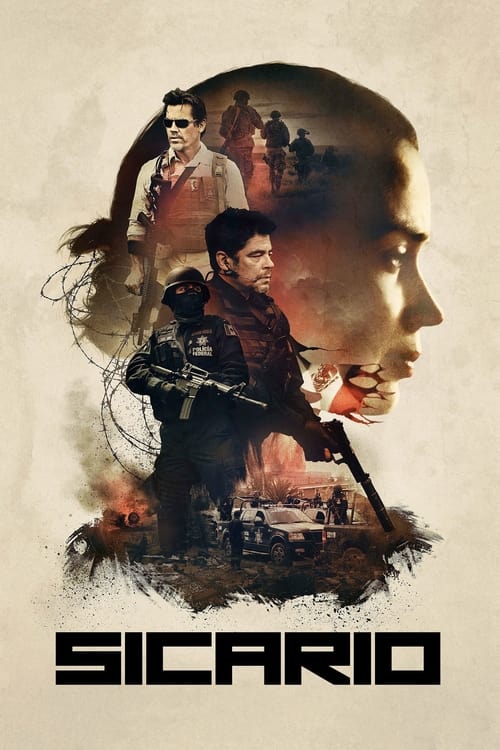
Sicario
2015 · Denis Villeneuve
The "serious sci-fi" standard-bearer whose Dune films made slow, austere blockbusters a mainstream event, and whose hiring to direct James Bond set off a fresh round of "can an auteur save a franchise" debate. Perpetually invoked in arguments about whether spectacle can still be art.
For when you want to be gripped by the throat for two hours and given no easy answers — a masterclass in tension for a night when you're ready to be unsettled, not soothed.
What it's about
An idealistic FBI agent volunteers for a shadowy interagency task force fighting the cartel war along the U.S.–Mexico border, only to find the mission's rules, goals, and even her own role kept deliberately out of her reach. Alongside a jocular CIA man and a silent, unreadable consultant with his own agenda, she's pulled deeper into operations no one will explain — and forced to decide what she can live with.
The experience
Almost unbearably tense — long stretches of coiled silence broken by sudden, precise violence, all soaked in a low hum of dread. It leaves you rattled and arguing with yourself on the drive home.
Performances
Emily Blunt makes bewilderment and moral erosion physically visible, and Benicio del Toro gives one of the great modern screen enigmas — a man whose stillness is scarier than anyone else's gun.
The craft
Roger Deakins shoots the borderlands like hostile terrain from another planet — a convoy sequence and a night-vision descent that are all-timers — while Jóhann Jóhannsson's score throbs underneath like a warning you can feel in your chest. Demands the biggest screen and best sound you can give it.
Why it matters
One of the defining American thrillers of the 2010s, it launched Taylor Sheridan's screenwriting career, cemented Denis Villeneuve as a major director, and spawned a sequel.
Snapshot
A federal agent is absorbed into a covert cross-agency task force operating in the shadow war along the U.S.-Mexico border, gradually stripped of every assumption she carried into the mission. Sicario is a film about the architecture of institutional violence — who authorizes it, who carries it out, and who is made to look the other way. Denis Villeneuve, working from Taylor Sheridan's debut feature screenplay, fused procedural rigidity with visceral landscape to produce one of the defining American thrillers of the decade: morally unresolved, technically immaculate, and deeply uncomfortable in its implications. The film announced Villeneuve as a director capable of operating at the highest register of Hollywood craft while refusing the genre's usual consolations.
Industry & production
Sicario was produced by Thunder Road Pictures (Basil Iwanyk) and Black Label Media (Molly Smith, Trent Luckinbill) and distributed in North America by Lionsgate through its Summit Entertainment label. The budget was modest relative to its eventual prestige — widely reported in the low-to-mid eight figures — and the film premiered in competition at the Cannes Film Festival in May 2015, an unusually high-profile platform for an American genre picture. Cannes gave the film immediate critical authority in Europe and positioned it as awards-season material long before its autumn theatrical release.
The screenplay was written by Taylor Sheridan, a Texas-born actor who had spent the previous decade in supporting television roles (including Sons of Anarchy) before pivoting to writing. Sicario was his first produced feature script, and it arrived with the confidence of a writer who understood genre architecture without being enslaved to its conventions. Sheridan had done significant research into U.S.-Mexico drug enforcement operations, and his script drew on the documented reality of inter-agency task forces — DEA, FBI, and Department of Defense elements operating in legal gray zones — that characterized the intensified drug war of the 2000s and 2010s. Villeneuve was drawn to the material's refusal to offer a protagonist who solves anything; he has described its moral structure as one of the central attractions of the project.
Emily Blunt, at the time primarily associated with comedic and romantic roles outside of Edge of Tomorrow (2014), was cast against expectation as FBI special agent Kate Macer. Josh Brolin played the Department of Defense operative Matt Graver with a relaxed menace that suggested institutional sociopathy normalized by years of sanctioned lawlessness. Benicio del Toro, cast as the enigmatic and devastatingly controlled Alejandro, would emerge as the film's most haunted and haunting presence. Del Toro's involvement was a signal of the production's seriousness; he did not take roles casually, and his presence conferred gravitas on the ensemble before a frame was shot.
Technology
Roger Deakins, Villeneuve's cinematographer on Prisoners (2013) and arguably the most technically authoritative cinematographer working in Hollywood at the time, shot Sicario on ARRI ALEXA digital cameras, a system he had been refining through earlier work and which he continued to develop into his subsequent collaborations with Villeneuve. The digital acquisition allowed Deakins extraordinary latitude in low-light conditions, a capacity the film exploits to its maximum in the tunnel sequence that anchors its third act.
That sequence — a Special Operations assault through a subterranean drug tunnel beneath the border — was shot using a combination of conventional low-light cinematography and imagery that approximates the look of night-vision and thermal optics. Deakins and the production designed the sequence to simulate the soldiers' own perceptual experience, using specially engineered rigs that achieved genuine near-darkness photography rather than relying solely on post-production enhancement. The resulting footage has a documentary authority that separates it from the aestheticized action cinematography of most comparable Hollywood productions.
The film also made extensive use of aerial photography to establish its geographical and psychic landscape. Overhead drone and helicopter shots of the Sonoran Desert, the border crossing at El Paso/Ciudad Juárez, and the highway infrastructure of the American Southwest function not as conventional establishing shots but as a sustained visual argument about the indifferent scale of the terrain through which human violence moves.
Technique
Cinematography
Deakins's work on Sicario is among his most celebrated and analytically rich contributions to the medium. His approach to the border landscape is geological rather than picturesque: the wide desert frames dwarf human figures without romanticizing the space, drawing on the tradition of the American landscape painting — and the classic Western — while refusing its mythic register. The color palette tends toward amber and ochre in the desert sequences, bruised blue and gray in the operational corridors of government and law enforcement infrastructure.
The traffic jam sequence at the Juárez border crossing is a technical set piece that rewards close study. Deakins choreographs a sequence of approximately twelve minutes — the task force convoy is gridlocked as it returns with a prisoner from Mexico — using lenses of varying focal lengths to compress and fragment space. What begins as procedural tension becomes kinetic violence without transition, the editing and camera position denying the audience any vantage point from which to fully comprehend what is happening. The disorientation is structural, not accidental.
Throughout, Deakins uses depth-of-field selectively and deliberately: faces are rendered in forensic clarity while backgrounds dissolve into abstraction, staging the film's epistemological anxiety — what Kate knows, and what she cannot see — at the optical level.
Editing
Joe Walker, the British editor who had collaborated with Steve McQueen on Shame (2011) and 12 Years a Slave (2013), cut Sicario with a tempo that is at once methodical and quietly relentless. Walker resists the accelerated cutting that characterizes most contemporary action cinema; his sequences breathe, accumulate dread, and then discharge it. The traffic jam sequence, the tunnel assault, and the film's final confrontation in Alejandro's kitchen are all edited to allow silence and stillness to carry as much weight as movement.
Walker's collaboration with Jóhann Jóhannsson's score is particularly precise: the editing and music function as a single organism rather than independent tracks. The decision to let particular shots hold — the aerial dissolve over the desert, the column of soldiers descending into the tunnel — reflects an editorial philosophy that trusts image over coverage.
Mise-en-scène / staging
Villeneuve's staging discipline is central to Sicario's effect. He consistently positions Kate at the perimeter of significant decisions: in briefing rooms where the operational logic is withheld, in vehicles where she cannot see what is ahead, in doorways at the moment of violence. This is not merely a narrative device but a spatial strategy; the blocking encodes her exclusion in three dimensions.
The film's most discussed single image — the silhouette of the assault team cresting a ridge against a blood-orange desert sunset, rendered as pure negative space against the sky — has the quality of a painting that has temporarily animated itself. It is one of several moments in which Villeneuve and Deakins allow the film to stop in its forward momentum and acknowledge, with the controlled grandeur of landscape art, the beauty and horror coexisting in the frame.
Sound
Jóhann Jóhannsson, the Icelandic composer who died in 2018, delivered a score that is among the most discussed in the decade's American cinema. Working with a palette centered on low brass, unconventional extended techniques, and percussion that suggests both ceremonial weight and organic threat, Jóhannsson produced music that refuses to be categorized as either underscore or foreground experience. The score's famous opening figure — a subsonic throb that registers as much in the sternum as the ear — sets the film's physiological ambitions from its first frames.
The sound design by Alan Murray and Martín Hernández equally deserves attention. The gunshots in the tunnel are reported with a full-range accuracy that contemporary action cinema has largely abandoned; the silence between sounds in the desert is treated as an active acoustic presence. Sicario received an Academy Award nomination for Sound Editing, and the film's sonic construction is inseparable from its emotional architecture.
Performance
Emily Blunt navigates a role structurally constructed against the conventions of the protagonist's arc. Kate is not permitted to understand, much less control, the operation she is nominally a part of, and Blunt's performance is built on the registers of suppressed frustration, professional discipline cracking under moral pressure, and a specific kind of institutional loneliness. She underwent extensive physical training for the role, and her physical presence — tactical, controlled, coiled — contrasts deliberately with the casual authority of the men around her.
Benicio del Toro's Alejandro is achieved largely through restraint and the management of stillness. Del Toro rarely raises his voice; his menace is conveyed through placement, eye-line, and a quality of absolute interior concentration that implies a history of violence too comprehensive to require demonstration. His final scene with Kate — in which he places a gun in her hand and asks her to authorize his action — is performed as quiet domestic coercion and is among the most unsettling scenes in the film.
Josh Brolin's Graver is the film's least examined performance, partly because Brolin effaces himself behind the character's easy charm. His willingness to be morally opaque while remaining likable is what makes the character genuinely disturbing.
Narrative & dramatic mode
Sicario operates in the procedural mode — the accumulation of operational detail grants it the texture of documentary — but its actual dramatic structure is one of sustained initiation and disillusionment. Kate is an audience surrogate who discovers, step by step, that the institutional framework she has trusted is either complicit in or indifferent to the violence it is ostensibly organized to prevent.
Sheridan's screenplay is notable for what it withholds: Alejandro's full history and identity is withheld until it is dramatically necessary, and even then disclosed partially; the legal authority under which the task force operates is never articulated; the ultimate destination of the operation's outcome is left unresolved. The film ends not with resolution but with a reframing — Kate signs a document authorizing what she has witnessed, confirming her complicity, and then Alejandro walks into a neighborhood in Mexico to enact his private vengeance while children play soccer in the street. The juxtaposition is the film's final moral statement.
Genre & cycle
Sicario belongs to a cycle of American border and drug-war films that developed in the aftermath of the 9/11 security state's expansion and the parallel militarization of drug enforcement — a cycle that includes Steven Soderbergh's Traffic (2000), Ridley Scott's Black Hawk Down (2001), and the Coen Brothers' No Country for Old Men (2007). It also participates in what might be called the "institutional critique thriller" that runs from The Parallax View (1974) through Zero Dark Thirty (2012): films organized around the demonstration that American state power operates according to logics that civilians and nominal protagonists cannot access.
The film additionally occupies a position in the neo-Western cycle that Sheridan himself would go on to define with Hell or High Water (2016) and Wind River (2017). The landscape — its indifference, its historical weight, its use as both setting and moral argument — is Western in derivation even as the firearms are contemporary and the antagonist is a cartel rather than a railroad or a cattle baron.
Authorship & method
Denis Villeneuve arrived at Sicario with a filmography defined by formal control and subject matter of concentrated moral darkness: Incendies (2010), Prisoners (2013), and Enemy (2013) had established him as a director who worked in slow-burn tension and was unafraid of irresolution. His method is characteristically meticulous in pre-production — extensive work with cinematographers, designers, and composers before shooting begins — and undemonstrative on set; his direction of actors tends toward preparation and trust rather than prescriptive instruction.
Roger Deakins (born 1949, Torquay, England) has a career that encompasses the full range of American prestige cinema from the late 1980s forward, including multiple Coen Brothers films, The Shawshank Redemption (1994), and Skyfall (2012). Sicario was his second collaboration with Villeneuve after Prisoners and earned him an Academy Award nomination for Best Cinematography — the thirteenth of an eventual fourteen nominations before his long-overdue win for Blade Runner 2049 (2017). His work here is as accomplished as anything in his career.
Taylor Sheridan was forty-five years old when Sicario was produced, and the script reads as the work of someone who had spent years observing storytelling without yet having the platform to practice it at scale. His subsequent work — particularly Hell or High Water and the Yellowstone television franchise — confirms that Sicario was not a one-off but the first expression of a coherent vision of American masculinity, institutional decay, and landscape as moral terrain.
Joe Walker and Jóhann Jóhannsson both came to the collaboration with credentials from prestige European and independent work; their contributions raised the film's overall register and prevented it from settling into the conventions of Hollywood action cinema.
Movement / national cinema
Sicario is formally a Hollywood production — American studio financing, American distribution, American stars — and its subject matter is intensely and specifically American: the drug war, the border, the security state. But Villeneuve is Canadian, Deakins is British, Walker is British, and Jóhannsson was Icelandic; the film is, in this sense, a product of Hollywood's longtime capacity to attract world-class craftspeople whose slight distance from the culture they are examining can produce a more analytical, less automatically validated vision of American power than purely domestic productions.
The film does not belong to a Mexican national cinema tradition and has been criticized — the critique deserves acknowledgment — for depicting Mexico and Mexicans primarily as the environment through which American agency moves, a landscape of threat and consequence rather than a place populated by fully elaborated interiority. The Juárez sequences, arresting in their documentary texture, nonetheless maintain a specifically American focal plane.
Era / period
Sicario is a film of the Obama-era security state: it depicts a moment when the militarization of drug enforcement, the normalization of inter-agency covert operations, and the legal architecture of the post-9/11 period had become settled institutional facts rather than controversial emergences. The film anticipates the border politics that would subsequently dominate American political discourse without being partisan in a conventional sense; its critique is structural, directed at bureaucratic and operational logic rather than at a particular political party or figure.
The film's moment of production also coincides with a broader cultural reckoning with the drug war: documentary series, long-form journalism, and a growing body of fiction were all examining the same terrain in the same period. Sicario brought this reckoning to mainstream cinema with an unusual degree of craft and moral seriousness.
Themes
The film's central subject is complicity — specifically, the mechanisms by which institutional logic recruits individuals into actions they would reject if presented with full knowledge. Kate's trajectory is an anatomy of this process: she is enrolled in an operation whose actual purpose is withheld, her legal standing is used instrumentally, and her eventual signing of the document is a confirmation that institutional participation is itself a form of moral authorization, regardless of what one understood oneself to be authorizing.
Adjacent to complicity is the film's preoccupation with the relationship between law and efficacy. The task force Graver leads operates in a legal gray zone by design; its effectiveness, such as it is, depends precisely on its unaccountability. Alejandro's resolution of his personal mission at the film's end — fully outside any legal framework — poses the question of whether his private justice is categorically different from the institutional violence he was enlisted to assist.
The border itself functions thematically as a figure for the permeability of all the film's apparent oppositions: law and lawlessness, state violence and cartel violence, visibility and concealment. Villeneuve and Deakins render it as a physical and moral zone of indeterminacy — a place where the usual categories cease to hold.
Reception, canon & influence
Sicario received immediate and sustained critical praise at Cannes and on its autumn theatrical release, with particular attention to Deakins's cinematography and the performances of Blunt and del Toro. Its reception was not entirely uncritical: some reviewers found its politics either nihilistic or, paradoxically, uncritically valorizing of state violence through the aesthetics it brought to bear on the task force's operations. The representation of Kate — a woman systematically excluded from knowledge and agency — generated debate about whether the film was critiquing this dynamic or reproducing it.
The film's antecedents are clearly traceable: No Country for Old Men, in its border landscape and commitment to unresolved moral violence; Zero Dark Thirty, in its procedural framework for examining authorized extra-legal operations; Traffic, in its systemic view of the drug war's multiple stakeholders; and The Battle of Algiers (1966), in its unflinching examination of counter-insurgency logic and the violence states permit themselves to suppress other violence. Villeneuve has acknowledged the Pontecorvo film as a point of reference.
Its forward legacy is substantial. Taylor Sheridan's subsequent screenwriting and directing career — Hell or High Water, Wind River, Yellowstone — proceeded directly from the foundation Sicario established, both in thematic preoccupation and in the reputation it conferred. The film contributed to a renewed critical and popular appetite for American genre cinema made with formal ambition and political seriousness, a cycle that continued through the decade's end.
Villeneuve's career after Sicario — Arrival (2016), Blade Runner 2049 (2017), Dune (2021), Dune: Part Two (2024) — confirms that the film was a pivot toward large-scale prestige filmmaking rather than a one-off. The confidence Villeneuve developed in managing the scope and tonal discipline of Sicario is audible in the grammar of those later films. A sequel, Sicario: Day of the Soldado (2018), directed by Stefano Sollima from another Sheridan screenplay, was produced without Villeneuve or Deakins and received significantly more mixed critical assessment — a confirmation, by negative example, of how dependent the original's achievement was on the specific alignment of its collaborators.
Sicario occupies a secure position in the canon of American genre cinema of the 2010s. Whether that position will deepen as the politics it diagrams come into sharper retrospective focus remains an open question; its craft ensures it will continue to be studied, and its discomforts ensure it will continue to be argued over.
A Deleuzian reading
Watch where Villeneuve keeps putting Kate Macer.
The full Deleuzian reading of Sicario →
Reception
It landed at Cannes 2015 already anointed — three Oscar nominations followed — but its stature has only grown since, now seen as the film that confirmed Villeneuve's run (Prisoners → Sicario → Arrival) as one of the great modern hot streaks. The Deakins-less, Blunt-less 2018 sequel mostly served to make everyone appreciate the original more.
How Sicario was received, from release to now →
Influences: the films it descends from and the films it influenced
- The Battle of Algiers (1966) — Pontecorvo's procedural staging of counter-insurgency logic — the exact bureaucratic and tactical mechanics by which a state authorizes violence to suppress other violence — is Sicario's named structural ancestor, cited by Villeneuve as a direct reference for how institutional permission to kill is rendered cinematically without authorial condemnation.
- Chinatown (1974) — Polanski's protagonist-spatial-exclusion mechanism — a competent investigator systematically denied access to the institutional decisions that determine the case's outcome, revelation arriving too late to matter — is the genre architecture Sicario imports wholesale for Blunt's Kate Macer.
- Traffic (2000) — Soderbergh's multi-stakeholder drug war procedural established both the systemic view of narco-politics that Sicario inherits and del Toro's specific performance grammar — menace held entirely in watchful stillness, the threat never externalized — which he carried directly to Alejandro.
- No Country for Old Men (2007) — The Coens' framing of the Tex-Mex border landscape as an active moral argument — terrain that indicts rather than contextualizes — and their staging of lethal threat through silhouette and negative space against open sky are the immediate visual and tonal predecessors for Deakins's Sicario cinematography.
- There Will Be Blood (2007) — Jonny Greenwood's subsonic orchestral score — low-frequency pressure deployed as existential dread rather than melodic support, bypassing the ear for the body — established the template that Jóhann Jóhannsson extended with Sicario's brass-driven sound design, including the use of acoustic silence as a pressure valve between assaults.
- The Assassination of Jesse James by the Coward Robert Ford (2007) — Deakins's aerial and landscape cinematography here — vast Western terrain framed as moral geography, figures staged as silhouettes against sky and burned earth, negative space as psychological register — directly anticipates the visual grammar he transposed to the Sonoran Desert for Sicario.
- The Hurt Locker (2008) — Bigelow's structure of tactical competence rendered institutionally irrelevant — a protagonist whose technical skills cannot address the political forces defining the mission's real terms — establishes the procedural-disillusionment model that Sicario inherits for Kate's systematic exclusion from strategic knowledge.
- Zero Dark Thirty (2012) — Bigelow's procedural framework for depicting authorized extra-legal operations — night-vision tactical sequences, a female operative whose moral perspective is suppressed by institutional hierarchy, and operations whose true command structure is permanently withheld — is the immediate genre precedent Sicario extends to the drug war.
- Prisoners (2013) — The first Villeneuve/Deakins collaboration established their shared formal language: selective depth-of-field as emotional isolator, silence-weighted cutting in which pauses carry argument, and a commitment to moral irresolution held without authorial rescue — all carried intact into Sicario.
- The Dark Knight (2008) — Jóhann Jóhannsson's score functions as ambient threat architecture—low-register drones that register as environmental sound before resolving as music—in direct lineage of Zimmer's Joker motif; Deakins' source-plausible cinematography and the moral witness trapped inside extralegal machinery she cannot stop extend TDK's institutional-erosion form.
- The Wages of Fear (1953) — Villeneuve's Juárez convoy sequence lifts Wages of Fear's staging method directly — establishing the spatial relationship (highway, overpass, border crossing) with total geographic legibility before threat materializes within that established space — while the corporate-imperial political framework (US agencies as a Southern Oil Company analog) and Jóhann Jóhannsson's near-silent score complete the formal inheritance.
- Munich (2005) — Villeneuve and Roger Deakins extend Munich's moral geometry staging — the use of architectural thresholds, corridor framings, and checkpoint lines to mark the protagonist's progressive loss of operative agency — into the US-Mexico border context, with Emily Blunt's descent structure mirroring Bana's: a legitimate agent whose moral authority is systematically stripped by the institutional logic she was recruited to serve.
- Hell or High Water (2016) — Sheridan's next screenplay deploys the neo-western institutional critique template directly from Sicario — landscape as moral indictment, law enforcement structurally complicit in systemic failure, procedural disillusionment withheld until the final scene — transposed to a West Texas bank robbery.
- Arrival (2016) — Jóhannsson's subsonic score and Villeneuve's silence-weighted editing grammar are transferred directly from Sicario, with the female protagonist's systematic exclusion from full institutional knowledge now recast as the film's structural spine rather than its political subject.
- Wind River (2017) — Sheridan's directorial debut transposes Sicario's staging of institutional failure — a female investigator excluded from situational authority in a male operational environment — to a Wyoming reservation landscape performing the same moral-desolation function as the Sonoran Desert.
- Blade Runner 2049 (2017) — Deakins won his first Academy Award for Cinematography here, extending Sicario's aerial landscape argument — terrain as existential and moral geography — to planetary scale, and confirming that the Villeneuve/Deakins approach to geological framing was the Academy's eventual object of recognition.
- Sicario: Day of the Soldado (2018) — Sollima's sequel, using Sheridan's screenplay but without Villeneuve or Deakins, demonstrates by negative example that Sicario's achievement was contingent on the specific alignment of those collaborators — the same setting, the same characters, and a significantly diminished formal authority confirm how inseparable the craft was from the craftsmen.
- Dune (2021) — Villeneuve extends Sicario's geological landscape framing to planetary scale while deploying Hans Zimmer's subsonic score in the same low-frequency register as Jóhannsson's Sicario work, confirming both techniques — terrain-as-argument and bass-frequency-as-dread — as anchors of his post-Sicario formal identity.
- Escape from Mogadishu (2021) — Introduces the convoy-as-crucible form — the motorcade advancing through a hostile city as the primary tension unit — with omnidirectional threat staging in which every civilian figure in the frame is a potential combatant, a configuration EfM applies to the Mogadishu extraction.
- Vikram (2022) — Drug-war thriller whose morally shaded black-ops operatives, tactical nocturnal palette and deliberate withholding of characters' true agendas inform Vikram's neon-noir surveillance and reveal-withholding cinematography.
- Uri: The Surgical Strike (2019) — The thermal-and-night-vision tunnel descent, built on a low sub-bass pulse that swells for minutes and resolves in seconds of clipped gunfire, supplies the charge-and-discharge grammar Uri's climax runs on.
- Dhurandhar (2025) — The briefing frame in which the protagonist is deliberately told less than the room knows, married to aerial crane-and-drone descents onto hostile geography scored to a low percussive pulse — the exact combination Dhurandhar uses for its Karachi approaches.
- 13 Hours: The Secret Soldiers of Benghazi (2016) — Roger Deakins and Dion Beebe pursued parallel solutions to the same aesthetic problem — desaturated tactical palette, ground-level staging of operations, ambient score over heroic underscore — arriving at the same visual register from different production traditions.
- Anthropoid (2016) — Villeneuve and Roger Deakins's score-withdrawal grammar — extended operational sequences where the score is withheld entirely and sound design alone carries dread — directly parallels Ellis's use of Robin Foster's score as a device of strategic restraint rather than continuous emotional underwriting.
- Thirteen Lives (2022) — Parallel procedural operation film deploying wide-angle environmental cinematography that aestheticizes the operational landscape without sentimentalizing it, and sustaining tension through Jóhann Jóhannsson's drone-ambient score — formal strategies Thirteen Lives shares as a sibling development within the procedural genre.
- Jarhead (2005) — Deakins transplants Jarhead's landscape grammar — vast symmetrical desert wides, dread-laden empty horizons, thermal/night-vision palettes — into the cartel war.
- Clear and Present Danger (1994) — Descendant that inherits CAPD's exact subject — a deniable U.S. anti-cartel operation exposed to an idealistic insider — and its convoy-ambush staging, with the border-bridge gridlock kill-zone descending directly from the motorcade set piece.
- Skyfall (2012) — Deakins reuses motivated low-key lighting, silhouetted figures against sky, and patient spatial legibility in action — the same craft grammar he forged on Skyfall.
- The Bourne Legacy (2012) — Extends the institutional-thriller lineage: a protagonist used as an expendable instrument by opaque agencies, with procedural cross-border operations and a cold-bureaucracy moral frame descended from Gilroy's template.
- The Equalizer (2014) — Shares the low-light digital, anamorphic widescreen aesthetic of darkness-modeled imagery and foregrounded quiet building dread before controlled bursts of violence.
- Jason Bourne (2016) — Stages tactical operations in contested public/border spaces against a percussion-and-electronics dread score (Jóhann Jóhannsson), with command-room handlers counterpointed against the field — the same staging-plus-sound architecture in a 2010s register.
- Crisis (2021) — The contemporary drug-war institutional thriller — procedural realism across enforcement tiers under a low, restrained dread-score that Crisis's sound design echoes.
- To Catch a Killer (2023) — Centers a woman investigator out of her depth inside an opaque institution, rendered through architectural wide framing and a dread-laden sound design that withholds and then detonates.
- Rebel Ridge (2024) — Builds tension from controlled information-release and institutional rot, staging restrained violence through legible tactical geography (convoys, border crossings) rather than spectacle.
Similar films
- Prisoners (2013) — influence & lineage · same viewing thread · often watched together
- Sicario: Day of the Soldado (2018) — influence & lineage · often watched together
- Blade Runner 2049 (2017) — influence & lineage · often watched together
- Traffic (2000) — influence & lineage
- No Country for Old Men (2007) — influence & lineage
- The Hurt Locker (2008) — influence & lineage
- Arrival (2016) — influence & lineage
- Dune (2021) — influence & lineage
All the films related to Sicario →
Watch it with: curated runs of related films
- Villeneuve's Kingdom of Dread — A run through Denis Villeneuve's dread years — vanished people, buried family secrets, moral rot, and uncanny doubles — best watched in order to feel one director tighten his grip on unease from Quebec art house to Hollywood thriller.