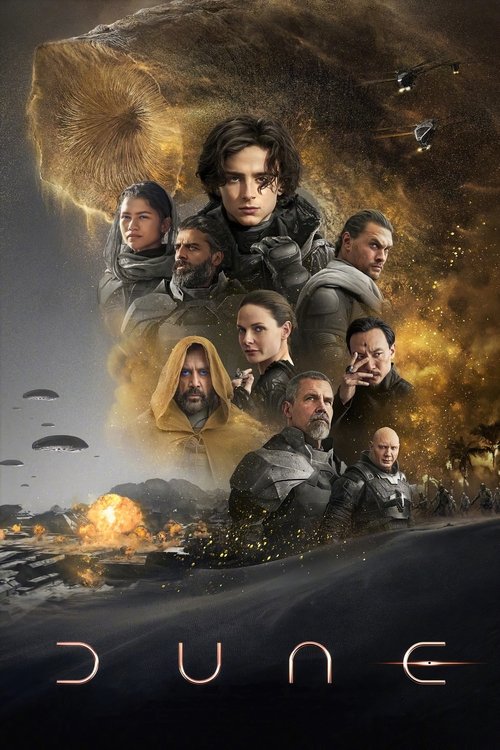
Dune
2021 · Denis Villeneuve
The "serious sci-fi" standard-bearer whose Dune films made slow, austere blockbusters a mainstream event, and whose hiring to direct James Bond set off a fresh round of "can an auteur save a franchise" debate. Perpetually invoked in arguments about whether spectacle can still be art.
For a night when you want to be completely swallowed by another world — lights off, sound up, phone away. It's an immersion, not a hangout movie; come ready to sink in rather than snack.
What it's about
Paul Atreides, the young heir to a noble house, is uprooted when his family is ordered to take control of Arrakis — a lethal desert planet that is the universe's only source of spice, the substance everything in this far-future empire runs on. What looks like an honor is a trap, and as rival powers close in, Paul is pushed toward a destiny he never asked for, haunted by visions of the desert people whose world his family now occupies.
The experience
Slow, enormous, and hypnotic — it moves like a tide rather than a plot machine, trading quips for awe. You feel the scale in your chest: sandstorms, ships like cathedrals, dread that builds patiently and then breaks.
Performances
Timothée Chalamet carries the weight of a boy visibly growing into something dangerous, and Rebecca Ferguson gives the film its anxious, beating heart as a mother torn between loyalty and fear for her son.
The craft
Greig Fraser's cinematography turns sand and shadow into something monumental, and Hans Zimmer's score — all wails, drums, and alien voices — feels invented from scratch for this world. Few films this century reward a big screen and serious speakers more; the sound design alone makes the sandworms an event.
Why it matters
It proved the famously 'unfilmable' novel could work on screen by refusing to rush it, swept the technical categories at the Oscars, and re-opened the door for slow, serious, big-canvas science fiction at blockbuster scale.
Snapshot
Dune (subtitled Part One on its title card, though marketed simply as Dune) is Denis Villeneuve's adaptation of roughly the first half of Frank Herbert's 1965 science-fiction novel — the book widely regarded as the most influential and the most stubbornly unfilmable in the genre. It is at once a long-deferred dream project and a calculated act of restraint: where David Lynch's 1984 version had tried to compress the entire novel into a single feature and collapsed under the weight of its own exposition, Villeneuve's wager was that Dune could only work as cinema if it slowed down, halved the story, and trusted spectacle and atmosphere to carry meaning that the novel conveys through interior monologue. The film follows Paul Atreides, heir to a ducal house, as his family is ordered by the Emperor to take stewardship of the desert planet Arrakis — sole source of "the spice" melange, the substance that enables interstellar travel — only to be betrayed and destroyed by the rival House Harkonnen in a trap engineered by the Emperor himself. Paul and his Bene Gesserit mother Jessica flee into the deep desert and the culture of the indigenous Fremen, where the film leaves him on the threshold of a destiny it pointedly declines, in this installment, to resolve. The result is a tone poem of immense scale, an ecological and political epic shot through with messianic dread, and a film whose very incompleteness — ending mid-story — became part of its argument about how seriously science fiction could ask to be taken.
Industry & production
Dune is the product of Legendary Entertainment's long campaign to mount a prestige adaptation, with Warner Bros. distributing. Legendary had acquired the film and television rights in 2016, and Villeneuve — fresh off the critical successes of Arrival (2016) and Blade Runner 2049 (2017) — attached himself early, having described Dune as a lifelong ambition dating to his adolescence. The decision to split the novel was made a condition of his involvement; he has said repeatedly that he would not attempt the whole book at once, and the studio greenlit Part One without a formal guarantee of Part Two, a notable gamble for a production of this magnitude.
The film's economics became inseparable from the circumstances of its release. Completed for a reported budget in the region of $165 million, it was repeatedly delayed by the COVID-19 pandemic and ultimately released in October 2021 under WarnerMedia's controversial 2021 policy of releasing its entire slate simultaneously in theaters and on the HBO Max streaming service. Villeneuve publicly and pointedly objected, arguing in print that the strategy undercut a film conceived for the largest possible screen and threatened the theatrical model itself. That the film nonetheless performed strongly at the global box office — enough to trigger the formal greenlight of Dune: Part Two shortly after release — was widely read as a vindication of theatrical scale in the streaming era.
Production was genuinely international and logistically vast. Principal photography took place largely in 2019, with major desert work in Jordan (Wadi Rum) and the United Arab Emirates, and extensive soundstage construction at Origo Film Studios in Budapest. The ensemble cast — Timothée Chalamet as Paul, Rebecca Ferguson as Jessica, Oscar Isaac as Duke Leto, Josh Brolin as Gurney Halleck, Stellan Skarsgård as Baron Harkonnen, Javier Bardem as Stilgar, Zendaya as Chani, Jason Momoa as Duncan Idaho, Sharon Duncan-Brewster as Liet-Kynes (a gender-reconceived casting of the novel's Imperial ecologist), and Charlotte Rampling as the Reverend Mother — reflects a deliberate blend of established prestige actors and rising stars.
Technology
Dune was shot digitally, primarily on ARRI Alexa LF and Alexa Mini LF cameras, capturing in large-format with Panavision optics — a choice consistent with cinematographer Greig Fraser's preference for a clean, high-resolution image that could later be roughened to taste. The most discussed technical dimension of the production, however, was its preference for in-camera and practical solutions over wholesale digital construction. Villeneuve and Fraser shot a great deal of the desert material on real dunes, building physical sets and large set-piece elements where possible, and using natural light extensively in the exteriors.
A distinctive technical decision was the partial use of infrared and near-infrared photography to render certain environments — notably sequences on the Harkonnen homeworld Giedi Prime, which in Part Two would be realized in a stark monochrome, with the approach prototyped here. The film also made notable use of the IMAX format; portions were framed and finished for IMAX presentation, and Villeneuve's insistence on the theatrical exhibition of the film was bound up with this large-format ambition. Visual effects, supervised by Paul Lambert (a Villeneuve regular), were extensive but oriented toward integration and realism rather than ostentation: the ornithopters, the colossal sandworms, the spice harvesters, and the various spacecraft were designed to feel weighty and physically plausible, with attention to scale, dust, and atmosphere rather than to clean digital gloss.
Technique
Cinematography
Greig Fraser's photography is the film's signature achievement and the element most responsible for its sense of monumentality. Working in large format, Fraser pursued a muted, sun-bleached palette for Arrakis — ochres, bone-whites, and shadow — against the cold blues and grays of Caladan and the oily darkness of Giedi Prime. He favored a slightly desaturated, sometimes deliberately softened image, at times shooting through diffusion or recapturing footage off a screen to introduce texture, so that the immaculate digital capture would read as something more tactile and analog. The compositional grammar is one of overwhelming scale: human figures dwarfed by architecture, machines, and landscape, frequently placed small within vast frames so that the spectator feels the insignificance of the individual against planetary and imperial forces. The camera is patient and often static or slow-moving, eschewing frenetic action coverage in favor of held, awed compositions. Fraser's work on the film was widely honored and is central to its reputation as a benchmark of large-scale science-fiction image-making.
Editing
Joe Walker, Villeneuve's longtime editor (Sicario, Arrival, Blade Runner 2049), cut the film at a deliberately measured, even stately tempo. The editing prioritizes immersion and gravity over propulsion; scenes are allowed to breathe, transitions are unhurried, and the rhythm is closer to that of an epic historical drama than a contemporary action blockbuster. Walker integrates Paul's premonitory visions — fragmentary glimpses of Chani, of holy war, of futures that may or may not come — as recurrent interruptions of the linear narrative, a formal device for externalizing the prescient consciousness that the novel renders through interiority. The most consequential editorial decision is structural and shared with the screenplay: the film ends not at a conventional climax but at a beginning, mid-journey, a choice that reframes the entire preceding two-and-a-half hours as overture.
Mise-en-scène / staging
Production designer Patrice Vermette and the costume designers Jacqueline West and Robert Morgan built a world of austere, brutalist monumentality. The architecture favors massive, unadorned planes — vast halls, monolithic forms, an aesthetic of weight and permanence that signals the deep-historical, feudal-imperial setting of Herbert's universe. Costuming distinguishes the houses through silhouette and material: the militaristic Atreides, the grotesque corporeal excess of the Harkonnen, the functional desert pragmatism of the Fremen, whose moisture-reclaiming stillsuits were designed with attention to plausible engineering. Villeneuve's staging consistently subordinates the human figure to environment and apparatus, reinforcing the film's thematic concern with individuals caught inside vast systems — ecological, political, religious. The desert itself is staged as a character: the sandworms emerge from it as sublime, terrifying forces of nature, and the choreography of human movement on the sand (the irregular, rhythm-less "sand-walk" to avoid attracting worms) is built into the blocking.
Sound
Sound is arguably the film's most aggressive expressive instrument. The sound design — and Hans Zimmer's score — were conceived to be felt physically. Zimmer, who reportedly turned down Christopher Nolan's Tenet to work on Dune, a project he had long wanted to score, abandoned conventional orchestral idioms in favor of an invented sonic palette: distorted and processed vocals (including wordless female voices for the Bene Gesserit and the spiritual register of Arrakis), unfamiliar and custom-built instruments, throat-like drones, and crushing low-end. The "Voice" — the Bene Gesserit power of vocal command — is realized through layered, distorted sound design that renders compulsion audible. The overall sonic strategy is one of immersion and overwhelming physical presence, a deliberate rejection of melodic familiarity in pursuit of an alien, ritualistic sublime. The score and sound work were among the film's most lauded and decorated elements.
Performance
The performances are calibrated to the film's restrained, ceremonial register. Timothée Chalamet plays Paul as a watchful, uncertain adolescent rather than a confident hero — youth, vulnerability, and a growing, frightened awareness of his own potential, which keeps the messianic arc ambivalent. Rebecca Ferguson's Jessica is the film's emotional fulcrum, a woman torn between her order's manipulations, maternal protectiveness, and her own grief and fear; hers is among the most internally complex performances. Oscar Isaac lends Duke Leto a weary nobility, and Stellan Skarsgård, encased in prosthetics, makes the Baron a slow, floating presence of pure appetite. Javier Bardem's Stilgar and Sharon Duncan-Brewster's Kynes ground the Fremen and Imperial-ecological strands respectively. Zendaya appears only briefly outside Paul's visions, her fuller role reserved for Part Two — a casting decision that became part of the film's much-discussed structure of deferral.
Narrative & dramatic mode
Dune operates in the mode of the mythic-epic: a slow, grave unfolding of dynastic, ecological, and religious forces, organized less around suspense than around inexorability. Its dramatic engine is prophecy and betrayal — the audience, like Paul, is granted premonitory glimpses of catastrophe, so that the mode tilts toward tragic foreknowledge rather than surprise. The film is structurally a first act: it establishes a world, destroys a house, and delivers its protagonist to the threshold of transformation, then stops. This is its boldest and most debated narrative choice. Where most blockbusters guarantee resolution, Dune explicitly withholds it, treating the novel's first half as a complete tonal and thematic statement — the fall of the Atreides and Paul's flight into the desert — while leaving the rise, and its horrifying consequences, for later. The mode is contemplative, immersive, and deliberately unresolved, asking the spectator to sit inside dread and scale rather than to be carried by event.
Genre & cycle
The film is a science-fiction epic, but its lineage is as much the historical and biblical epic — Lawrence of Arabia above all — as it is space opera. It belongs to a 2010s–2020s cycle of "elevated," auteur-driven, large-format science fiction that sought to reclaim the genre for serious adult drama and theatrical spectacle: Villeneuve's own Arrival and Blade Runner 2049, Christopher Nolan's Interstellar (2014), and the broader appetite for prestige genre filmmaking on the largest possible canvas. It also belongs, more specifically, to the long and tortured cycle of attempts to bring Dune itself to the screen — Alejandro Jodorowsky's famously unrealized 1970s project (documented in Jodorowsky's Dune, 2013), Lynch's 1984 film, and the Sci-Fi Channel television miniseries (2000) — against all of which Villeneuve's version positions itself as the first to find an adequate form.
Authorship & method
Dune is a defining statement by Denis Villeneuve, the culmination of the science-fiction trilogy that established him as the foremost contemporary practitioner of the serious genre epic. His method is consistent across these films: a privileging of atmosphere, scale, and image over dialogue and exposition; a slow, immersive tempo; a fascination with individuals dwarfed by overwhelming systems; and a conviction that science fiction should be visually monumental and emotionally grave. His self-described lifelong attachment to Herbert's novel makes this his most personal large-scale work.
The screenplay was written by Villeneuve with Jon Spaihts and Eric Roth — Roth (Forrest Gump, The Insider) lending a veteran dramatist's structural sensibility, Spaihts a science-fiction screenwriter's command of the world's machinery. The film's craft rests heavily on Villeneuve's core collaborators, several recurring across his filmography: cinematographer Greig Fraser, whose large-format imagery defines the film's look; editor Joe Walker, whose measured assembly sets its tempo; production designer Patrice Vermette; visual-effects supervisor Paul Lambert; and composer Hans Zimmer, whose invented sonic language is inseparable from the film's identity. The authorship is genuinely collaborative in the manner of the modern auteur-led blockbuster, but unmistakably governed by Villeneuve's controlling sensibility.
Movement / national cinema
Dune is a Hollywood studio production and does not belong to a national-cinema school, but Villeneuve is a French-Canadian (Québécois) filmmaker whose earlier work (Incendies, Polytechnique) emerged from Quebec cinema before his move to English-language production, and his sensibility — austere, controlled, image-led — carries traces of an art-cinema formation into the blockbuster idiom. The more useful framing is institutional: the film is a leading example of the auteur-driven tentpole, in which a studio entrusts an enormous budget and intellectual property to a director with a strong, recognizable authorial signature. Within that contemporary "movement" of prestige genre filmmaking, Villeneuve stands alongside figures like Nolan as a defender of theatrical, large-format cinema against the gravitational pull of streaming.
Era / period
The film is a document of its production and release moment in several respects. Its making and release were shaped by the COVID-19 pandemic, and the simultaneous theatrical-and-streaming release thrust it into the central industry argument of the early 2020s about the survival of the theatrical experience — a debate in which Villeneuve became an outspoken partisan. Thematically, its ecological preoccupations — a planet whose single resource drives interstellar exploitation, an indigenous people stewarding a fragile desert ecology against extractive empire — resonate with a period acutely conscious of climate crisis and resource politics, even though they originate in Herbert's 1960s text. Its wariness toward charismatic messianism and the dangers of the "chosen one" likewise reads against a contemporary skepticism of populist saviors, though again the critique is Herbert's own.
Themes
The film's master theme, inherited and faithfully foregrounded from Herbert, is the danger of the messianic hero: the narrative establishes Paul as a prophesied savior while seeding warnings — Paul's own terror of the holy war he foresees, Jessica's complicity in the Bene Gesserit's manufactured prophecies — that this destiny is a catastrophe in the making rather than a triumph. Around it cluster ecology and resource extraction, the spice as a transparent figure for oil and the colonial economy built atop it; colonialism and indigeneity, in the Fremen's relation to the off-world powers who exploit their planet; religion as engineered control, embodied in the Bene Gesserit's "Missionaria Protectiva," the deliberate seeding of myths across populations to be exploited later; fate, prescience, and free will, dramatized through Paul's visions of futures he both desires and dreads; and the individual against vast systems — feudal, imperial, ecological, genetic — that is the through-line of Villeneuve's authorship. The film stages these without resolving them, its very incompleteness an argument that the cost of Paul's ascent must be reckoned with rather than celebrated.
Reception, canon & influence
Critically, Dune was received as a major achievement of contemporary science-fiction filmmaking — widely praised for its visual grandeur, sound, score, and the seriousness of its world-building, and admired as the adaptation that had finally found a workable cinematic form for a notoriously resistant novel. The most consistent reservations concerned its coolness and its deferral: some critics found it emotionally remote, a magnificent machine more awe-inspiring than moving, and others questioned the satisfaction of a film that ends mid-narrative. That tension between sublime scale and dramatic incompleteness is the defining note of its reception. Institutionally it was heavily decorated in the technical and craft categories at the major awards, recognized above all for cinematography, score, sound, editing, visual effects, and design — a pattern confirming that its canonical standing rests first on its formal and sensory mastery.
Looking backward, its influences are legible and openly acknowledged: Herbert's novel as scripture; Lawrence of Arabia as visual and structural model for the desert epic; the Jodorowsky and Lynch attempts as cautionary precedents the film defines itself against; and Villeneuve's own Arrival and Blade Runner 2049 as the immediate stylistic groundwork. Looking forward, Dune's most concrete consequence was that it made Dune: Part Two (2024) possible, completing the arc the first film deliberately left open and vindicating the gamble of the split. More broadly, its commercial and critical success reinforced the viability of slow, serious, auteur-led, large-format science fiction at blockbuster scale, and its insistence on theatrical, IMAX-oriented spectacle became a touchstone in the post-pandemic argument for the cinema as an irreplaceable venue. Within Villeneuve's filmography it stands as the keystone of his science-fiction work and the fullest realization of his ambition to make the genre epic an instrument of grave, monumental cinema.
A Deleuzian reading
Watch the shot of a lone figure at the crest of a dune, the sand running out to a horizon that holds no landmark, the camera refusing to cut until the man stops reading as a man and becomes a unit of measurement.
The full Deleuzian reading of Dune →
Reception
Released day-and-date on HBO Max in 2021 — a move Villeneuve publicly blasted — amid real doubt Part Two would ever get made; then it won six Oscars, Part Two happened and soared, and Part One retroactively hardened from 'risky half-a-story' into the opening act of the decade's defining sci-fi epic.
How Dune was received, from release to now →
Influences: the films it descends from and the films it influenced
- Lawrence of Arabia (1962) — The grammar of the desert epic Villeneuve openly models on—wide 70mm horizon compositions that strand a lone human figure against an empty dune sea, holding the shot until scale itself becomes the drama.
- 2001: A Space Odyssey (1968) — Establishes the measured, near-wordless tempo and monumental architectural framing that subordinate exposition to image and sound, treating science fiction as grave formal contemplation rather than incident.
- Solaris (1972) — Model for the slow immersive duration and the rendering of premonitory/visionary interior states as a sustained psychic texture inside a sci-fi frame.
- Dune (1984) — The prior adaptation whose Brutalist guild architecture and Harkonnen grotesque set the production-design vocabulary Villeneuve both inherits and deliberately corrects toward monumental austerity.
- Apocalypse Now (1979) — Walter Murch's enveloping, physically immersive sound mix as narrative device—the ancestor of Dune's bodily low-frequency sound and invented sonic palette used to overwhelm rather than illustrate.
- Arrival (2016) — Villeneuve's own template for premonitory-vision editing (foreknowledge folded into the cut), restrained ceremonial performance, and an invented, non-melodic sonic language.
- Blade Runner 2049 (2017) — Immediate stylistic groundwork: figures dwarfed by Brutalist monoliths, a desaturated palette, and Zimmer/Wallfisch's invented sub-bass drones—the exact craft toolkit carried into Dune.
- Sicario (2015) — Where editor Joe Walker's dread-building measured assembly and Villeneuve's tension-through-stillness method were forged, later setting Dune's tempo.
- Zero Dark Thirty (2012) — Cinematographer Greig Fraser developed his naturalistic available-light realism and infrared/low-light night photography here—directly the technique behind Dune's Sardaukar night raid.
- Rogue One: A Star Wars Story (2016) — Fraser's earlier large-format sci-fi: documentary-style handheld realism and figures dwarfed by colossal imperial architecture, a rehearsal of Dune's scale-against-the-body framing.
- Star Wars (1977) — Greig Fraser's anamorphic Arrakis cinematography consciously works within the Lean–Lucas desert-as-spiritual-terrain tradition, and Villeneuve's Campbellian monomyth adaptation of Herbert's space-opera source (which Lucas had also read before writing Star Wars) closes the loop between the two most direct applications of the Hero's Journey to the genre.
- No Time to Die (2021) — Greig Fraser's large-format photography with spare near-silence and patient dramatic rhythm extends the same prestige big-format aesthetic, a pandemic-era theatrical bellwether sharing the moment.
- The Batman (2022) — Carries Fraser's Dune photographic method into a tentpole: desaturated large-format imagery, practical in-frame light sources, and infrared-flavored darkness as a deliberate texture.
- Dune: Part Two (2024) — Direct continuation completing the deliberately unresolved first act, extending every craft signature—large-format desert compositions, invented sound, premonitory editing—to the saga's tragic climax.
- Masters of the Universe (2026) — Greig Fraser's desaturated, low-contrast, single-source naturalism applied to maximalist pulp architecture proved that operatic material photographed with restraint reads as grave rather than cheap — the exact photographic register Knight needs to keep Frazetta iconography from tipping into camp — alongside a hybrid practical-set/volume workflow at sword-and-planet scale.
- Interstellar (2014) — Sibling project in IMAX-format serious sci-fi epic with Hans Zimmer's invented organ-based sonic palette deployed for sheer physical, theater-shaking immersion.
- Mad Max: Fury Road (2015) — Sibling in elevated desert spectacle built on practical effects and real-location dunescapes, prizing tactile in-camera scale over digital backdrops.
- The New World (2005) — Shares the natural-light, restrained-performance immersion that Fraser cites as influence—bodies inside vast landscape rendered with ceremonial quietude.
- Star Wars: The Last Jedi (2017) — Descendant extending the large-format shallow-focus, negative-space-isolation epic grammar — dwarfing figures in minimalist frames to convey scale and solitude.
- Kingdom of the Planet of the Apes (2024) — Large-format epic built on patient pacing and the politics of weaponized prophecy — the instrumentalized-myth and memory themes Kingdom dramatizes through Proximus's distorted Caesar.
- Zack Snyder's Justice League (2021) — Contemporaneous craft-sibling in desaturated, vertical-monumental sci-fi epic image-making, dwarfing figures against brutalist scale with a low, droning leitmotif score.
- Gladiator II (2024) — Contemporary large-canvas epic that stages dynastic power as architecture and ritual through monumental digital set extension, the theatrical-scale spectacle-as-politics idiom II operates within.
- The Hunger Games: The Ballad of Songbirds & Snakes (2023) — Sibling in monumental brutalist production design, using vast concrete-and-monolith architecture to render authoritarian power as spatial oppression, the register the prequel's Capitol adopts.
- Furiosa: A Mad Max Saga (2024) — Parallels Furiosa's fusion of photoreal digital desert environments with practical foreground elements to sustain a mythic, worldbuilt scale.
Similar films
- Dune: Part Two (2024) — influence & lineage
- Arrival (2016) — influence & lineage
- Mad Max: Fury Road (2015) — influence & lineage
- Interstellar (2014) — influence & lineage
- Sicario (2015) — influence & lineage
- Rogue One: A Star Wars Story (2016) — influence & lineage
- Lawrence of Arabia (1962) — influence & lineage
- Blade Runner 2049 (2017) — influence & lineage
All the films related to Dune →
Watch it with: curated runs of related films
- Galaxies to Get Lost In — Watch these when you want to disappear into an entire built world — hostile planets, star empires, colonial expeditions gone wrong — at full blockbuster scale.