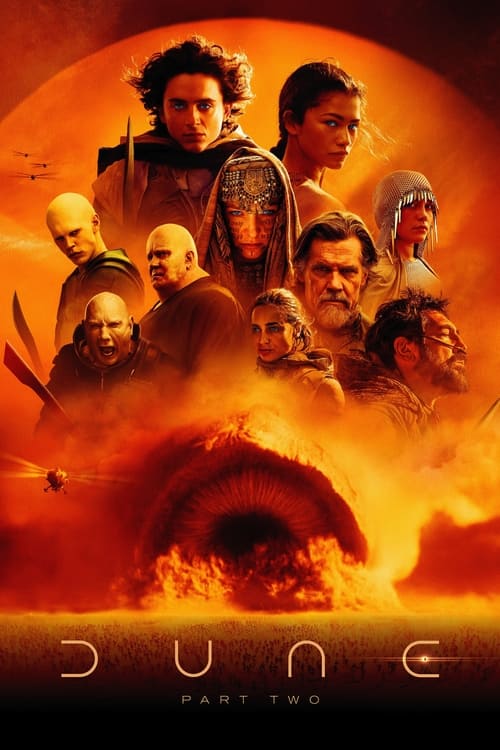
Dune: Part Two
2024 · Denis Villeneuve
The sandworm bucket that broke the internet and got roasted in Deadpool & Wolverine — the purest case of merchandising-as-discourse and the "theatrical event-ization" of movie ephemera.
For when you want a true big-canvas spectacle — event-movie night, biggest screen and best sound you can find. It's thrilling rather than comforting, and it gives you plenty to argue about afterward.
What it's about
Picking up moments after the first film, Paul Atreides is a fugitive among the Fremen of the desert planet Arrakis, learning their ways, falling in love with Chani, and plotting revenge against the great houses that destroyed his family. As his legend grows among people primed by prophecy to see him as a messiah, Paul is torn between the woman he loves and a destiny he can foresee — one that could set the whole universe on fire.
The experience
Overwhelming in the best way: colossal images, thundering sound, and a story that keeps accelerating — but with a persistent chill underneath, because the film keeps asking whether the hero's triumph is something to cheer. You leave exhilarated and uneasy at once.
Performances
Timothée Chalamet convincingly darkens from uncertain heir to something more frightening, Zendaya gives the film its conscience as Chani, and Austin Butler is a memorably reptilian new villain. Rebecca Ferguson does eerie, commanding work as Paul's mother.
The craft
Denis Villeneuve stages desert warfare, sandworm riding, and a stark gladiatorial arena with a clarity and scale few blockbusters attempt, backed by Greig Fraser's monumental cinematography and Hans Zimmer's seismic score. This is one of the strongest arguments in years for seeing a film theatrically — or at least with serious speakers.
Why it matters
It proved that a dense, decades-'unfilmable' science-fiction classic could be both a massive popular hit and genuinely uncompromising, and confirmed Villeneuve as the defining large-scale sci-fi director of his era.
Snapshot
Dune: Part Two completes the adaptation of the first half of Frank Herbert's 1965 novel that Denis Villeneuve began with Dune (2021), carrying Paul Atreides from fugitive exile among the Fremen to his ascent as Lisan al-Gaib, the prophesied messiah whose rise ignites an interstellar holy war. Where Part One was a film of withdrawal and dread — a slow gathering of forces ending in catastrophe — Part Two is a film of momentum, conversion, and terrible fulfillment. It is at once the most commercially muscular and the most thematically pointed of Villeneuve's blockbusters, using the scale of the modern event film to stage a critique of the very heroism that scale usually celebrates. Its central formal achievement is to make spectacle legible as warning: the more sublime Paul's power becomes, the more the film insists we recognize it as a catastrophe foreseen.
Industry & production
The film was produced by Legendary Pictures and distributed by Warner Bros., continuing the arrangement under which Part One had been released. Villeneuve had long conceived the novel as two films and shot Part One without a greenlit sequel; the strong theatrical and home performance of the 2021 installment — itself a gamble, having debuted simultaneously in theaters and on HBO Max during the pandemic — secured the second part, which Villeneuve and Warner Bros. committed to as a theatrical-first release rather than a hybrid.
Principal photography took place largely in 2022 across Budapest's Origo Studios (the production's stage base), the deserts of Abu Dhabi (the Liwa/Rub' al Khali dunes), Jordan (Wadi Rum, again standing in for Arrakis as it had in Part One), and locations in Italy. The release was originally dated for late 2023 but was pushed to 1 March 2024; the delay is attributable to the 2023 SAG-AFTRA strike, which would have prevented the cast from promoting the film. The picture became a major critical and commercial success and a touchstone in the post-pandemic argument that theatrical, large-format cinema retained cultural force. I avoid citing a precise gross here, as exact box-office figures should not be asserted without the ledger in front of me; the qualitative record — a strong, sustained theatrical performance — is secure.
Technology
The production's defining technical decision was the pursuit of large-format and IMAX imaging throughout. Cinematographer Greig Fraser and ARRI collaborated on adapting the ALEXA large-format system so that it could be IMAX-certified, allowing Villeneuve to shoot far more of the film in the high-resolution format than is typical, rather than confining IMAX to select sequences.
The film's most discussed technological gambit is the treatment of Giedi Prime, the Harkonnen homeworld. For the sequences under its "black sun," the filmmakers used infrared photography, producing a stark, alien monochrome in which skin, fire, and water read with uncanny tonal inversions and the world appears bleached of ordinary color. The approach was used to its fullest in Feyd-Rautha's gladiatorial arena, where the black-and-white infrared imagery renders the Harkonnen aesthetic as something genuinely other — a sun that does not warm. This is a rare instance of a tentpole film deploying an experimental capture process not as a gimmick but as worldbuilding grammar.
On the sound and music side, Hans Zimmer continued the practice he established on Part One of building bespoke instruments and recording unconventional vocal and percussion textures rather than relying on a conventional orchestral palette, extending an invented sonic language for the Fremen and the desert.
Technique
Cinematography
Greig Fraser, who won the Academy Award for his cinematography on Part One, again anchors the film's look in hard natural light and immense negative space. The Arrakis exteriors privilege the sun as an antagonist: figures are dwarfed by dunes, horizons swallow armies, and the human scale is dramatized against geological and cosmic enormity. Fraser favors long lenses and patient framing that let the desert's emptiness do dramatic work, then contrasts this with the controlled, brutalist interiors of the Harkonnen and Imperial worlds. The infrared Giedi Prime sequences function as a deliberate rupture in this visual logic. The sandworm-riding set piece — Paul's first mounting of a worm — is the film's bravura passage of motion and scale, and is staged to be experienced as physical sensation as much as plot.
Editing
Joe Walker, Villeneuve's longtime editor, cuts the film at roughly two and three-quarter hours, sustaining the director's characteristically deliberate tempo while building a forward propulsion absent from the more becalmed Part One. The editing manages a difficult structural task: it must track Paul's gradual conversion to the Fremen cause and to messianic identity, hold Chani's parallel arc of disillusion in counterpoint, and keep the political machinery of Bene Gesserit, Emperor, and Harkonnen legible. Walker's cutting tends to let scenes breathe to their dramatic limit before release, reserving rapid cutting for combat.
Mise-en-scène / staging
Production designer Patrice Vermette extends the film's monumental, monolithic architecture — surfaces stripped of ornament, spaces scaled to overwhelm the body — which gives each faction a distinct material world: the organic, sand-toned Fremen sietches; the obsidian severity of the Harkonnens; the cold grandeur of the Imperial sphere. Costume design by Jacqueline West continues the tactile, lived-in approach to Fremen stillsuits and robes, with the ceremonial and royal costuming marking the gulf between desert and empire. Villeneuve's staging repeatedly composes Paul as either an isolated small figure within vast frames or, increasingly, as a figure elevated and centered before crowds — a visual progression from individual to icon that tracks his transformation into a leader of multitudes.
Sound
Mark Mangini's sound design is integral to the film's worldbuilding: the subsonic approach of the sandworms, the percussive thumping that summons them, the modulated authority of the Bene Gesserit "Voice," and the texture of the invented Fremen tongue, Chakobsa, developed for the films by constructed-language specialists. Sound and Zimmer's score are tightly interwoven, often blurring the line between diegetic environment and musical underscore, so that the desert itself seems to hum.
Performance
Timothée Chalamet carries the film's most demanding arc, modulating Paul from reticent exile to a figure of frightening conviction; the late shift into command — particularly his oratory before the Fremen — is the performance's hinge. Zendaya's Chani is given substantially expanded weight, functioning as the film's moral conscience and skeptic. Rebecca Ferguson's Lady Jessica grows into a manipulative architect of prophecy as the Reverend Mother of the Fremen. Austin Butler's Feyd-Rautha is a genuinely unsettling antagonist, all coiled menace, and Javier Bardem's Stilgar supplies the film's vein of true-believer fervor — at times its only comedy, at others its most pointed illustration of how faith reshapes perception. Florence Pugh (Princess Irulan), Christopher Walken (Emperor Shaddam IV), Stellan Skarsgård (Baron Harkonnen), Josh Brolin (Gurney Halleck), Dave Bautista (Rabban), and Charlotte Rampling (Reverend Mother Mohiam) fill out the ensemble.
Narrative & dramatic mode
The film operates in the register of myth — prophecy, chosen one, revenge, ascension — but turns that register against itself. Herbert wrote Dune partly as a corrective to the heroic mode, intending Paul as a cautionary figure rather than an aspirational one, and Villeneuve foregrounds that intent more explicitly than the novel's first half does. The decisive dramatic instrument is Chani: where Herbert's Chani is a devoted partner, the film makes her a clear-eyed critic of the messiah myth, suspicious of how prophecy is being used to harness her people. Her arc runs counter to Paul's, and the film's closing movement — her turning away from his ascendancy — recasts the entire triumph as a tragedy. The dramatic mode is thus double: the surface delivers the catharsis of a hero's rise and a tyrant's fall, while the structure quietly withholds endorsement, ending on rupture rather than coronation-as-resolution.
Genre & cycle
Dune: Part Two belongs to the lineage of the science-fiction epic and, more broadly, to the tradition of the large-canvas historical epic of which David Lean's desert films are the obvious ancestor. It also sits within a contemporary cycle of auteur-driven event cinema — films by directors such as Villeneuve, Christopher Nolan, and others — that argue for the theatrical blockbuster as a venue for formal ambition rather than only franchise maintenance. Within science fiction specifically, the film closes a loop: Dune was a foundational influence on Star Wars and decades of screen sci-fi, and Villeneuve's adaptation arrives in a landscape those imitators shaped, allowing it to feel both originary and belated at once.
Authorship & method
Villeneuve's authorship is legible in the film's tempo, scale, and tonal seriousness — the patience with silence and landscape, the preference for the sublime over the frenetic, the treatment of genre material with grave commitment. He co-wrote the screenplay with Jon Spaihts. The film is, by Villeneuve's own framing, the realization of a long-held personal ambition to adapt Herbert, and his method is fundamentally collaborative with a stable creative core: cinematographer Greig Fraser, editor Joe Walker, composer Hans Zimmer, production designer Patrice Vermette, costume designer Jacqueline West, and sound designer Mark Mangini. The consistency of this team across both parts gives the diptych its unusual unity of voice — a single sustained aesthetic across roughly five and a half hours of screen time.
Movement / national cinema
Villeneuve is a Québécois filmmaker whose early French-language work (Incendies, Polytechnique) preceded his move into English-language cinema (Prisoners, Sicario, Arrival, Blade Runner 2049) and then into franchise filmmaking. Dune: Part Two is unambiguously a Hollywood studio production, but it can be read within the broader phenomenon of internationally trained auteurs importing an art-cinema sensibility — slowness, ambiguity, formal rigor — into the American blockbuster. It is not a work of national cinema in any strict sense, but its sensibility is continuous with the patience and seriousness of Villeneuve's Canadian and arthouse roots.
Era / period
The film is a document of its moment in the exhibition wars. Released in early 2024, after the pandemic had hollowed out theatrical habit and as streaming threatened the primacy of the big screen, it became a rallying point for the case that premium large-format theatrical cinema remained both viable and irreplaceable. Its delayed release — a consequence of the 2023 labor actions in Hollywood — also ties it to a period of acute industry conflict over residuals, AI, and the economics of the streaming era. In that context the film reads as an argument, by example, for cinema as a public, monumental, theatrical art.
Themes
The film's governing concerns are messianism and the danger of charismatic leadership; the political instrumentalization of religion, with the Bene Gesserit's engineered prophecies shown as a tool for controlling colonized peoples; imperialism and resource extraction, with the spice melange as an unmistakable analog for oil and Arrakis for an exploited periphery; ecology and the dream of planetary transformation; revenge and its capacity to consume those it serves; and fate versus agency, dramatized through Paul's prescient visions and his doomed effort to avert the holy war he can foresee. Above all, the film is about the seduction of belief — how a people's faith can be cultivated, weaponized, and turned into the engine of a catastrophe carried out in their own name.
Reception, canon & influence
The film was met with strong critical acclaim and broad acknowledgment as a high point of contemporary studio filmmaking, frequently singled out for its imagery, sound, and the rare achievement of a sequel surpassing an already admired original. Its specific awards record I leave unstated rather than risk error, but its standing as a craft showcase — particularly in cinematography, sound, production design, and score — was widely recognized.
Looking backward, the film's influences are layered. The bedrock is Herbert's novel and its critique of the hero myth. Behind the adaptation stand two prior cinematic engagements with the same material: Alejandro Jodorowsky's famously unrealized 1970s adaptation, whose design ambitions seeded a generation of science-fiction imagery, and David Lynch's 1984 Dune, against which Villeneuve's version is implicitly measured and from which it pointedly diverges in tone and coherence. The broader visual and narrative debt to David Lean's Lawrence of Arabia — the desert epic, the Western outsider drawn into and elevated by a tribal cause, the suspicion of that elevation — is foundational. And the film exists in dialogue with the entire post-Star Wars screen tradition that Herbert's novel originally helped birth.
Looking forward, the film re-established the Dune property as a flagship of serious-minded blockbuster cinema and set the stage for a planned continuation adapting Dune Messiah, the novel in which Herbert's critique of Paul becomes explicit — a direction Villeneuve's Chani-centered ending has already prepared. Its more diffuse legacy lies in strengthening the commercial and critical argument for director-driven, large-format, theatrically conceived spectacle, and in demonstrating that experimental capture techniques and a slow, grave aesthetic can coexist with mass-scale success. Its full influence on the films that follow it remains, necessarily, still unfolding.
A Deleuzian reading
Watch Stilgar, and you understand the whole film.
The full Deleuzian reading of Dune: Part Two →
Reception
Landed in March 2024 as an instant event — the 'cinema is back' movie of its year, credited with dragging audiences to IMAX en masse — and two years on it's already treated less like a recent release than a settled modern classic; the only drift has been the 'was Part One actually the better half?' revisionism.
How Dune: Part Two was received, from release to now →
Influences: the films it descends from and the films it influenced
- Lawrence of Arabia (1962) — The template for staging an individual against monolithic desert vastness via extreme long lenses and negative space, dwarfing the human figure until landscape becomes a character — the source of Villeneuve's wide-to-icon framing of Paul in the dunes.
- Dune (1984) — The prior screen attempt at Herbert's interior monologue, Bene Gesserit voice-acoustics, and Brutalist Harkonnen design — against which Fraser and Vermette define their cleaner, harder-light coherence by pointed divergence.
- El Topo (1970) — The mystic-Western desert pilgrimage and messianic-violence iconography that fed Jodorowsky's unmade Dune, whose design lineage (Giger, Moebius, Foss) seeded the visual grammar Villeneuve's production design inherits.
- Lawrence of Arabia's heir, The Last Emperor (1987) — Staging individual figures inside vast monolithic architecture and imperial ritual, using human-to-monument scale contrasts that Vermette echoes in the Harkonnen and Imperial spaces.
- 2001: A Space Odyssey (1968) — The deliberate slow tempo, monolithic forms, and use of subsonic/ambient sound as awe-inducing scale device — the model for treating science fiction with grave, patient sublimity rather than kinetic action.
- Blade Runner 2049 (2017) — The immediate Fraser–Villeneuve–Walker–Zimmer prototype: hard monochrome light, brutalist monumental sets, and subsonic Zimmer drones establishing the exact large-format aesthetic later scaled to Arrakis.
- Lawrence of Arabia (sound peer) Apocalypse Now (1979) — Walter Murch's immersive, subsonic-heavy sound mixing as narrative subjectivity — the design philosophy behind Mangini's enveloping low-frequency Arrakis soundscape and the worm's felt-not-heard rumble.
- Andrei Rublev (1966) — The long-take, deliberate-tempo treatment of faith, prophecy, and charismatic religious power, modeling the grave patience with which Villeneuve films messianic spectacle and crowd-as-believer staging.
- The Battle of Algiers (1966) — The insurgent-uprising-against-colonizer staging and the moral ambiguity of charismatic anti-imperial leadership, the political-cinema grammar behind the Fremen guerrilla campaign and its 'individual to icon' crowd dynamics.
- Dune: Part One (2021) — The direct progenitor whose stable creative core (Fraser, Walker, Zimmer, Vermette, West, Mangini) and established aesthetic — hard light, subsonic score, Chakobsa sound-language — Part Two continues into a single unified diptych voice.
- Dune (2021) — Direct continuation completing the deliberately unresolved first act, extending every craft signature—large-format desert compositions, invented sound, premonitory editing—to the saga's tragic climax.
- Star Wars (1977) — The desert-planet hero's-journey blockbuster that Herbert's novel originally birthed, against which Dune: Part Two consciously inverts the messianic arc into anti-heroic tragedy rather than triumph.
- Arrival (2016) — Establishes Villeneuve's invented-language sound design (Jóhannsson's vocalizations) and patient tonal seriousness, the method Mangini and Zimmer extend into Fremen Chakobsa acoustics and worm-sound vocabulary.
- The Revenant (2015) — Greig Fraser's contemporary peer in natural-hard-light, available-light wilderness capture; the naturalistic-light blockbuster ethos Fraser carries into Arrakis's unforgiving sun.
- Mad Max: Fury Road (2015) — The contemporary benchmark for practical desert spectacle and cult-of-personality messianism (the War Boys' worship), a peer in staging fanatical devotion to a charismatic figure across sand.
- Lawrence-descended Gladiator (2000) — The Zimmer-scored, individual-to-icon arena/crowd elevation of a reluctant leader, sharing the messianic-arc staging and monumental imperial architecture that frames the hero as instrument of empire.
- Oppenheimer (2023) — The contemporary IMAX large-format event film that, like Dune: Part Two, proves experimental capture and a grave, slow aesthetic can drive mass-scale theatrical success — including shared infrared/large-format experimentation.
- Children of Men (2006) — The long-lens, immersive, documentary-adjacent staging of crowds and political violence in a single grave register, a peer model for filming chaotic insurgency with sustained, unflinching tempo.
- Avatar: Fire and Ash (2025) — A contemporaneous large-format theatrical wager built on IMAX-scale imagery and an immersive theatrical sound mix, betting the same way Cameron does that spectacle draws audiences back to the big screen.
Similar films
- Blade Runner 2049 (2017) — influence & lineage
- Mad Max: Fury Road (2015) — influence & lineage
- Star Wars (1977) — influence & lineage · same viewing thread
- Kingdom of the Planet of the Apes (2024) — same viewing thread
- Dawn of the Planet of the Apes (2014) — same viewing thread
- Star Wars: The Force Awakens (2015) — same viewing thread
- Aliens (1986) — same viewing thread
- War for the Planet of the Apes (2017) — same viewing thread
All the films related to Dune: Part Two →
Watch it with: curated runs of related films
- The Blockbuster Sci-Fi Canon — A run of the effects-driven epics that taught modern audiences what a movie could feel like — from the desert planets of Star Wars to the rain of Blade Runner and the sands of Arrakis.